Page 4 of 13

Announcing the Thomas Gregory Song Research Fellowship, Spring 2020

OVERVIEW:

The Ohio State University Libraries is pleased to announce the Thomas Gregory Song Research Fellowship for an independent research project that makes substantial on-site use of the Thomas Gregory Song (TGS) Papers in the Rare Books and Manuscripts Library (https://library.osu.edu/collections/ SPEC.RARE.0195/collection-inventory). Written predominantly in Japanese and English (with some documents in Korean), the TGS Papers include Song family genealogical records; personal photographs from Song’s childhood; an Oral History Interview; over 2300 blog posts; and personal correspondence, journals, and essays. The TGS Papers shed significant light on topics of World History, East Asian Studies, Asian American Studies, Asian diaspora, migration, and gender and sexuality studies. 

Applications are due by on Dec. 15, 2019 at 5:00pm.

Continue reading

Night Parade of One Hundred Demons: Kyōsai’s Hyakki Gadan Now at OSU Libraries

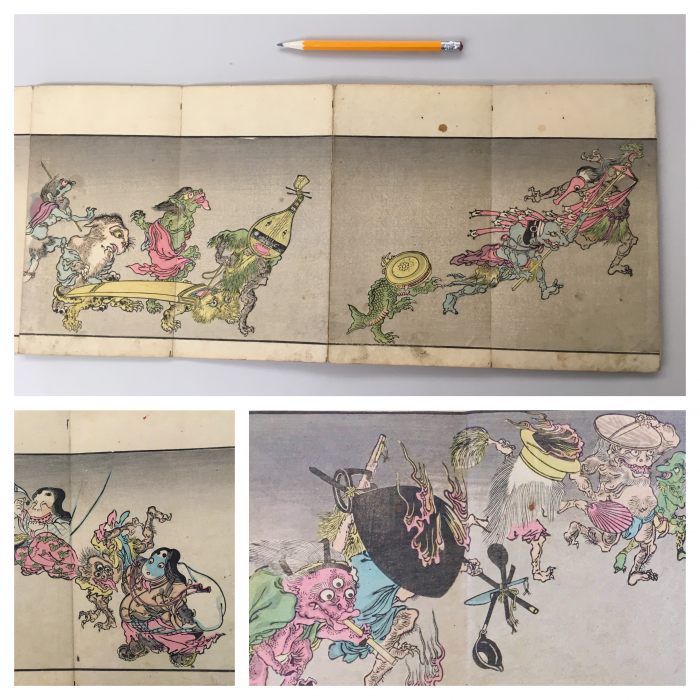
Japanese Studies invites you to learn about the mythology and artistic culture of Meiji Japan (1868-1912) through the newly acquired Kyōsai Hyakki Gadan (暁斎百鬼画談), a color woodblock print by eccentric painter and manga forerunner, Kawanabe Kyōsai (河鍋 暁斎, 1831-1889). The long, accordion book (orihon) depicts a parade of all manner of weird and wicked yōkai (妖怪), spirits and demons from Japanese mythology. This particular scene is evocative of the hyakki yagyō (百鬼夜行) idiom, a historic theme in Japanese visual representation wherein a procession of legendary creatures sets foot upon the communities of mortal men and women.

For more information about this new acquisition, please check out the full article on our Manga Blog at OSU Libraries, available here: https://library.osu.edu/site/manga/2019/10/02/night-parade-of-one-hundred-demons-kyosais-hyakki-gadan-now-at-osu-libraries/

New Acquisition: Day of the Western Sunrise — Film and Educator’s Toolkit

We are thrilled to announce the recent acquisition of the award-winning film, Day of the Western Sunrise, a powerful new resource for researchers and instructors of international studies, global and Japanese history, environmental studies, peace studies, atomic studies, and more! While the film is an excellent resource in its own right, it comes accompanied by an educator toolkit designed specifically for instructors of college and secondary education. 

Partnering with OSU’s East Asian Studies Center, we are equally excited to hold a viewing of this film, preceded by comments from the film’s writer, director, and producer Keith Reimink, at Hagerty Hall, Room 180, on the main campus. This event will take place on September 28, 2019 from 10:00am to 12:30pm.  For more details please visit https://easc.osu.edu/events/easc/sept28-film.


Day of the Western Sunrise Documentary Trailer from DALIBORKAfilms

The film covers the terrible consequences of a US hydrogen bomb test on the Bikini Atoll, which contaminated a Japanese fishing boat called the Lucky Dragon Five (Daigo Fukuryū Maru, 第五福龍丸) on March 1954.  The affair also saw the contamination of all 23 fishermen on board, each of whom subsequently suffered Acute Radiation Syndrom (ARS) in the aftermath. After living for months under observation and quarantine, all of the men recovered except for the boat’s chief radioman, Aikichi Kuboyama, 40, who died on September 23, 1954.  

The incident received media coverage throughout Japan and around the world, as startled onlookers awaited to learn the fate of fishermen who suffered from “atomic bomb disease,” as it was then known. Later that year, the legendary film Godzilla  (Gojiraゴジラ)  was released by Toho films, inspired in part by the terrible incident.  Although he had set out to make a conventional monster film, the screenwriter, Ishirō Honda, explained that after hearing about it, he “took the characteristics of an atomic bomb and applied them to Godzilla” (quoted by Ropeik, 2018).

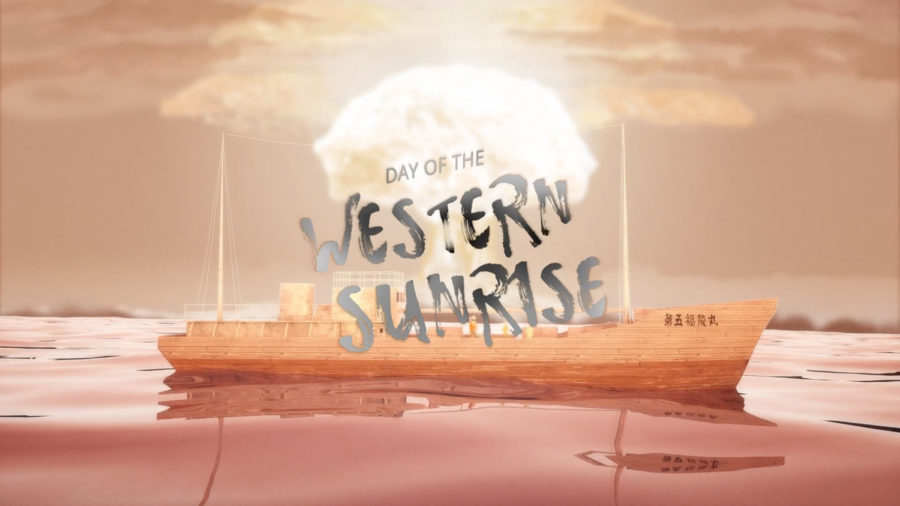
A still from the animated documentary, Day of the Western Sunrise, about 23 crew members of a fishing boat, who survived the atomic bomb test in the Bikini Atoll in 1954. (DALIBORKAfilms)

Keith Reimink, director and producer of the Day of the Western Sunrise, documents the ways in which nuclear technology changed the lives of the young men who were caught in the blast radius. His film captures rare oral interviews with remaining survivors as they near the end of their lives. His film juxtapositions these intimate interviews with handcrafted animations inspired by the famous kamishibai, or ‘paper theater,’ style of Japanese storytelling.


Film and Educator Toolkit: 

Day of the Western Sunrise: Daigo Fukuryū Maru = Nishi kara nobotta taiyō (Day of the Western Sunrise: 第五福竜丸 = 西から昇った太陽) , written and directed by Keith Reimink (Pittsburgh: Daliborka Films LLC, 2018)


Related Upcoming Lecture:

Bill Tsutsui Lecture — “Beyond the Man in the Rubber Suit: Godzilla, Postwar Japan, and the Global Imagination,” sponsored by EASC and OSU Libraries. (November 19, 2019)


Select sources at Ohio State on the Lucky Dragon, Bikini Atoll, and the atomic bomb:

Atomic Comics: Cartoonists Confront the Nuclear World by Ferenc Morton Szasz (Reno: University of Nevada Press, 2012)

Daigo Fukuryū Maru (第五福竜丸), written by Yasutarō Yagi (八木保太郎), directed by Kaneto Shindō (新藤兼人) (Tokyo: Asmik Ace Entertainment, 2001)

The Day the Sun Rose in the West: Bikini, The Lucky Dragon, and I by Oishi Matashichi (Honolulu: University of Hawai’i Press, 2011)

Deleuze, Japanese Cinema, and the Atom Bomb: the Spectre of Impossibility by David Deamer (New York: Bloomsbury, 2014)

Human Face of the Pacific, The Marshall Islands: Living with the Bomb, directed by Dennis O’Rourke and Tim Litchfield (Canberra: National Film and Sound Archive of Australia, 1983)

Narrative as Counter-Memory: A Half-Century of Postwar Writing in Germany and Japan by Reiko Tachibana (New York: State University of New York Press, 1998)

“U.S. Military Tests Nuclear Weapons at Bikini Atoll ca. 1946” (WPA Film Library, 1946)


Online Sources:

How the unlucky Lucky Dragon birthed an era of nuclear fear” by David Ropeik (Chicago: Bulletin of the Atomic Scientists, February 28, 2018)

“Gojira vs. Godzilla: Two nuclear narratives in one monster” by Lovely Umayam (Medium.com) Note: “This piece was written by Sayaka, a student at the Monterey Institute of International Studies, and published on Bombshelltoe on March 3, 2013.”

Japanese Monsters, Ghosts, and Spirits: Mythical Yōkai (妖怪) at OSU Libraries

An example of a colorful three-panel woodblock print of Japanese spirits and demons from the book Yōkai: Strange Beasts & Weird Spectres — 100 Japanese Triptychs (pages 56-57)

In Japanese folklore, yōkai (妖怪) refers to legendary ghosts, monsters, and spirits.  Rooted in Japanese animism, ancient Japanese religion, and the providence of nature, these mythical creatures are attributed with strange behaviors to explain the otherwise mysterious phenomena encountered in ancient life. Shedding light on the meaning of this word, the two kanji for yōkai, mean “attractive, bewitching” (妖)  and “mystery, wonder” (怪) respectively.  Because of their connection to human nature, yōkai were often depicted as strange embodiments of ordinary individuals or creatures — some resembling humans, for example, with altered features such as a long neck or three eyes.  Others looked like strange animals, plants, insects, or household goods. 

Continue reading

New Collection of over 600 Picture Postcards of the Great Kantō Earthquake (1923)

Japanese Studies at the Libraries has recently acquired a vast collection of postcards showing scenes from the Great Kantō Earthquake (関東大地震 Kantō daijishin). With over 600 in the set, the photographic images on the face of the cards provide an in-depth look at the progress and ensuing destruction, including the tragic deaths of an estimated 100,000 to 140,000 people, of this historic event. The postcards are in good condition and offer a valuable window on the many sites, from Tokyo to Kanagawa, Saitama, Chiba, and other prefectures on the Kantō Plain, affected by this disaster.

Sample Postcard Showing the Earthquake’s Destruction in Isezakichō, a district of Naka Ward in Yokohama

Continue reading

Exploring Shashi (社史, Company Histories)

Nissin Food Product Shashi Outer Packaging

Shashi (社史, Company Histories) are the chronological accounts of a company or corporation, usually written in the form of a book. Their contents typically include information about a specific company’s  history, including its foundation, expansion, and changes of administration corresponding to historical shifts in politics and economics. They can also reflect many other aspects of a company’s history, such as the biographies of its administrative members, interviews with workers, exhibitions of historical documents, and special topics about technological improvements.

Continue reading

Introducing the newly available Manchuria Daily News Online English Database

Introduction

Japanese Studies at OSU Libraries is pleased to announce that the Manchuria Daily News Database is now available to the university community through the OSU library catalog.  The newly acquired database offers full access to the complete digital text of the Manchuria Daily News newspaper, published from 1908 to 1940.  The database thus offers an English-language archives of a rare newspaper that once provided the official Japanese interpretation of its presence in China in the early twentieth century. 


Image of the Database Home Page

Continue reading

Introducing The Oriental Economist Archives and Database

The Oriental Economist Digital Archives is the 6th database offered through JK Books at OSU.


Japanese Studies at OSU Libraries (OSUL) is proud to announce that The Oriental Economist Digital Archives is now open for OSU users.  It is the 6th database offered through JK Books at OSU, along with five other searchable databases. The Oriental Economist (TOE) was published by the Toyo Keizai Inc. (Toyo Keizai Shimposha:  東洋経済新報社) from 1934 to 1985. TOE was exceptional in the sense that, despite being a domestic magazine in Japan, it was written in English and intended for overseas readership.

Continue reading

Japanese Culture Event at Marysville High School

On April 7th, we participated in the 4th Annual Evening of Japanese Culture at Marysville High School! The event attracted upwards of 500 visitors and was an opportunity for the local community to experience Japanese culture and learn about the high school’s vibrant Japanese language program.

Recreating the look and feel of a Japanese festival, there were well over a dozen info booths, eating and craft stands, and workshops. 

The stands featured different aspects of Japanese culture such as ikebana (Japanese flower arrangement); sadō (Japanese tea ceremony); omocha (children’s toys); Japanese food (such as mochi stuffed with red beans, bento boxes, and kushikatsu, or lightly fried foods on a stick); and even a kingyo sukui (goldfish catching) pool.  In addition to the stalls, there were live events such as exhibitions of kyūdō (Japanese archery) and taiko (Japanese drums) as well as group classes for participants in shodō (Japanese calligraphy) and taiko!

EAS at at OSUL participated in the event with our own stand (made up of two tables) dedicated entirely to Japanese manga. Visitors were encouraged to peruse pieces of OSUL’s manga collection, and library staff and students were on hand to talk about the collection and answer any questions.

One of our two tables featured distinctive and rare manga held by OSU, with an emphasis on the history and origins of manga.  Facsimiles of art by Hokusai and Kitazawa Rakuten were included in this display. Staff on hand offered background explanations and context to each piece.

Our second table focused on more contemporary manga. Reflecting the diversity of our collection, our display included every thing from manga on giant robots to high school romance, futuristic ninja, and post-apocalyptic wastelands. We were excited to see many students and other visitors have a seat at our tables to peruse the manga at their leisure.  

Spotlight Article: OSUL Collection of Tanikawa Shuntaro (谷川俊太郎)

One of the strengths of the Japanese Studies Collections at the Ohio State University Libraries is an extensive collection of  works and rare publications by world-acclaimed author TANIKAWA Shuntaro ( 谷川俊太郎). Tanikawa is Japan’s preeminent contemporary poet whose work has won over ten literary awards and can be found in Japanese textbooks across the nation. In addition to being a poet, he is also an acclaimed translator, picture book writer, and scriptwriter.

Much of Tanikawa’s work has already been translated and published in English, including his Floating the River in Melancholy, for which he won the American Book Award. His work in translating children’s literature, including Charles Shultz’s Peanuts comic strip, Mother Goose rhymes, and Swimmy by Leo Lionni,  garnered him a nomination for the Hans Christian Andersen award in 2008.  His worldwide stature and presence in literature has also made him a perennial contender for the Nobel Prize in Literature.

Shuntarō Tanikawa, 2015 by Círculo de traductores is licensed under CC0

Continue reading

« Older posts Newer posts »