Tag: full text

Diaries and Documents of Premodern Japan: Shiryō Sanshū

Front page of a website

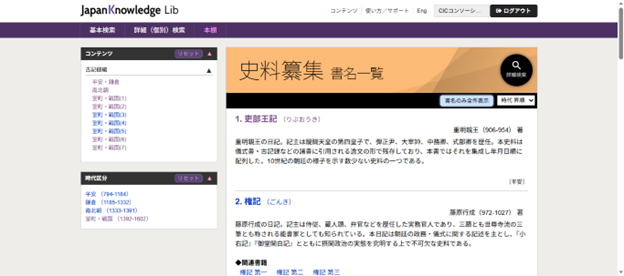
Homepage of the JapanKnowledge collection of the Shiryo Sanshu.

As part of our ongoing effort to strengthen access to premodern Japanese historical sources, we announced earlier this fall the addition of the complete digital transcription of Heian Ibun (平安遺文). Building on that momentum, we are pleased to now offer access to the first unit of Shiryō Sanshū, newly available through the JapanKnowledge platform.

This initial release includes documents and diaries dating from the Heian, Kamakura, and Nanboku-chō periods, offering valuable insight into Japan’s premodern past. The collection features writings by prominent historical figures, including Prince Shigeakira (4th son of Emperor Daigo, 重明親王), Emperor Hanazono (花園天皇), Fujiwara no Teika (藤原定家), and Nakahara Momori (中原師守), among others. These diaries and journals allow researchers to explore the daily lives, thoughts, and concerns of court nobles and members of the imperial family.

The Shiryō Sanshū is a highly respected compilation of ancient diaries and documents, published by Yagi Shoten (八木書店), a Tokyo-based publishing house, between 1968 and 2020. The series encompasses more than 260 documents spanning from the Heian period through the Edo period. Each volume has been meticulously digitized, presenting both the original script and modern Japanese transcriptions. This dual-format approach enables full-text searching using both historical and modern character forms.
Continue reading

Expanding Premodern Japanese Sources: Heian Ibun Now Available

A website featuring a variety of Japanese texts, listed in chronological order.

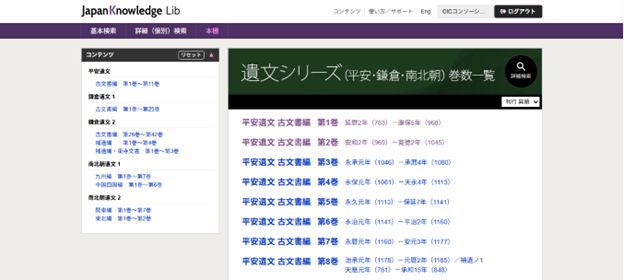
Front page of the Heian Ibun collection, which is included in the “Ibun Series” (遺文シリーズ) archive on JKBooks.

We are pleased to announce another significant addition to our growing collection of accessible archives and databases: the complete digital transcription of Heian Ibun (平安遺文), one of the largest and most comprehensive collections of Heian-period (794–1185) historical documents in the world. This digitization greatly expands research possibilities by providing full-text, searchable transcriptions of all included materials.

Heian Ibun was compiled by historian Dr. Rizō Takeuchi (竹内理三博士), who began assembling the collection in 1947. Over the course of approximately twenty years, he brought together more than 5,500 documents, publishing them across 11 volumes arranged largely in chronological order and spanning the entirety of the Heian period. In 1974, Dr. Takeuchi returned to the project to revise and reorganize the volumes into a new format.

These revised editions were later digitized and further updated by historians at the University of Tokyo, who have continued to make corrections and enhancements since 1996. The most up-to-date versions of these texts are now available digitally through the JKBooks platform on JapanKnowledge.

Continue reading

Level Up Your Japanese With Online TADOKU

Some of our Tadoku (多読) books at Thompson Library, now available online, too!

What is Tadoku?

Do you like to read? Seeing that you have made it to this library website, I’m guessing you do. If so, tadoku (多読 )—literally, “extensive reading”—is one of the best things you can do to improve your Japanese language skills. In fact, you may have done tadoku before without even realizing it!

As a grade-schooler, did you ever have “silent reading?” An “SSR” (Sustained Silent Reading) period? If this rings a bell, then you are already familiar with the practice of tadoku. Now, if you hated being forced to read for long periods of time in school, don’t fret! Tadoku need not be so regimented. In principle, it is the reading of a large quantity of comprehensible material rather than reading short-yet-difficult material (think chapter books over academic reading assignments).

While not a uniquely Japanese concept, tadoku is popular in the Japanese language learning sphere to improve reading speed, comprehension, and vocabulary. Incidentally, you can also use this method for listening practice!  The concept is simple: read a lot from a book that you mostly understand, without the help of a dictionary.

Continue reading

Hakubunkan’s Taiyō (1895-1928) full text!

The Libraries’ subscription for access to Meiji-era issues of Taiyō (太陽), published by Hakubunkan (博文館) during 1895-1928, is now set up, with access available for Ohio State faculty, students and staff: http://library.ohio-state.edu/record=b7114669~S7

Taiyo 3:12 (June 1897) exhibited at Yamaguchi Prefectural Library


e-resour
Published by Hakubunkan during January 1895 to February 1928 in 34 volumes (531 issues; 175,000 pages), Taiyō (The Sun) was Japan’s first general interest popular magazine. Continue reading