Tag: Digital Archives

Diaries and Documents of Premodern Japan: Shiryō Sanshū

Front page of a website

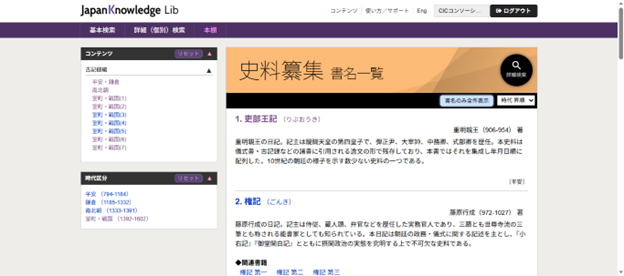
Homepage of the JapanKnowledge collection of the Shiryo Sanshu.

As part of our ongoing effort to strengthen access to premodern Japanese historical sources, we announced earlier this fall the addition of the complete digital transcription of Heian Ibun (平安遺文). Building on that momentum, we are pleased to now offer access to the first unit of Shiryō Sanshū, newly available through the JapanKnowledge platform.

This initial release includes documents and diaries dating from the Heian, Kamakura, and Nanboku-chō periods, offering valuable insight into Japan’s premodern past. The collection features writings by prominent historical figures, including Prince Shigeakira (4th son of Emperor Daigo, 重明親王), Emperor Hanazono (花園天皇), Fujiwara no Teika (藤原定家), and Nakahara Momori (中原師守), among others. These diaries and journals allow researchers to explore the daily lives, thoughts, and concerns of court nobles and members of the imperial family.

The Shiryō Sanshū is a highly respected compilation of ancient diaries and documents, published by Yagi Shoten (八木書店), a Tokyo-based publishing house, between 1968 and 2020. The series encompasses more than 260 documents spanning from the Heian period through the Edo period. Each volume has been meticulously digitized, presenting both the original script and modern Japanese transcriptions. This dual-format approach enables full-text searching using both historical and modern character forms.

Continue reading

Expanding Premodern Japanese Sources: Heian Ibun Now Available

A website featuring a variety of Japanese texts, listed in chronological order.

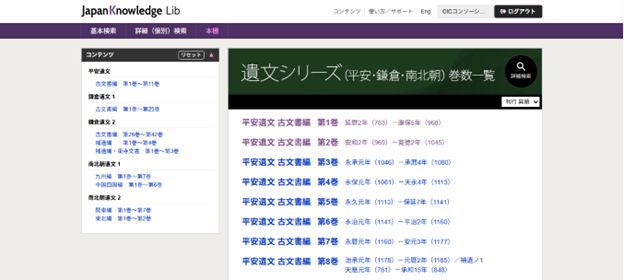
Front page of the Heian Ibun collection, which is included in the “Ibun Series” (遺文シリーズ) archive on JKBooks.

We are pleased to announce another significant addition to our growing collection of accessible archives and databases: the complete digital transcription of Heian Ibun (平安遺文), one of the largest and most comprehensive collections of Heian-period (794–1185) historical documents in the world. This digitization greatly expands research possibilities by providing full-text, searchable transcriptions of all included materials.

Heian Ibun was compiled by historian Dr. Rizō Takeuchi (竹内理三博士), who began assembling the collection in 1947. Over the course of approximately twenty years, he brought together more than 5,500 documents, publishing them across 11 volumes arranged largely in chronological order and spanning the entirety of the Heian period. In 1974, Dr. Takeuchi returned to the project to revise and reorganize the volumes into a new format.

These revised editions were later digitized and further updated by historians at the University of Tokyo, who have continued to make corrections and enhancements since 1996. The most up-to-date versions of these texts are now available digitally through the JKBooks platform on JapanKnowledge.

Continue reading

A Short Tour of JKBooks, an eBook platform from JapanKnowledge

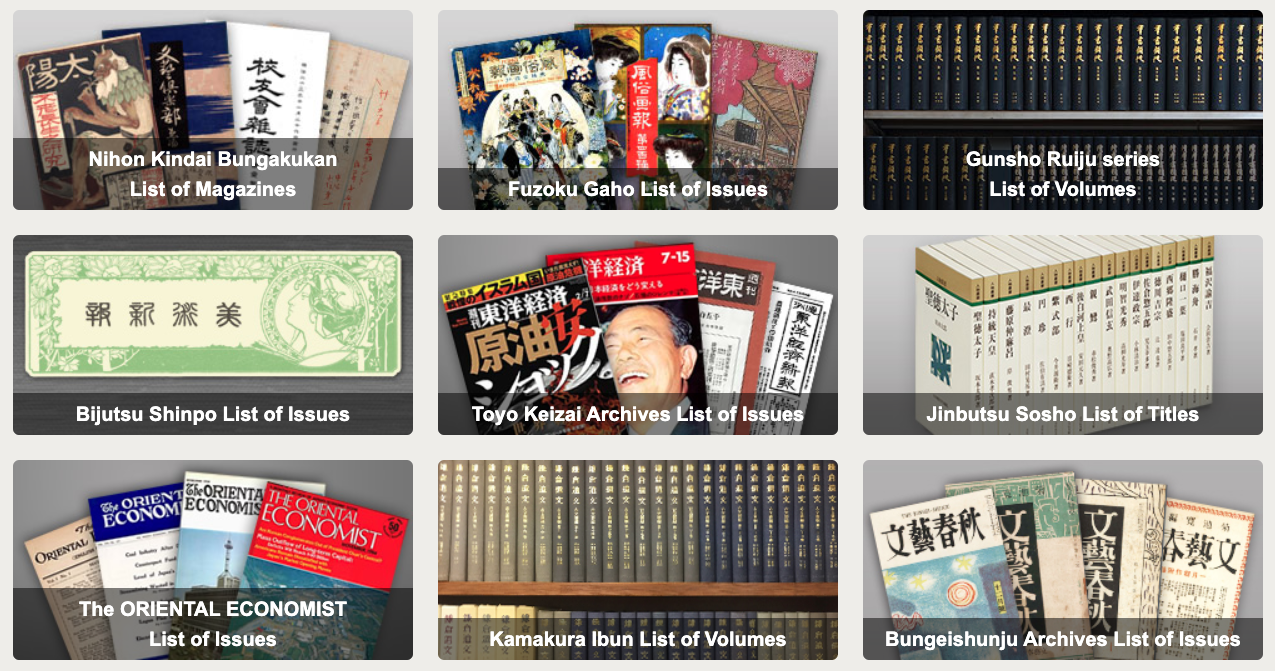
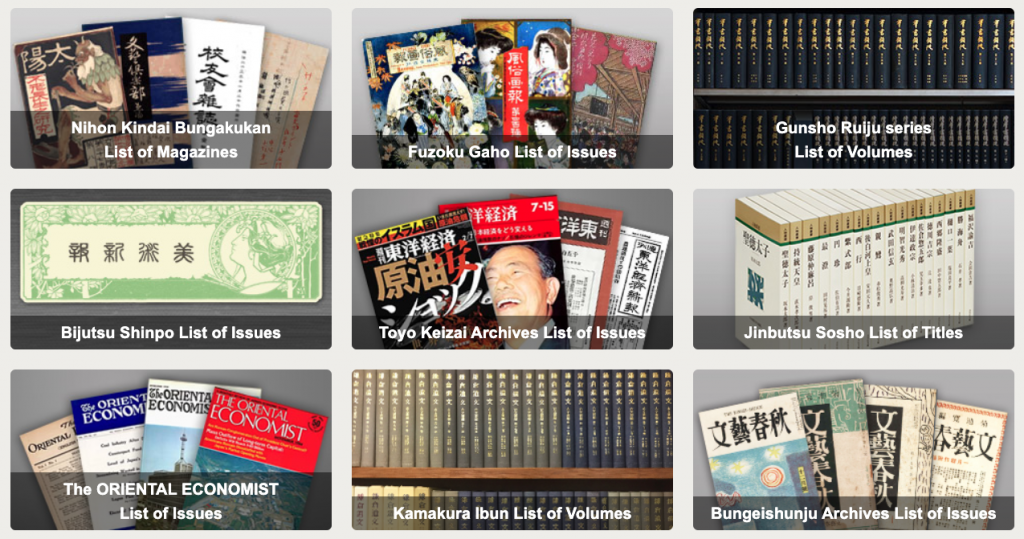
A glimpse of titles available on the JKBooks “Book Shelf” (Hondana) search page

You may have caught our earlier posts outlining some of OSU Libraries’ useful Japanese Studies online databases and archives. In the past, we’ve covered the Maruzen e-Book library and the KinoDen digital library, and described some specific collections including The Oriental Economist Archives and Manchuria Daily News Online.

Here I would like to highlight specifically JapanKnowledge Books, or “JKBooks,” a valuable database with access to a range of corpora dating from antiquity to the present. Presently, our libraries offers access to 11 titles (of the total 13 that are available for sale) to users with OSU credentials. This list is expanding all the time, and just this year, in fact, we have acquired three new titles. (To preview these titles, please use the link here to jump down to our list below.)

As the name suggests, JKBooks is connected to the JapanKnowledge database.  However, in contrast to JapanKnowledge, which contains a lengthy list of reference books — specialized dictionaries, encyclopedia, and yearbooks, for example — JKBooks offers specialized corpora of primary sources.

Three of my favorite JKBook titles are Taiyo (The Sun), a 19th-20th century magazine; the Gunsho Ruiju series, a compilation of manuscripts dated from ancient times to the early modern era; and the ORIENTAL ECONOMIST archives, a monthly English language magazine elucidating economic topics in industrialized, Imperial Japan. This is only a small sampling of the interesting and valuable JK Books collections you can access online!

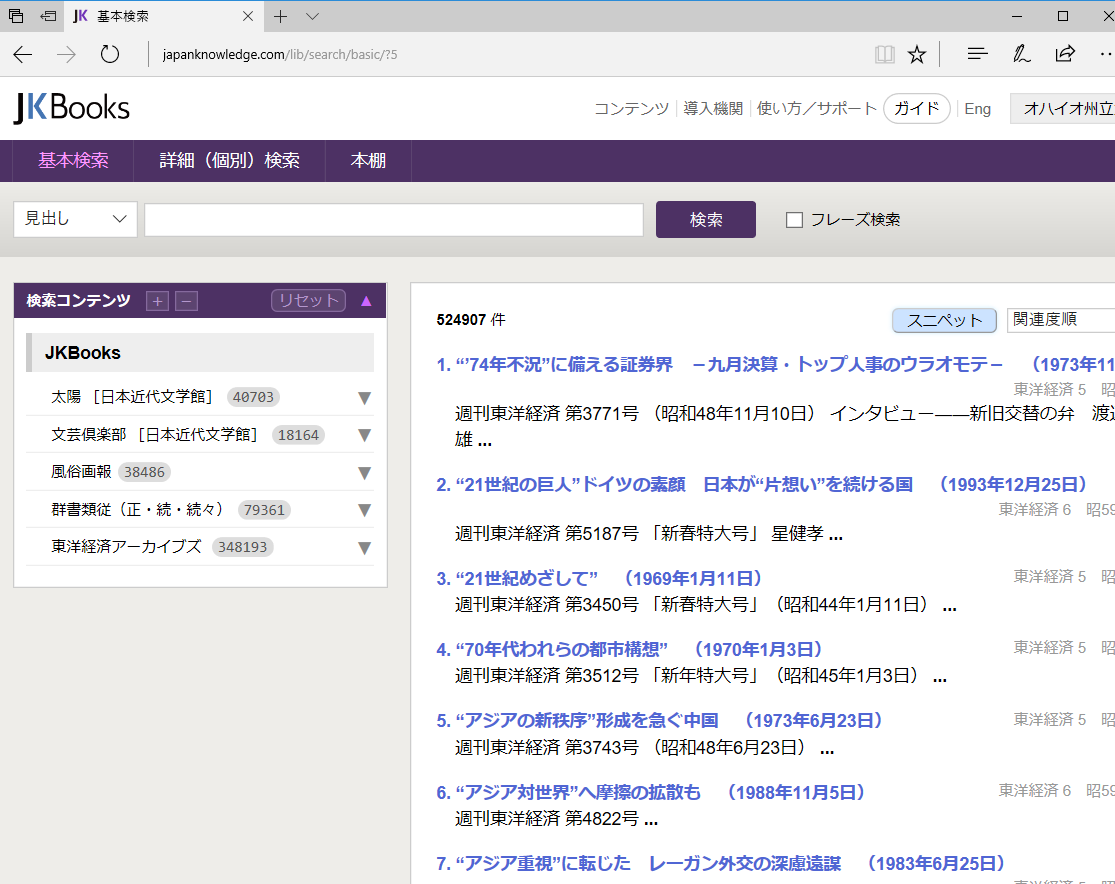
Incidentally, while JapanKnowledge is a Japanese platform, with Japanese-language materials, English users can easily switch the interface language by clicking the “Eng” button found in the top right of every page (see image):
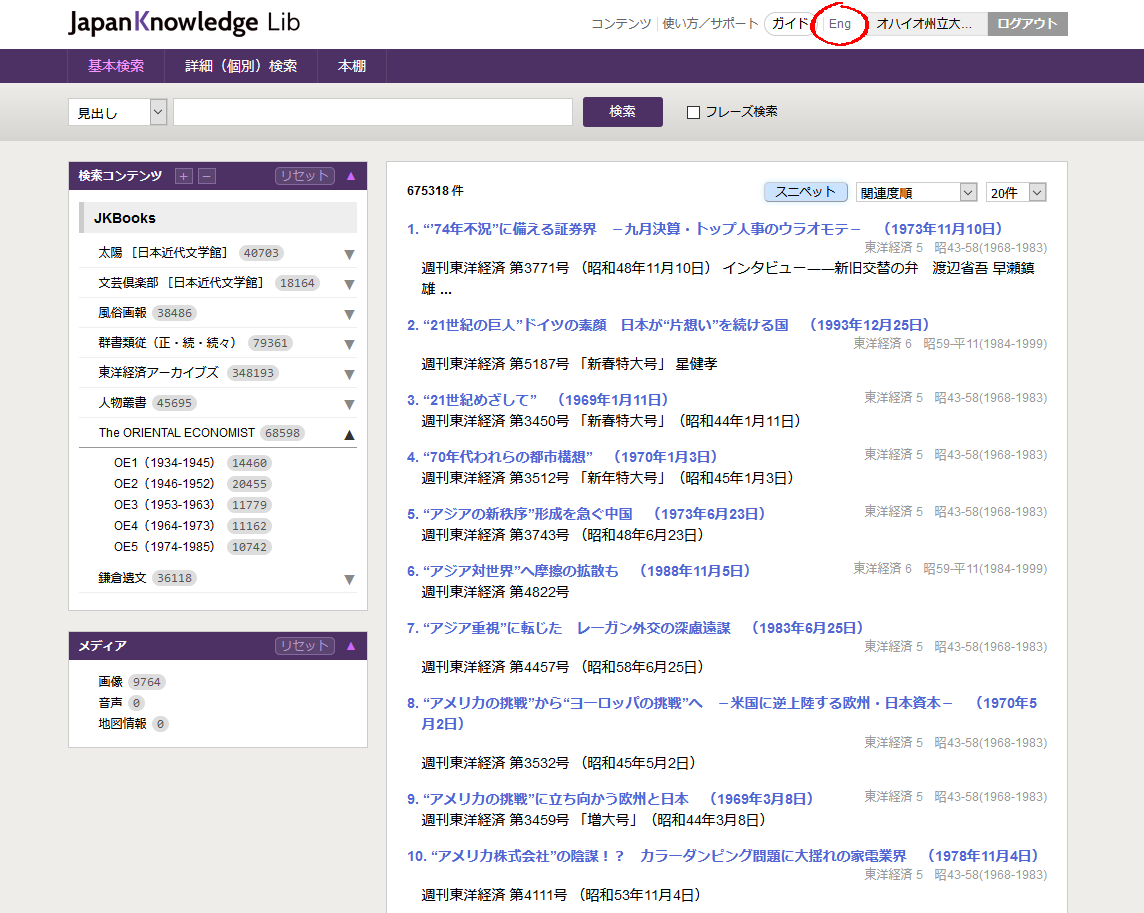
Screenshot of JKBooks basic search page in Japanese

On the top purple ribbon, you will see a menu leading to three different search pages to help you find the content you need in the database: Basic Search (基本検査), Advanced Search ( 詳細(個別)検査), and Book Shelf (本棚).

Basic Search allows searches on particular words or phrases contained in any of the archived materials. Advanced Search lets you narrow your options a bit, letting you drill down within one or more particular collection(s). And finally, Book Shelf features a user-friendly interface that lays out each particular collection by volume, issue, and/or date of publishing. This may be your best choice if you are interested in a specific series in the database or simply want to browse the publications from cover to cover. The image below shows the “Book Shelf” search options available upon clicking the title The Oriental Economist, in JKBooks’ English-language interface.
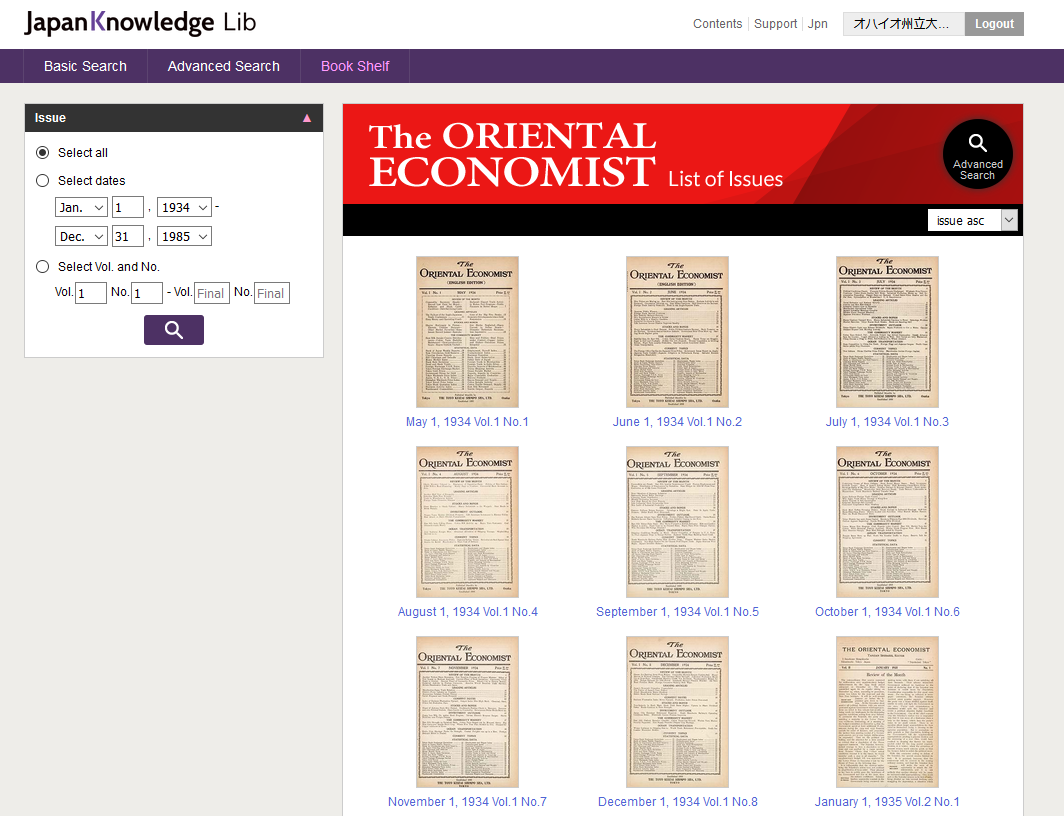
Screenshot of JKBooks Book Shelf page featuring The Oriental Economist archive

JK Books is an especially powerful resource for those who need primary sources in the vernacular and for those who are forced to work remotely. There is no shortage of unique perspectives and in-context information hiding in this treasure trove of
materials!

Current JKBooks at OSU

  1. Taiyo [Nihon Kindai Bungakukan]
  2. Bungei Kurabu: Meiji-hen [Nihon Kindai Bungakukan]
  3. Kindai sakka genkokushu [Nihon Kindai Bugakukan]*
  4. Fuzoku Gaho
  5. Gunsho Ruiju series
  6. Bijutsu Shinpo*
  7. Toyo Keizai Shimpo / Weekly Toyo Keizai Digital Archives
  8. Jinbutsu Sosho
  9. The ORIENTAL ECONOMIST Digital Archives
  10. Kamakura Ibun
  11. Bungeishunju Archives*

Note: Titles with asterisks (*) denote new databases acquired in academic year 2020-21.

If you have any questions regarding this resource, or any other resource offered for Japanese Studies at the OSU Libraries, please contact Dr. Ann Marie Davis, Japanese Studies Librarian at the Ohio State University: davis.5257@osu.edu.

Introducing the Toyo Keizai Archives (東洋経済アーカイブズ)

The suite of 5 databases offered through JKBooks at OSU appears in the left margin. The Toyo Keizai Archives is listed at the bottom.

Japanese Studies at OSU Libraries (OSUL) is delighted to announce that the Toyo Keizai Archives (東洋経済アーカイブズ) has been added to our suite of online offerings. It is an extraordinary database of one of Japan’s oldest economic magazines and one of the three leading business magazines in Japan, along with Nikkei Business (日経ビジネス) and Weekly DIAMOND (週刊ダイヤモンド). The full-text, searchable digital archives includes 120 years of publications, or 58,000 issues, from the inaugural issue of November 15th, Meiji 28 (1895) to Heisei 27 (2015).

Continue reading

New to OSU Libraries: The Japan Times Digital Archive!

Japanese Studies at OSU Libraries is delighted to announce that The Japan Times Digital Archive is now available at The Ohio State University. It is an extraordinary archive of Japan’s oldest English language newspaper and only independent English-language newspaper in existence today.  The digital archive allows you to search the full text of all issues of The Japan Times published since its inauguration in March 1897 (Meiji 30) until 2014.

“The Japan Times Archives” search interface

Continue reading