Author: Nicholas Castle

Online Japanese Newspapers with PressReader!

Current newspapers can offer a great way to see how events are unfolding and discussed in Japan. In this digital age, such resources are thankfully at our fingertips. The present blog shows how advanced readers of Japanese can access Japanese periodicals and newspapers like the Mainichi Shinbun (毎日新聞, literally “Daily News”) in full print view through an online database called PressReader!

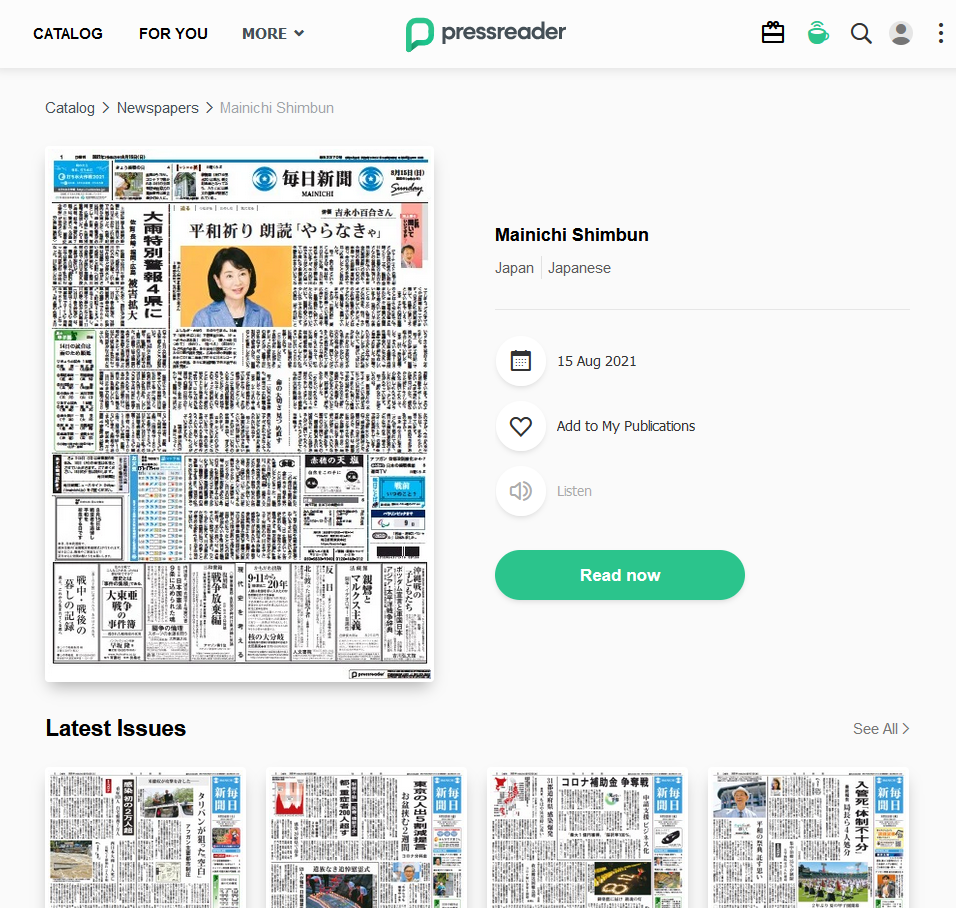
Mainichi Shimbun shown on PressReader

The Mainichi Shimbun is one of the top five most widely read daily newspapers in Japan (along with the Asahi Shimbun, Yomiuri Shimbun, Sankei Shimbun, and Nikkei Shimbun). In addition to carrying the daily news, PressReader also offers over ten years of full print views of the Mainichi Shimbun dating back to April 2011.  (It also offers of other foreign language newspapers, as well as English language newspapers published overseas. For example, readers who prefer reading in English can also access the Japan News, a major English language newspaper published by the Yomiuri Shinbun, on this powerful digital archive.)

Accessing PressReader and the Mainichi Shinbun

To access the Mainichi Shinbun, we recommend starting from the OSU library catalog page for PressReader. From here, you will click on the blue “PressReader” link near the middle of the page. After entering your OSU credentials (name.# and password), you will next be brought to Pressreader’s home page.

Continue reading

Herman J. Albrecht Library of Historical Architecture – Rare Pop-up Teahouses by Nobutatsu Tansai

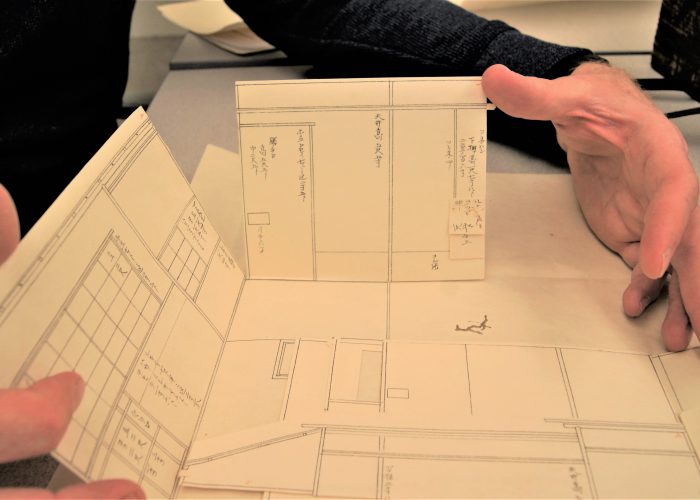
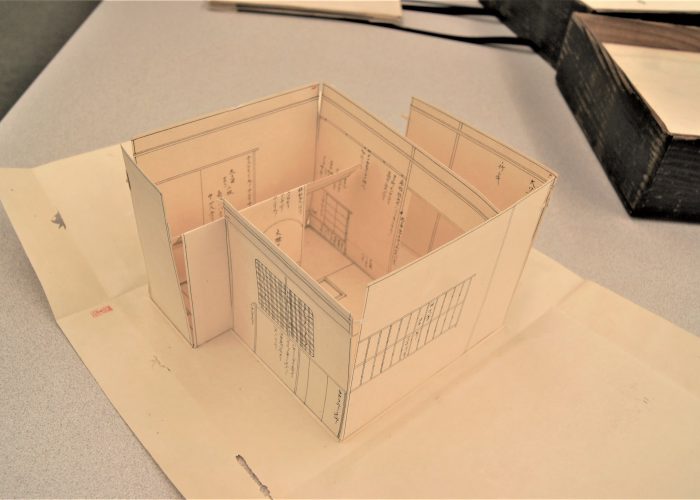
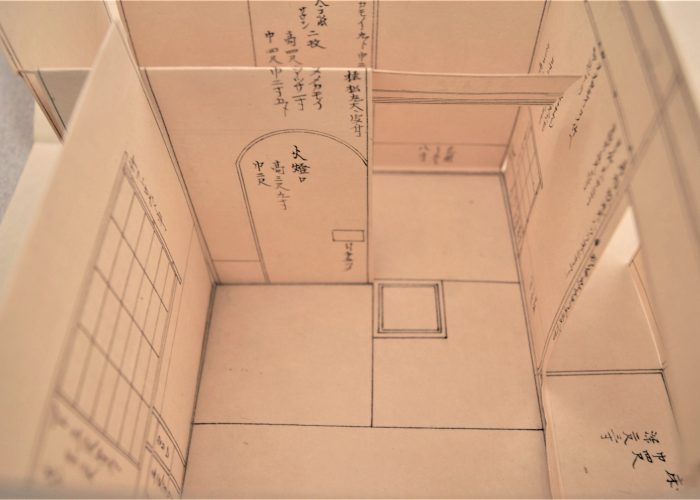
Modern architects are acquainted with the idea of representing their designs in three-dimensions with the help of computer software. CAD (computer-aided design) programs can turn useful two-dimensional plans into practical 3D models as they would be seen in real life. Before the evolution of such digital technologies, artists in Edo Japan (1603-1868) created highly technical pop-up drawings known as okoshi-ezu (起絵図 Okoshi-ezu defined by JAANUS), which modeled 3D buildings through the construction of folding paper and cut-outs. Nobutatsu Tansai (覃斎信立) was one such designer, and he made dozens of examples of this origami-like art form with a particular focus on the spaces of the tea ceremony (茶の湯, cha no yu)

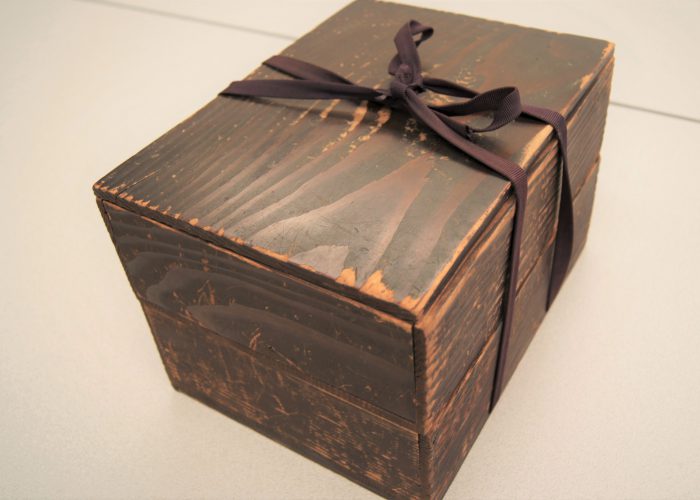
  • The contemporary wooden box containing the flattened pop-ups

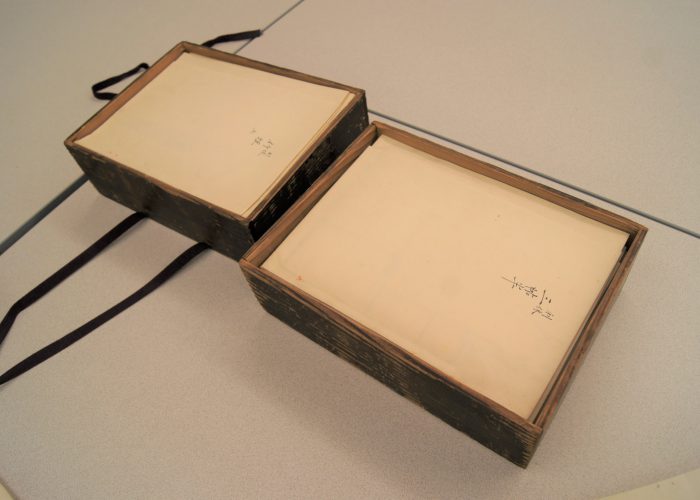
This unique collection of Tansai’s chashitsu (茶室, teahouse, lit. “tea room”) pop-ups is held in the Herman J. Albrecht Library of Historical Architecture, located in OSU’s Thompson Library. Contained in a wooden box, these paper replicas are exceptionally rare, one of only three known collections in the world. The other two are held in Japan’s National Diet Library in Tokyo and in the Peabody Essex Museum in Salem, Massachusetts. Dated between 1820 and 1860 and believed to have been made in Kyoto, this set of okoshi-ezu are comprised of 65 pieces and are in remarkable condition for nearly 200-year-old sheets of folding paper.

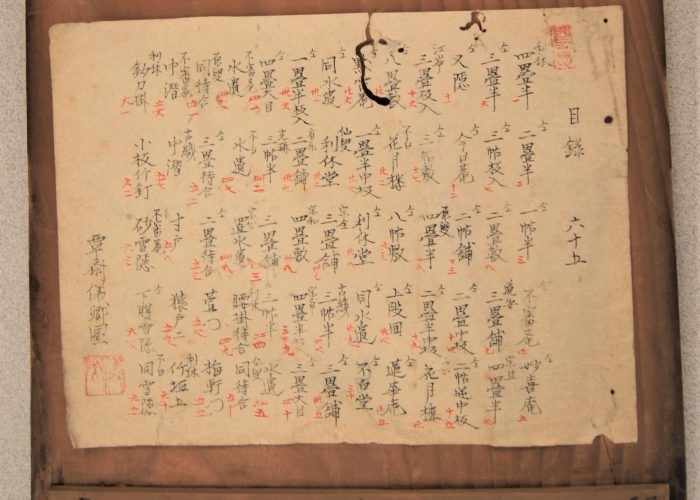
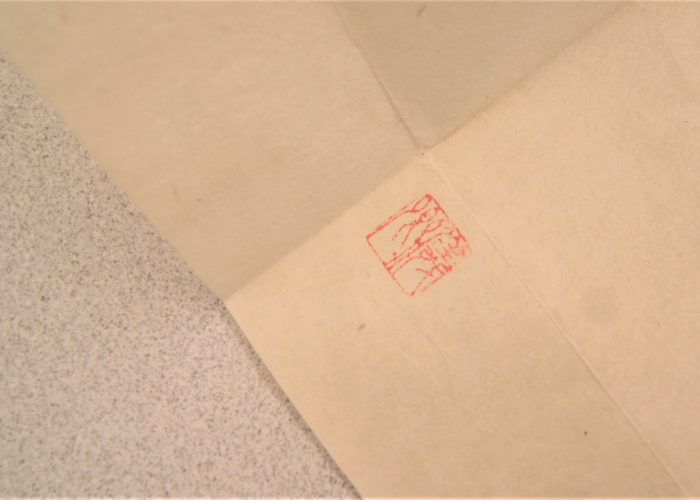
Japanese-style architecture is eminently unique. Tansai masterfully captured the trappings of chashitsu, drawing (and folding) from the designs of famous historical buildings in and around Kyoto like the Fushin-an and Myoki-an teahouses. Each design is numbered and recorded in an accompanying manuscript. Tansai’s precise work demarcates the shape of the teahouses, but he has also faithfully written the materials and exact real dimensions of each structure. The sizes of rooms in Japan are often measured by the number of straw tatami mats that can fit inside, one of the measurements Tansai recorded. This is especially apt for a traditional tea room, an exemplar of Japanese-style rooms (和室, washitsu). Other elements of Japanese architecture represented include shōji (paper-covered sliding doors) and tokonoma (alcoves where hanging calligraphy scrolls or other artistic objects are displayed). The folded drawings are made on washi (和紙), a kind of durable handmade paper crafted in Japan, and the artist has stamped his personal artist’s stamp (判子, hanko) onto each model.

It is hard to overstate the rarity and significance of this special item. Japan’s paper arts, historic architecture, and ceremonial heritage are all well represented here through Tansai’s work. They are tangible icons enveloping intangible tradition; carefully crafted and lovingly preserved, these drawings express qualities that one could say permeate the macro culture of Japan’s old customs and are befitting of the stature of great historical architecture.

To view this rare collection, please contact Dr. Eric Johnson (johnson.4156@osu.edu), Curator of Thompson Special Collections, or Dr. Ann Marie Davis (davis.5257@osu.edu), Japanese Studies Librarian.

To see additional photographs, you can take a look at the Rare Books & Manuscript Library’s Facebook page. Consider following them to see news about other unique pieces.

These folding models belong to the Herman J. Albrecht Library of Historical Architecture, which can be visited in Thompson Library.

Read more about Japanese teahouses with materials from our collections:

Niwa to chashitsu by Tei Nishimura (Tokyo: Kodansha, 1956)

Shiro to chashitsu : Momoyama no kenchiku, kōgei I by Nobuo Tsuji et al. (Tokyo: Kodansha, 1992)

Kyō no chashitsu by Takao Okada (Kyoto: Gakugei Shuppansha, 1989)

External links to scholarly articles about okoshi-ezu:

Okoshi-ezu: Speculations on Thinness by Andrew Barrie, comparing modern Japanese architectural design to the paper pop-ups of the past

Okoshi-ezu by Siân Bowen, written for the Victoria and Albert Museum of Art & Design, UK, the world’s largest museum of applied arts and decorative design

The Shining Prints: Visualizing The Tale of Genji – Part 2

Welcome to Part 2 of this blog series exploring a duo of fascinating Tale of Genji reproduction artworks found in our Rare Books and Manuscripts Library.  In this half of the blog, I will introduce the Genji monogatari gajō and then offer an analytical commentary comparing this material to the iconic Genji monogatari emaki (discussed in Part 1) in their portrayal of Murasaki Shikibu’s original tale. Lastly, I will briefly introduce some of our Japanese comics related to the Genji mongatari and held in our extensive manga collection!

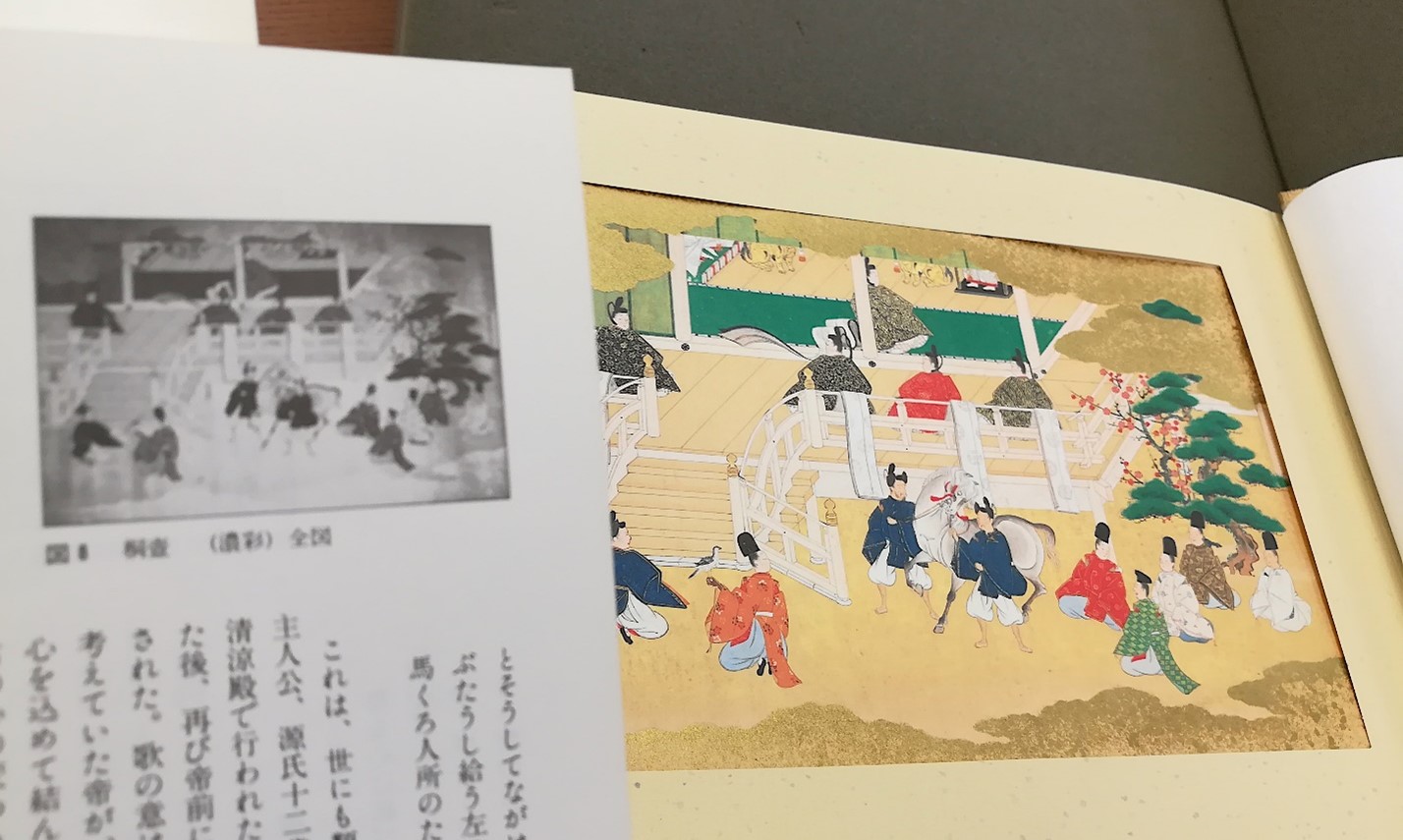
This sample from the Genji monogatari gajō shows Genji’s coming-of-age ceremony in the first chapter, “Kiritsubo” (I, “The Lady of the Paulownia-Courtyard Chambers”). Explanatory text (left) accompanies the prints.

Continue reading

The Shining Prints: Visualizing The Tale of Genji – Part 1

The Ohio State University Libraries are fortunate to have a wide range of fascinating Japan-related special collections. Several available are related to the famous classical Japanese novel, The Tale of Genji. Whether you are an established Genji scholar or a curious student, I would like to highlight some of our materials  that can provide an extraordinary visual guide to this classic tale. I have spent time with two works in particular for this essay: they are a set of reproduction prints of the iconic Genji monogatari emaki as well as a separate set referred to as the Genji monogatari gajō. This post will serve as part one in a two-part blog series about these iconic artworks!

Wood-block reproductions of the Genji picture scrolls,” ND1059.6 G4 W66 1994

The Tale of Genji (源氏物語, Genji monogatari), written by the female court attendant Murasaki Shikibu in the 11th century, is perhaps the most well-known and precious treasure of the Japanese literary tradition. This Heian-era (794-1185) classic is lengthy, character-driven, and full of vivid detail about the look and feel of the imperial Japanese court and aristocratic society. The tale follows the romantic life of Hikaru Genji, the “Shining” Prince, and depicts his many, mostly tragic relationships with women. Genji is the son of the emperor and a lower-ranking court lady known as the Lady Kiritsubo. While he is his father’s favorite child and is considered for imperial succession, he is ultimately removed from the imperial line and made a member of the Genji clan.  This protagonist earns the description “hikaru” (光る, shining or radiant) on account of his beautiful appearance and endearing qualities. However, these same infatuating traits set up the bulk of the conflict in the tale, as the myriad women Genji becomes intimate with invariably experience neglect and jealousy or other courtly drama of the polygynous aristocratic setting. The memorable and complex characters of the Shining Prince’s world have appealed to Japanese audiences for centuries, and it’s no surprise that scores of portrayals, homages, and allusions have popped up since the tale was written over a millenium ago.

Continue reading

Using PressReader to Find Periodicals from East Asia and Beyond

Last fall, we posted a blog about accessing a Japanese newspaper online with PressReader. This blog will introduce more of PressReader’s features and tools as well as more of their East Asian titles.

Screenshot of PressReader Home page

PressReader is an online archive and database of periodicals from around the world. It has a large selection of newspapers and magazines in over two dozen categories, from cultural publications to demographic-targeted and informational materials. The site includes publications in both English and non-English languages and can be easily filtered for titles from specific countries, in target languages, and specific years spanning the last two decades.

Aside from the slew of content, PressReader also has useful tools increase the archive’s accessibility. For example, a narration feature makes the site more accessible to users with impaired eyesight. Additionally, users can switch between scanned page views or reformatted text views, which makes the screen reader more adaptable to various screen sizes and hand held devices.

Screenshot of PressReader Narration feature

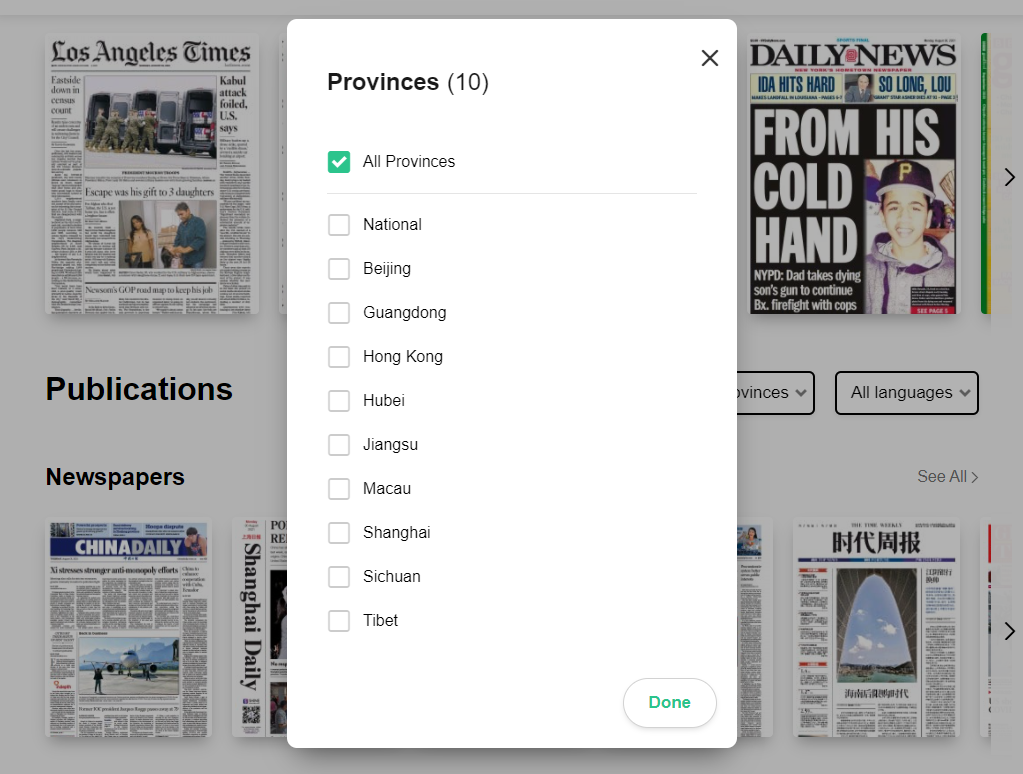
For users in East Asian studies, the PressReader has an abundant selection of Chinese, Korean, and Japanese resources.  For Chinese periodicals, you even have the option to narrow the search to a particular province.

PressReader makes available major publications like the Mainichi Shimbun in Japanese and Japan News in English, for instance; the China Daily and Global Times from China; and the Korea Times and Dong-a Ilbo from Korea.

Screenshot of China province selection

Whether you are looking for a contemporary source for a major political event, first-hand coverage of a natural disaster, or a native-language write-up in a business journal, PressReader can be a powerful resource. 

If you have further questions about PressReader, or if you would like to inquire or request others materials, please contact Dr. Ann Marie Davis, Japanese Studies Librarian, at davis.5257@osu.edu.

Twenty-first Century Hanga from the Modern Master Tsuruya Kokei

Three prints by Tsuruya Kokei. From the “Five Styles of Banzai-Ukiyoe” series.

The Ohio State University Libraries have acquired a new trio of Japanese woodblock prints, or hanga, now in the care of the Rare Books & Manuscripts Library (RBML). Those with an interest in traditional Edo and Meiji era ukiyo-e prints may find these works interesting, as they were created by the postwar artist Tsuruya Kokei (弦屋光溪, born 1946). All very recent works, the above prints are dated 2020, 2019, and 2018 (left to right). Known for his striking portraits of Japanese kabuki actors, Kokei has created a number of prints that echo in modified style the works of the mysterious yet recognizable Edo-period kabuki printmaker Sharaku (東洲斎 写楽, Tōshūsai Sharaku). While Sharaku’s prints spanned a period of just ten months (from 1794 to 1795), they formed a lasting impression as a dynamic and nonidealized collection of famous theater actors.

Like the early twentieth century shin-hanga (新版画) artists who mimicked the workflow of traditional ukiyo-e masters, Kokei produces all of his work himself, from the design phase, to cutting the woodblocks, and then finally creating the prints. For the vast majority of his prints, Kokei uses very thin and fragile Japanese papers such as ganpishi (雁皮紙), which allow his works to possess both a unique visual quality while demonstrating his impressive skills as a craftsman.
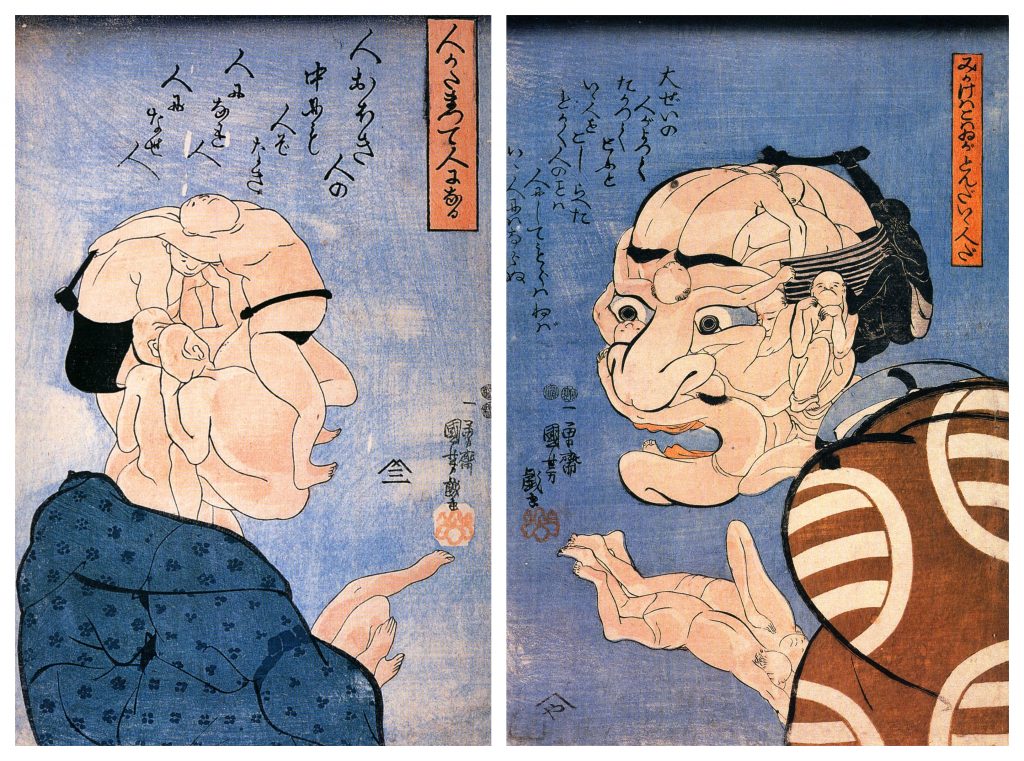
Yose-e by Kuniyoshi (1798-1861). Image courtesy of Wikimedia.org.

Kokei is associated with the prestigious Kabuki-za theater in Tokyo, where he sells limited amounts of his original works. Among the selection now housed in RBML is a 2020 homage to the prolific Edo artist Utagawa Kunisada (歌川 国貞, 1786-1865). A successful print designer recognized for his portraits of kabuki actors (yakusha-e) and female beauties (binjinga), Kunisada is famous as well for his more playful or humorous prints (asobi-e) of people and animals. Kokei’s prints are also evocative of Utagawa Kuniyoshi (歌川 国芳, 1798-1861), whose humorous prints often featured men’s faces, comprised of bodies, or an assemblage of cats in an array of satirical positions. A quick study of these playful yose-e (寄席絵), or “gather together pictures,” certainly reveals the inspiration behind Kokei’s ironic twenty-first century pictures featuring cats, kabuki artists, and a strange blue face comprised of human bodies!

If you wish to view these or other impressive works of Japanese art held in RBML, please contact OSU’s Japanese collections manager Dr. Ann Marie Davis (davis.5257@osu.edu).

Additionally, OSU Libraries holds many circulating volumes on related Japanese artists and woodblock prints. I have listed a sampling below. Please check them out if you are interested!
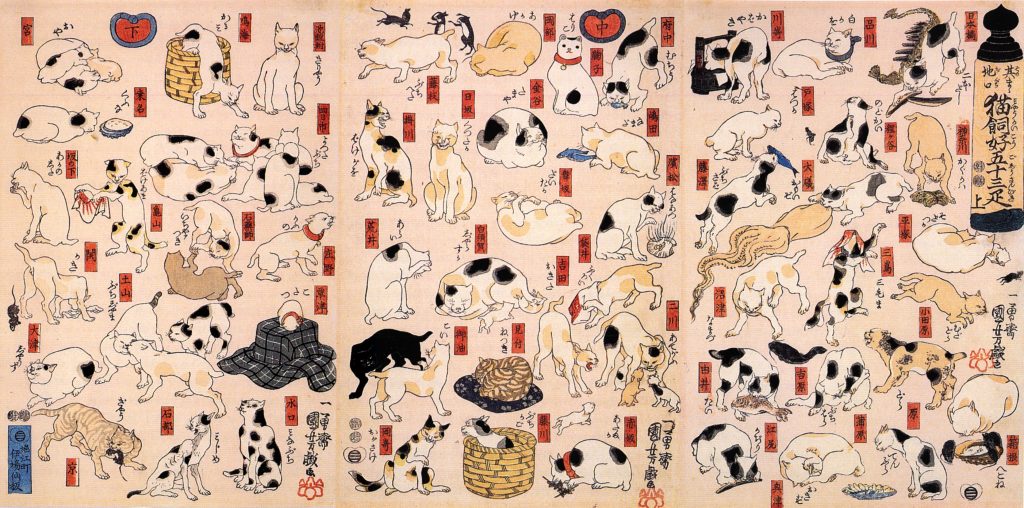
Asobi-e of cats representing the 53 stations of the Tokaido, by Kuniyoshi. Image courtesy of Wikimedia.org.
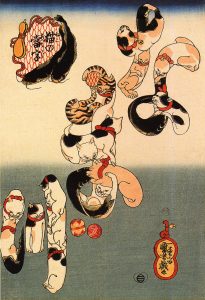
Asobi-e of cats spelling “catfish” in hiragana, by Kuniyoshi. Image courtesy of Wikimedia.org.


Select Materials on Tsuruya Kōkei:

Tsuruya kōkei mokuhangashū (Matsuyaginzabijutsubu, 1992)

Tsuruya Kokei, kabuki actor prints : the 100th anniversary of the Kabuki-za Theatre (Shōchiku Kabushiki Kaisha, 1988)

Tsuruya Kokei : the complete woodblock prints, 1978-2000 (Hiraki Ukiyoe zaidan, 2000)

Select Materials on the Shin hanga (New Print) Movement:

Shin hanga : the new print movement of Japan by Barry Till (Pomegranate, 2007)

Kawase Hasui and his contemporaries : the Shin Hanga (New Print) movement in landscape art by Irwin J. Pachter (University of Michigan, Museum of Art, 1986)

Fresh impressions : early modern Japanese prints by Carolyn M. Putney (Toledo Museum of Art, 2013)

Select Materials on the Rise of Asobi-e:

Edo no asobie / Fukuda Shigeo kanshū edited by Inagaki Shinʼichi (Tōkyō Shoseki, 1988)

Kuniyoshi Kunisada by Sarah E. Thompson (MFA Publications, 2017)

Kunisada’s Tōkaidō : riddles in Japanese woodblock prints by Andreas Marks (Brill, 2013)

A Short Tour of JKBooks, an eBook platform from JapanKnowledge

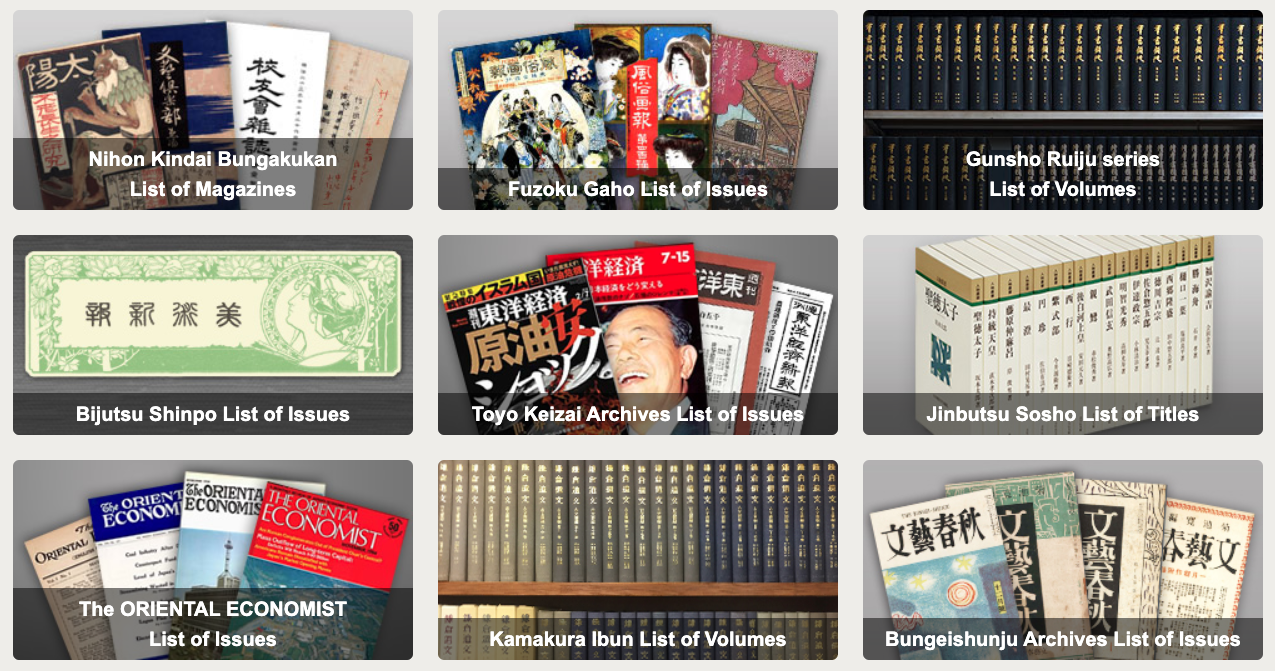
A glimpse of titles available on the JKBooks “Book Shelf” (Hondana) search page

You may have caught our earlier posts outlining some of OSU Libraries’ useful Japanese Studies online databases and archives. In the past, we’ve covered the Maruzen e-Book library and the KinoDen digital library, and described some specific collections including The Oriental Economist Archives and Manchuria Daily News Online.

Here I would like to highlight specifically JapanKnowledge Books, or “JKBooks,” a valuable database with access to a range of corpora dating from antiquity to the present. Presently, our libraries offers access to 11 titles (of the total 13 that are available for sale) to users with OSU credentials. This list is expanding all the time, and just this year, in fact, we have acquired three new titles. (To preview these titles, please use the link here to jump down to our list below.)

As the name suggests, JKBooks is connected to the JapanKnowledge database.  However, in contrast to JapanKnowledge, which contains a lengthy list of reference books — specialized dictionaries, encyclopedia, and yearbooks, for example — JKBooks offers specialized corpora of primary sources.

Three of my favorite JKBook titles are Taiyo (The Sun), a 19th-20th century magazine; the Gunsho Ruiju series, a compilation of manuscripts dated from ancient times to the early modern era; and the ORIENTAL ECONOMIST archives, a monthly English language magazine elucidating economic topics in industrialized, Imperial Japan. This is only a small sampling of the interesting and valuable JK Books collections you can access online!

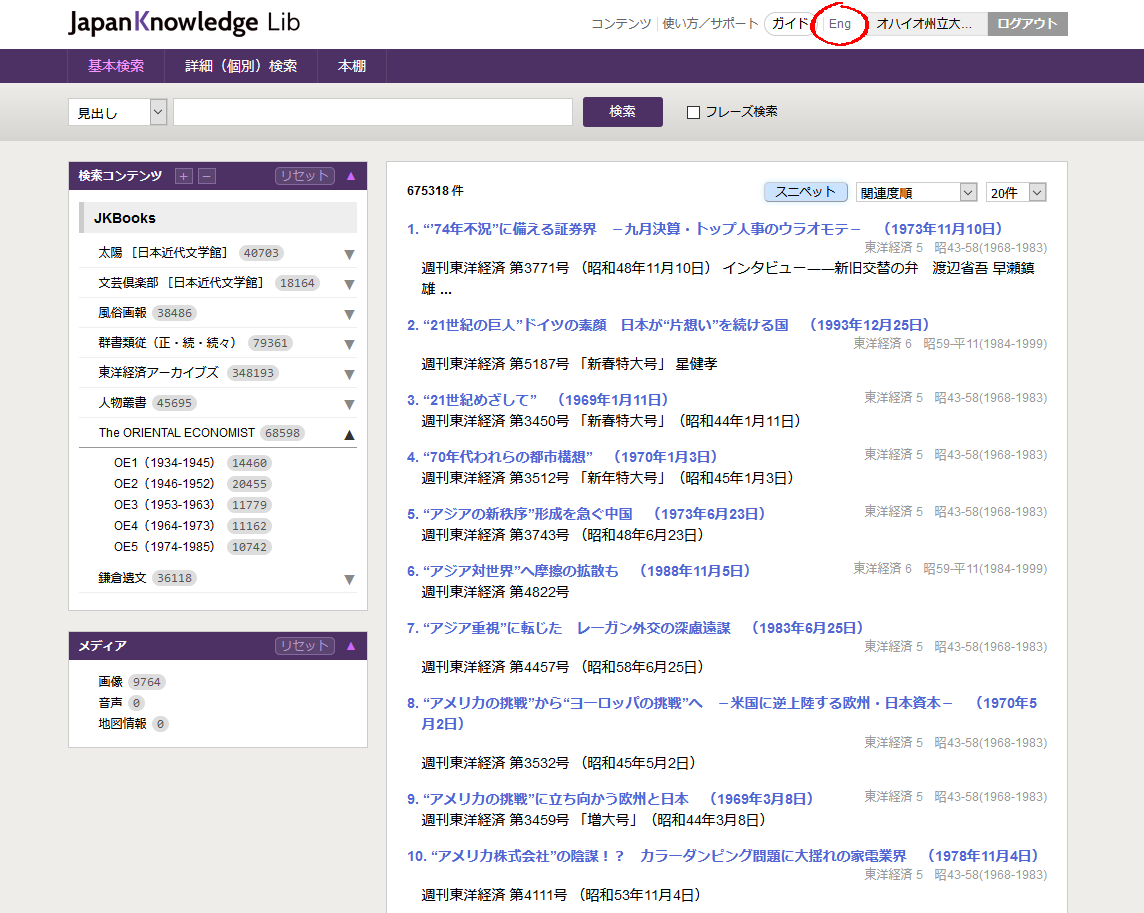
Incidentally, while JapanKnowledge is a Japanese platform, with Japanese-language materials, English users can easily switch the interface language by clicking the “Eng” button found in the top right of every page (see image):

Screenshot of JKBooks basic search page in Japanese

On the top purple ribbon, you will see a menu leading to three different search pages to help you find the content you need in the database: Basic Search (基本検査), Advanced Search ( 詳細(個別)検査), and Book Shelf (本棚).

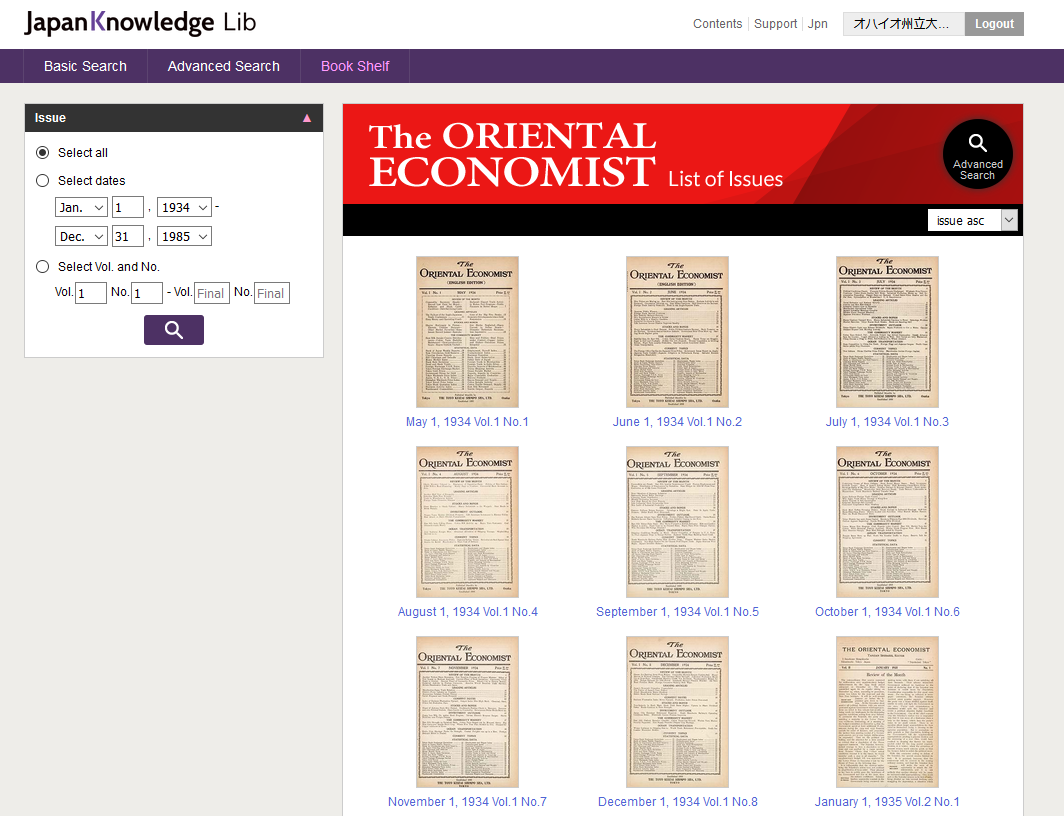
Basic Search allows searches on particular words or phrases contained in any of the archived materials. Advanced Search lets you narrow your options a bit, letting you drill down within one or more particular collection(s). And finally, Book Shelf features a user-friendly interface that lays out each particular collection by volume, issue, and/or date of publishing. This may be your best choice if you are interested in a specific series in the database or simply want to browse the publications from cover to cover. The image below shows the “Book Shelf” search options available upon clicking the title The Oriental Economist, in JKBooks’ English-language interface.

Screenshot of JKBooks Book Shelf page featuring The Oriental Economist archive

JK Books is an especially powerful resource for those who need primary sources in the vernacular and for those who are forced to work remotely. There is no shortage of unique perspectives and in-context information hiding in this treasure trove of
materials!

Current JKBooks at OSU

  1. Taiyo [Nihon Kindai Bungakukan]
  2. Bungei Kurabu: Meiji-hen [Nihon Kindai Bungakukan]
  3. Kindai sakka genkokushu [Nihon Kindai Bugakukan]*
  4. Fuzoku Gaho
  5. Gunsho Ruiju series
  6. Bijutsu Shinpo*
  7. Toyo Keizai Shimpo / Weekly Toyo Keizai Digital Archives
  8. Jinbutsu Sosho
  9. The ORIENTAL ECONOMIST Digital Archives
  10. Kamakura Ibun
  11. Bungeishunju Archives*

Note: Titles with asterisks (*) denote new databases acquired in academic year 2020-21.

If you have any questions regarding this resource, or any other resource offered for Japanese Studies at the OSU Libraries, please contact Dr. Ann Marie Davis, Japanese Studies Librarian at the Ohio State University: davis.5257@osu.edu.

Introducing KinoDen, a New Online Digital Library of Japanese e-Books

With the new stay-at-home orders of COVID-19, many of us are wondering how we can access the materials we need to continue teaching and studying?  It’s a difficult situation, but the platform KinoDen can help. This new resource offers a brand new library of Japanese e-books that we can now access from the comfort of our homes.

What is KinoDen?

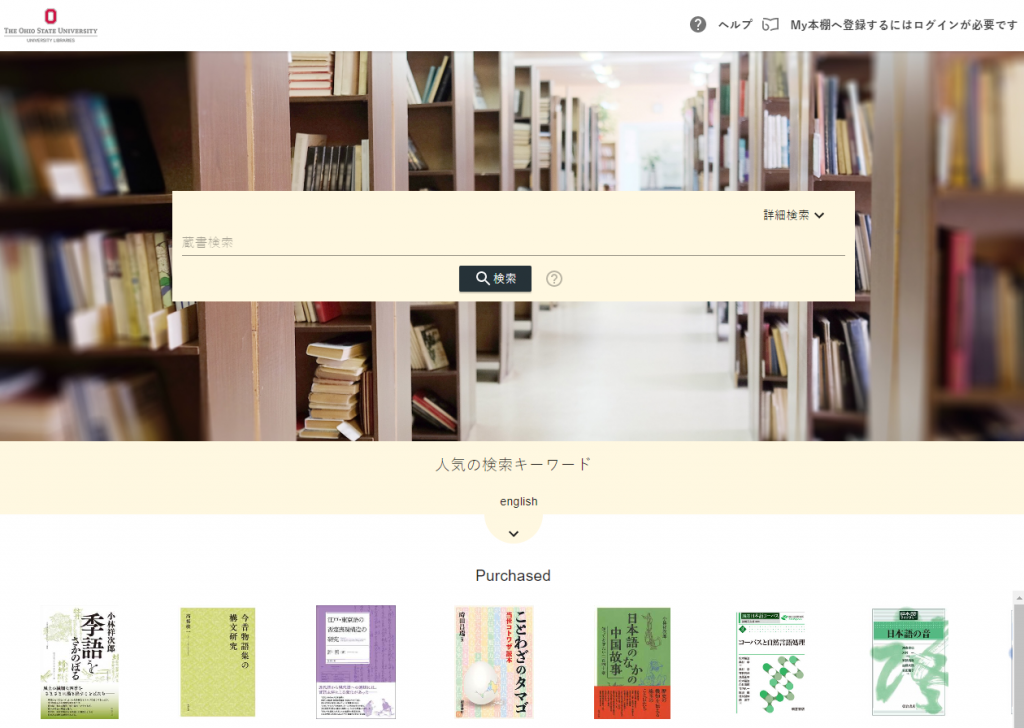
KinoDen is the name of a digital library service that was launched in 2018 by Books Kinokuniya, a Japanese bookstore based in Tokyo. OSU users logging on to KinoDen will find the following user interface (picture below) allowing them to browse, read, and request new titles from a growing selection of thousands of e-books. 

Image of the KinoDen home page now available through OSU Libraries

KinoDen e-books can be read online through a web app called bREADER for smartphones, tablets, and PCs. This app offers useful features such as a bookshelf, highlighter, note-taking function, and more.  OSU Libraries has already purchased a number of KinoDen titles and has plans to purchase many more in the coming weeks.  Once you log on to KinoDen platform, you can browse the titles by clicking “検索.” and then checking out the list as categorized, under various subject headings on the left-hand column.  By clicking the  button “未所蔵を含める” (in the upper left corner of the page), users can view the list of titles that OSU has already purchased and are available now in full-text format.

Returning to the larger list of all available titles (by un-clicking the button “未所蔵を含める”) , OSU users will also have the option to request additional titles for the bREADER. If there is a particular book you would like to access in full-text, please click on the title of the desired book, and then click on the button “購入をリクエスト,” which should be visible on the right-hand side of the page. This will activate a short form for users to fill in order to put in their purchase request to Kinokuniya Books and our Library. (If all else fails, and you’d like to follow up on a book title, please don’t hesitate to contact our Japanese Studies Librarian, Dr. Ann Marie Davis, at davis.5257@osu.edu.)

If you would like more information about how to use this resource, please check out this video, which offers a useful guide to newcomers to KinoDen.  Students and scholars who need Japanese-language books should feel welcome to take advantage of this new platform and suggest titles to add to our growing collection of e-books. 

To view KinoDen on the OSU catalog, please click here.

Still have questions or suggestions? Please contact Japanese Studies Librarian, Dr. Ann Marie Davis at davis.5257@osu.edu.

Temperance in Tokyo – Unique Woodblock Prints from the Early Japanese Women’s Rights Movement

Following the Meiji Restoration (1868) and the new policies of modernization (kindaika) and Westernization (seiyōka), Japan began to import much more than material goods from the Western imperial powers. New concepts and ideologies soon made their way across the Pacific and freely entered the once “closed country.”   Riding this wave were Christian values and models of Western feminism, which in part were proselytized by the American teacher and temperance crusader Mary Greenleaf Clement Leavitt (1830-1912).

Title: “Inshu no Nariyuki.” Meiji Woodblock Print Leaves, Illustrated by Sasaki Toyoju.
Collection number SPEC.RARE.MMS.0127.
Counterclockwise: Angled view of the six prints, detail of a jovial tavern scene, drunken disorderly conduct from the main character confronting a Native American man, drunken disheveled main character robbing a man by the roadside

Inspired by Christian sermons about the destructive nature of alcohol,  Leavitt  helped found the Woman’s Christian Temperance Union (WCTU) in New York and Ohio in 1873.  Soon thereafter, her global crusade  led her as far as Japan and other countries including New Zealand, Burma, India, and Turkey, where female allies launched new chapters of the World WCTU.  Tired of the ill effects of alcohol on their domestic lives, women worldwide were drawn to the message of temperance and created an unprecedented transnational movement “for God, home and country.”

Continue reading

Night Parade of One Hundred Demons: Kyōsai’s Hyakki Gadan Now at OSU Libraries

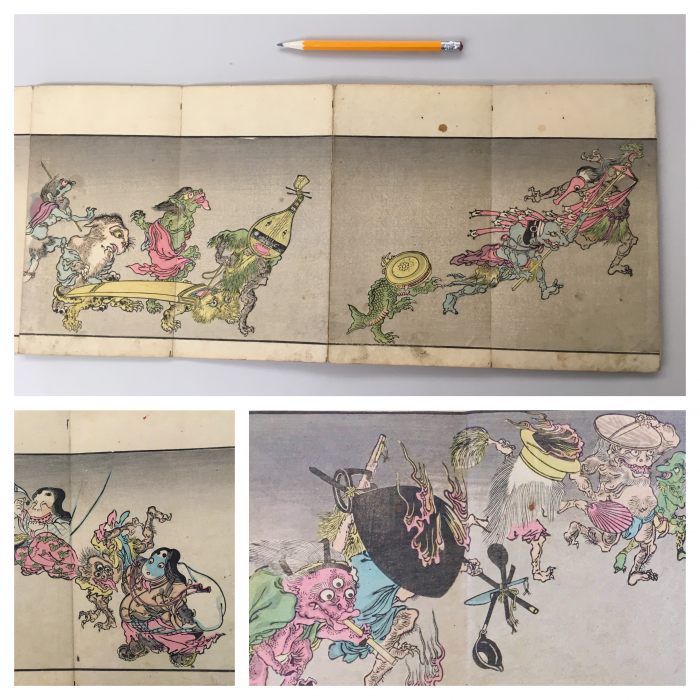
Japanese Studies invites you to learn about the mythology and artistic culture of Meiji Japan (1868-1912) through the newly acquired Kyōsai Hyakki Gadan (暁斎百鬼画談), a color woodblock print by eccentric painter and manga forerunner, Kawanabe Kyōsai (河鍋 暁斎, 1831-1889). The long, accordion book (orihon) depicts a parade of all manner of weird and wicked yōkai (妖怪), spirits and demons from Japanese mythology. This particular scene is evocative of the hyakki yagyō (百鬼夜行) idiom, a historic theme in Japanese visual representation wherein a procession of legendary creatures sets foot upon the communities of mortal men and women.

For more information about this new acquisition, please check out the full article on our Manga Blog at OSU Libraries, available here: https://library.osu.edu/site/manga/2019/10/02/night-parade-of-one-hundred-demons-kyosais-hyakki-gadan-now-at-osu-libraries/