Category: Japanese libraries

Harvesting History: The Meg Milk Shashi and Their Agricultural Roots

Guest Post by Brendon Baughn

The Ohio State University recently expanded its collection of shashi (社史, company histories) with the 2023 acquisition of three volumes from Meg Milk Snow Brand, Japan’s leading dairy producer. This addition brings the total number of Meg Milk–related shashi held by the University Libraries to seven and further strengthens OSU’s growing collection of materials related to agriculture, food production, and corporate development. The most recent volumes were donated during a campus visit by Meg Milk Snow Brand representatives, which included a tour of OSU’s main campus library, where the shashi are housed.
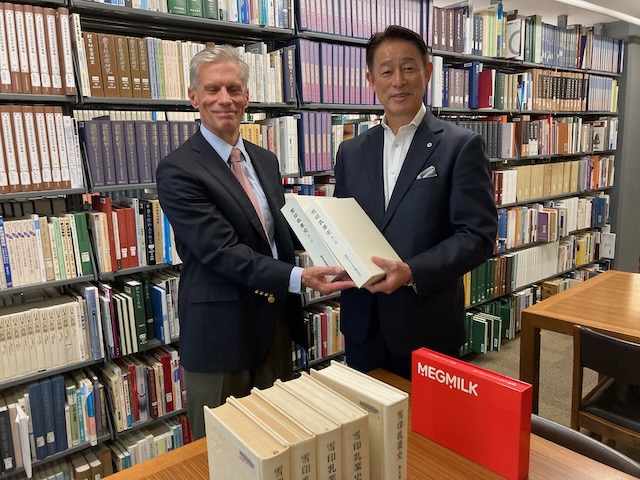
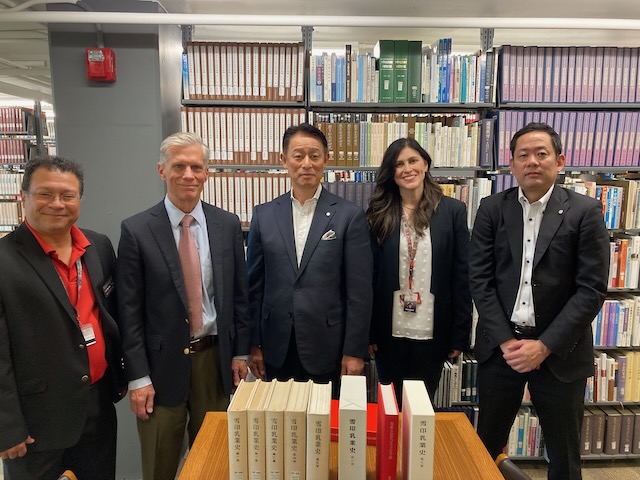


Images in the slider above show representatives from Meg Milk Snow Brand presenting the most recent volumes of their company’s history to The Ohio State University Libraries during a campus visit.

Entitled Yukijirushi Nyūgyō shi, the seven-volume Corporate History of Meg Milk Snow Brand chronicles the evolution of Japan’s modern dairy industry. Beyond tracing the company’s institutional history, these volumes document broader developments in milk processing technologies, as well as the establishment of legal and quality standards that shaped dairy production and consumption across Japan through the oil crisis of 1974.
Continue reading

Diaries and Documents of Premodern Japan: Shiryō Sanshū

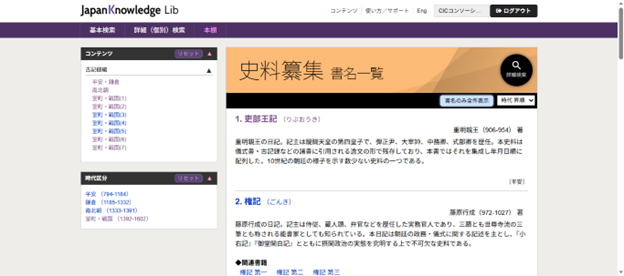
Front page of a website

Homepage of the JapanKnowledge collection of the Shiryo Sanshu.

As part of our ongoing effort to strengthen access to premodern Japanese historical sources, we announced earlier this fall the addition of the complete digital transcription of Heian Ibun (平安遺文). Building on that momentum, we are pleased to now offer access to the first unit of Shiryō Sanshū, newly available through the JapanKnowledge platform.

This initial release includes documents and diaries dating from the Heian, Kamakura, and Nanboku-chō periods, offering valuable insight into Japan’s premodern past. The collection features writings by prominent historical figures, including Prince Shigeakira (4th son of Emperor Daigo, 重明親王), Emperor Hanazono (花園天皇), Fujiwara no Teika (藤原定家), and Nakahara Momori (中原師守), among others. These diaries and journals allow researchers to explore the daily lives, thoughts, and concerns of court nobles and members of the imperial family.

The Shiryō Sanshū is a highly respected compilation of ancient diaries and documents, published by Yagi Shoten (八木書店), a Tokyo-based publishing house, between 1968 and 2020. The series encompasses more than 260 documents spanning from the Heian period through the Edo period. Each volume has been meticulously digitized, presenting both the original script and modern Japanese transcriptions. This dual-format approach enables full-text searching using both historical and modern character forms.

Continue reading

Expanding Premodern Japanese Sources: Heian Ibun Now Available

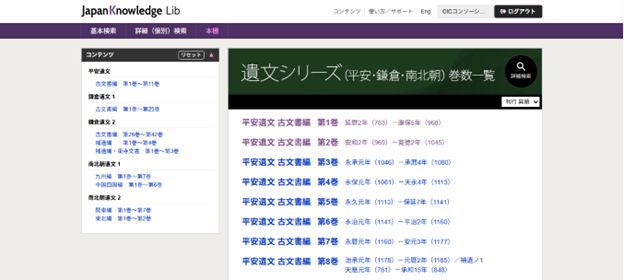
A website featuring a variety of Japanese texts, listed in chronological order.

Front page of the Heian Ibun collection, which is included in the “Ibun Series” (遺文シリーズ) archive on JKBooks.

We are pleased to announce another significant addition to our growing collection of accessible archives and databases: the complete digital transcription of Heian Ibun (平安遺文), one of the largest and most comprehensive collections of Heian-period (794–1185) historical documents in the world. This digitization greatly expands research possibilities by providing full-text, searchable transcriptions of all included materials.

Heian Ibun was compiled by historian Dr. Rizō Takeuchi (竹内理三博士), who began assembling the collection in 1947. Over the course of approximately twenty years, he brought together more than 5,500 documents, publishing them across 11 volumes arranged largely in chronological order and spanning the entirety of the Heian period. In 1974, Dr. Takeuchi returned to the project to revise and reorganize the volumes into a new format.

These revised editions were later digitized and further updated by historians at the University of Tokyo, who have continued to make corrections and enhancements since 1996. The most up-to-date versions of these texts are now available digitally through the JKBooks platform on JapanKnowledge.

Continue reading

Kabuki’s Modern History, as Told by Postcards


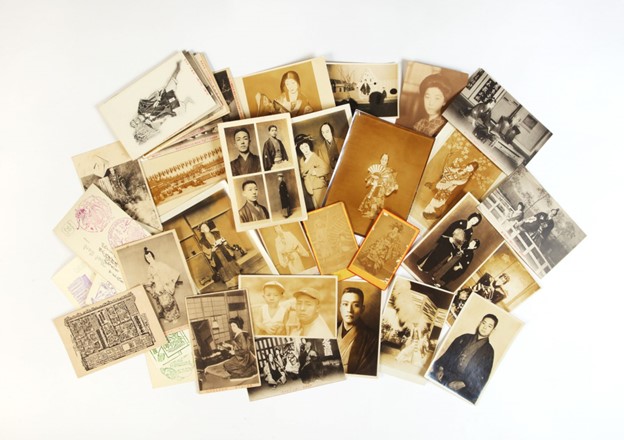
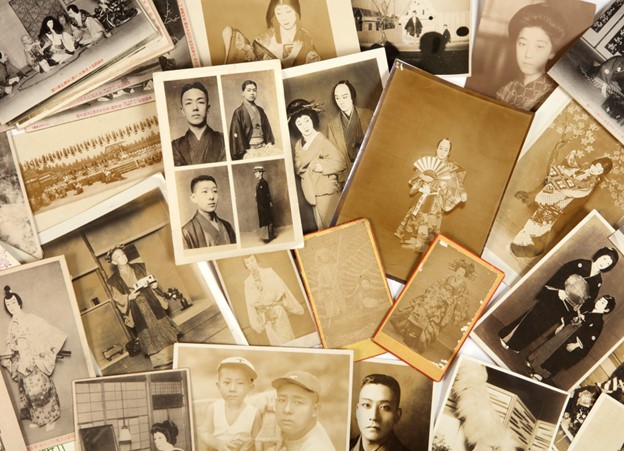
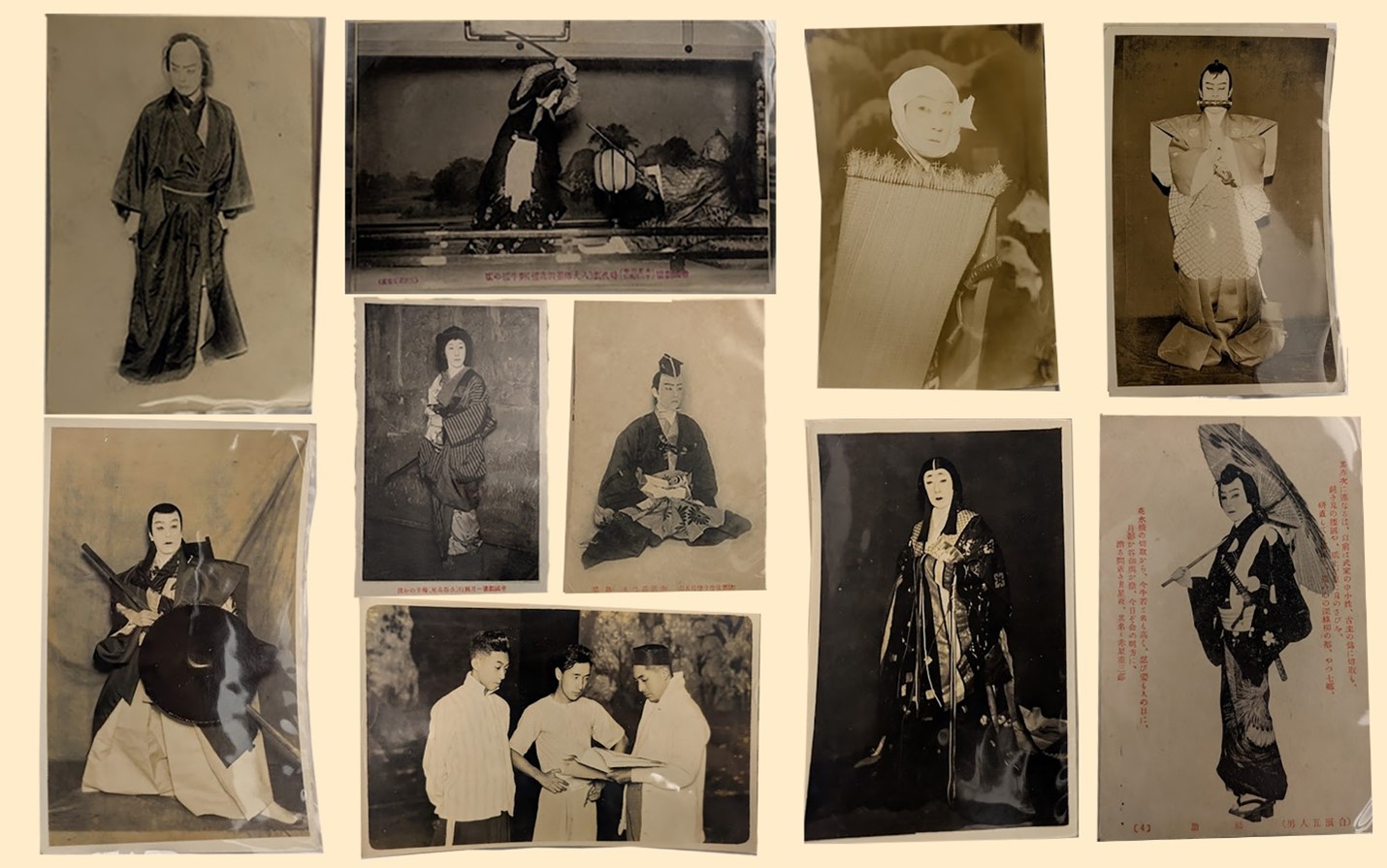
Today I would like to highlight one of our library collections that was featured in our recent atrium exhibit: an impressive set of 20th-century kabuki actor postcards. Featuring photographs of kabuki actors and plays—both onstage and behind the scenes—this collection contains over 2,500 postcards and is the largest we are aware of outside Japan. The contents date from the early Taishō period (1912–1926) to the 1980s and are in excellent condition overall, although some earlier cards show minor signs of wear or fading.

Portrait postcards like these became increasingly popular in Japan at the turn of the 20th century, when advancements in photography allowed printed cards to be produced at ever-faster rates. This meant that mass-produced images became prime collectibles for fans who visited kabuki theaters and other cultural sites. Soon, they surpassed the popularity of ukiyo-e woodblock prints, which had dominated the 19th century as one of the most sought-after Japanese collectibles of the era.

Continue reading

From Scrolls to Postcards: Rare Treasures of East Asian Art on Display

Guest post by Jayden Mitchell

A banner on the left side and a chair and two display cases on the left side

The Thompson Library exhibit ‘Mobility, Collecting and Diaspora’, a collection of East Asian objects related to performing arts, open until July 20, 2025.

We are proud to be part of the ongoing exhibition “Mobility, Collecting, and Diaspora: Preserving and Teaching East Asian History, which brings together remarkable artifacts from Japanese, Chinese, Korean, and Indonesian performance and fine arts. Located in the Thompson Library Special Collections Display Atrium, this exhibit represents an unprecedented collaboration between the Bliss M. and Mildred A. Wiant Collection of Chinese Art, and Chinese and Japanese collections from the Lawrence and Lee Theatre Research Institute, the Rare Books and Manuscripts Library, and the Herman J. Albrecht Library of Historical Architecture.

Continue reading

Exploring Shashi (社史, Company Histories)

Nissin Food Product Shashi Outer Packaging

Shashi (社史, Company Histories) are the chronological accounts of a company or corporation, usually written in the form of a book. Their contents typically include information about a specific company’s  history, including its foundation, expansion, and changes of administration corresponding to historical shifts in politics and economics. They can also reflect many other aspects of a company’s history, such as the biographies of its administrative members, interviews with workers, exhibitions of historical documents, and special topics about technological improvements.

Continue reading

Searching for Japanese books by subject

The Ohio State University Libraries uses the Library of Congress subject headings (LCSH) to support subject searches with controlled vocabulary — in addition to the convenient keyword search. Other research libraries also use LCSH, so the subject headings can also be used in Worldcat or to search in other research library catalogs. Spending some time becoming familiar with subject headings can be helpful in conducting research. An easy way to do this is to look at the “full record” when you find a book — then click on the subject headings to find other books on the same subject (or click on the call number to find books classified in the same call number range — another kind of subject index!)

Japanese library catalogs also use subject headings. At the National Diet Library(NDL)try the advanced search . There is a guide to NDL’s subject headings.

An older edition of NDL’s subject headings is available in print:
国立国会図書館件名標目表
Kokuritsu Kokkai Toshokan kenmei hyōmokuhyō
Z695 .K68 1991

A few years ago we kept subject bibliographies in the EAS Reference collection. For specific research purposes the printed books may still be helpful —