Tag: Woodblock Prints

From Scrolls to Postcards: Rare Treasures of East Asian Art on Display

Guest post by Jayden Mitchell

A banner on the left side and a chair and two display cases on the left side

The Thompson Library exhibit ‘Mobility, Collecting and Diaspora’, a collection of East Asian objects related to performing arts, open until July 20, 2025.

We are proud to be part of the ongoing exhibition “Mobility, Collecting, and Diaspora: Preserving and Teaching East Asian History, which brings together remarkable artifacts from Japanese, Chinese, Korean, and Indonesian performance and fine arts. Located in the Thompson Library Special Collections Display Atrium, this exhibit represents an unprecedented collaboration between the Bliss M. and Mildred A. Wiant Collection of Chinese Art, and Chinese and Japanese collections from the Lawrence and Lee Theatre Research Institute, the Rare Books and Manuscripts Library, and the Herman J. Albrecht Library of Historical Architecture.

Continue reading

A Rare Acquisition: Yosano Akiko’s A New Translation of The Tale of Genji

The Japanese collections at OSU hold a wide range of contemporary and historic editions of the famous Genji Monogatari. Among these is a rare and historically significant set of A New Translation of The Tale of Genji (Shin’yaku Genji monogatari), published in 1912 by the renowned feminist writer Yosano Akiko (与謝野晶子, 1878–1942). Held in the Rare Books and Manuscript Library, this set represents a pivotal moment in the reception of Genji Monogatari, as Yosano boldly transformed the Genji Monogatari into a modern-language masterpiece that could be easily appreciated by all.


4 books

The four books that make up Shin’yaku Genji Monogatari.
Image courtesy of The Lavenberg Collection of Japanese Prints

Her translation was both a scholarly achievement and an uncommon intervention, offering a fresh poetic rendering of Genji at a time when it was largely studied through a male-centric academic lens. As a first edition, this set is exceptionally rare and an invaluable resource for scholars, students, and enthusiasts of Japanese literature.

Continue reading

(Un)Censored Wooden Printing Block from the Edo Period

Collage of wooden printing block, obverse and reverse, with features

Recently our library acquired a couple of wooden printing blocks that were used during the Edo Period (1603-1868). One of these, featuring a kabuki actor named “Matsumoto Koshiro,” forms part of the Japanese Theatre Collection and is held in the Lawrence and Lee Theatre Research Institute. Dated roughly from the 18th century, the object measures 165 x 340 x 20 mm and is double-sided, with the main image carved on the obverse, and a background and outline carved on the reverse.

Matsumoto Koshiro is a stage name that has been held by a distinguished line of kabuki actors since the early 18th century. Based on the carving of “Toyokuni-e” on the upper right side of the obverse, it is believed that one of Utagawa Tokyokuni’s skilled disciples created the original illustration upon which the wooden block carvings are based.

This wooden block also bears a mark of censorship: a seal carved onto a “wooden plug” (ireki, 入木) that was inserted into the block to indicate it had been approved by censors.

Continue reading

Learning from Woodblock Prints at OSU

Within the depths of our libraries’ shelves, cases, and drawers lie hundreds of special materials you may have never have imagined were there! With so much to explore, today we’d like to bring your attention to our collection of woodblock prints and one of the many ways we enjoy sharing these materials with faculty and students.

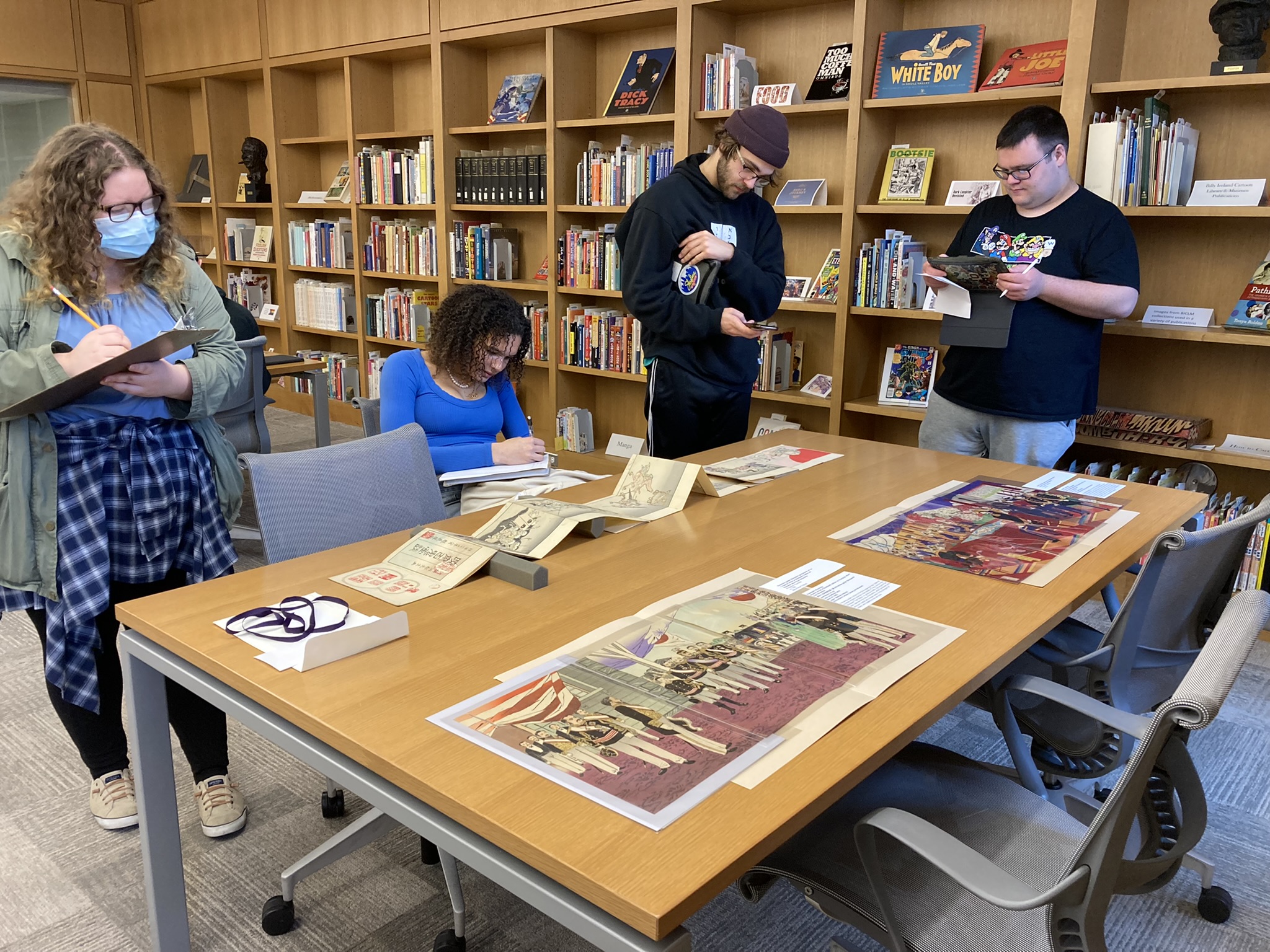
Students of HISTART 2003 observing original Meiji-era prints
by artists Kyōsai, Kiyochika, and Toshinobu

As our reading rooms opened up again last year, we were thrilled to hold several open houses, featuring our manga collection as well as substantial holdings of  woodblock prints (many of which are considered precursors to contemporary manga). Held across the University Libraries in the Theatre Research Institute, the Rare Books and Manuscripts Library, and the Billy Ireland and Cartoon Library,  these historic prints were gathered and displayed together in the reading room of the Billy Ireland for students in Artistic Media and Techniques (HISTART 4005) last October and again for those in Art & Visual Culture of East Asia (HISTART 2003) in December and April.

Continue reading

The Shining Prints: Visualizing The Tale of Genji – Part 2

Welcome to Part 2 of this blog series exploring a duo of fascinating Tale of Genji reproduction artworks found in our Rare Books and Manuscripts Library.  In this half of the blog, I will introduce the Genji monogatari gajō and then offer an analytical commentary comparing this material to the iconic Genji monogatari emaki (discussed in Part 1) in their portrayal of Murasaki Shikibu’s original tale. Lastly, I will briefly introduce some of our Japanese comics related to the Genji mongatari and held in our extensive manga collection!

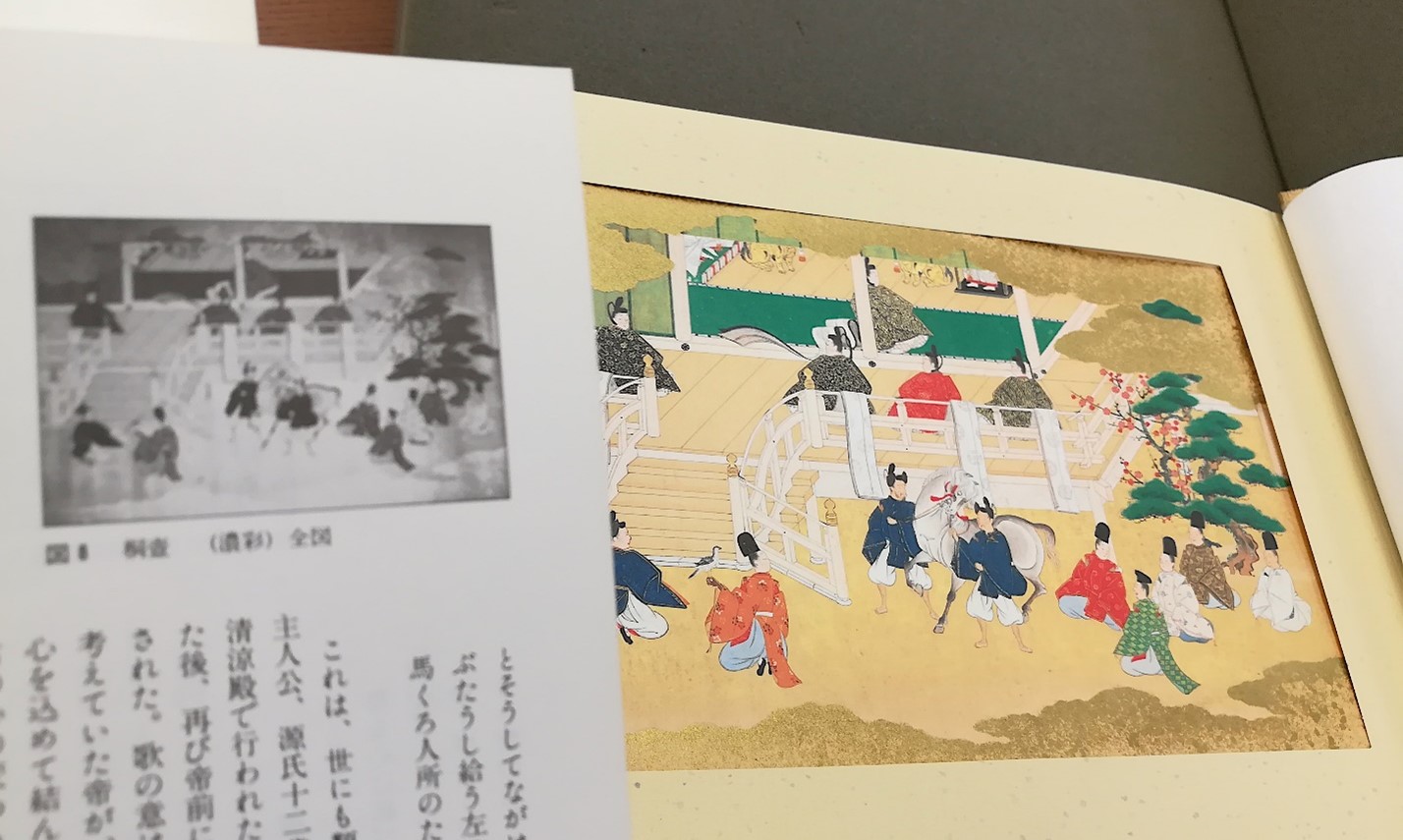
This sample from the Genji monogatari gajō shows Genji’s coming-of-age ceremony in the first chapter, “Kiritsubo” (I, “The Lady of the Paulownia-Courtyard Chambers”). Explanatory text (left) accompanies the prints.

Continue reading

The Shining Prints: Visualizing The Tale of Genji – Part 1

The Ohio State University Libraries are fortunate to have a wide range of fascinating Japan-related special collections. Several available are related to the famous classical Japanese novel, The Tale of Genji. Whether you are an established Genji scholar or a curious student, I would like to highlight some of our materials  that can provide an extraordinary visual guide to this classic tale. I have spent time with two works in particular for this essay: they are a set of reproduction prints of the iconic Genji monogatari emaki as well as a separate set referred to as the Genji monogatari gajō. This post will serve as part one in a two-part blog series about these iconic artworks!

Wood-block reproductions of the Genji picture scrolls,” ND1059.6 G4 W66 1994

The Tale of Genji (源氏物語, Genji monogatari), written by the female court attendant Murasaki Shikibu in the 11th century, is perhaps the most well-known and precious treasure of the Japanese literary tradition. This Heian-era (794-1185) classic is lengthy, character-driven, and full of vivid detail about the look and feel of the imperial Japanese court and aristocratic society. The tale follows the romantic life of Hikaru Genji, the “Shining” Prince, and depicts his many, mostly tragic relationships with women. Genji is the son of the emperor and a lower-ranking court lady known as the Lady Kiritsubo. While he is his father’s favorite child and is considered for imperial succession, he is ultimately removed from the imperial line and made a member of the Genji clan.  This protagonist earns the description “hikaru” (光る, shining or radiant) on account of his beautiful appearance and endearing qualities. However, these same infatuating traits set up the bulk of the conflict in the tale, as the myriad women Genji becomes intimate with invariably experience neglect and jealousy or other courtly drama of the polygynous aristocratic setting. The memorable and complex characters of the Shining Prince’s world have appealed to Japanese audiences for centuries, and it’s no surprise that scores of portrayals, homages, and allusions have popped up since the tale was written over a millenium ago.

Continue reading

Temperance in Tokyo – Unique Woodblock Prints from the Early Japanese Women’s Rights Movement

Following the Meiji Restoration (1868) and the new policies of modernization (kindaika) and Westernization (seiyōka), Japan began to import much more than material goods from the Western imperial powers. New concepts and ideologies soon made their way across the Pacific and freely entered the once “closed country.”   Riding this wave were Christian values and models of Western feminism, which in part were proselytized by the American teacher and temperance crusader Mary Greenleaf Clement Leavitt (1830-1912).

Title: “Inshu no Nariyuki.” Meiji Woodblock Print Leaves, Illustrated by Sasaki Toyoju.
Collection number SPEC.RARE.MMS.0127.
Counterclockwise: Angled view of the six prints, detail of a jovial tavern scene, drunken disorderly conduct from the main character confronting a Native American man, drunken disheveled main character robbing a man by the roadside

Inspired by Christian sermons about the destructive nature of alcohol,  Leavitt  helped found the Woman’s Christian Temperance Union (WCTU) in New York and Ohio in 1873.  Soon thereafter, her global crusade  led her as far as Japan and other countries including New Zealand, Burma, India, and Turkey, where female allies launched new chapters of the World WCTU.  Tired of the ill effects of alcohol on their domestic lives, women worldwide were drawn to the message of temperance and created an unprecedented transnational movement “for God, home and country.”

Continue reading