Category: News (page 1 of 10)

Two Maps of Mount Fuji: A Nook Exhibit in the Research Commons

Guest Post by Anqi Chen

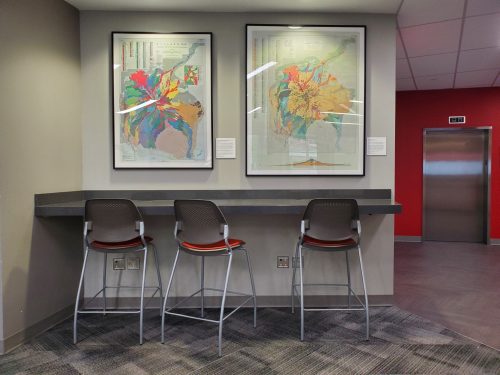
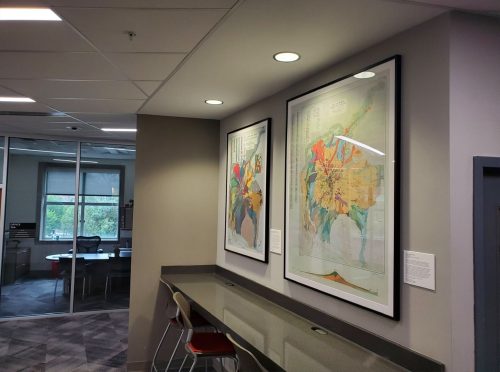
Located in a small corner of the Research Commons on the third floor of the 18th Avenue Library, a small display highlights two colorful examples from the Japanese collections held by The Ohio State University Libraries: geological maps of Mount Fuji, the highest peak in Japan and one of the country’s most recognizable natural and cultural landmarks.


Mount Fuji is an active volcano located near the geographic center of Japan, and its geological structure has been the subject of sustained interdisciplinary attention. The two maps featured here were produced by the Geological Survey of Japan (地質調査総合センター): one published in 1968 by Hiromichi Tsuya, and a second, updated version published in 2016 by Akira Takada, Takahiro Yamamoto, Yoshihiro Ishizuka, and Shun Nakano. Displayed together, they reflect more than a half century of geological research and illustrate how scientific approaches to studying Mount Fuji have developed over time.

Continue reading

Harvesting History: The Meg Milk Shashi and Their Agricultural Roots

Guest Post by Brendon Baughn

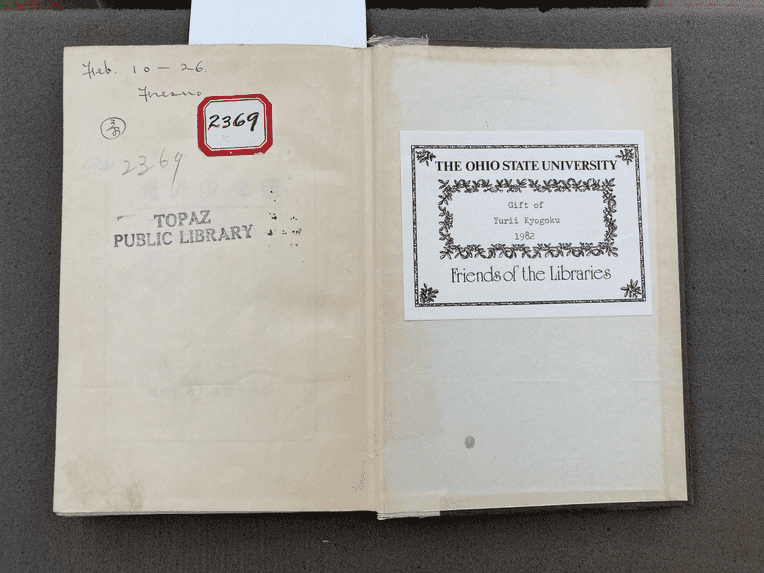
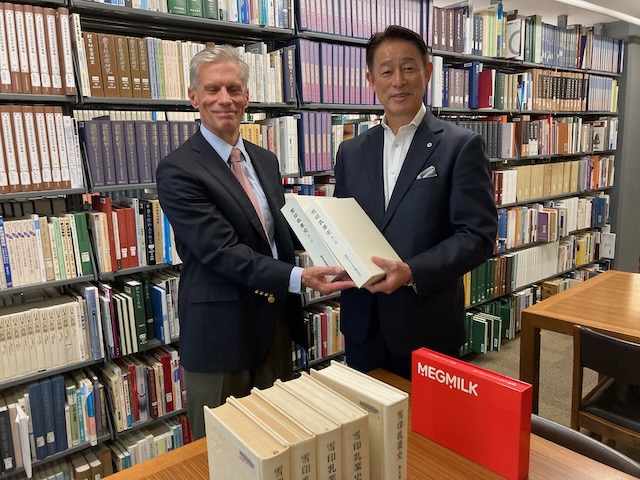
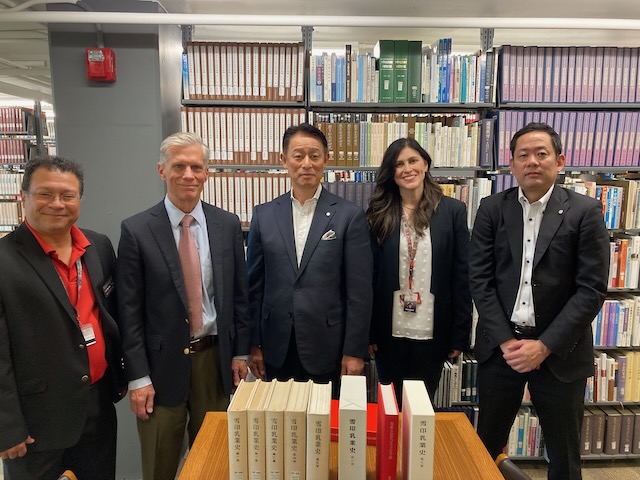
The Ohio State University recently expanded its collection of shashi (社史, company histories) with the 2023 acquisition of three volumes from Meg Milk Snow Brand, Japan’s leading dairy producer. This addition brings the total number of Meg Milk–related shashi held by the University Libraries to seven and further strengthens OSU’s growing collection of materials related to agriculture, food production, and corporate development. The most recent volumes were donated during a campus visit by Meg Milk Snow Brand representatives, which included a tour of OSU’s main campus library, where the shashi are housed.


Images in the slider above show representatives from Meg Milk Snow Brand presenting the most recent volumes of their company’s history to The Ohio State University Libraries during a campus visit.

Entitled Yukijirushi Nyūgyō shi, the seven-volume Corporate History of Meg Milk Snow Brand chronicles the evolution of Japan’s modern dairy industry. Beyond tracing the company’s institutional history, these volumes document broader developments in milk processing technologies, as well as the establishment of legal and quality standards that shaped dairy production and consumption across Japan through the oil crisis of 1974.

Continue reading

From Scrolls to Postcards: Rare Treasures of East Asian Art on Display

Guest post by Jayden Mitchell

A banner on the left side and a chair and two display cases on the left side

The Thompson Library exhibit ‘Mobility, Collecting and Diaspora’, a collection of East Asian objects related to performing arts, open until July 20, 2025.

We are proud to be part of the ongoing exhibition “Mobility, Collecting, and Diaspora: Preserving and Teaching East Asian History, which brings together remarkable artifacts from Japanese, Chinese, Korean, and Indonesian performance and fine arts. Located in the Thompson Library Special Collections Display Atrium, this exhibit represents an unprecedented collaboration between the Bliss M. and Mildred A. Wiant Collection of Chinese Art, and Chinese and Japanese collections from the Lawrence and Lee Theatre Research Institute, the Rare Books and Manuscripts Library, and the Herman J. Albrecht Library of Historical Architecture.

Continue reading

A Rare Acquisition: Yosano Akiko’s A New Translation of The Tale of Genji

The Japanese collections at OSU hold a wide range of contemporary and historic editions of the famous Genji Monogatari. Among these is a rare and historically significant set of A New Translation of The Tale of Genji (Shin’yaku Genji monogatari), published in 1912 by the renowned feminist writer Yosano Akiko (与謝野晶子, 1878–1942). Held in the Rare Books and Manuscript Library, this set represents a pivotal moment in the reception of Genji Monogatari, as Yosano boldly transformed the Genji Monogatari into a modern-language masterpiece that could be easily appreciated by all.


4 books

The four books that make up Shin’yaku Genji Monogatari.
Image courtesy of The Lavenberg Collection of Japanese Prints

Her translation was both a scholarly achievement and an uncommon intervention, offering a fresh poetic rendering of Genji at a time when it was largely studied through a male-centric academic lens. As a first edition, this set is exceptionally rare and an invaluable resource for scholars, students, and enthusiasts of Japanese literature.

Continue reading

(Un)Censored Wooden Printing Block from the Edo Period

Collage of wooden printing block, obverse and reverse, with features

Recently our library acquired a couple of wooden printing blocks that were used during the Edo Period (1603-1868). One of these, featuring a kabuki actor named “Matsumoto Koshiro,” forms part of the Japanese Theatre Collection and is held in the Lawrence and Lee Theatre Research Institute. Dated roughly from the 18th century, the object measures 165 x 340 x 20 mm and is double-sided, with the main image carved on the obverse, and a background and outline carved on the reverse.

Matsumoto Koshiro is a stage name that has been held by a distinguished line of kabuki actors since the early 18th century. Based on the carving of “Toyokuni-e” on the upper right side of the obverse, it is believed that one of Utagawa Tokyokuni’s skilled disciples created the original illustration upon which the wooden block carvings are based.

This wooden block also bears a mark of censorship: a seal carved onto a “wooden plug” (ireki, 入木) that was inserted into the block to indicate it had been approved by censors.

Continue reading

Online Japanese Newspapers with PressReader!

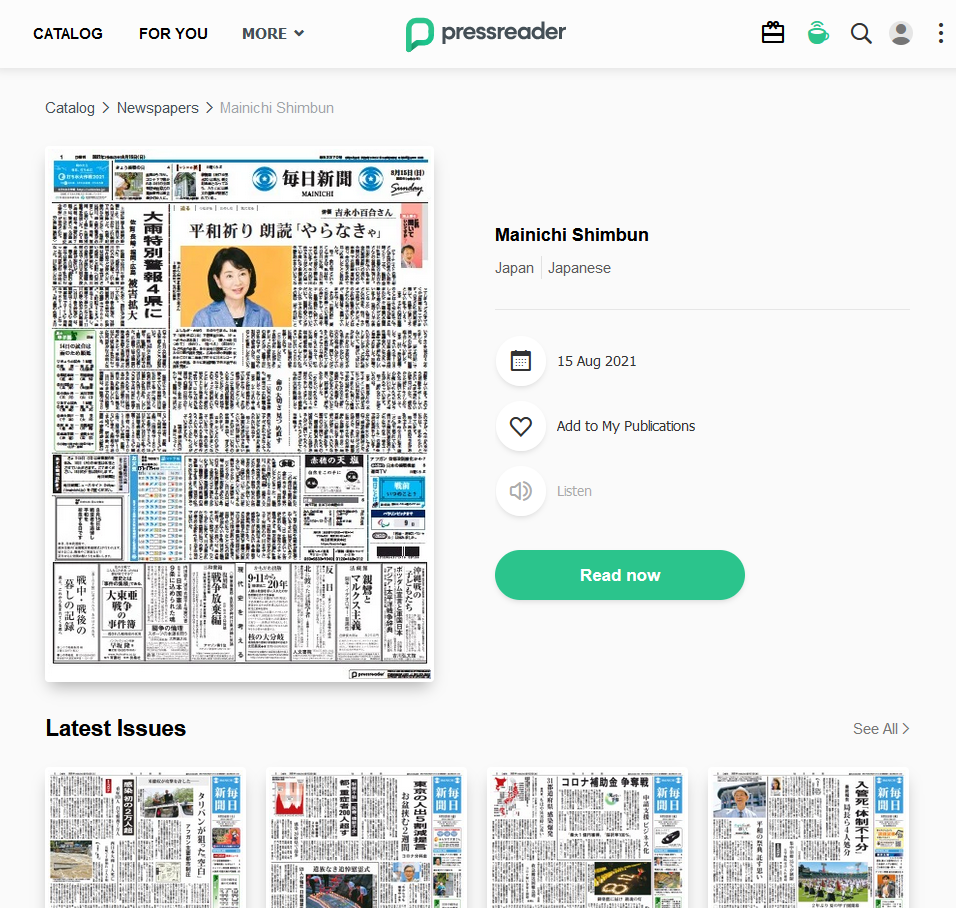
Current newspapers can offer a great way to see how events are unfolding and discussed in Japan. In this digital age, such resources are thankfully at our fingertips. The present blog shows how advanced readers of Japanese can access Japanese periodicals and newspapers like the Mainichi Shinbun (毎日新聞, literally “Daily News”) in full print view through an online database called PressReader!

Mainichi Shimbun shown on PressReader

The Mainichi Shimbun is one of the top five most widely read daily newspapers in Japan (along with the Asahi Shimbun, Yomiuri Shimbun, Sankei Shimbun, and Nikkei Shimbun). In addition to carrying the daily news, PressReader also offers over ten years of full print views of the Mainichi Shimbun dating back to April 2011.  (It also offers of other foreign language newspapers, as well as English language newspapers published overseas. For example, readers who prefer reading in English can also access the Japan News, a major English language newspaper published by the Yomiuri Shinbun, on this powerful digital archive.)

Accessing PressReader and the Mainichi Shinbun

To access the Mainichi Shinbun, we recommend starting from the OSU library catalog page for PressReader. From here, you will click on the blue “PressReader” link near the middle of the page. After entering your OSU credentials (name.# and password), you will next be brought to Pressreader’s home page.

Continue reading

“If I could read that…” and other Paleography Handbooks

Woodblock print of Japanese courtesan with Japanese script in upper left corner Have you ever wished you could read the Japanese calligraphy (kuzushiji) in museum woodblock prints or old Edo-period manuscripts? When it comes to archival sources and manuscripts, even expert Japanologists often feel the need to brush up on– if not start completely from ‘zero’–their Japanese paleography reading skills.

With this in mind, we’ve recently stepped up our holdings in Japanese paleography handbooks, including several nifty new acquisitions by Kobayashi Masahiro, an expert and scholar of historical documents (komonjo).

The image here, courtesy of the Tokyo Fuji Art Museum, is a digital facsimile of Shojiki-mono (正直者) from Kitagawa Utamaro’s series Kyokun Oya no Megane (教訓親の目鑑).  It is one of several museum pieces featured in Kobayashi’s book Korenara yomeru! Kuzushiji, komonjo nyūmon (これなら読める!くずし字・古文書入門), which roughly translated is “If I Could Read That: An Introduction to Japanese kuzushiji and komonjo.” As the picture suggests, the book offers a variety of lesson as well as useful tips for learning how to decipher such Japanese texts often found in Edo-period woodblock prints.  Describing the moral virtue of being honest for Edo period young women, the body text of famous woodblock prints such this one are all the more legible thanks to Kobayashi’s insightful lessons.


For additional titles on learning Japanese hentaigana, check out these recent additions:

An Update on JKBooks: Two New Primary Source e-Collections

Guest post by Mitch Clark

We are pleased to announce the addition of two new exciting collections to the JKBooks eBook platform at University Libraries: the Dai-ichi Koto Gakko Koyukai Zasshi (published by The Museum of Modern Japanese Literature) and the Kobunso Taika Koshomoku (a major corpus of antiquarian book catalogs). Both of these collections will be useful to scholars investigating topics related to early 20th century culture, especially youth culture, education, literature, and philology. With the addition of these titles, the number of online JKBooks collections now reaches a grand total of thirteen available to OSU users. Below is a short description of these collections as well as some highlights and screenshots of their contents.

Dai-ichi Koto Gakko Koyukai Zasshi (第一高等学校 校友会雑誌)

2 Catalog Covers

Two Sample covers of the
Daiichi Koto Gakko Koyukai Zasshi

The Dai-ichi Koto Gakko Koyukai Zasshi is a magazine published by First Higher School of Japan, a former preparatory boy’s boarding school in Tokyo and one of Japan’s most elite institutions of the modern era. Published from the Meiji period until during WWII, the database offers all but 2 issues (380 of 382 ever published) of the magazine. (Issues No. 293 and 295 of 1923 (Taisho 12) have not been found and are therefore not included in the collection).

In the publisher’s words, this “magazine vividly records the mentality fostered within this elite high school” from the pre-war period until World War II. In addition to leading artists and literary figures, many of the students of this school eventually became prominent leaders in academia, politics, the economy, and education. The repository thus “stands as a spiritual record of the youthful times of those figures” during much of Japan’s modern era (1890-1940).

Among other topics, the journal overflows with poetry and prose written by such luminaries as Jun’ichiro Tanizaki (谷崎 潤一郎Tanizaki Jun’ichirō, 1886 – 1965) and Yasunori Kawabata (川端 康成Kawabata Yasunari, 1899 – 1972) during their high school days. While many of the issues emphasize the arts, its diverse contents will be of interest to wide-ranging scholars from many disciplines including the social sciences. Some of pages that stood out to me, for instance, were those with multiple essays (as well as a team fight song) about the school’s baseball club in the early Taisho period. An analysis of such sources can certainly help in constructing a more vivid image of early baseball culture in Tokyo and Japan!

Screenshot of the school’s Baseball Club Fight Song, Supplement Issue No. 2, February 28, 1909, pp. 110-11.

Kobunso Taika Koshomoku (弘文荘待賈古書目)

2 Catalog Covers

Two Sample covers of the 77-volume
catalog Kobunso Taika Koshomoku

The Kobunso Taika Koshomoku is a 77-volume catalog collection that lists approximately 20,000 antiquarian books. Distributed to customers of the vintage bookstore “Kōbunsō” founded by Shigeo Sorimachi (1901-1991), the volumes were originally published between 1933 and 1984 and filled with detailed bibliographical information, illustrations, and publishing histories. They are therefore an especially useful reference for scholars of philology and bibliographical studies.

In my first browsing of the catalogue, I stumbled upon some Western classics. Entries 93 through 95, for example, list first edition copies of such famous English language books as The Adventures of Huckleberry Finn by Mark Twain, The Jungle Book by Rudyard Kipling, and The Grapes of Wrath by John Steinbeck.

Entries 93-95. Kobunso Taika Koshomoku, No. 48,
Showa 51.01 (January 1976), pp. 106.


JapanKnowledge Books (aka JK Books) is an ever-expanding eBook platform hosted by JapanKnowledge (an online treasure trove in its own right of Japan’s most important dictionaries and encyclopedia). For an overview (or just a refresher) on “JKBooks,” please take the time to visit this past blog. The list below shows a list of the newest collections (marked with *) along with the many others offered through our library.

1. Taiyo
2. Bungei Kurabu: Meiji-hen
3. Dai-ichi Koto Gakko Koyukai Zasshi*
4. Takita Choin kyuzo Kindai sakka genkoshu
5. Fuzoku Gaho
6. Gunsho Ruiju series
7. Bijutsu Shinpo
8. Toyo Keizai Shimpo / Weekly Toyo Keizai Digital Archives
9. Kobunso Taika Koshomoku*
10. Jinbutsu Sosho
11. The ORIENTAL ECONOMIST Digital Archives
12. Kamakura Ibun
13. Bungeishunju Archives

If you have any questions regarding JKBooks, or any other resource offered for Japanese Studies at the OSU Libraries, please contact us!


The Dainihon kōtei ōezu: an Edo Travel Map Facsimile (ca. 1840s)

Guest Post by Takuma Goto

Originally published in 1843, the Dainihon kōtei ōezu (大日本行程大繪圖 transl.: Great Japanese Travel Map) illustrated the Japanese state and its borders at that time. The northern island of Ezochi (present-day Hokkaido), for instance, is not pictured on this map as it was not yet annexed into Japanese territory. This colonial acquisition occurs after the Meiji Restoration (1868).  Our copy at OSU (pictured below) is a facsimile (printed in 1977) of an 1857 re-issue of the original version from 1843.

Dainihon kōtei ōezu ( 大日本行程大繪圖).  27 x 199 cm (unfolded)

Continue reading

Mapping the Allied Air War – AAF Target Chart of Tokyo

Guest Post by Takuma Goto

In a previous blog, I discussed our University Libraries’ ongoing Japanese maps project. Today, I’d like to share another interesting map I’ve encountered: a World War II U.S. Army Air Forces’ (AAF) “target chart” of Tokyo, Japan.

Historical Background

Soon after the attack on Pearl Harbor on December 8, 1941, the United States quickly mobilized for the Pacific War. The following April, the AAF’s aerial campaigns against Imperial Japan began with the Doolittle Raid on the Tokyo Metropolitan Area. This small-scale air raid would become the first of hundreds of Allied bombings throughout World War II until Japan’s surrender in August 1945. 

AAF Target Chart Japan. Washington, D.C.: Army Map Service, 1942.


Continue reading

Older posts