Editor’s Note: The Song Family Papers, held by Ohio State’s Rare Books & Manuscripts Library, document the transnational history of a Korean family whose lives intersected with Japan, China, and the United States across multiple generations. The collection offers particularly rich opportunities for exploring the intertwined histories of Korea and Japan, including migration, education, medicine, colonialism, and diaspora. In this guest post, originally published as a blog on the Song family digital exhibit, student researcher Max Li examines one especially fascinating object preserved within the family papers: an eighteenth-century Korean calligraphy book whose own history extends across East Asia.
Guest Post by Max Li
In March 2025, we opened the exhibit “Mobility, Collecting, and Diaspora: Preserving and Teaching East Asian History” in the Special Collections Atrium of the main campus library. Drawing on rare and distinctive works from multiple campus collections—including the Thompson Libraries’ Special Collections and the Bliss M. and Mildred A. Wiant Collection of Chinese Art—the exhibit celebrates the depth and diversity of East Asian materials at OSU.
Among the featured items, one artifact stands out: a well-preserved calligraphy book that contains Chinese poems and inscriptions from Korean monuments.
A treasured family heirloom, the book has journeyed across borders and generations—traveling from Korea to Japan, northeast China, back to Korea, and ultimately to the United States. Preserved for centuries by the ancestors of Thomas Gregory Song’s mother, So Jong-Ah (1905–1995), the volume now resides in the Rare Books & Manuscripts Library at University Libraries. Its remarkable journey truly captures the exhibit’s central themes of mobility, collecting, and diaspora.
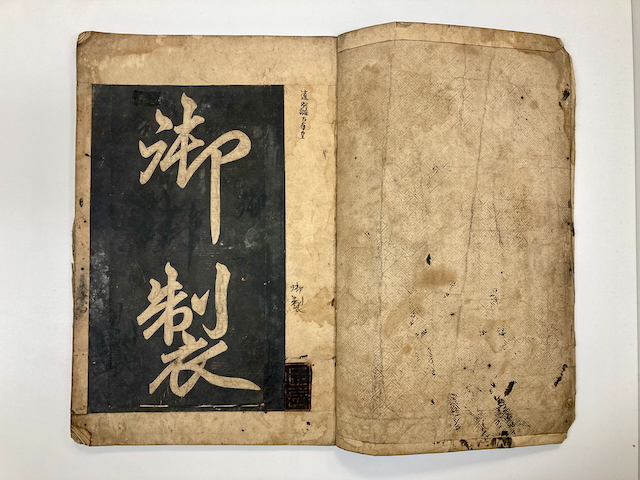
The first page of ink rubbings in the remarkable calligraphy book.
Created in 1740, the book contains ink rubbings of calligraphic inscriptions originally carved on one of two stone stelae that are part of the Historic Monuments and Sites of Kaesong, a UNESCO World Heritage Site in present-day North Korea. The calligraphy was drawn by the reigning monarch at the time, King Yeongjo (r. 1724–1776), the 21st ruler of the Joseon dynasty. Scholars believe that the rubbings are roughly contemporary with the original stele: their precision and clarity suggest they were made immediately, before the stone inscriptions were weathered by time.
Produced by royal hand, such calligraphy rubbings served as exemplary models for students learning to write—a vital skill in the East Asian scholarly tradition, where penmanship was linked to reputation and status. Creating these rubbings required meticulous craftsmanship. After pasting a traced copy of the original calligraphy onto the stone, engravers would carefully carve through the outline, striving for exact replication.
“Stowaway Poems” and Recycled Paper
Interestingly, the rubbings in this book were printed on the reverse sides of reused paper—sheets that had been inscribed previously with poetry, likely at a much earlier date. In traditional China, it was not uncommon for new texts to be printed on the backs of both public and private discarded papers. Following a consult with Chinese Studies Librarian, Professor Guoqing Li, we know that the hidden texts on the back of these pages include poems by the renowned Tang dynasty poet Li Bai (李白, 701–762), also known as Li Bo, courtesy name Taibai (太白). Widely celebrated as one of China’s greatest poets, Li Bai’s “stowaway” verses add another layer of significance to this already remarkable manuscript.
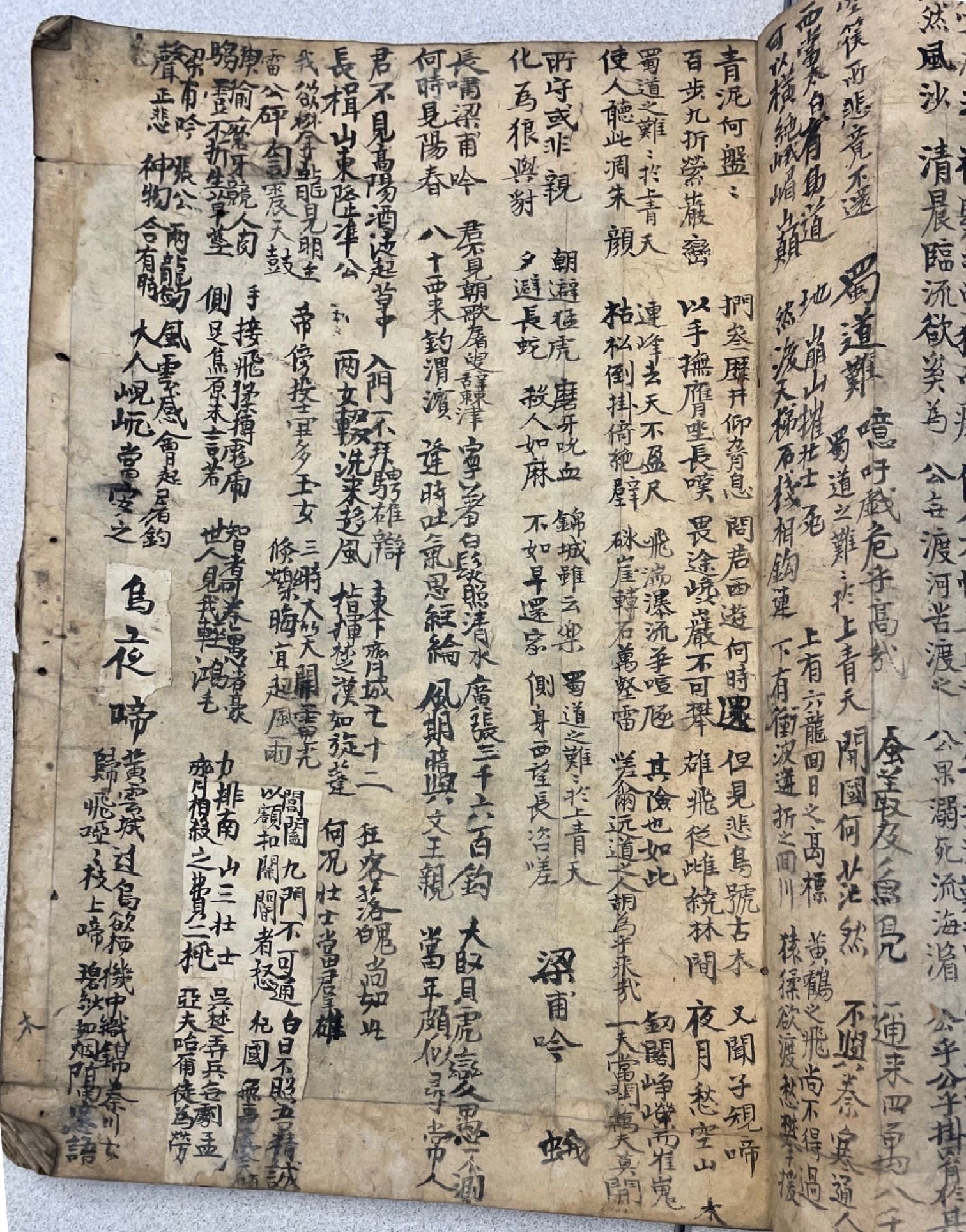
Poems by Li Bai discovered in the calligraphy book.
Beyond the Page
The donation of the Song Family “calligraphy book” builds on the important historic materials already held in that collection. This is an exceedingly rare artifact that presents great potential for research in Chinese literature and book technologies, as well as Korean history and calligraphy. It not only contains important stone monument rubbings from a world heritage site in North Korea, but also provides a rare example of ancient “paper recycling.” The reverse sides of the pages in this calligraphy book contain “stowaway” poems that were written on the paper at an earlier (unknown) date, prior to 1740. The calligraphy book is a precious and unique resource that bridges history, literacy, and transnational heritage, underscoring the Song family’s deep respect for both tradition and knowledge.
Library Resources
- Calligraphy book of Phyochung Monument ink rubbings, circa 1740 in Song Family Papers Collection
- Other related heritage objects in Thomas Gregory Song Papers Collection
About Li Bai
- Li Bai zhuan by Li Changzhi (Chang Jiang wen yi chu ban she, 2019).
- Li Bai shi ji xin zhu by Guan Shiguang zhu (Shanghai san lian shu dian, 2014).