Category: Literature

A Rare Acquisition: Yosano Akiko’s A New Translation of The Tale of Genji

The Japanese collections at OSU hold a wide range of contemporary and historic editions of the famous Genji Monogatari. Among these is a rare and historically significant set of A New Translation of The Tale of Genji (Shin’yaku Genji monogatari), published in 1912 by the renowned feminist writer Yosano Akiko (与謝野晶子, 1878–1942). Held in the Rare Books and Manuscript Library, this set represents a pivotal moment in the reception of Genji Monogatari, as Yosano boldly transformed the Genji Monogatari into a modern-language masterpiece that could be easily appreciated by all.


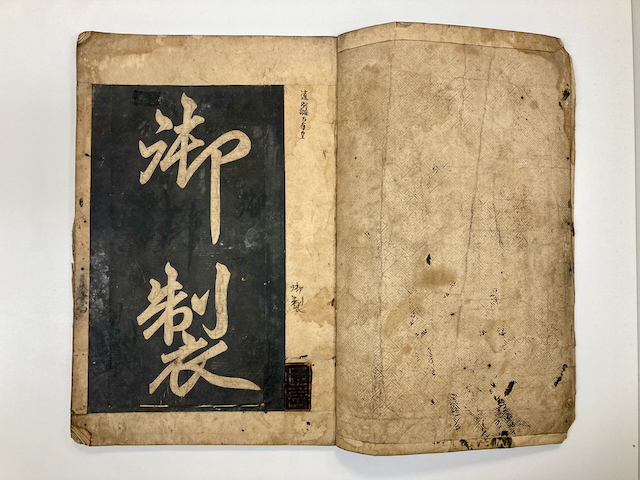
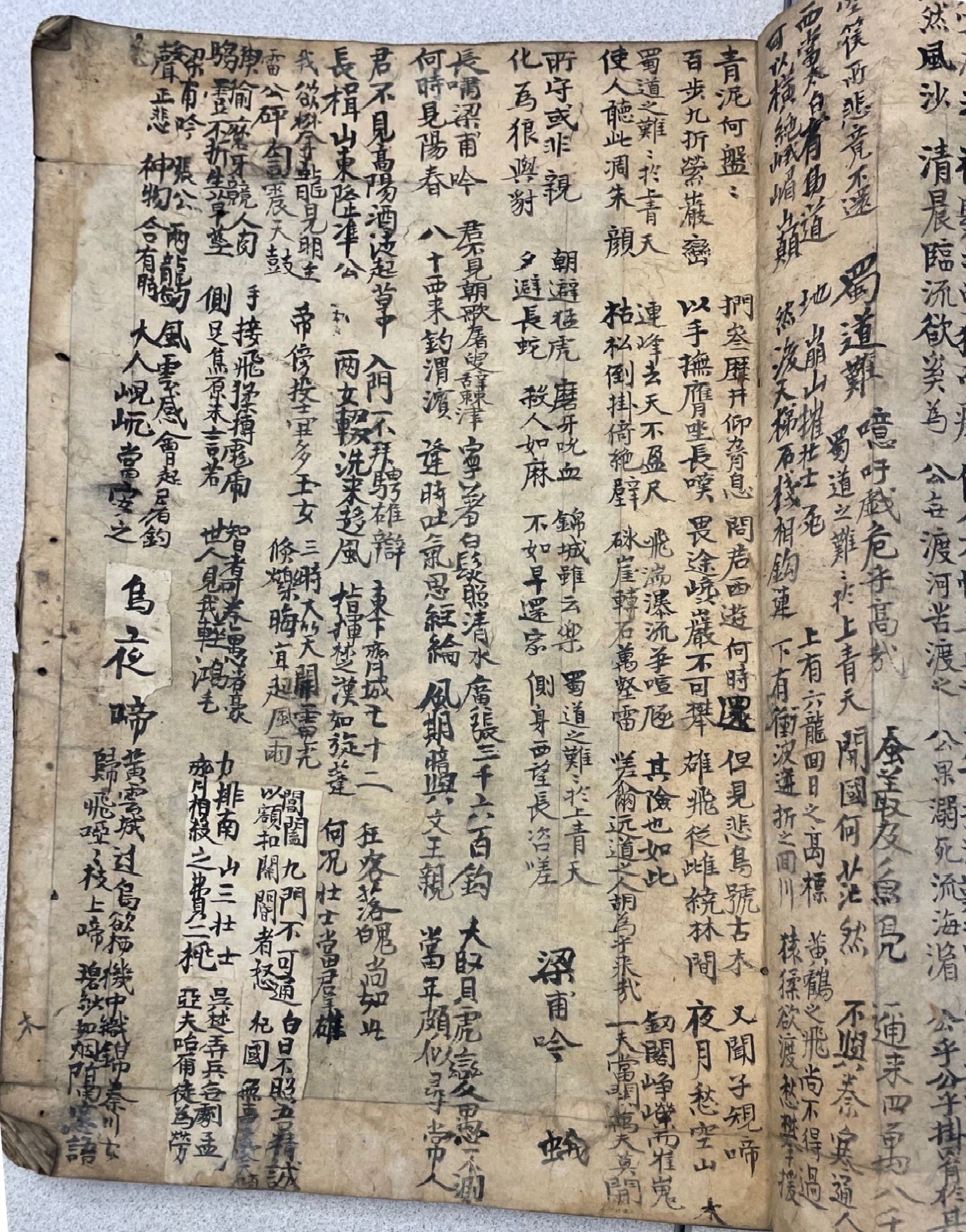
4 books

The four books that make up Shin’yaku Genji Monogatari.
Image courtesy of The Lavenberg Collection of Japanese Prints

Her translation was both a scholarly achievement and an uncommon intervention, offering a fresh poetic rendering of Genji at a time when it was largely studied through a male-centric academic lens. As a first edition, this set is exceptionally rare and an invaluable resource for scholars, students, and enthusiasts of Japanese literature.

Continue reading

A Short Tour of JKBooks, an eBook platform from JapanKnowledge

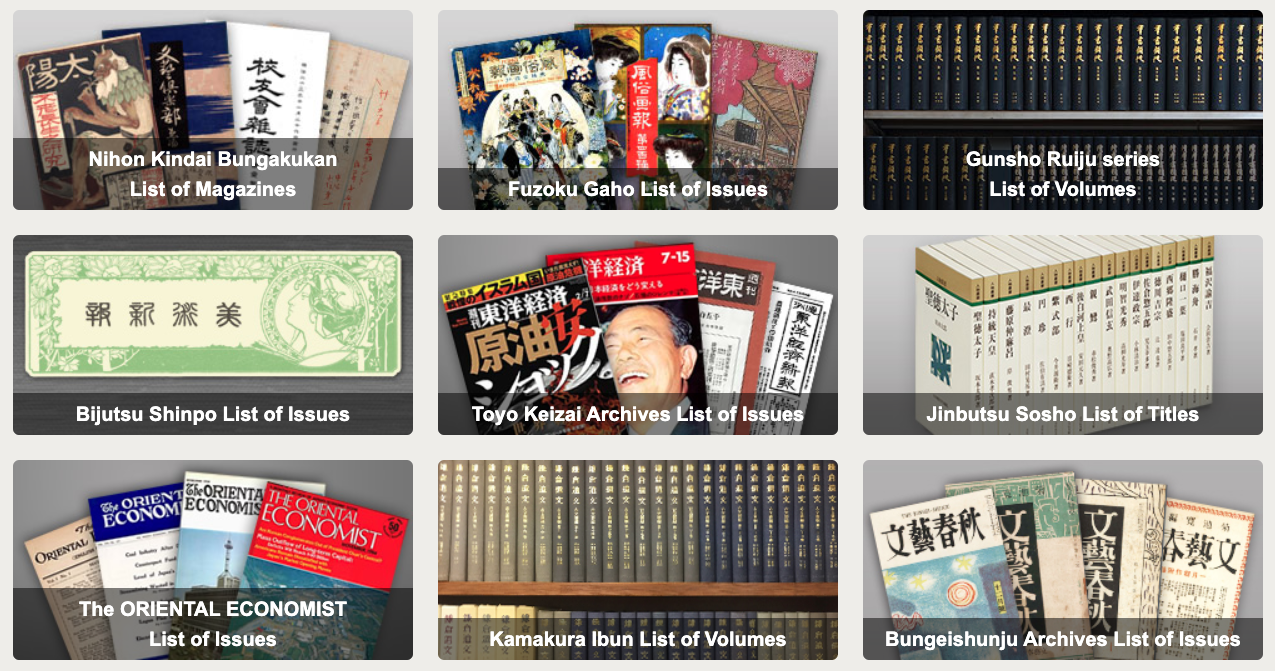
A glimpse of titles available on the JKBooks “Book Shelf” (Hondana) search page

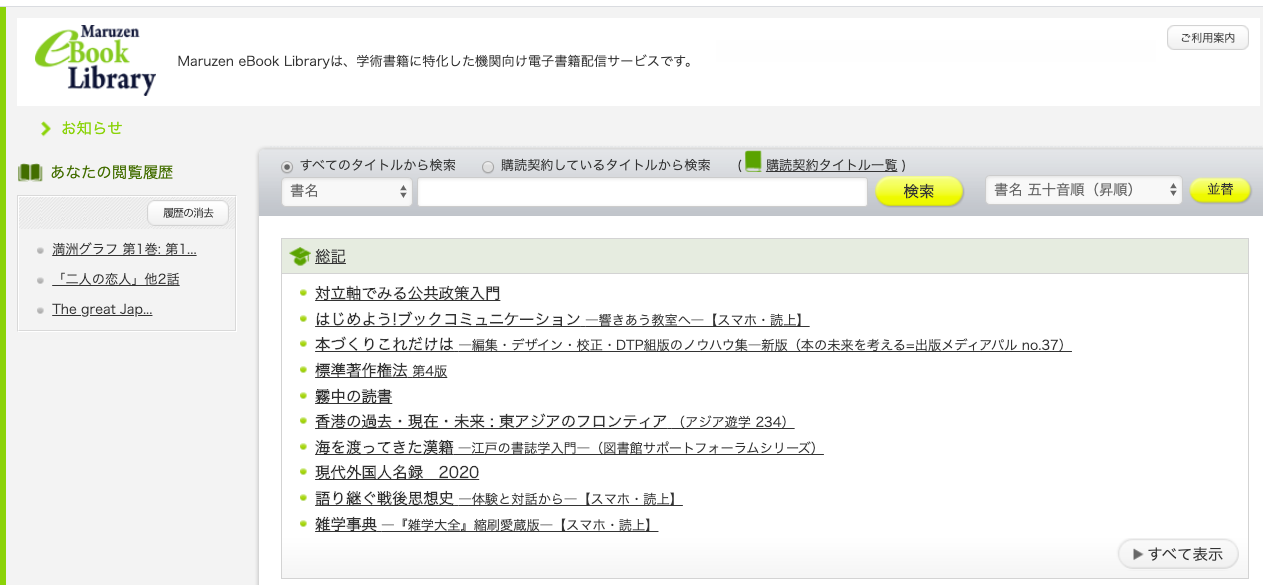
You may have caught our earlier posts outlining some of OSU Libraries’ useful Japanese Studies online databases and archives. In the past, we’ve covered the Maruzen e-Book library and the KinoDen digital library, and described some specific collections including The Oriental Economist Archives and Manchuria Daily News Online.

Here I would like to highlight specifically JapanKnowledge Books, or “JKBooks,” a valuable database with access to a range of corpora dating from antiquity to the present. Presently, our libraries offers access to 11 titles (of the total 13 that are available for sale) to users with OSU credentials. This list is expanding all the time, and just this year, in fact, we have acquired three new titles. (To preview these titles, please use the link here to jump down to our list below.)

As the name suggests, JKBooks is connected to the JapanKnowledge database.  However, in contrast to JapanKnowledge, which contains a lengthy list of reference books — specialized dictionaries, encyclopedia, and yearbooks, for example — JKBooks offers specialized corpora of primary sources.

Three of my favorite JKBook titles are Taiyo (The Sun), a 19th-20th century magazine; the Gunsho Ruiju series, a compilation of manuscripts dated from ancient times to the early modern era; and the ORIENTAL ECONOMIST archives, a monthly English language magazine elucidating economic topics in industrialized, Imperial Japan. This is only a small sampling of the interesting and valuable JK Books collections you can access online!

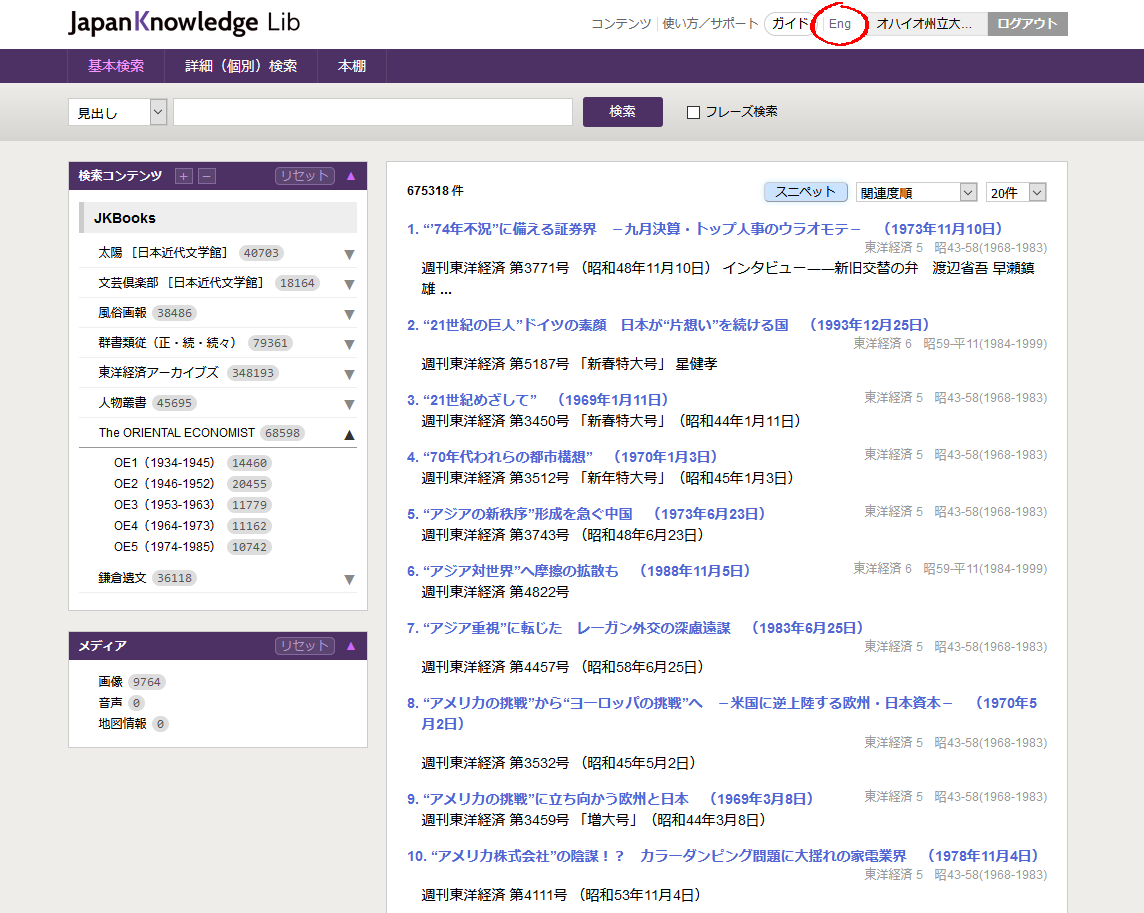
Incidentally, while JapanKnowledge is a Japanese platform, with Japanese-language materials, English users can easily switch the interface language by clicking the “Eng” button found in the top right of every page (see image):

Screenshot of JKBooks basic search page in Japanese

On the top purple ribbon, you will see a menu leading to three different search pages to help you find the content you need in the database: Basic Search (基本検査), Advanced Search ( 詳細(個別)検査), and Book Shelf (本棚).

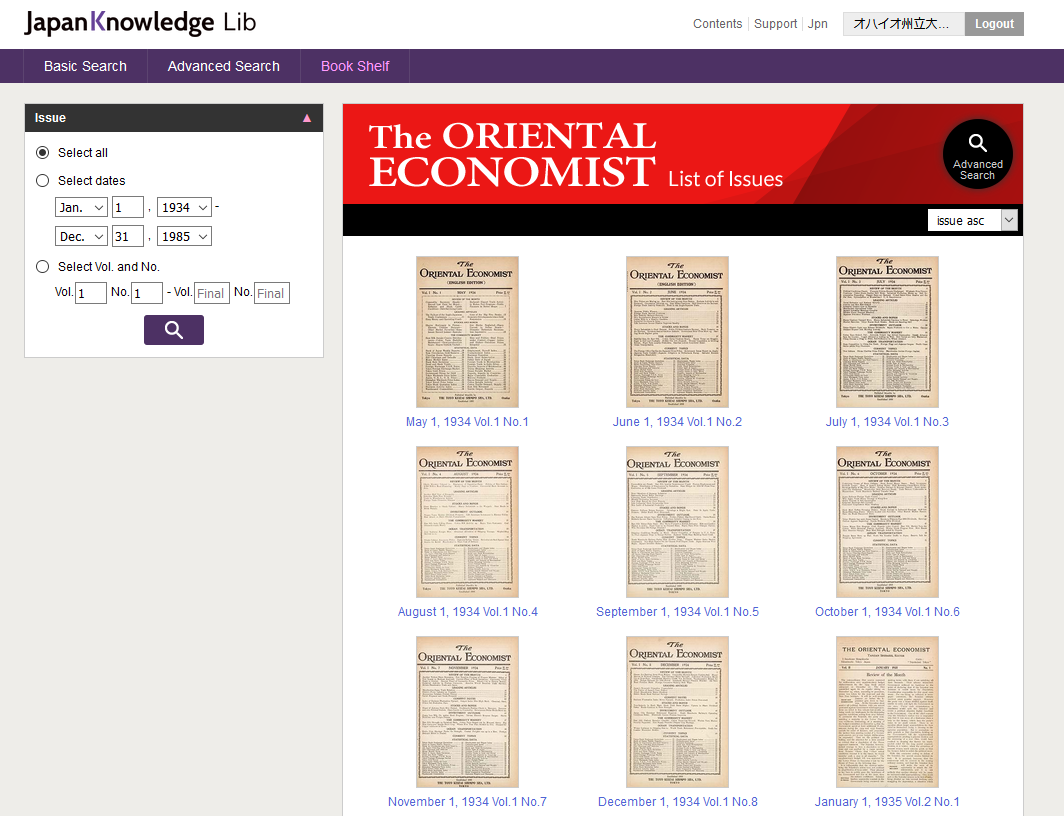
Basic Search allows searches on particular words or phrases contained in any of the archived materials. Advanced Search lets you narrow your options a bit, letting you drill down within one or more particular collection(s). And finally, Book Shelf features a user-friendly interface that lays out each particular collection by volume, issue, and/or date of publishing. This may be your best choice if you are interested in a specific series in the database or simply want to browse the publications from cover to cover. The image below shows the “Book Shelf” search options available upon clicking the title The Oriental Economist, in JKBooks’ English-language interface.

Screenshot of JKBooks Book Shelf page featuring The Oriental Economist archive

JK Books is an especially powerful resource for those who need primary sources in the vernacular and for those who are forced to work remotely. There is no shortage of unique perspectives and in-context information hiding in this treasure trove of
materials!

Current JKBooks at OSU

  1. Taiyo [Nihon Kindai Bungakukan]
  2. Bungei Kurabu: Meiji-hen [Nihon Kindai Bungakukan]
  3. Kindai sakka genkokushu [Nihon Kindai Bugakukan]*
  4. Fuzoku Gaho
  5. Gunsho Ruiju series
  6. Bijutsu Shinpo*
  7. Toyo Keizai Shimpo / Weekly Toyo Keizai Digital Archives
  8. Jinbutsu Sosho
  9. The ORIENTAL ECONOMIST Digital Archives
  10. Kamakura Ibun
  11. Bungeishunju Archives*

Note: Titles with asterisks (*) denote new databases acquired in academic year 2020-21.

If you have any questions regarding this resource, or any other resource offered for Japanese Studies at the OSU Libraries, please contact Dr. Ann Marie Davis, Japanese Studies Librarian at the Ohio State University: davis.5257@osu.edu.

Maruzen eBook Library (MeL) Now on Trial at OSU Libraries

Update (posted September 1, 2020): Following the trial period described in this blog, OSU Libraries made the decision to permanently adopt the Maruzen eBook Library (MeL) platform, which can be accessed now at: https://library.ohio-state.edu/record=e1002576~S7. Continue reading for details on how to use this helpful new e-resource!

In an effort to increase the list of e-resources for research and teaching in Japanese Studies, we have set up an Extended Trial Reading Agreement for the Maruzen eBook Library (MeL), which will last until the end of May.  During this trial period, OSU users will be able to access over 56,000 Japanese ebook titles.

Also during this trial period, unlimited concurrent user access is possible, but printing and downloading are not. If you have specific printing and downloading needs – or any questions whatsoever about Japanese language e-resources –  please contact me, Ann Marie Davis, the Japanese Studies Librarian at OSU, at davis.5257@osu.edu

To get started using this online platform, click the link in the OSU catalog here: 

https://library.ohio-state.edu/record=e1002576~S7   

For tips on how to search for books in MeL and use the various platform functions, please refer to the Maruzen eBook Library cheatsheet.

If you see something you’d like to consider purchasing, please feel free to e-mail me. If you need MeL materials for your teaching or research projects, you can also fill out this form for eBook purchases, which goes straight to our OSU Library acquisitions office: 

http://go.osu.edu/resourcerequest2020


Night Parade of One Hundred Demons: Kyōsai’s Hyakki Gadan Now at OSU Libraries

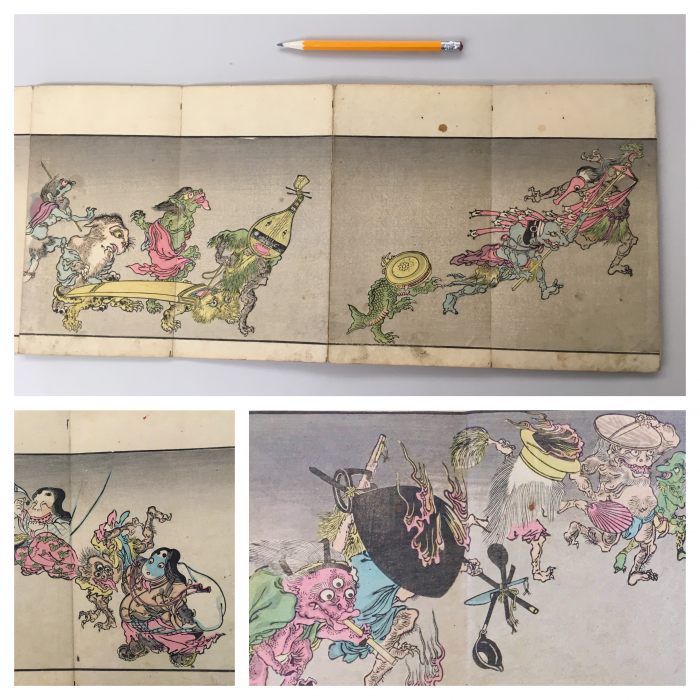
Japanese Studies invites you to learn about the mythology and artistic culture of Meiji Japan (1868-1912) through the newly acquired Kyōsai Hyakki Gadan (暁斎百鬼画談), a color woodblock print by eccentric painter and manga forerunner, Kawanabe Kyōsai (河鍋 暁斎, 1831-1889). The long, accordion book (orihon) depicts a parade of all manner of weird and wicked yōkai (妖怪), spirits and demons from Japanese mythology. This particular scene is evocative of the hyakki yagyō (百鬼夜行) idiom, a historic theme in Japanese visual representation wherein a procession of legendary creatures sets foot upon the communities of mortal men and women.

For more information about this new acquisition, please check out the full article on our Manga Blog at OSU Libraries, available here: https://library.osu.edu/site/manga/2019/10/02/night-parade-of-one-hundred-demons-kyosais-hyakki-gadan-now-at-osu-libraries/

Japanese Monsters, Ghosts, and Spirits: Mythical Yōkai (妖怪) at OSU Libraries

An example of a colorful three-panel woodblock print of Japanese spirits and demons from the book Yōkai: Strange Beasts & Weird Spectres — 100 Japanese Triptychs (pages 56-57)

In Japanese folklore, yōkai (妖怪) refers to legendary ghosts, monsters, and spirits.  Rooted in Japanese animism, ancient Japanese religion, and the providence of nature, these mythical creatures are attributed with strange behaviors to explain the otherwise mysterious phenomena encountered in ancient life. Shedding light on the meaning of this word, the two kanji for yōkai, mean “attractive, bewitching” (妖)  and “mystery, wonder” (怪) respectively.  Because of their connection to human nature, yōkai were often depicted as strange embodiments of ordinary individuals or creatures — some resembling humans, for example, with altered features such as a long neck or three eyes.  Others looked like strange animals, plants, insects, or household goods. 

Continue reading

Spotlight Article: OSUL Collection of Tanikawa Shuntaro (谷川俊太郎)

One of the strengths of the Japanese Studies Collections at the Ohio State University Libraries is an extensive collection of  works and rare publications by world-acclaimed author TANIKAWA Shuntaro ( 谷川俊太郎). Tanikawa is Japan’s preeminent contemporary poet whose work has won over ten literary awards and can be found in Japanese textbooks across the nation. In addition to being a poet, he is also an acclaimed translator, picture book writer, and scriptwriter.

Much of Tanikawa’s work has already been translated and published in English, including his Floating the River in Melancholy, for which he won the American Book Award. His work in translating children’s literature, including Charles Shultz’s Peanuts comic strip, Mother Goose rhymes, and Swimmy by Leo Lionni,  garnered him a nomination for the Hans Christian Andersen award in 2008.  His worldwide stature and presence in literature has also made him a perennial contender for the Nobel Prize in Literature.

Shuntarō Tanikawa, 2015 by Círculo de traductores is licensed under CC0

Continue reading

Japanese Literature: Collections

Tokyo Metropolitan Library Guides:

Major Collectanea:

古典文庫総目錄 (1991): 2d FL  Z3308.L5 Y67 1991
古典文庫総目錄 : 続 (2003): 2d FL  Z3308.L5 Y67 2003

Hard copy: Thompson 2d FL: http://library.ohio-state.edu/record=b2136009~S7
CD-ROM in OSU Libraries: http://library.ohio-state.edu/record=b5755741~S7
(NOTE: There is a new DVD version: http://www.kadokawa.co.jp/sp/201211-06/ )

guide: http://library.ohio-state.edu/record=b4428776~S7

Online Resources:

古典選集本文データベースhttp://base1.nijl.ac.jp/~anthologyfulltext/