Page 5 of 13

Japanese Culture Event at Marysville High School

On April 7th, we participated in the 4th Annual Evening of Japanese Culture at Marysville High School! The event attracted upwards of 500 visitors and was an opportunity for the local community to experience Japanese culture and learn about the high school’s vibrant Japanese language program.

Recreating the look and feel of a Japanese festival, there were well over a dozen info booths, eating and craft stands, and workshops. 
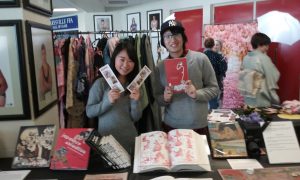
The stands featured different aspects of Japanese culture such as ikebana (Japanese flower arrangement); sadō (Japanese tea ceremony); omocha (children’s toys); Japanese food (such as mochi stuffed with red beans, bento boxes, and kushikatsu, or lightly fried foods on a stick); and even a kingyo sukui (goldfish catching) pool.  In addition to the stalls, there were live events such as exhibitions of kyūdō (Japanese archery) and taiko (Japanese drums) as well as group classes for participants in shodō (Japanese calligraphy) and taiko!
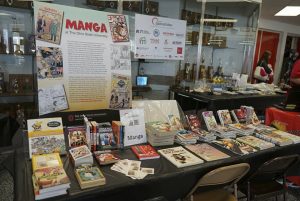
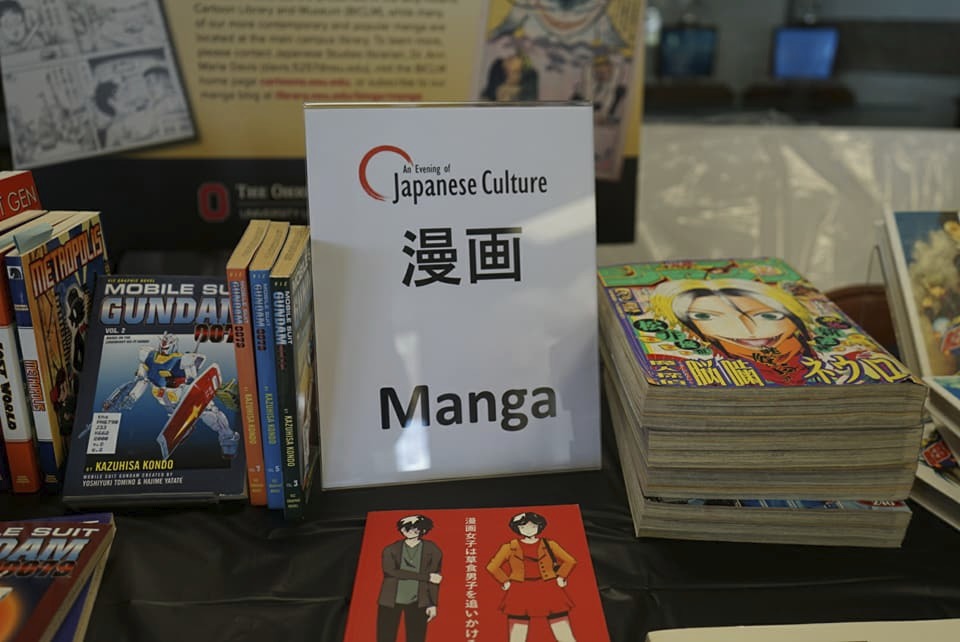
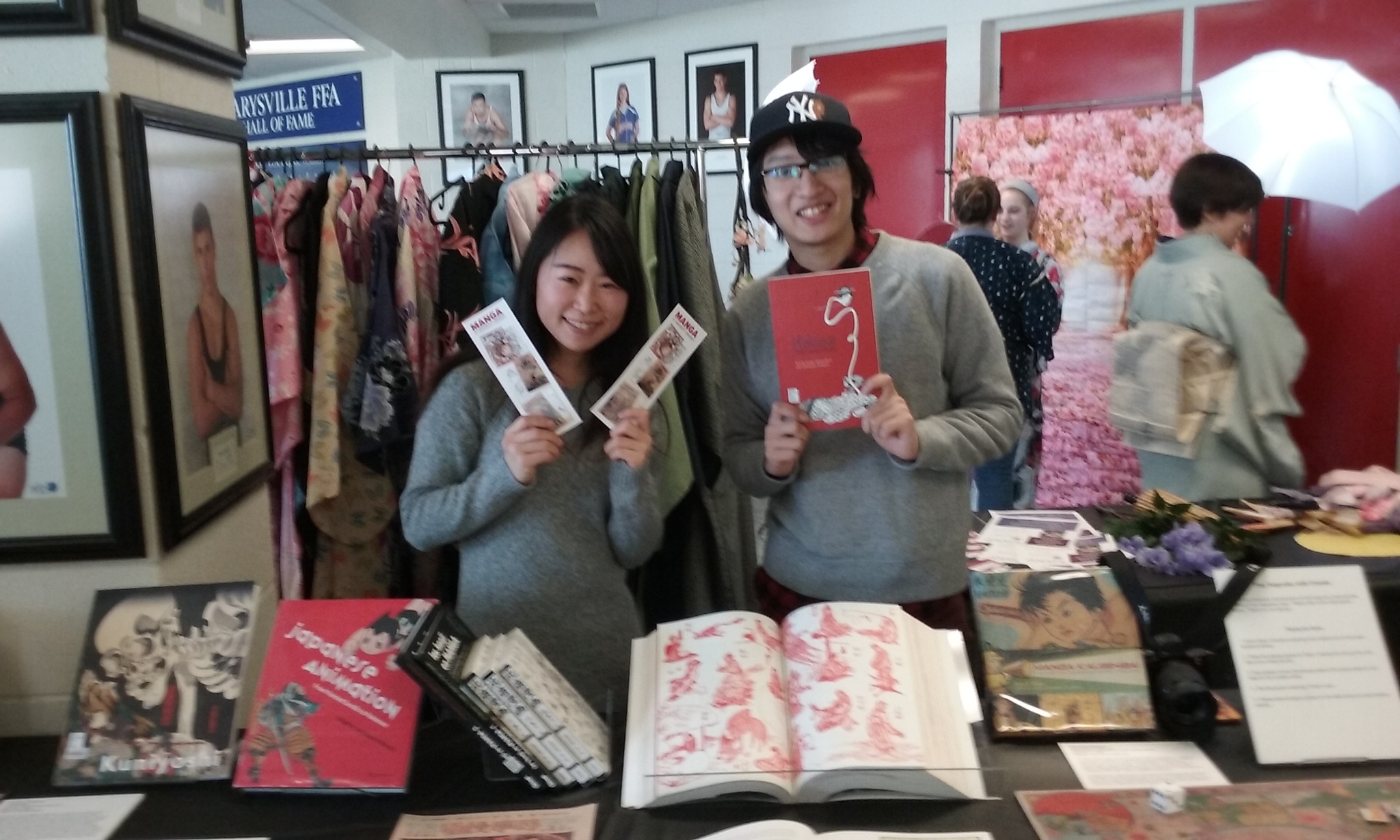
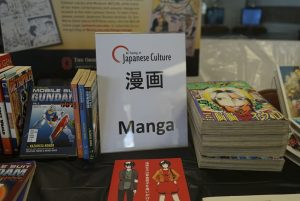
EAS at at OSUL participated in the event with our own stand (made up of two tables) dedicated entirely to Japanese manga. Visitors were encouraged to peruse pieces of OSUL’s manga collection, and library staff and students were on hand to talk about the collection and answer any questions.

One of our two tables featured distinctive and rare manga held by OSU, with an emphasis on the history and origins of manga.  Facsimiles of art by Hokusai and Kitazawa Rakuten were included in this display. Staff on hand offered background explanations and context to each piece.

Our second table focused on more contemporary manga. Reflecting the diversity of our collection, our display included every thing from manga on giant robots to high school romance, futuristic ninja, and post-apocalyptic wastelands. We were excited to see many students and other visitors have a seat at our tables to peruse the manga at their leisure.  

Spotlight Article: OSUL Collection of Tanikawa Shuntaro (谷川俊太郎)

One of the strengths of the Japanese Studies Collections at the Ohio State University Libraries is an extensive collection of  works and rare publications by world-acclaimed author TANIKAWA Shuntaro ( 谷川俊太郎). Tanikawa is Japan’s preeminent contemporary poet whose work has won over ten literary awards and can be found in Japanese textbooks across the nation. In addition to being a poet, he is also an acclaimed translator, picture book writer, and scriptwriter.

Much of Tanikawa’s work has already been translated and published in English, including his Floating the River in Melancholy, for which he won the American Book Award. His work in translating children’s literature, including Charles Shultz’s Peanuts comic strip, Mother Goose rhymes, and Swimmy by Leo Lionni,  garnered him a nomination for the Hans Christian Andersen award in 2008.  His worldwide stature and presence in literature has also made him a perennial contender for the Nobel Prize in Literature.

Shuntarō Tanikawa, 2015 by Círculo de traductores is licensed under CC0

Continue reading

What’s Cooking in the Collections

East Asian Studies at Ohio State University Libraries is happy to announce that our collection of Japanese food culture-related resources has grown with a new donation of Japanese recipe books! They cover everything from trendy new food creations to traditional home style cooking.

Continue reading

Introducing the Toyo Keizai Archives (東洋経済アーカイブズ)

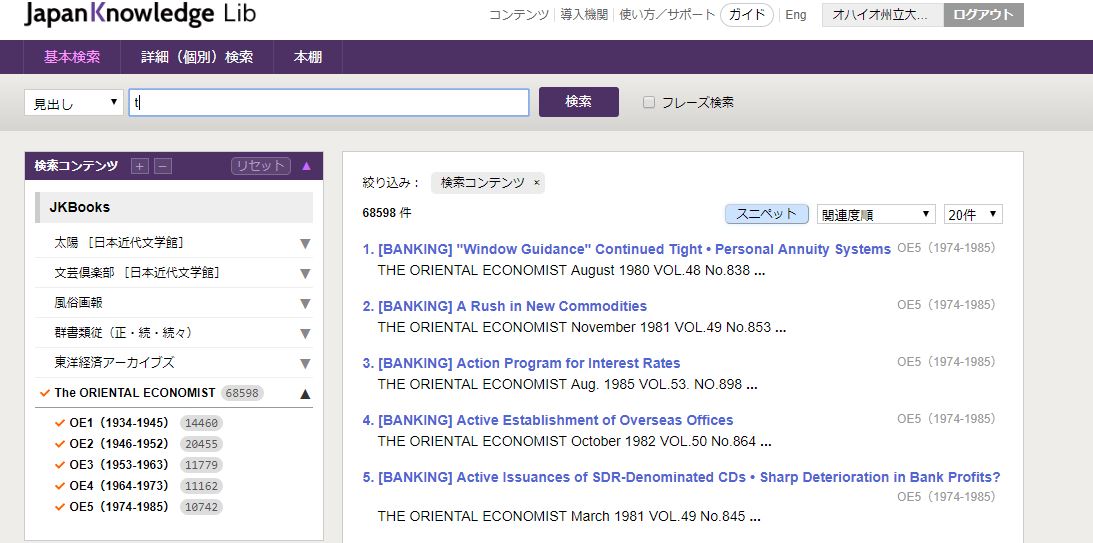
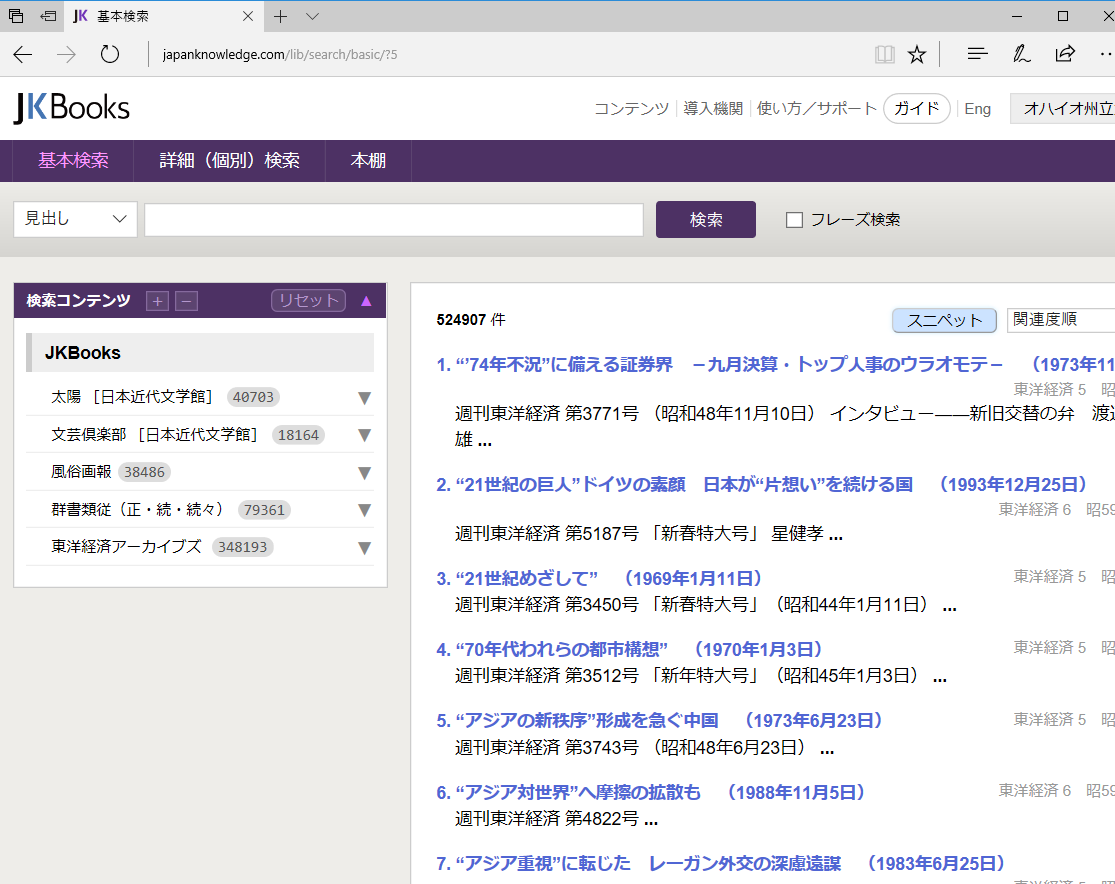
The suite of 5 databases offered through JKBooks at OSU appears in the left margin. The Toyo Keizai Archives is listed at the bottom.

Japanese Studies at OSU Libraries (OSUL) is delighted to announce that the Toyo Keizai Archives (東洋経済アーカイブズ) has been added to our suite of online offerings. It is an extraordinary database of one of Japan’s oldest economic magazines and one of the three leading business magazines in Japan, along with Nikkei Business (日経ビジネス) and Weekly DIAMOND (週刊ダイヤモンド). The full-text, searchable digital archives includes 120 years of publications, or 58,000 issues, from the inaugural issue of November 15th, Meiji 28 (1895) to Heisei 27 (2015).

Continue reading

Commemorating Asian Pacific American Heritage Month at Thompson Library: Book Display on “Global Asias”!

In honor of Asian Pacific American Heritage month, East Asian Studies at OSU Libraries recently opened a feature book display for the month of May. Focusing on the exchange of ideas, people, and culture between Asia, the Pacific Islands and broader global communities, the display’s theme “Global Asias” draws inspiration from recent scholarship on topics from across the Humanities and Social Sciences in Asian and Asian American Studies. Given the context of Asian Pacific American Heritage month, the display emphasizes Asian-American experiences in the United States. In addition, it showcases OSU’s extensive collections in Chinese, Japanese, and Korean Studies while highlighting recently published books on the Asian diaspora in the Pacific Rim. With books available for immediate circulation, the display is located near the stairwell in the east atrium of Thompson Library.

Continue reading

Focus on Japan in WWII: Kōa Shingun Ezu Iri (興亜進軍絵図入)

Interior of aerogram depicting Japanese battles in the Pacific

On February 14th, I wrote a blog introducing the Pearl Harbor Exhibit that was hung last winter in commemoration of the 75th anniversary of Pearl Harbor (December 7, 2016). In order to showcase the Japanese military perspective, the exhibit included a very special document, a fold-up aerogram that was made by the Japanese wartime government.  The present blog will feature that document, known as gunji yūbin (軍事郵便), or “military mail” in English.

Gunji Yūbin (軍事郵便)

Gunji yūbin was the military mail service that connected soldiers on the front lines to their families back in the metropole. It was established in 1894 (Meiji 27) during the Sino-Japanese War. Because the gunji yūbin was responsible for handling all letters going back and forth between the soldiers and their families, its extant pieces can be a treasure trove for researchers of war-time and Imperial Japan.

Continue reading

New to OSU Libraries: The Japan Times Digital Archive!

Japanese Studies at OSU Libraries is delighted to announce that The Japan Times Digital Archive is now available at The Ohio State University. It is an extraordinary archive of Japan’s oldest English language newspaper and only independent English-language newspaper in existence today.  The digital archive allows you to search the full text of all issues of The Japan Times published since its inauguration in March 1897 (Meiji 30) until 2014.

“The Japan Times Archives” search interface

Continue reading

Pearl Harbor Exhibit at Thompson Library of The Ohio State University

On December 7, 2016, the National Pearl Harbor Remembrance Day Commemoration was held at Kilo Pier, located in the Joint Base Pearl Harbor-Hickam. The 1941 Japanese attack on the US naval base Pearl Harbor was one of the defining events of the twentieth century. In that single moment, the U.S. was dragged out of its post-WWI isolationism and into a role of world leadership. The U.S. put away half a century of Mahan naval doctrine, with its emphasis on naval superiority, and moved into the age of naval air combat.

In commemoration of this historic event, Area Studies at Thompson Library created the Pearl Harbor Exhibit, which can be found on the 3rd floor at reading area Room 341. This exhibit fills two glass cases, each divided into several distinct sections.

Continue reading

Toyo Suyemoto

Professional woman sorting papers in an office.

Photograph of Toyo Suyemoto (Kawakami) Columbus, Ohio. Undated, circa 1974

On the occasion of Asian Pacific American Heritage month at OSU, Japanese Studies is pleased to announce the online publication of select materials from the Toyo Suyemoto (Kawakami) Collection.  Highlights of the digital exhibit include a rare oral interview, available in streaming video format, in which Suyemoto discusses memories of forced relocation and incarceration in U.S. internment camps during World War II. Images of diaries, personal photographs, notes and essays are also available in this online collection.
Continue reading

Herman J. Albrecht Library of Historical Architecture – Ginza Kaiwai (銀座界隈)

As Japan was recovering from World War II, Sōhachi Kimura (木村荘八), Yoshikazu Suzuki (鈴木芳一), and several others, set out to document the history and architecture of the Ginza district in Tokyo. The finished project, Ginza Kaiwai (銀座界隈), contains two separate volumes. The main volume has detailed text, illustrations, drawings, woodblock prints, and hand-drawn maps of the entire district. The supplement, Arubamu, Ginza Hatchō (アルバム・銀座八丁) by Suzuki, is a panoramic photo, folded in leporello style, documenting the length of the main boulevard Ginza-dori.  

Continue reading

« Older posts Newer posts »