The following is a list of NHK dramas offered through the Japanese Studies Collections. Brief plot synopses for each series are provided along with links to their pages in the library’s catalog. Continue reading
Category: Resources (page 4 of 4)
Learning the everyday mannerisms necessary to operate in a foreign society like Japan can seem overwhelming. However, taking the time to research some common social practices can go a long way in deepening your understanding. For those looking to visit Japan, or those just researching at home, OSUL has numerous resources available on Japanese culture and etiquette. There are also studies, such as 在日留学生に必要なソーシャル・スキル (Necessary Social Skills for International Students in Japan) by 田中 共子(Tomoko Tanaka), 高井 次郎(Jiro Takai) and 神山 貴弥 (Takaya Kohyama), that analyze and give suggestions on how to successfully cope with these social difficulties. Continue reading
Yurii Kyogoku was a Serials Cataloger at OSU Libraries until her retirement in 1982. Born on April 13, 1916 near Hiroshima, Japan, Yurii came with her family to the United States in 1919 and graduated from the University of California at Berkeley.
When she retired and moved to Virginia, Yurii donated 523 volumes of Japanese books to the Ohio State University Libraries. Most of them were acquired by her father in California during the 20s and 30s, providing a rare glimpse into Japanese-American history. Continue reading
OSUL contains several different resources which can serve as valuable insight into modern Japanese innovations and professions. Among these are the two documentary television series from 日本放送協会 (NHK) known as プロジェクトX (Project X) and プロフェッショナル (Professional). プロシェクトX delves into the historical backgrounds for major advancements in Japanese industry, science, technology, public affairs, and sports. プロフェッショナル focuses on the detailed analysis of different professions by shadowing those who work in them, providing a glimpse into their daily work and motivations.
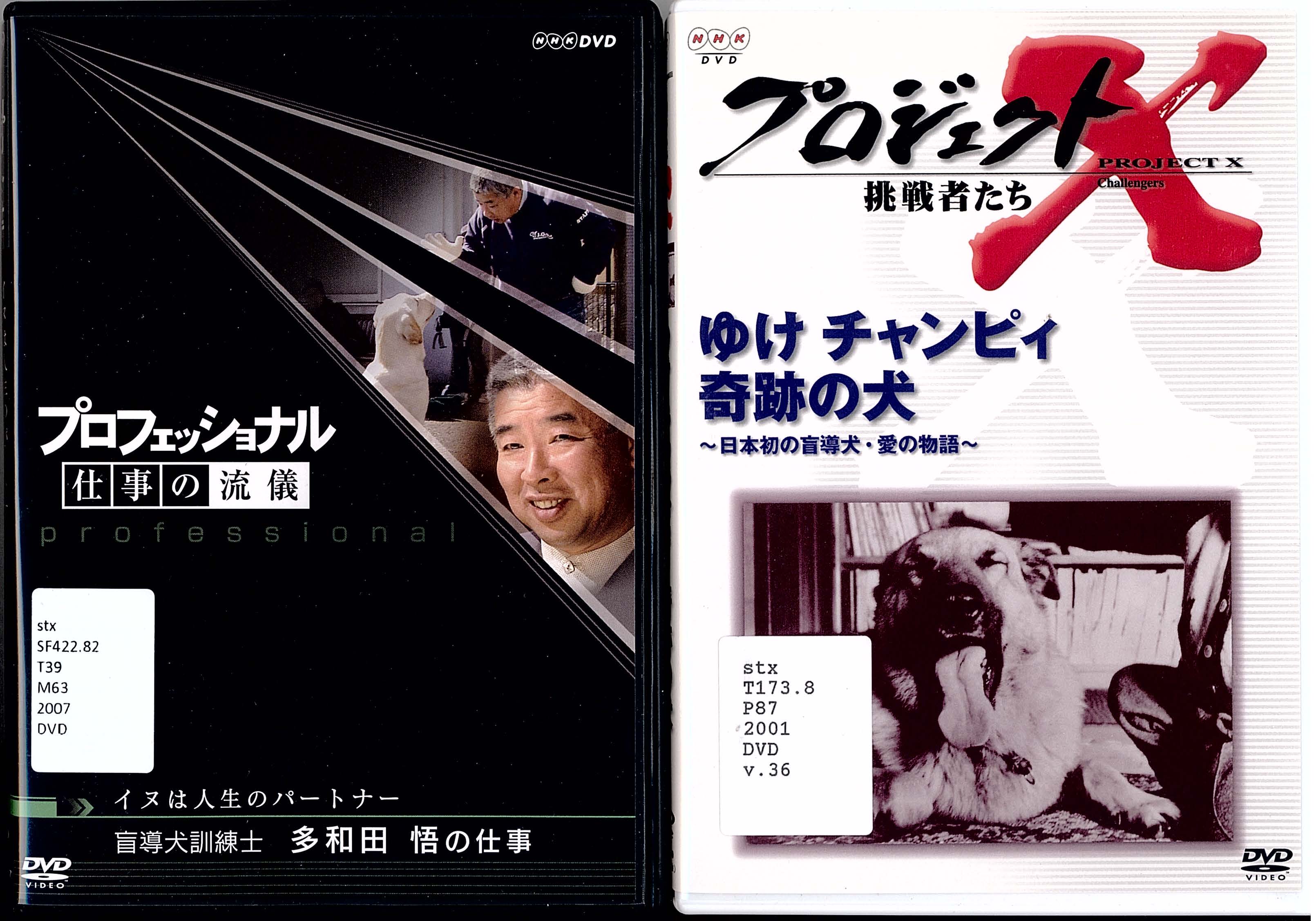
(Left): プロフェッショナル – 盲導犬訓練士多和田悟の仕事 (Right): プロジェクトX – ゆけチャンピイ奇跡の犬 日本初の盲導犬・愛の物語
- プロジェクトX (Project X) can be accessed through the library’s wiki here
- プロフェッショナル (Professional) titles in OSUL catalog are listed below:
Tokyo Metropolitan Library Guides:
- 日本の古典をさがすhttp://www.library.metro.tokyo.jp/reference/benri_series/tabid/371/Default.aspx
- 日本の詩歌をさがすhttp://www.library.metro.tokyo.jp/reference/benri_series/tabid/372/Default.aspx
Major Collectanea:
-
- NKBT 日本古典文学大系 PL753.N53 (Iwanami): + Titles cataloged individually
- SNKBT 新日本古典文学大系 PL753.S3 1980 (Iwanami ) + Titles cataloged individually
- NKBZ 日本古典文学全集 PL753 .N54 1973 (Shogakkan) + Titles cataloged individually
- SNKBZ 新編 日本古典文学全集 PL753 .S55 1994 (Shogakkan)– All 88 volumes now available through Japan Knowledge
- Koten bunko 古典文庫 Cataloged separately (different call numbers)
古典文庫総目錄 (1991): 2d FL Z3308.L5 Y67 1991
古典文庫総目錄 : 続 (2003): 2d FL Z3308.L5 Y67 2003
-
- Shinpen Kokka Taikan 新編国歌大観 (wiki entry, with information on how to use CD-ROM):
Hard copy: Thompson 2d FL: http://library.ohio-state.edu/record=b2136009~S7
CD-ROM in OSU Libraries: http://library.ohio-state.edu/record=b5755741~S7
(NOTE: There is a new DVD version: http://www.kadokawa.co.jp/sp/201211-06/ )
-
- Yōkyoku taikan 謡曲大観 PL765 .S34 (3 editions)
- Meijiki kankōbutsu shūsei (JMSTC). Dai 1-ki, Bungaku, bungo hen 明治期刊行物集成 (JMSTC). 第1期, 文学, 言語編 : PL755.6 .M39 Microfiche
guide: http://library.ohio-state.edu/record=b4428776~S7
Online Resources:
-
- Kindai Digital Library (National Diet Library): http://kindai.ndl.go.jp/
- National Institute of Japanese Literature: http://www.nijl.ac.jp/pages/database/
古典選集本文データベースhttp://base1.nijl.ac.jp/~anthologyfulltext/
- Nichibunken: http://db.nichibun.ac.jp/en/
- JAIRO: includes full text books
- Online Resources: Classical Japanese https://library.osu.edu/wiki/index.php?title=Online_resources:_Classical_Japanese
The Libraries’ subscription for access to Meiji-era issues of Taiyō (太陽), published by Hakubunkan (博文館) during 1895-1928, is now set up, with access available for Ohio State faculty, students and staff: http://library.ohio-state.edu/record=b7114669~S7

Taiyo 3:12 (June 1897) exhibited at Yamaguchi Prefectural Library
e-resour
Published by Hakubunkan during January 1895 to February 1928 in 34 volumes (531 issues; 175,000 pages), Taiyō (The Sun) was Japan’s first general interest popular magazine. Continue reading
The best way to find Japanese films in the Ohio State University Libraries’ collections is through the library’s catalog. I found 563 Japanese films! using the advanced search, limiting to Video Recording and Language = Japanese. The titles I found include TV shows and educational films in addition to movies.
Books on Japanese cinema in the library have the subject: Motion pictures — Japan
There are many databases on Japanese film, including these: Continue reading
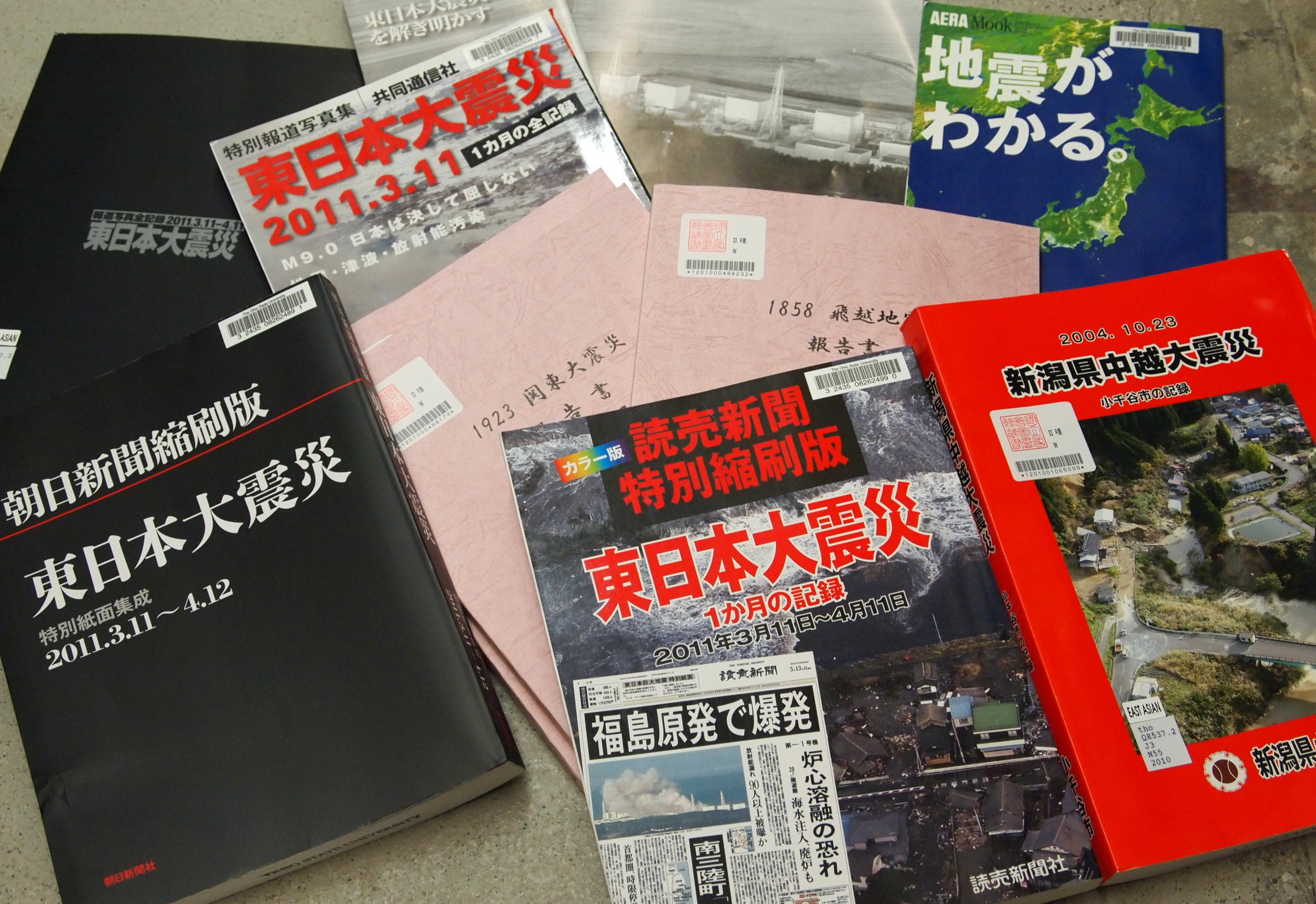
Last month the world observed the first anniversary of the devastating earthquake and tsunami on March 11, 2011. As time passes since the Great East Japan Earthquake (2011 Tōhoku earthquake and tsunami) some important and interesting records of this event are being added to the collection to support research. The National Diet Library has generously sent us some materials as part of their gift and exchange program, including in-depth studies of previous earthquakes and tsunamis in Japanese history. Recently I have also started to collect creative writings, such as poetry, fiction and literary essays, as well as personal accounts of those who survived. Continue reading
Mutsuyo and Jim Unger have been weeding research materials no longer needed. Prior to leaving for Japan on sabbatical, they donated these books and journals to the Ohio State University Libraries. Continue reading

© 2026 The Ohio State University - University Libraries
1858 Neil Avenue Mall, Columbus, OH 43210
Phone: (614) 292-OSUL (6785)
Request an alternate format of this page | Accessibility | Privacy Policy | Contact Us |