Within the depths of our libraries’ shelves, cases, and drawers lie hundreds of special materials you may have never have imagined were there! With so much to explore, today we’d like to bring your attention to our collection of woodblock prints and one of the many ways we enjoy sharing these materials with faculty and students.
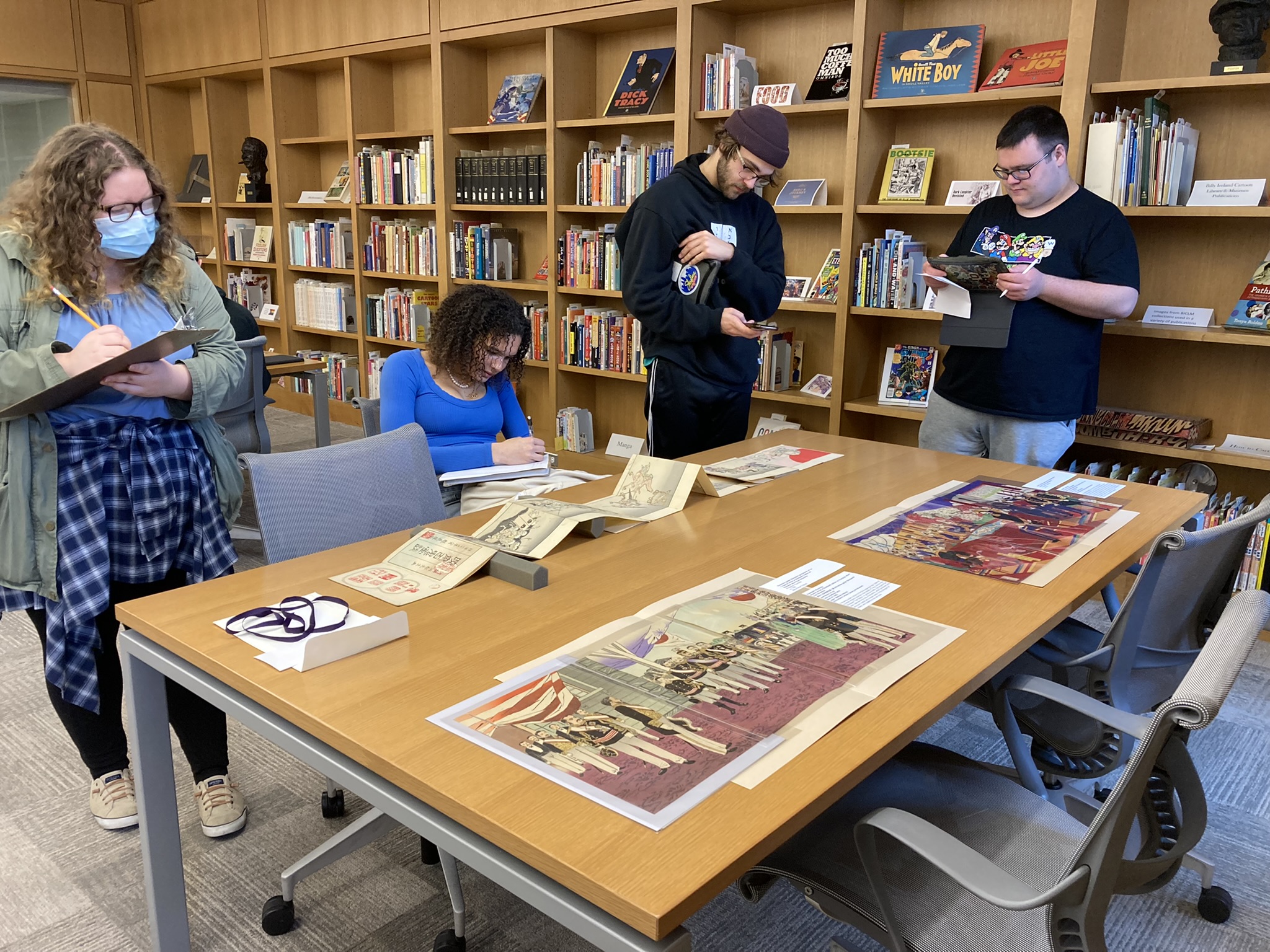
Students of HISTART 2003 observing original Meiji-era prints
by artists Kyōsai, Kiyochika, and Toshinobu
As our reading rooms opened up again last year, we were thrilled to hold several open houses, featuring our manga collection as well as substantial holdings of woodblock prints (many of which are considered precursors to contemporary manga). Held across the University Libraries in the Theatre Research Institute, the Rare Books and Manuscripts Library, and the Billy Ireland and Cartoon Library, these historic prints were gathered and displayed together in the reading room of the Billy Ireland for students in Artistic Media and Techniques (HISTART 4005) last October and again for those in Art & Visual Culture of East Asia (HISTART 2003) in December and April.
Led by Dr. Christina Burke Mathison of the Department of History of Art, these hands-on classes gave students the opportunity to observe the various details and still-vibrant colors of original woodblock prints ranging from the mid-1800s to the 1920s. Highlights included the elaborate Gyōsai Hyakki Gadan (曉齋百鬼画談), a color woodblock print by the eccentric painter Kawanabe Kyōsai (河鍋 暁斎, 1831-1889) and Gyōsai Gadan (暁齋畫談), an illustrated guide on art created by Kyōsai and Batei Kinga (梅亭金鵞, 1821-1893). Also in the showcase was Nōgaku Zue (能樂圖繪) by Tsukioka Kōgyo (月岡, 耕漁, 1869-1927), a four-volume set of cloth-bound accordion books with canonical scenes from various Noh (nōgaku) theater classics.

Students discuss the vibrant images of Japanese Noh (nōgaku)
theatre in Nōgaku Zue produced by Tsukioka Kōgyo ca. 1906
In addition to over two dozen original woodblock prints, these open houses showcased a fascinating book from the Fine Arts Library, Ukiyo Junjozuri, about the history and technique of woodblock prints. Focusing on one single view, or print, from Andō Hiroshige’s One hundred famous views of Edo, the book contains successive re-printings of “Yabu Lane at the Foot of Atago” (Atagoshita yabukōji) on one continuous strip of paper folded in accordion style. Each re-printing on each page of the book shows only one color block on the left, facing a complementary print with the black outlines and all color blocks up to that point on the right. The last page reveals a complete color print, showing the painstaking technique behind the delicate woodblock printing technology.
Complimenting this class further, this past spring we were delighted to include a newly acquired piece entitled “Sparrow in a Pine Grove” (“Suzume no Matsubara”). The artifact is a rare survival of a woodblock employed in the printing of a Japanese illustrated travel book (title unknown) from the late Edo period (1600-1868).
We look forward to sharing such materials with future classes and visitors to our special collections. For scholars and instructors interested in viewing these materials, please do not hesitate to contact us!
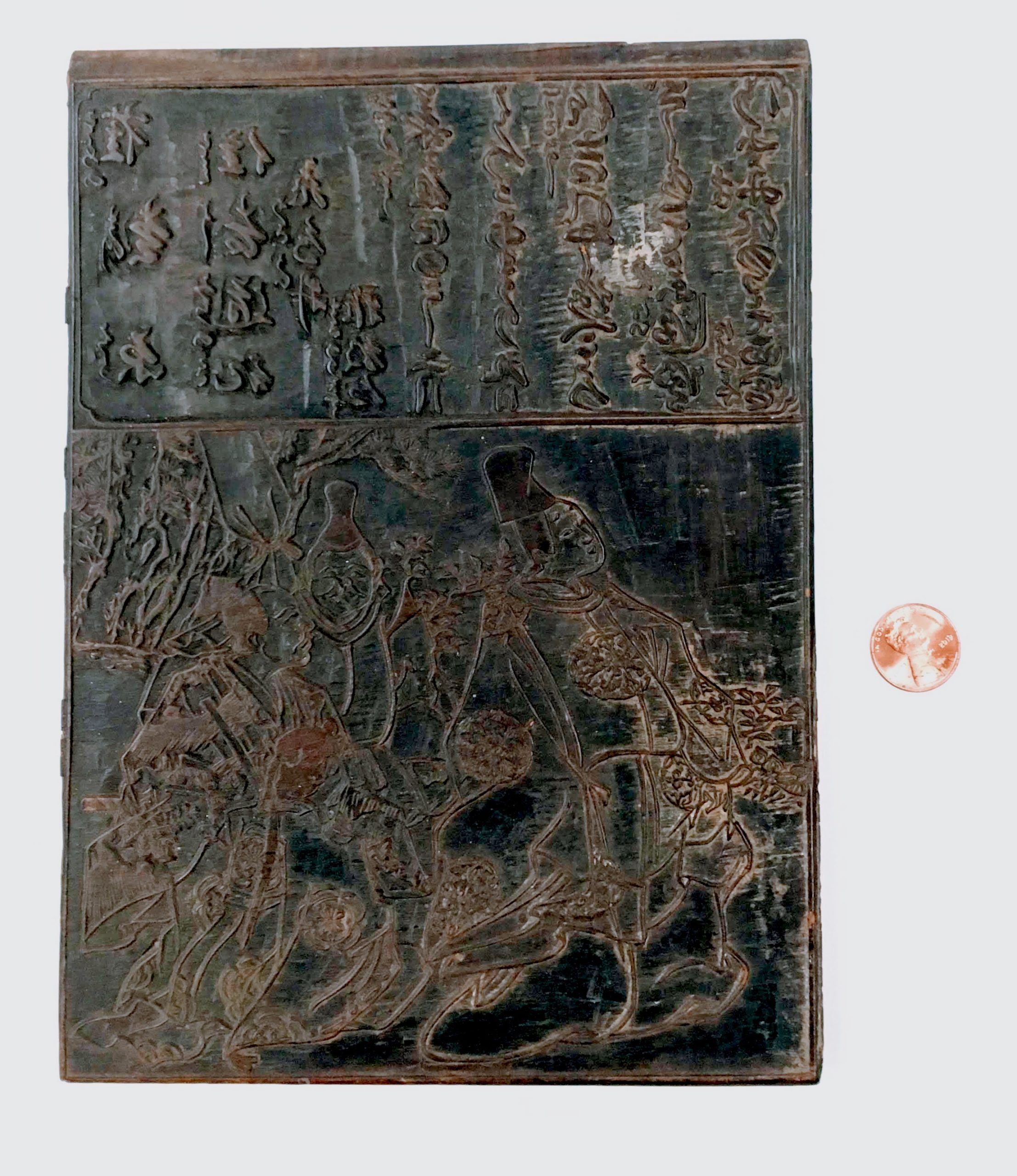
“Suzume no Matsubara” (“Sparrow in a Pine Grove”) Woodblock
Used to Print a Japanese Illustrated Travel Book, circa 1800s-1868
To learn more about some of the pieces mentioned above, check out these blogs:
Night Parade of One Hundred Demons: Kyōsai’s Hyakki Gadan Now at BICLM by Nick Castle (University Libraries Blog, 2019)
“Nogaku zue” in Tsukioka Kōgyo, 月岡耕漁: The Art of Noh, 1869-1927 by the University of Pittsburgh Library Systems.
Read more about woodblock printing with materials from our collections:
Evolving Techniques in Japanese Woodblock Prints by Gaston Petit and Amadio Arboleda (Kodansha International, 1977).
The Hotei Encyclopedia of Japanese Woodblock Prints edited by Amy Reigle Newland (Hotei Publishing, 2005).
Japanese Woodblock Printing by Rebecca Salter (University of Hawai’i Press, 2002).
Japanese Woodblock Prints: Their Techniques and Appreciation translated by Charles A. Pomeroy (Toto Shuppan Co,, 1963).
Japanese Woodblock Print Workshop: A Modern Guide to the Ancient Art of Mokuhanga by April Vollmer (Watson-Guptill, 2015).
Ukiyoe junjozuri: Mokuhanzuri no Rekishi to Gihō by Hiroshige Ando (Takamizawa Mokuhansha, 2001).