Author: Jayden Mitchell

Beyond Jiji Manga: A New Digital Anthology of 20th-Century Manga

Guest post by Jayden Mitchell

For those of you who have followed our Jiji Manga Wiki, you may remember that we hold a nearly complete collection of the Jiji Shinpō manga supplement, Jiji Manga, published from 1921 to 1931. After the publication of the final issue, Jiji Manga was renamed Manga to yomimono (漫画と読物, Manga and Readings), and beginning with Issue 537, it also appeared under the title Manga to shashin (漫画と寫眞, Manga and Pictures). Under these new titles, the supplement continued publication for just over another year, from July 1931 until October 1932.

Screenshot of a Japanese-language webpage for a digital manga anthology

The new digital anthology makes rare manga by artists associated with Jiji Manga available for online exploration

We are pleased to announce that Ohio State has gained access to a newly digitized anthology of these later issues, providing online access to Issues 505–572 of Manga to yomimono and Manga to shashin. Complete transcriptions of section titles make the collection fully searchable, while high-resolution digital scans allow researchers to examine each issue in remarkable detail.

Together with our print collection of Jiji Manga and its accompanying Wiki, researchers now have access to nearly the entire run of the publication and its successor titles. This expanded access opens new opportunities for research on Taishō- and early Shōwa-period Japan, including popular culture, politics, publishing history, and the early development of modern manga.

Links

Links to the database:

  1. Issues 505-521
  2. Issues 522-546
  3. Issues 547-564
  4. Issues 565-572

For more information about this resource, please contact Japanese Studies Librarian Dr. Ann Marie Davis at davis.5257@osu.edu.  Additionally, to learn more about the Jiji Manga Wiki and how to use it, please see our earlier blog post introducing the collection and demonstrating its search features.
Updates to Yurii Kyogoku Collection

Guest post by Jayden Mitchell

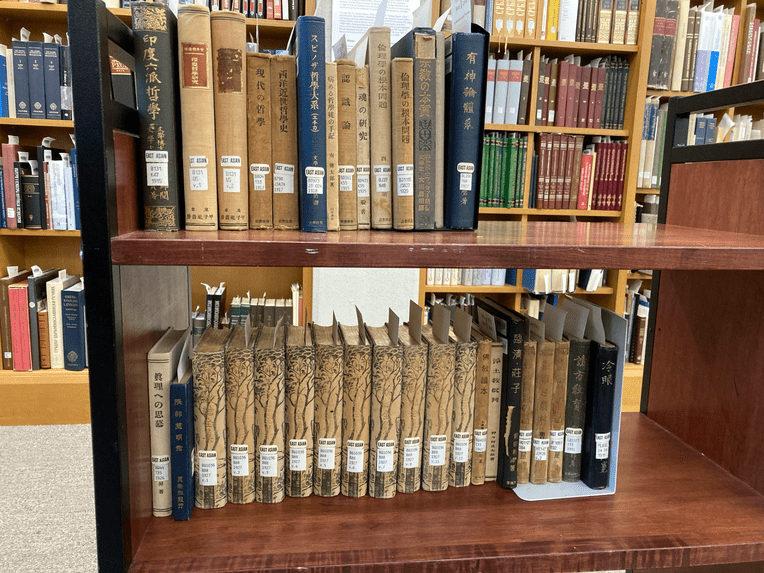
A rolling shelf with two rows of books written in Japanese, spines facing the camera

A sampling of some of our materials from this collection

Long-time readers of our blog may remember a post we published in 2015 about the Yurii Kyogoku Collection, a donation of more than 500 Japanese books that once formed part of the library at the Topaz Relocation Center in Utah. Topaz was one of ten camps where more than 120,000 Japanese Americans and Japanese immigrants were forcibly removed from their homes and incarcerated during World War II, making the surviving books important witnesses to a difficult chapter in American history.

The collection was donated to Ohio State by Yurii Kyogoku, who later worked as a Japanese cataloger at Ohio State University Libraries for many years. In our earlier blog post, we shared a list of approximately 60 titles from the donation—a substantial sample, but only a fraction of the collection as a whole.

Prompted by renewed interest in the collection, we recently collaborated with Collections Analyst Karen Ferris to compile a comprehensive inventory. The resulting bibliography identifies 497 volumes and provides the most complete record of the collection assembled to date.

Interestingly, the vast majority of the books—470 volumes—were published before 1945 and are believed to have originated from the personal library of Itsuzō Kyōgoku (1887– ), a Buddhist clergyman who immigrated to the United States in 1919. During his incarceration at the Topaz Relocation Center, Kyōgoku served on the camp’s Adult Education Committee and became the largest contributor to the camp’s Japanese-language library by bringing much of his own collection into the camp. After the war, the books were returned to him, although many had deteriorated beyond repair. The remaining 27 volumes in the donation were published after 1945 and are therefore more likely to have belonged to his daughter, Yurii Kyōgoku, who later served as a Japanese cataloger at Ohio State University Libraries before donating the collection.

The collection is especially strong in Buddhism, philosophy, religion, language, and Japanese culture, while also encompassing a wide range of literary and historical works. Researchers interested in exploring the collection can browse the complete inventory of the 497 volumes.

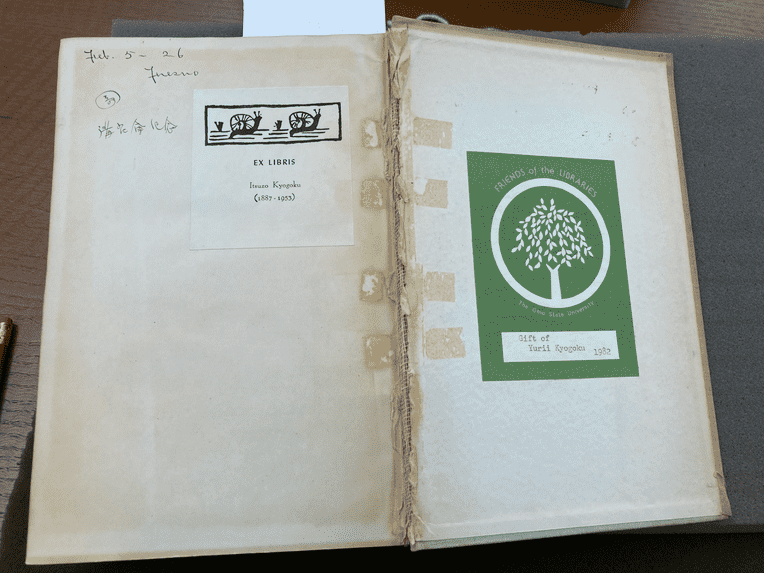
The inside of a book cover and the first page

Some items from the collection include bookplates such as these.

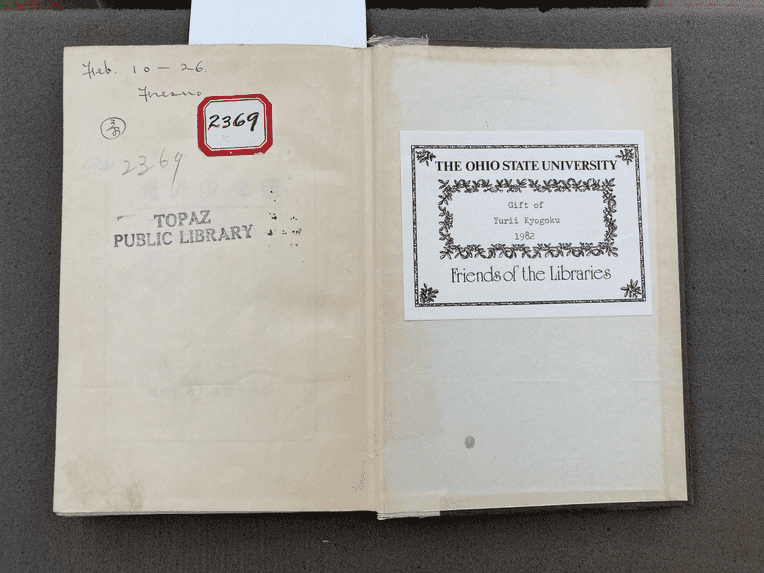
The inside of a book cover and the first page

Notice the “Topaz Public Library” stamp on the endpaper here.

Diaries and Documents of Premodern Japan: Shiryō Sanshū

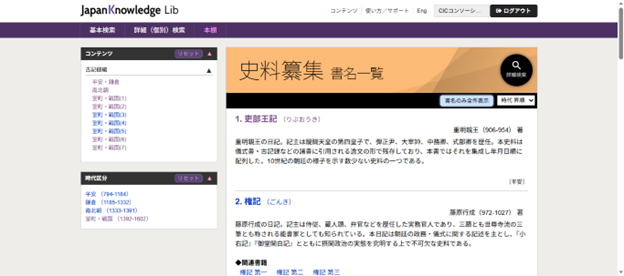
Front page of a website

Homepage of the JapanKnowledge collection of the Shiryo Sanshu.

As part of our ongoing effort to strengthen access to premodern Japanese historical sources, we announced earlier this fall the addition of the complete digital transcription of Heian Ibun (平安遺文). Building on that momentum, we are pleased to now offer access to the first unit of Shiryō Sanshū, newly available through the JapanKnowledge platform.

This initial release includes documents and diaries dating from the Heian, Kamakura, and Nanboku-chō periods, offering valuable insight into Japan’s premodern past. The collection features writings by prominent historical figures, including Prince Shigeakira (4th son of Emperor Daigo, 重明親王), Emperor Hanazono (花園天皇), Fujiwara no Teika (藤原定家), and Nakahara Momori (中原師守), among others. These diaries and journals allow researchers to explore the daily lives, thoughts, and concerns of court nobles and members of the imperial family.

The Shiryō Sanshū is a highly respected compilation of ancient diaries and documents, published by Yagi Shoten (八木書店), a Tokyo-based publishing house, between 1968 and 2020. The series encompasses more than 260 documents spanning from the Heian period through the Edo period. Each volume has been meticulously digitized, presenting both the original script and modern Japanese transcriptions. This dual-format approach enables full-text searching using both historical and modern character forms.

Continue reading

Expanding Premodern Japanese Sources: Heian Ibun Now Available

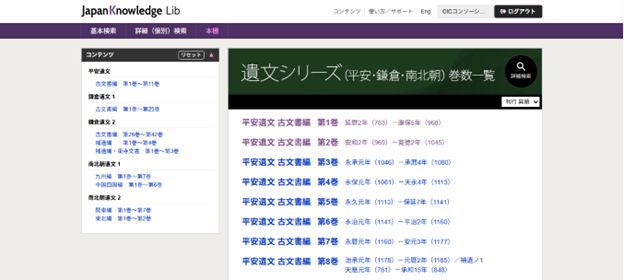
A website featuring a variety of Japanese texts, listed in chronological order.

Front page of the Heian Ibun collection, which is included in the “Ibun Series” (遺文シリーズ) archive on JKBooks.

We are pleased to announce another significant addition to our growing collection of accessible archives and databases: the complete digital transcription of Heian Ibun (平安遺文), one of the largest and most comprehensive collections of Heian-period (794–1185) historical documents in the world. This digitization greatly expands research possibilities by providing full-text, searchable transcriptions of all included materials.

Heian Ibun was compiled by historian Dr. Rizō Takeuchi (竹内理三博士), who began assembling the collection in 1947. Over the course of approximately twenty years, he brought together more than 5,500 documents, publishing them across 11 volumes arranged largely in chronological order and spanning the entirety of the Heian period. In 1974, Dr. Takeuchi returned to the project to revise and reorganize the volumes into a new format.

These revised editions were later digitized and further updated by historians at the University of Tokyo, who have continued to make corrections and enhancements since 1996. The most up-to-date versions of these texts are now available digitally through the JKBooks platform on JapanKnowledge.

Continue reading

Kabuki’s Modern History, as Told by Postcards


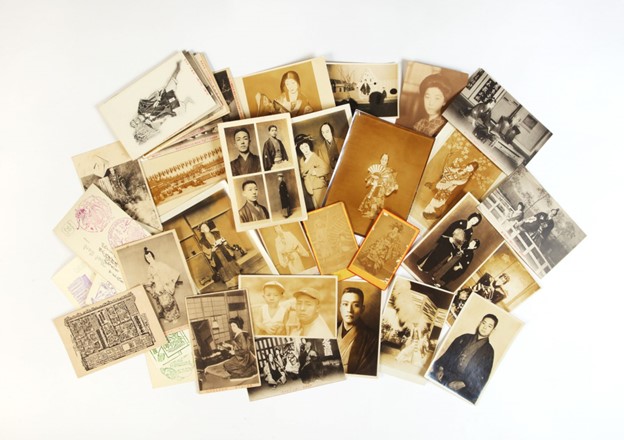
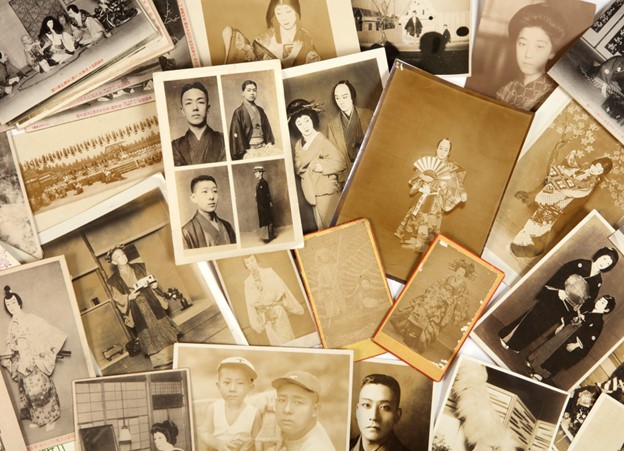
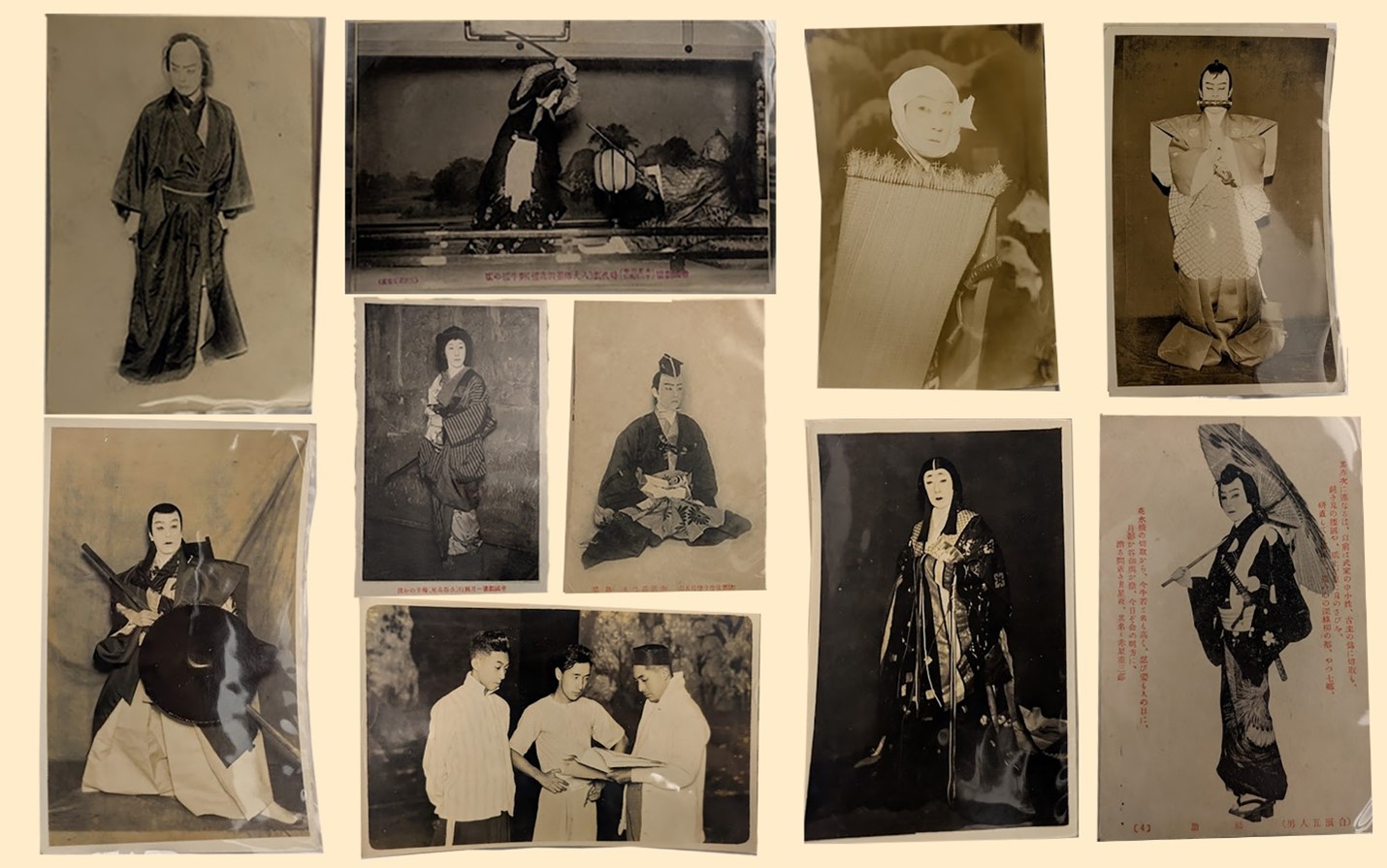
Today I would like to highlight one of our library collections that was featured in our recent atrium exhibit: an impressive set of 20th-century kabuki actor postcards. Featuring photographs of kabuki actors and plays—both onstage and behind the scenes—this collection contains over 2,500 postcards and is the largest we are aware of outside Japan. The contents date from the early Taishō period (1912–1926) to the 1980s and are in excellent condition overall, although some earlier cards show minor signs of wear or fading.

Portrait postcards like these became increasingly popular in Japan at the turn of the 20th century, when advancements in photography allowed printed cards to be produced at ever-faster rates. This meant that mass-produced images became prime collectibles for fans who visited kabuki theaters and other cultural sites. Soon, they surpassed the popularity of ukiyo-e woodblock prints, which had dominated the 19th century as one of the most sought-after Japanese collectibles of the era.

Continue reading