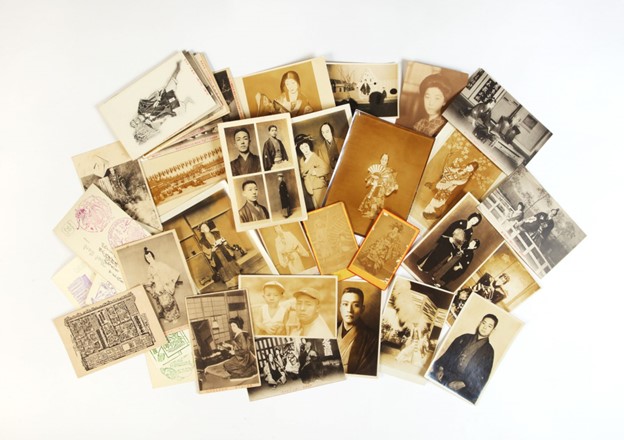
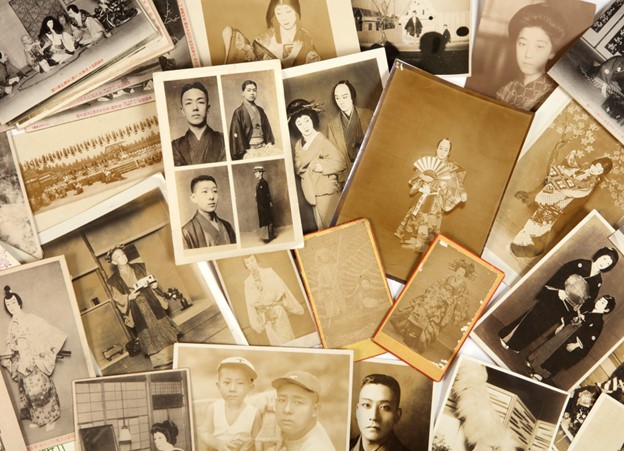
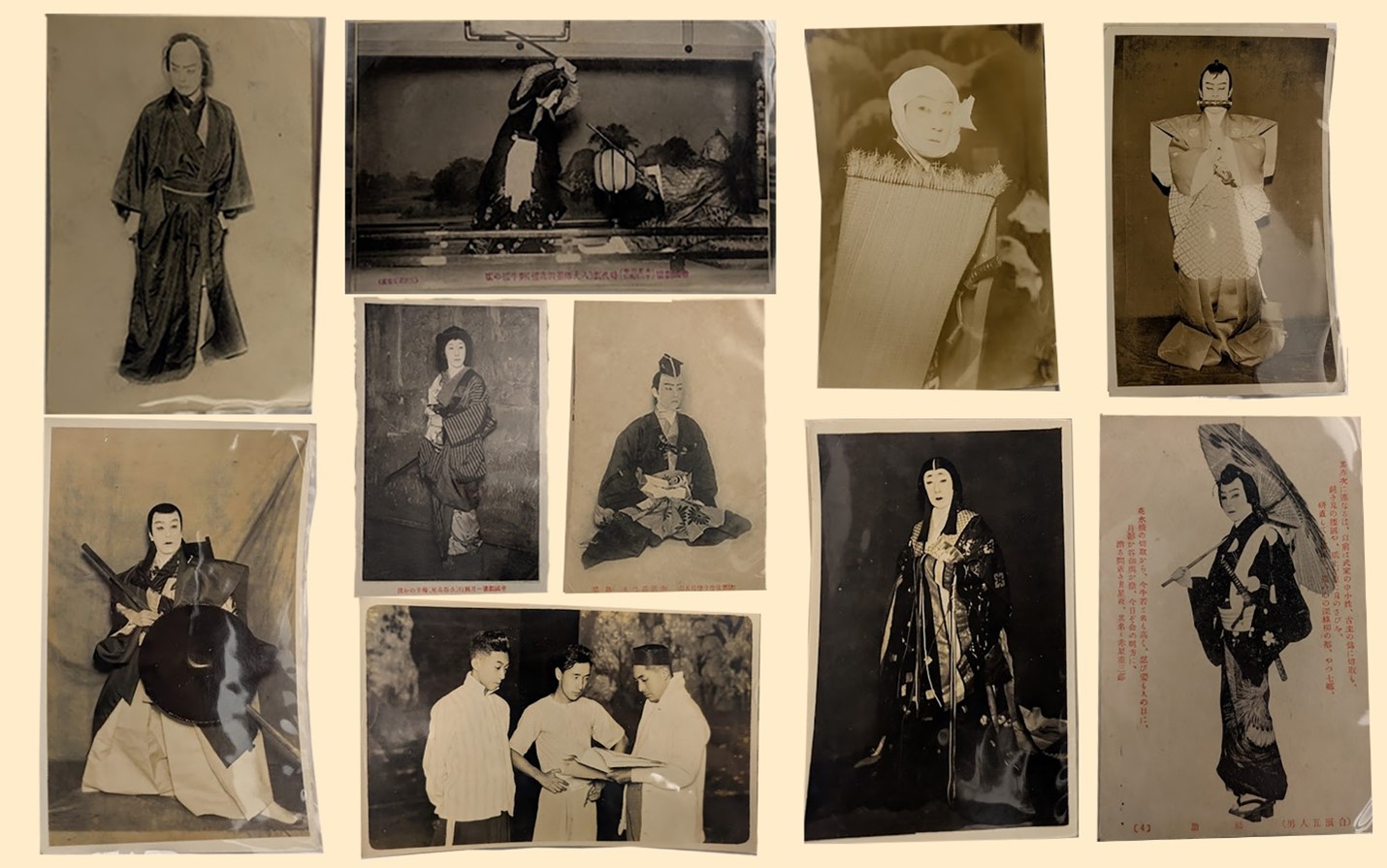
Today I would like to highlight one of our library collections that was featured in our recent atrium exhibit: an impressive set of 20th-century kabuki actor postcards. Featuring photographs of kabuki actors and plays—both onstage and behind the scenes—this collection contains over 2,500 postcards and is the largest we are aware of outside Japan. The contents date from the early Taishō period (1912–1926) to the 1980s and are in excellent condition overall, although some earlier cards show minor signs of wear or fading.
Portrait postcards like these became increasingly popular in Japan at the turn of the 20th century, when advancements in photography allowed printed cards to be produced at ever-faster rates. This meant that mass-produced images became prime collectibles for fans who visited kabuki theaters and other cultural sites. Soon, they surpassed the popularity of ukiyo-e woodblock prints, which had dominated the 19th century as one of the most sought-after Japanese collectibles of the era.
By the early 20th century, fans began collecting images of their favorite Japanese actors, theaters, and plays to show their dedication to the art or to memorialize their experiences. Presumably, the postcards also found success overseas through foreign tourists who purchased these mementos of the places they visited. Given the inclusion of English terms such as “postcard” alongside the Japanese word hagaki (葉書), the cards may have been intended for an international audience. Some were even printed entirely in English, without any Japanese text whatsoever.
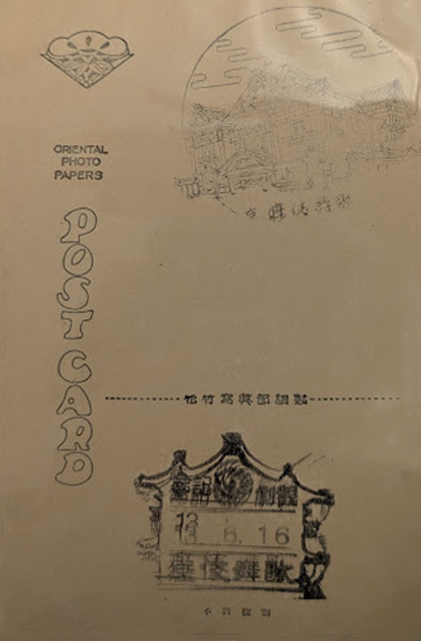
The back side of one of our postcards, made by Oriental Photo Papers. Note the English “Postcard” and the two kabuki theater stamps.
In addition to documenting tourism and fan culture, this postcard collection provides an excellent visual record of the evolution of kabuki theater throughout the 20th century. Popular stage sets, costumes, and acting styles are well chronicled across the collection. In the early Taishō period, fascinating efforts to modernize kabuki theater in the wake of the Meiji Restoration were still underway. Many actors traveled abroad to study Western acting styles, which led to the development of new techniques upon their return to Japan. With the onset of the Second Sino-Japanese War and World War II, kabuki continued to evolve and nearly faced extinction following Japan’s surrender and post-war occupation. Many theaters were destroyed in wartime air raids, and many actors lost their lives. According to the Japan Arts Council, the trauma of war—coupled with the banning of many popular kabuki plays during the Allied Occupation—nearly killed the art form.
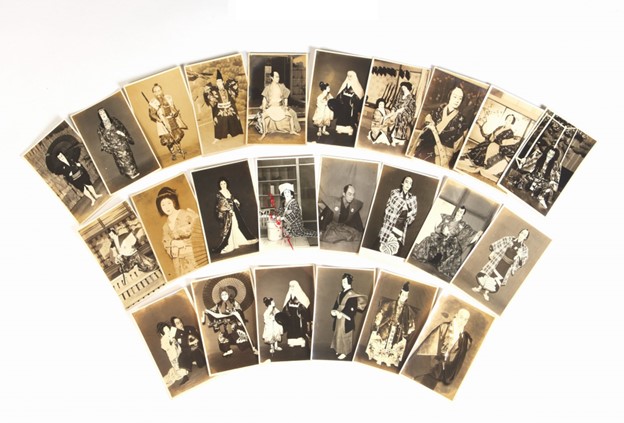
A small handful of our kabuki postcards, our collection contains over 2,500 cards and photographs in total, making it one of the largest in the world outside of Japan. (Photo Credits: Jonathan A. Hill, Booksellers)
Despite these challenges, kabuki experienced a resurgence in the 1950s and ’60s and continued to evolve into the 1980s and beyond. We invite you to view this collection to gain valuable insights into an ever-changing art form that is still cherished and valued today. To view this collection, please contact Japanese Studies Librarian, Ann Marie Davis, at davis.5257@osu.edu or Jerome Lawrence and Robert E. Lee Theatre Research Institute Curator Beth Kattelman, at kattelman.1@osu.edu. A descriptive finding aid can be found at https://library.osu.edu/collections/spec.tri.0071/inventory.
Further Reading
Kabuki Theater
- Kabuki: Backstage, Onstage: An Actor’s Life by Matazo Nakamura (Kodansha Itl, 1990)
- Japan’s Modern Theatre: A Century of Change and Continuity by Brian Powell (Japan Library, 2002)
- History and Characteristics of Kabuki: The Japanese Classical Drama by Shoyo Tsubouchi and Jiro Yamamoto (Heiji Yamagata, 1960)
- The Stars Who Created Kabuki: Their Lives, Loves, and Legacy by Laurence R. Kominz (Kodansha Itl, 1997)
Postcards/Ehagaki/Buromaido
- New Collection of over 600 Picture Postcards of the Great Kantō Earthquake (1923) by Alexis Parker (OSU Libraries, 2019)
- Postcards in Japan: A Historical Sociology of a Forgotten Culture by Kenji Sato (Journal of Japanese Sociology, 2003)
- Souvenir Photography in Japan: Between Stereotype and Art by Renate Noda (Itl Journal for History, Culture and Modernity, 2023)