Guest post by Jayden Mitchell

The Thompson Library exhibit ‘Mobility, Collecting and Diaspora’, a collection of East Asian objects related to performing arts, open until July 20, 2025.
We are proud to be part of the ongoing exhibition “Mobility, Collecting, and Diaspora: Preserving and Teaching East Asian History,” which brings together remarkable artifacts from Japanese, Chinese, Korean, and Indonesian performance and fine arts. Located in the Thompson Library Special Collections Display Atrium, this exhibit represents an unprecedented collaboration between the Bliss M. and Mildred A. Wiant Collection of Chinese Art, and Chinese and Japanese collections from the Lawrence and Lee Theatre Research Institute, the Rare Books and Manuscripts Library, and the Herman J. Albrecht Library of Historical Architecture.
In previous blog posts, we highlighted some featured items, including the Pop-Up Teahouses by Nobutatsu Tansai (覃斎信立) and a striking Edo-period wooden printing block of the kabuki actor Matsumoto Koshiro (松本幸四郎). Another standout piece is a triptych titled “Imayo Mitate Shi-No-Ko-sho: Shokunin” (今様見立士農工商), or “A Modern-Day Adaptation of the Four Classes: Artisans,” by Utagawa Kunisada (歌川 国貞), an 1858 print portraying seven female artisans creating woodblock prints — a vivid portrayal of women working in what was traditionally a male-dominated craft.
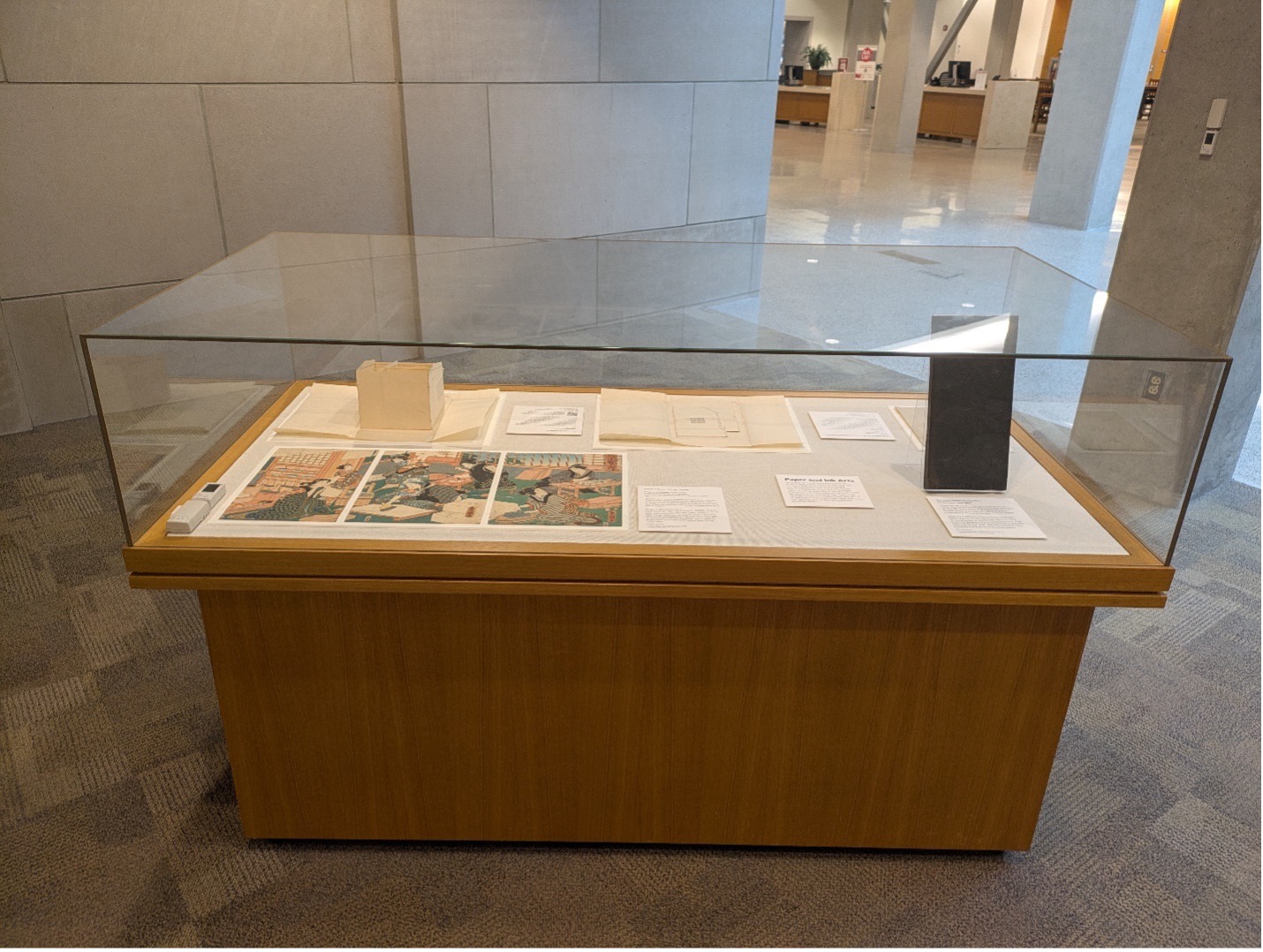
Display case containing a triptych print, wooden printing block, and paper architectural diagrams.
Within the exhibit, one of the displays focuses on artifacts from traditional Japanese theater, including noh, kabuki, and kyogen. Among these are two rare volumes from the Nogaku zue (能樂圖繪), a multi-volume collection of illustrations of noh and kyogen plays by Kogyo Tsukioka (月岡 耕漁), encompassing 261 woodblock prints of performances and backstage scenes. According to an extensive digital exhibit on this title from the University of Pittsburgh, only five other repositories in North America hold a complete set, and the University Libraries is one of them! Visitors to the current exhibit will see four colorful prints from this title, which was produced around 1906 in concertina format (orihon).
Another exciting treasure on display is the Bugaku Emaki (舞楽絵巻), or Illustrated Scrolls of Imperial Court Dancing, an original Edo-period handscroll depicting traditional Japanese bugaku dance, a form introduced to Japan from China during the Heian period. Featured as the banner image on the exhibit web page, the scroll is opened to the first sequence of the bugaku performance known as enbu (振鉾) and shows musicians playing traditional wind and percussion instruments.
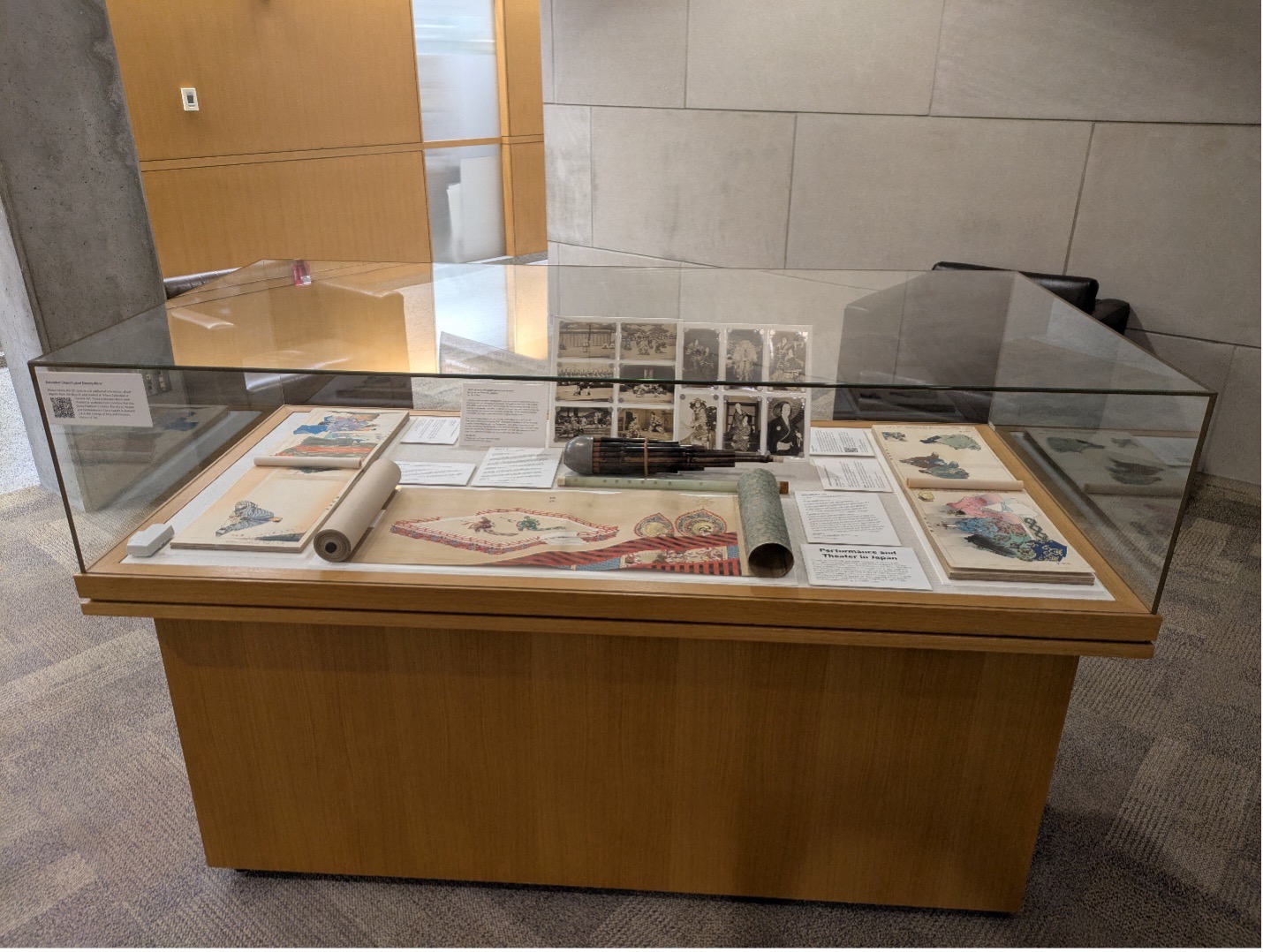
Display case Japanese performance, containing two volumes of the Nogaku zue, Kabuki photo postcards, and bugaku scroll.
Rounding out the exhibit are twelve postcards from our Kabuki Actors Postcard Collection, which, like the Bugaku Emaki, forms part of the Japanese Theatre Collection, and contains around 2500 cards depicting kabuki scenes from the 1910s through the 1950s. These postcards surged in popularity with the rise of silver bromide printing technology, known in Japan as bromide (buromaido, ブロマイド), which eventually became a generic term for glossy celebrity photographs. Our collection includes both bromide prints and ehagaki (絵葉書), or picture postcards, and, to our knowledge, is one of the largest such collections outside Japan.
We warmly invite you to visit the exhibit, which will be on display until July 20, 2025. Material selections and object descriptions from the Bliss M. and Mildred A. Wiant Collection of Chinese Art were made possible through The Art of Modern and Contemporary China course, taught by Christina Wei-Szu Burke Mathison in Autumn ’24 in the College of Arts and Sciences, History of Art, with special assistance from Jason Wang. Special Collections from the University Libraries were curated by Chinese Studies Librarian Guoqing Li and Japanese Studies Librarian Ann Marie Davis, with contributions from Student Research Assistant George Penney.
Special thanks to the Wexner Center for the Arts.
Further Reading
- “Kōgyo: The Art of Noh 1869-1927” (U of Pittsburgh, 2021)
- The Beauty of Silence: Japanese Nō & Nature Prints by Tsukioka Kōgyo, 1869-1927 by Robert Schaap and J. Thomas Rimer (Hotei Publishing, 2010)
- “Postcards in Japan: A Historical Sociology of a Forgotten Culture” by Kenji Sato (Japanese Journal of Sociology, 2003)
- Art of the Japanese Postcard: The Leonard A. Lauder Collection at the Museum of Fine Arts, Boston by Anne Nishimura Morse, J. Thomas Rimer and Kendall H. Brown (MFA Publications, 2004)
- Bugaku: Japanese Court Dance: With the Notation of Basic Movement and of Nasori by Carl Wolz (Asian Music Publications, 1971)
- “Kunisada and the Last Flowering of Ukiyo-e Prints” by Ellis Tinios (Print Quarterly, 1991)
- Bugaku zukan (舞楽図鑑) (Mie Prefectural Museum, 2013)