From Woody's Couch

Our Playbook on OSU History

Category: Uncategorized (page 4 of 10)

Frozen Fridays: ‘X’ is for Xenophile!

This blog post is part of the Frozen Friday Series, an A-Z journey of the Polar Archives.  Each week, we will feature some aspect of the history of polar exploration with a blog post written by our student authors.

In 1925, having returned from his inaugural journey to the Arctic and now dreaming of his flight over the North Pole, Commander Richard Byrd began a lecture tour across America, armed with pictures and films of the Arctic. While on tour, Byrd discovered how bad his public speaking skills and his films were. Still, people poured into his lectures anyway, burning to see the “dim, flickering films of the Far North.”[i]  Byrd had uncovered a nation of xenophiles.[ii]

A xenophile is someone who is attracted to foreign things, places or people. By the very nature of their work, explorers tend to be xenophiles, willing to risk their lives for such attraction. At the beginning of the 20th century, however, the broader public caught the bug and began craving the strange, the daring, and the exotic.  Byrd was far from the only man to capitalize on this fascination—in fact, he came late to the game. Newspapers had been catering to this desire for years, using any news, discoveries or controversies to sell papers and make money. By the time Byrd embarked on his lecture tours, the tie between newspapers and polar exploration was so strong that media outlets paid explorers in advance for exclusive rights to future exploits. Success and the resulting public venerations allowed many explorers to pay off debts or fund their next adventure.

Many of the stories, diaries and images that so enthralled the public are now held by the Byrd Polar and Climate Research Center Archival Program at The Ohio State University.  While the Richard E. Byrd Papers are the most well-known of our collections, we document the history of polar exploration through the papers and records of other explorers as well!

In this week’s Frozen Friday’s post, we will display a number of newspaper headlines found within the collections of the  Byrd Polar and Climate Research Center Archival Program!

[i] Explorer, page 102

[ii] At least in regards to the uninhabited polar regions.
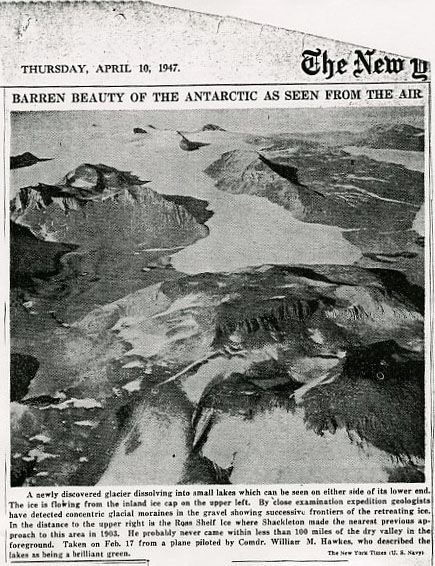
Many Americans were fascinated by the never-before-seen aerial view of Antarctica.

Many expeditions to the Antarctic attempted to
return with live specimens of penguin.
Unfortunately, very few birds survived the
journey.

The American media was very interested in domestic life, even those of penguins.

Companies like Coca Cola used Byrd’s expeditions as an advertising opportunity.
Advertisements and product placement were important aspects of Admiral
Byrd’s fundraising efforts.


Many of the brands that used Byrd in their advertisements
are still familiar to us today.


Members of Byrd’s expeditions became something of
celebrities. Their personal lives were talked about in
the media as though they were movie stars.
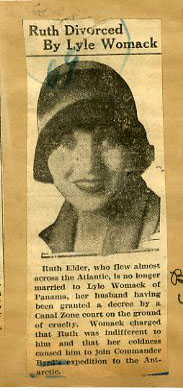
 

This gossip was not always a
good thing.
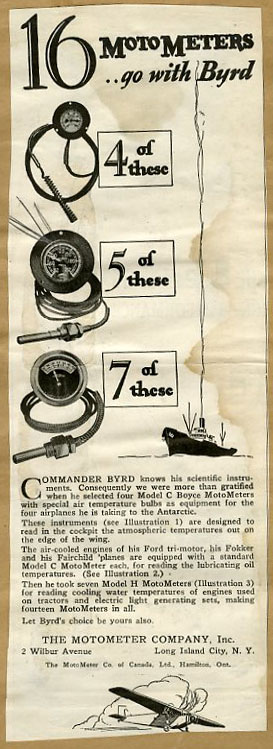
 

Byrd made deals with companies when planning
his expeditions. Advertizing rights were sold in
exchange for funding and equipment.
Paramount Pictures was one such company.


Written by Autumn Snellgrove and published by John Hooton
Remembering the Kent State and Ohio State Demonstrations

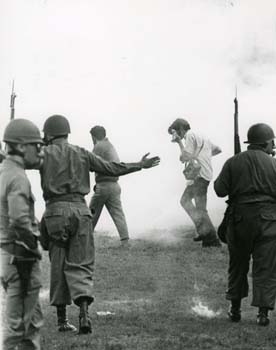
Forty-seven years ago today, the Ohio National Guard opened fire at a crowd of Kent State University students, injuring nine and killing four.[1] The shooting at Kent State University would have national effects, the most prominent of which affected schools around the country. The Ohio State University was among the many college and university campuses to see a rift between students and school administrators.

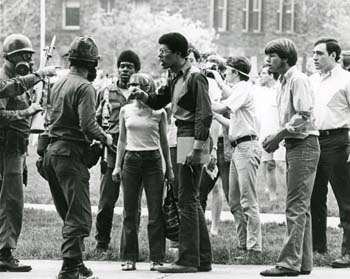
Students confront members of the National Guard.

Student demonstrations had become commonplace on the Columbus campus in the months leading up to May. The African American student group Afro-Am Society was one prominent group in these demonstrations, demanding better treatment of African American students by the university. Issues of race, sex, feminism, student involvement in the administration of the university, and the Vietnam War drove many students into demonstrations, disrupting the day-to-day operations of the university.[2]

Guardsmen with bayonets ready in front of Hayes
Hall.


The Ohio State University Archives began collecting eyewitness accounts on the fortieth anniversary of the demonstrations in 2010. One anonymous student recalled “Seeing National Guard vehicles riding around the Oval.” They were armed and “no one was sure if guns were loaded.” Another witness remembers participating in a student demonstration at the 1970 ROTC May Day review: “Very quickly several busloads of Ohio National Guard arrived. They kneeled in front of the protestors with rifles pointed at us. Angry words were shouted, and for a moment it looked like violence could ensue.”[3]

National Guard members shoot tear
gas onto the Oval.

After the shootings at Kent State University and following consultation with Ohio’s governor, the administration at Ohio State decided to close the campus in an attempt to prevent a similar scenario. Starting on May 7, 1970, the university shut down until May 19 that same year. Although no one was killed at Ohio State during the demonstrations, there were numerous injuries and property damage.[4]

For more information about this time period at The Ohio State University, Bill Shkurti’s book “The Ohio State University in the Sixties” covers these demonstrations and more.  Please also see these resources from the University Archives:

Spring of Dissent: https://library.osu.edu/projects/spring-of-dissent/

The Lantern archives: http://digital.olivesoftware.com/Olive/APA/Ohio/#panel=home


Written by John Hooton


[1] “Spring of Dissent,” The Ohio State University Libraries Exhibitions, accessed May 2, 2017, https://library.osu.edu/projects/spring-of-dissent.

[2] “Spring of Dissent,” The Ohio State University Libraries Exhibitions.

[3] “Spring of Dissent,” The Ohio State University Libraries Exhibitions.

[4] “Spring of Dissent,” The Ohio State University Libraries Exhibitions.

Frozen Fridays: ‘M’ is for McMurdo!

This blog post is part of the Frozen Friday Series, an A-Z journey of the Polar Archives.  Each week, we will feature some aspect of the history of polar exploration with a blog post written by our student authors.

Residents of McMurdo Station enjoy the festivities of
Icestock 2017.

A group of people gather in front of the stage. They are bundled up in puffy coats and warm winter hats or hoods. It is a motley group and the largest gathering of people anyone in the crowd has seen for months. There’s a certain nip in the air, although the temperature is higher than usual. The band on stage seems to have chosen to abandon their fingers to the cold as they refuse to put on gloves for fear of tarnishing their performance. In all, the excitement for the much anticipated performance and the heat of the moment will warm them. The planning committee did their work well. They picked a good day for Icestock this year.

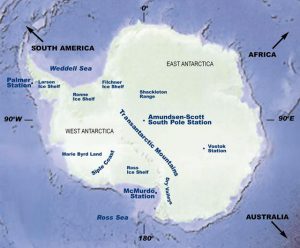
McMurdo Station is located on the cost of the Ross
Sea, represented here.

Icestock has become something of a tradition at McMurdo Station, Antarctica. Every year around the first of January, a stage and audio equipment are set up for musicians to demonstrate their talent in front of a small crowd of the station’s occupants. Several genres of music are played for McMurdo’s mostly scientist population, including rock, funk, electronica, and even bluegrass.[1] The event also includes a chili cook-off, a welcome meal for the eager audience.[2] It is unknown whether this pun was intentional or unintentional at this time.

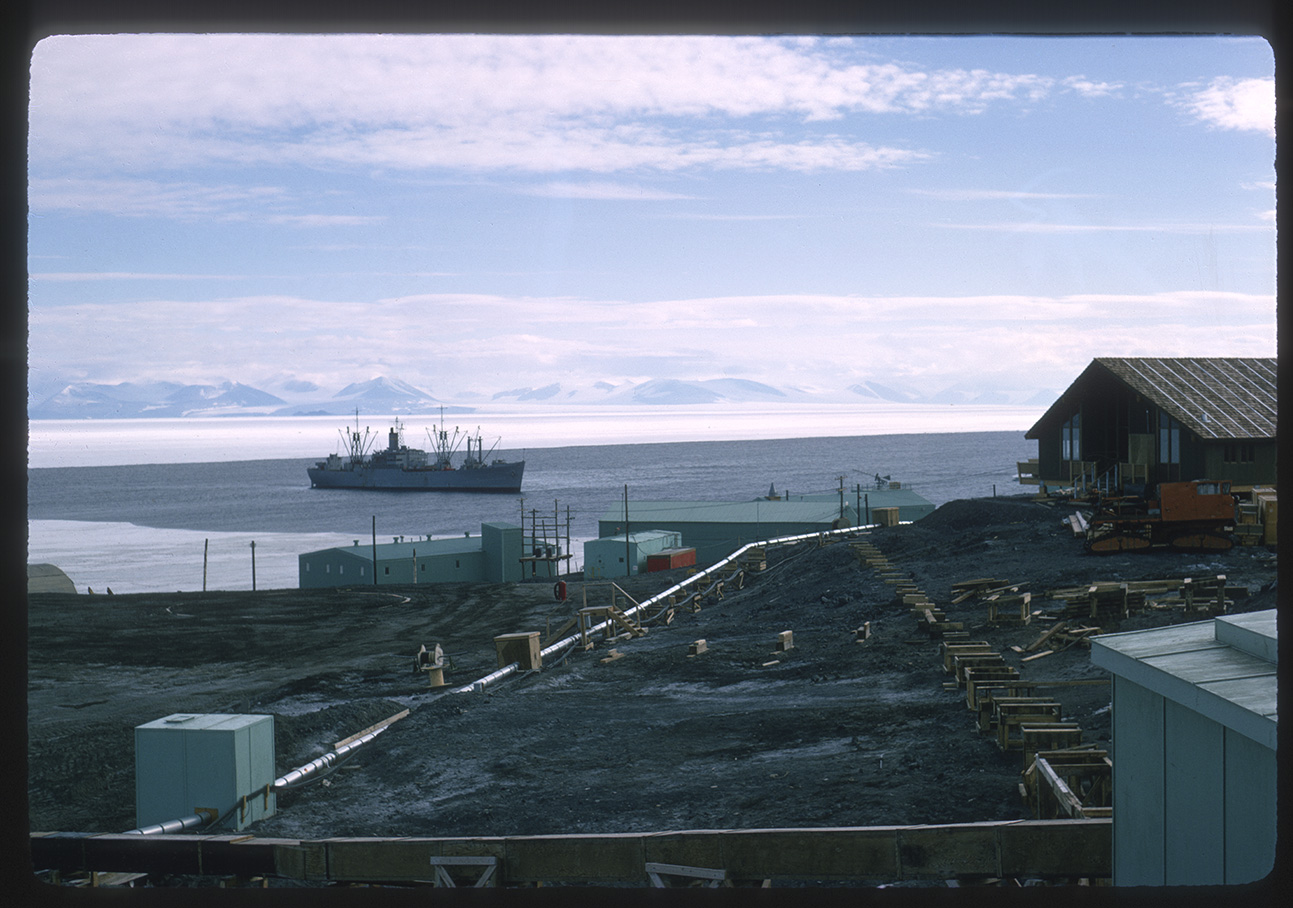
McMurdo Station’s Main Street with Observation Hill in the
background, circa 1960.


That the New Year is regularly welcomed by a music concert on Antarctic soil is something of an anomaly. Then again, the idea that there could be a permanent human settlement on the coldest of continents might also seem absurd to the less informed. McMurdo Station is located on the ice-free tip of Ross Island, just around eight hundred miles away from the South Pole, and houses over one thousand people (mostly Americans) every Antarctic Summer.[3] Though the population drops significantly in the Antarctic Winter as residents cycle out, the station is still maintained and operated by the smaller population of around two hundred individuals.[4]

McMurdo Station has the capability of receiving
boats as well as aircraft.

McMurdo Station, named for the nearby McMurdo Sound (which is in turn named for Lieutenant Archibald McMurdo of the HMS Terror), is an up-to-date scientific research station and includes all of the necessary facilities required for a modern-day human presence in Antarctica.[5]  In addition to the world’s southernmost seaport, Winter Quarters Bay, McMurdo Station operates two runways and a skiway (a runway designed for use with ski-equipped planes).[6] McMurdo is also typically equipped with six C-130s, two Twin Otter aircraft, and four helicopters.[7] The station has working telephones, email, and internet, allowing the population to remain in contact with the outside world.[8] The United States Antarctic Program even has several live web cameras from McMurdo Station posted on their website! Diesel engines generate energy while also providing heat to buildings.[9] In terms of scientific instruments, McMurdo has a large multidiscipline laboratory with various facilities meant to support and house scientific work.[10]

McMurdo Station also has a
monument to the great polar
explorer, Admiral Richard E. Byrd.

McMurdo Station is crucial in human Antarctic activities. While McMurdo serves as the primary United States base in Antarctica, it also serves as a support center for other research stations in and around the continent.[11] Located near many natural sites of scientific interest, McMurdo Station is ubiquitous to the modern Antarctic explorer’s experience. Many such scientists, such as Lois Jones and Henry Brecher, have spent time in its halls and many of their collections can be found in the Byrd Polar and Climate Research Center Archival Program. Also, check out our digital collections page, where you can find images of McMurdo!

Written by John Hooton.

[1] Jeremy Day, “Mid-Summer Holidays,” The Antarctic Sun, January 05, 2017, accessed January 18, 2017, https://antarcticsun.usap.gov/aroundTheContinent/contentHandler.cfm?id=4292

[2] Day, “Mid-Summer Holidays.”

[3] Encyclopedia of the Antarctic, s.v. “McMurdo Station,” New York: Routledge, 2007.

[4] Encyclopedia of the Antarctic.

[5] The Geographic Names Information System is our authoritative source on geographic location information in Antarctica.

[6] Encyclopedia of the Antarctic.

[7] Encyclopedia of the Antarctic.

[8] Encyclopedia of the Antarctic.

[9] Encyclopedia of the Antarctic.

[10] Encyclopedia of the Antarctic.

[11] Encyclopedia of the Antarctic.

Older posts Newer posts