From Woody's Couch

Our Playbook on OSU History

Category: Uncategorized (page 3 of 10)

Celebrating the life of John Glenn on the one-year anniversary of his death

Today marks the one-year anniversary of the death of John Glenn. To honor his life, we have selected several clips from his oral histories that capture important moments in his life and in history. To read and listen to all oral histories visit the oral history page on our website. For more information on John Glenn, view his finding aid.


John Glenn on his time in the military:

Full transcript and audio


John Glenn on why he volunteered to be a test pilot in the space program:

Full transcript and audio


John Glenn on the Space Race:

Full transcript and audio


John Glenn on the naming of the Friendship 7:

Full transcript and audio


John Glenn on his first view of Earth from space:

Full transcript and audio


John Glenn on why he ran for President:

Full transcript and audio

OSU professor connected education to democracy and freedom

“Nobody learns what is set before him”

–Alan F. Griffin

[Editor’s note: Recently, John Farley, who received his Ph.D. at Ohio State in 1978, donated letters written to him in response to a questionnaire he distributed that year to former associates and students of OSU Education Professor Alan F. Griffin, who taught at OSU from 1936 to 1964. Griffin was the subject of Farley’s dissertation, The Life and Thought of Alan Griffin: Exemplar of Education. The correspondence donated by Farley offers observations of a professor dedicated to the belief that education and democracy go hand in hand, and of an educator passionate about teaching his students the critical-thinking skills that would serve them beyond the classroom. Below, OSU volunteer Becca Bushman has written an account of Griffin’s work and life, based in part on Farley’s correspondence.

By Becca Bushman

Alan Francis Griffin was born in 1907 in Barnesville, Ohio. His mother died of Huntington’s disease when he was only eight, at which point he and his brother John relocated to Mansfield, Ohio.

Before becoming an educator, Griffin worked in dairy and at a steel foundry. Griffin was also a radio announcer from 1927 to 1930, and from 1930 to 1932, he worked as a newspaper reporter for the Mansfield News Journal.

Alan F. Griffin, with students at WOSU, 1943

Griffin began teaching in 1929, though not originally at the college level; he worked at John Simpson Junior High School in Mansfield until 1936, when he completed his B.S. in Education at The Ohio State University and began working at Ohio State. He went on to earn a Ph.D. at OSU in 1942. He became a full professor in 1949 and remained at Ohio State until he died in 1964.

Like many of his contemporaries, Griffin subscribed to ideas on education set forth by John Dewey, an influential American educator and reformer who was a key figure in the Progressive Education movement of the early 20th century. Like Dewey, Griffin understood the relationship between education and democracy to be pivotal. His 1942 dissertation “contained central ideas about the role of reflective thought and its relationship to the survival of democracy,” and he also emphasized “the critical need for active engagement of citizens.”*

Griffin demonstrated this belief even when he was teaching junior high school where he sought to further stimulate the minds of secondary school students through his work with the Junior Town Meeting League. The League, which was sponsored by the American Education Press, organized forums and debates in which high school students could discuss salient current issues and events. Its goal was to decrease apathy and ignorance and to increase civic engagement in America’s youth.

Griffin continued his work with the League even after moving into higher education; he served as a trustee to the organization and contributed to its publications.

In any class he taught, Griffin worked to promote and provoke reflective thought in his students. Indeed, “for Griffin, no meaningful reflection could take place without the serious and persistent examination of student beliefs and values.” For him, education was about teaching his students how to think critically—he worked to make his students simultaneously more skeptical and more open-minded. Griffin was the sort of instructor to come to class with questions, not answers, according to Eugene Gilliom, Professor Emeritus of the Department of Educational Theory and Practice.*

Griffin’s approach was unstructured and casual; his lectures largely consisted of organic, collaborative discussion. Students were so enthralled by the atmosphere he created that his courses were widely audited. As James Louis Barth, who earned a Ph.D in Education in 1963, said, “It was not unusual for him to have a seminar full of people who were interested in being with him…his seminars were well attended but nobody was paying for the credit—this of course upset the University!”

Griffin also worked with students at WOSU, on a radio program called “No Corner on Democracy.” Griffin and students wrote scripts for the program, although Griffin wrote many more, according to former student Paul Gump. Griffin was able to “belt out a script late at night,” whereas it might take a student a few weeks to complete the same amount of work, Gump said in his correspondence with Farley.

Airing in the early 1940s, the program’s intent was to show how “other people in other times and places have also struggled to advance democracy,” Gump said. Griffin felt the emergence of McCarthyism threatened democratic processes, and he spoke out against it. Former student Lawrence Metcalf wrote to Farley that Griffin was “totally opposed to any form of witch hunting.”

Griffin, 1960

For Griffin, democratic principles did not apply to just certain segments of society, either. He and other College of Education faculty worked to integrate the OSU chapter of Phi Delta Kappa, the national education honorary society, to include both African Americans and women. The OSU chapter opposed the provision in the national constitution restricting membership to white males. After the national body amended its constitution, the OSU chapter immediately voted for the same change in early 1940. At the time, Griffin, who authored the amendment, told The Lantern that “the chapter action was taken in terms of the realization that many educators…were being lost to the organization simply because of the color of their skin.”

Griffin’s perspective demonstrates a determination to connect formal higher education to the so-called “real world.” He placed his classroom in the context of larger cultural and political phenomena, and encouraged his students to do so as well. He encouraged students to interrogate information, both on their own and with others, especially in the public arena by participating in democratic government. Griffin understood education to be less about rote memorization and to be more about learning how to think critically and reflectively, to continually question and examine assumptions. Perhaps this is what is meant by the quote cited at the beginning of the post, sent to John Farley by Katharine E. Jones. In Alan F. Griffin’s eyes, for learning to occur, people had to take initiative to become and remain actively and reflectively engaged in the classroom and in society.

*From “Alan F. Griffin: role model for the reflective study of modern problems,” by William R. Fernekes, 2007.

Sunny Days: Forecast cloudy when student humor magazine Sundial found to be not-so funny


Written by Olivia Wood

Sundial cover of the “Freshman
Uplift Issue,” September 1944.

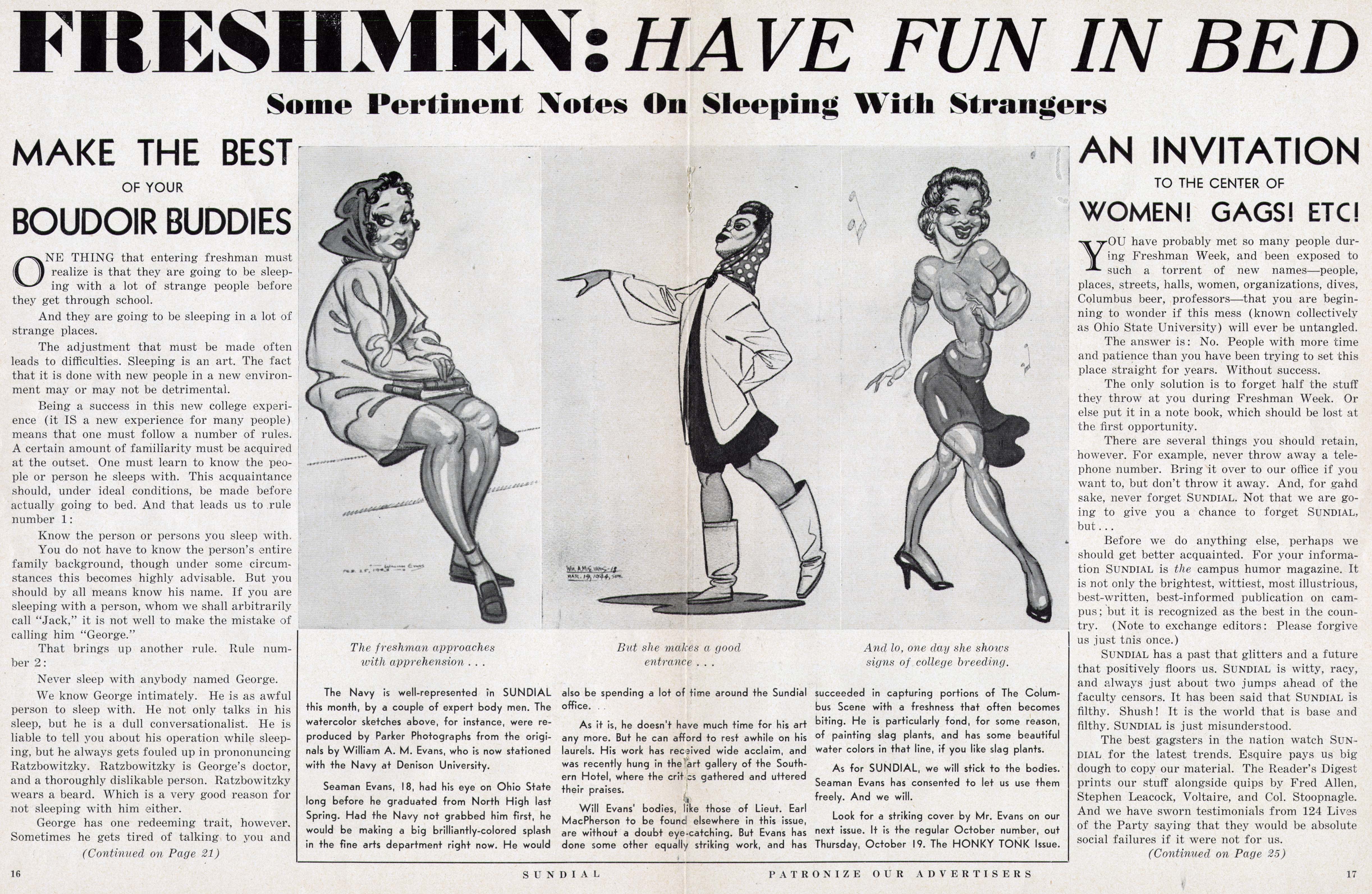
On the morning of October 5, 1944, a new issue of the Sundial hit the Ohio State newsstands.  For twenty cents, anyone could purchase the “Freshman Uplift Issue” of the student-run humor magazine.  The cover, a cartoon, depicted a freshman girl upset at her companion for staring at another woman; the sidebar read “this issue filthy with fun.”  The magazine was riddled with sexual innuendos, double entendres, and risqué pictures of scantily clad women, while the centerfold included a detailed article that read: “FRESHMEN: HAVE FUN IN BED; Some Pertinent Notes on Sleeping with Strangers.”  By the end of the day, University President Howard Landis Bevis ordered all copies of the “Sunny” turned in to his office, declaring it “the filthiest issue” produced.

The September 1944 issue is perhaps one of the most controversial of the Sundial to date, but it wasn’t the magazine’s first run-in with University administrators that school year.  Earlier in the year, the March issue of the Sundial faced accusations of printing nude photographs and obscene jokes.  Bevis, who had previously warned the Sundial to clean up its crude content, addressed Professor James E. Pollard of the School of Journalism—through which the magazine was published—about his discontent with the magazine’s false promises of improved content on March 31, 1944: “The result is always the same—a ‘clean up’ for an issue or two, jocosely referred to in the improved editions, then further descent to the depths.”

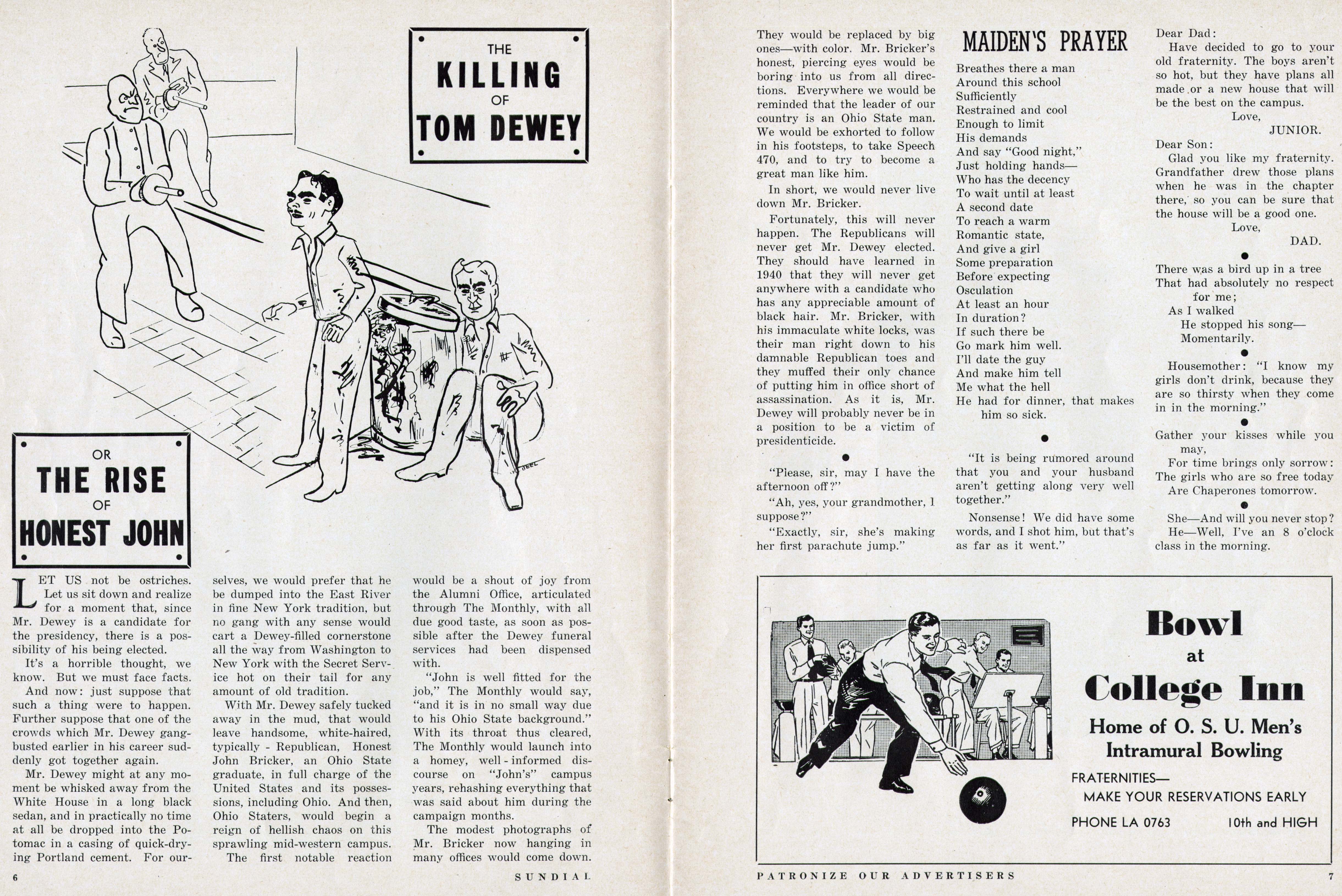
“The Killing of Tom Dewey or the
Rise of Honest John” in the September 1944
issue of the Sundial.

Concerned about the University’s image, Bevis called for an investigation of the Sundial under the Committee on Student Publications.  The Sundial faced repercussions as a result of the March issue, as the committee provided strict guidelines for the magazine which included “warn[ing] the Sundial staff to improve the quality of the remaining issues this spring of 1944” or face further problems with the University.  The committee also demanded the appointment of a censorship board that promised to “carry out the strict standards outlined in our discussions” by heavily editing the magazine’s content, hopefully ridding the repeated inappropriateness of the Sundial.

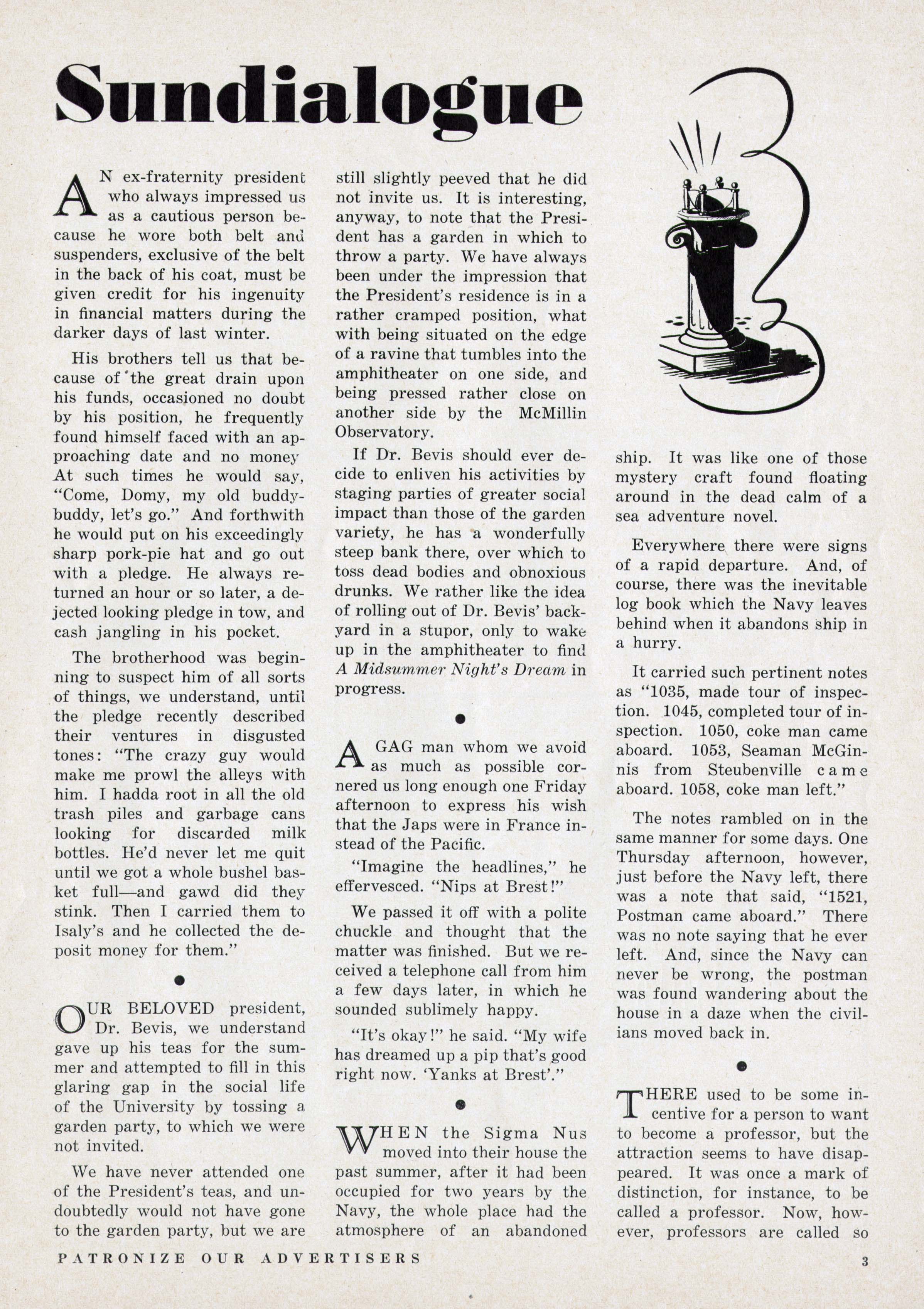
The satirical piece regarding
University President Howard Bevis,
“Our Beloved President,” in the
September 1944 issue of the Sundial.

However, the magazine proved its inability to clean up its content and finally went too far for Bevis.  Its punishment resulted in Bevis’s suspension of the Sundial indefinitely after dismissing the two newly-appointed student editors and the student business manager.  However, the explicit sexual overtones were probably not the single issue that Bevis found appalling in the October-released issue.  Page six bore the satirical article “The Killing of Tom Dewey or the Rise of Honest John,” which regarded John Bricker, an Ohio State alum who was the Governor of Ohio and Republican nominee for Vice President in 1944.  The same article poked fun at the Alumni Monthly, an Ohio State-sponsored publication read by thousands of alumni, some of whom contributed financially to the University.  A few pages earlier, the issue featured a short soliloquy about Bevis’ supposed lavish lifestyle compared to that of the students at Ohio State, remarking on his out-of-touch and supposed questionable philosophies.

The reaction to Bevis’ disassembly of the Sundial was mixed among the University crowd.  In personal correspondence to the president, some students and parents praised his actions and swift justice.  However, others felt the Sundial did not deserve to be shut down, as seen in some guest editorials published in the student newspaper, The Lantern.  Students made the argument of replacing the staff rather than shutting down the magazine altogether.  One student wrote to The Lantern that “such a magazine is necessary to the campus,” while another wrote “[students] feel that the University was a little too harsh in suddenly discontinuing its publication.”  One student even argued the staff was only catering to the public’s demands, therefore deserved no punishment for their actions.

The controversial “Freshmen: Have Fun In Bed”
spread in the “Freshman Uplift Issue” of
the Sundial, September 1944.

A week after its termination, a petition to begin a new humor magazine launched, then an official request for the new magazine was submitted to the president’s office in February 1945.  President Bevis and Vice President Bland Stradley agreed to the publication, but they required specific guidelines: the magazine must launch two trial issues; the magazine must have an acceptable budget; there must be an editor, art editor, and business manager; a faculty advisor has full authority over the magazine content; and, finally, a new name must be found for the magazine.  A contest was held which allowed the student body to contribute to the new name; students provided the new magazine with 550 name suggestions.  The winner of the contest was Scarlet Fever, which printed its first issue in May 1945.

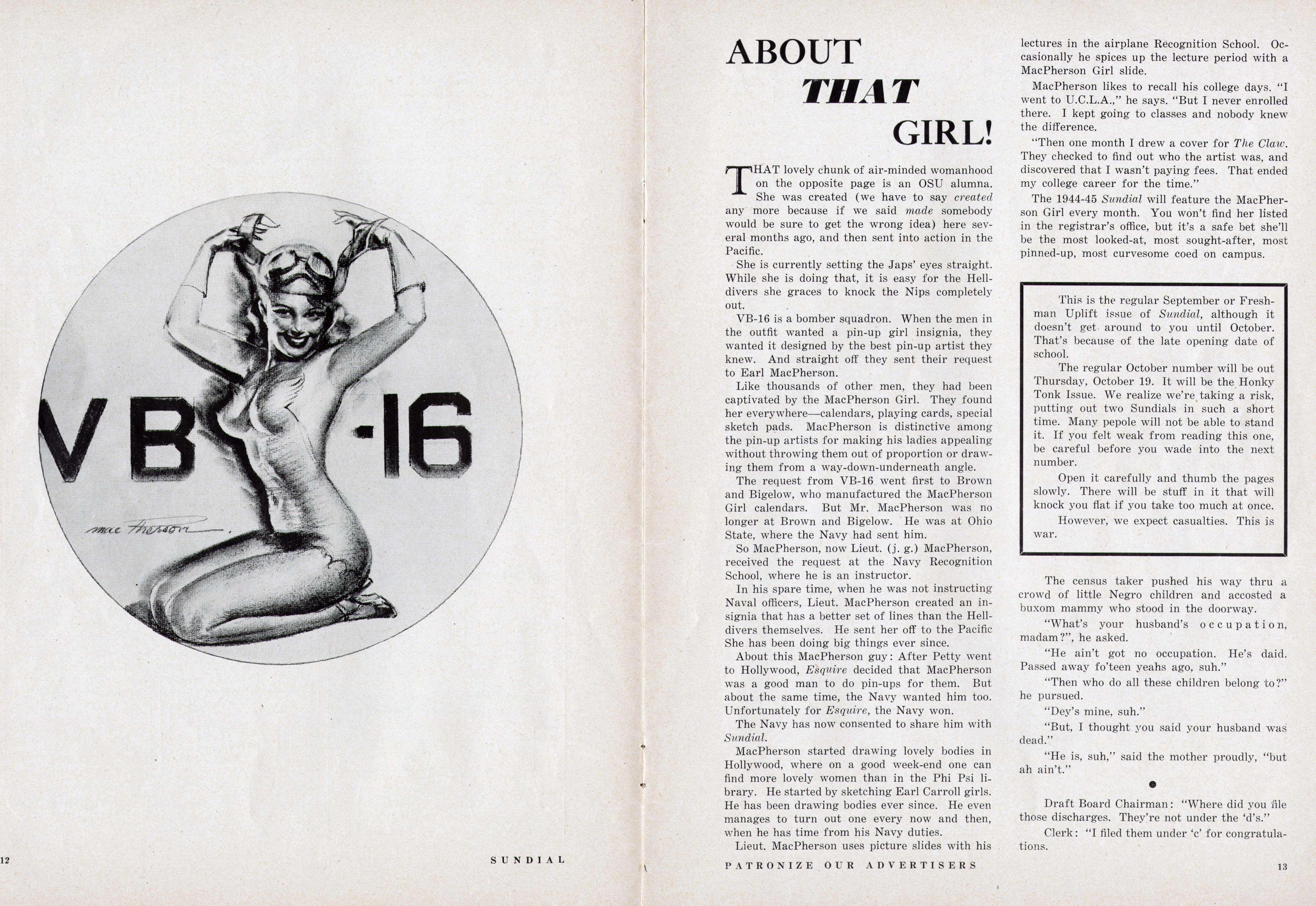
Another questionable and sexually explicit sketch
in the September 1944 issue of the Sundial.

The name change went over well with many students but did not sit well with alums, most notably previous Sundial contributors like James Thurber and Gardner Rea, both of whom were well-known authors and illustrators.  The two men pushed for the switch back to Sundial, as they both felt it held a stronger place in Ohio State’s heart than Scarlet Fever.  “Frankly,” Rea wrote to Bevis, “I could never see the slightest need for the change in the first place. I could see the need for a complete staff change … but no reason for the change of name. […] Scarlet Fever means nothing to anybody.”  Bevis defended the name change, stating the Sundial’s lifespan was over and Scarlet Fever was the new, better-welcomed humor magazine.

Most students changed their minds about the new magazine just three months after the first issue of Scarlet Fever hit the newsstands.  A large group of petitioners from across campus demanded Scarlet Fever change its name to its predecessor.  This eventually caught fire in the president’s office, as Bevis approved the name change in late 1946.  The Sundial reclaimed its title as Ohio State’s official humor magazine in October 1946, just over the two-year-anniversary of its banishment from the campus.


Older posts Newer posts