From Woody's Couch

Our Playbook on OSU History

Category: Uncategorized (page 5 of 10)

As Woody Hayes would say, fan paid it forward with his love of Buckeyes football

Here at the Archives we come into contact almost on a daily basis – particularly during football season – with devoted Buckeye football fans. Most are looking for photos or statistics or articles about

Woody Hayes commemorative plate

Woody Hayes commemorative plate, 1970

their favorite players or coaches. In fact, we have a whole collection of materials related to Woody Hayes, the head coach with the longest tenure and most wins in the history of the program. We have letters, speeches, photos, artifacts, and lots of other material related to Hayes’ life and career. The collection is open to fans and serious researchers alike.

Now we add a commemorative plate of Coach Hayes to the collection, and while this would not appear to be unusual, the family who donated it – the Pattis of Akron – took the time to contact the Archives and to send the artifact to us in order to preserve the legacy of love that Michael Jerome Patti, who passed away last April at the age of 67, had for Buckeye football for more than 50 years.

Mike came into possession of the donated plate in 2003 at about the time of the Buckeyes’ National Title win over Miami when his nephew, Andy Flores, a resident of Lewis Center and ardent Buckeye fan, gave the plate to him. Andy had found the plate on eBay and chose it for his uncle Mike since he was sure he would treasure it, which he most certainly did, displaying it reverently in his home. When Mike’s son, Keith, wrote to us in September that he would like us to consider adding the plate to our collections, he wrote that “it would mean so much to my family that Ohio State carries on my dad’s legacy of a loyal fan.”

Mike Patti, wearing his OSU cap, and his wife, Lynn, congratulate their son, Keith, at his Air Force graduation in 2009

Mike Patti, wearing his OSU cap, and his
wife, Lynn, congratulate their son, Keith, at his Air
Force graduation in 2009.

And loyal he was. Mike, a native of Akron who never attended OSU, earned his bachelor’s degree in mathematics education from the University of Akron. While attending school with a full course load, he also worked as an assistant manager at a local McDonald’s to finance his education.  He graduated in 1971.

Despite Mike’s time constraints, he always made time to cheer on the Buckeyes, especially during the 1969 Rose Bowl where the team clinched the National Title. Mike also was as steadfast in his devotion during the losses as with the wins. Fast forward to 2000, during the fourth quarter of the game

against South Carolina, when the Patti clan was sitting down to eat. Mike, according to his other nephew, Ben, another loyal Buckeye, would not leave the television “even during what felt like the worst loss in the history of OSU football.”

Ben also recounted a similar story about Mike wanting to share his enthusiasm with the family: “I will never forget him driving me home from his neighborhood one year. I must have been eight, maybe nine years old. I know it was hard for him to not watch the Buckeyes football game, but nevertheless, he was happy to take me home even after a long night of trick-or-treating. I tried so hard to keep my eyes open in the car and listen to the
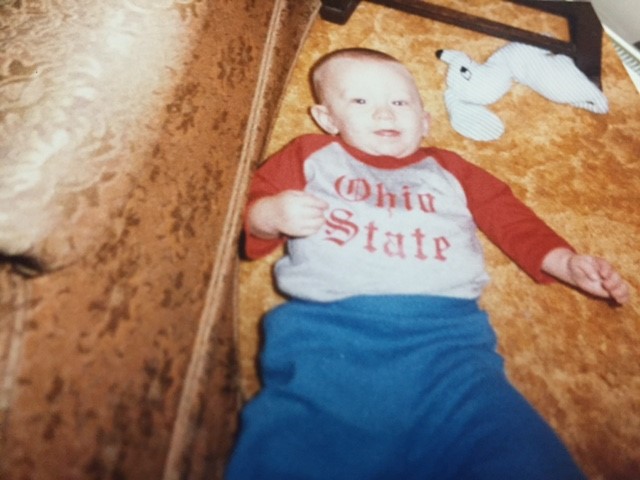
Keith Patti displays an outfit chosen by his father, Mike, in 1984.

Keith Patti displays an outfit chosen by his
father, Mike, in 1984.

game. He was so excited, cheering for every play and cursing at every penalty. Eventually I was awakened by him shaking me and yelling, ‘Ben, wake up – the Buckeyes are going to the Rose Bowl!’ Even in October, he was so optimistic.”

For the three of them – Keith, Ben, and Andy – the inclusion in the Archives of one of their respective father and uncle’s most prized possessions of his Buckeye fandom is very gratifying, since all three carry on Mike’s dedication to the Buckeyes.

An autographed photo from then-coach Jim Tressel.

An autographed photo from then-coach Jim
Tressel.

Over the years, we have received many commemorative artifacts related to OSU football – pins, buttons and even drinking glasses. We are thankful for each of them because they demonstrate in a tangible way the connection that fans have to their treasured team. But we rarely have the opportunity to hear such a wonderful tale of a truly dedicated fan who was so beloved by his family.

When you watch The Game this weekend, think of all the devoted fans who have been there for the Buckeyes through thick and thin, and whose loyalty we help preserve here at the Archives. And of course, Go Bucks!

Donors’ dilemmas bring historical treasures to the Archives

When people contact us to donate material to the Archives, they often say something like, “I don’t really know what to do with it, but I just can’t bear to throw it away.” To that, we give a hearty and grateful thank-you. If it weren’t for donors like that – who try their hardest to find a good home for a historical object instead of just pitching it into the trash – the Archives would have far less materialDSC_0071 that documents the history of campus life at OSU.

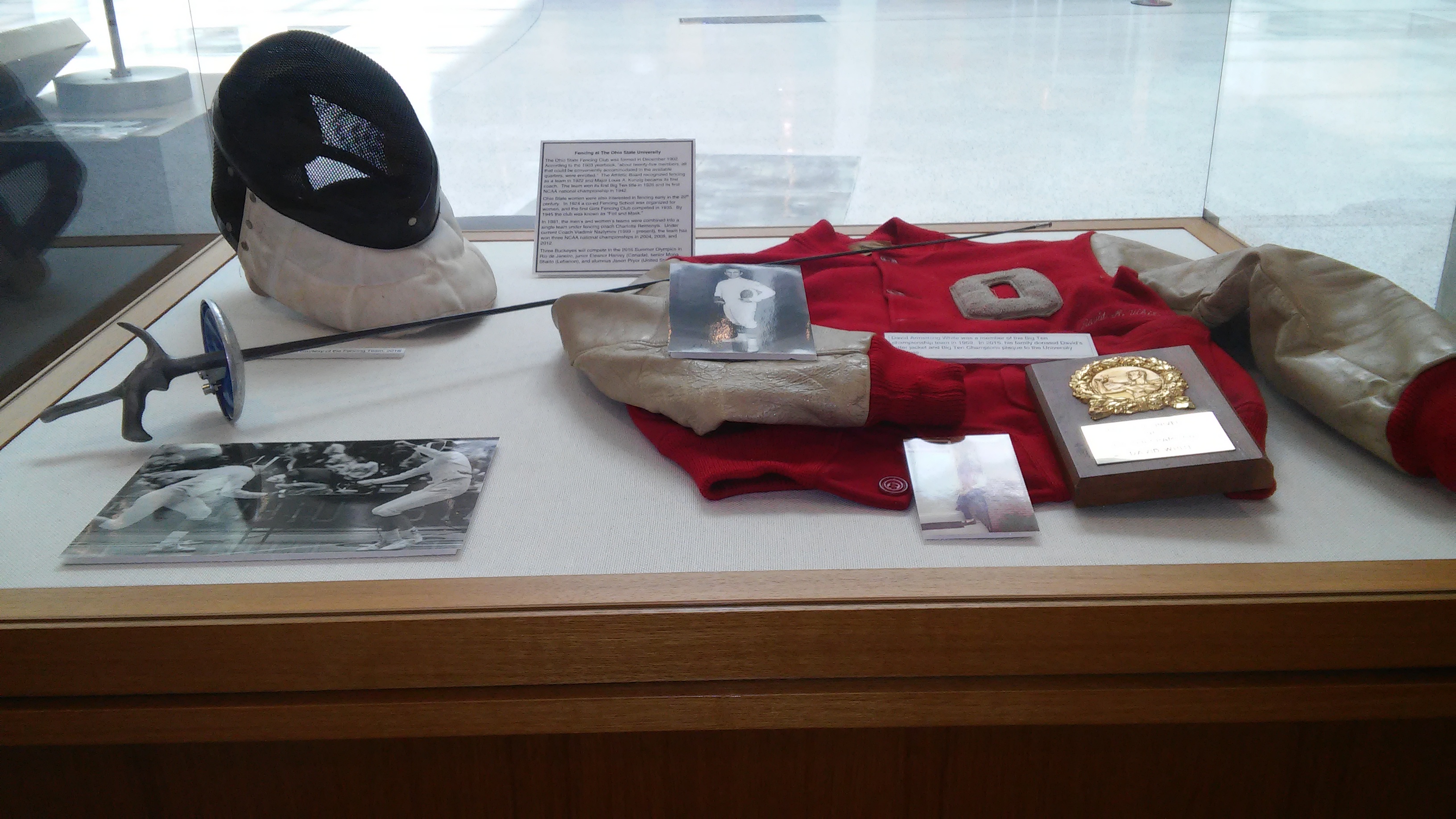
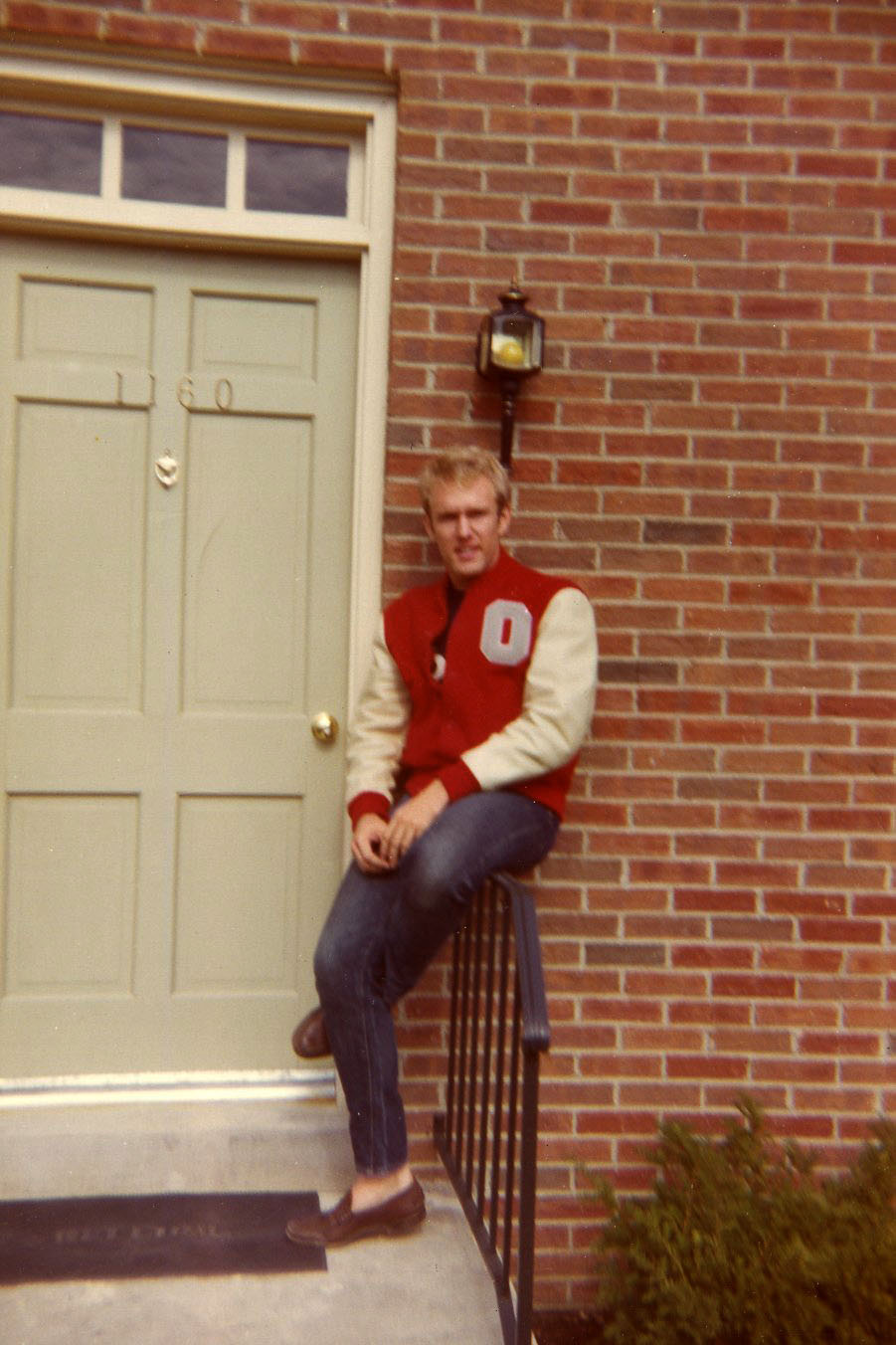
Case in point: In February 2015 Beth White of Gainesville, Ga., offered to donate material from her uncle, David Armstrong White, who had attended OSU from the fall of 1965 to June 1970. He had died in 1999 and had never had children, so there was no one in the next generation to hand down some of his “stuff” from OSU. And what great “stuff” it is! It turns out David White was a member of OSU’s 1969 Big Ten Championship Fencing Team. As such, he was awarded a plaque for being on the team, and since he participated at the Varsity level, he received a Varsity “O” jacket.  Along with these items, Beth White also donated earlier this year a photo of David White in 1971 wearing the jacket, a photo of the team in 1969, and some photos of a team reunion from 1994.

1969, David Armstrong White in letterman

1969, David Armstrong White in letterman

It also turns out that because of Beth White, we know the rest of the story about her uncle. Unless an OSU alum does something that gets him or her onto the pages of The Lantern or the Alumni Magazine after graduation, we usually don’t know the path their lives took after leaving campus. In David White’s case, after earning his bachelor of science degree in Architecture in June 1970, he lived in Columbus for a while, then moved to Atlanta in 1973 where he worked for an architectural firm for several years. He decided to return to school to obtain a degree in child psychology, so he entered George State University where he earned a master’s degree and specialization degree in that field. He was employed by Gwinnett County Public Schools as a staff psychologist until he retired in 1997. He passed away in October 1999.

By the way, David followed in his father’s footsteps when it came to attending OSU. Willard Chandler White Sr. earned a bachelor of arts degree in June 1960 and

followed that with a master of arts degree, specializing in Speech, in March 1962.

1969 Men's Fencing Team

1969 Men’s Fencing Team

To see some of David White’s artifacts and photos and to learn more about the history of fencing, visit the Archives’ exhibit case in the display area of Thompson Library at the east end of the first level, closest to the Oval. The exhibit will be up through early December. And thanks again to Beth White for taking the time and effort to find an appropriate home for her uncle’s pieces of OSU history.


fencing

The Great Adventures of the Graf Zeppelin

In May of 1928, disaster hovered in the air above France. The Graf Zeppelin, a German airship marginally shorter than the Titanic, ten stories tall and filled with one hundred thousand cubic meters of hydrogen (the world’s most flammable gas) had lost several of its engines.

Graf Zeppelin above Tokyo

Graf Zeppelin flying over Tokyo on its around the
world flight.

The forward port engine had lost its main shaft and two other engines had immediately seized, leaving the ship floating on its last two engines. In response, Commander Hugo Eckener, a very skilled aviator, tried to return the airship to its base in Germany.   But then a fourth engine stopped, stranding the ship and its passengers with the Alps between themselves and safety.

Sketch of the Graf Zeppelin

Sketch of the side view and floor plan of the
Graf Zeppelin, reproduced here on a German postcard.

The choice was either to abandon ship, or to attempt an emergency landing in France. To land on the open ground would cause the ship to bounce, unless gas could be released fast enough to prevent it—a major fire risk. Instead Eckener maneuvered the Graf Zeppelin to an old French hangar, where French troops waited. The French helped the Graf Zeppelin to land but immediately locked down the base—“after all, the last Zeppelin landing in France had been a war machine.” [i]  The Graf Zeppelin and its passengers, as well as the two gorillas on board[ii], were saved.

It was an exciting time in the history of flight.  Two years before, Charles Lindbergh had flown from New York to Paris in about thirty-three hours, sparking a huge rise in popularity for aviators and a surge in the public’s interest in flight.  Commander Hugo Eckener and the Zeppelin Company wanted to build upon this fascination by using the Graf Zeppelin to circumnavigate the globe.

Freud, the radio operator aboard the Graf Zeppelin

Freud, the radio operator aboard
the Graf Zeppelin, dangling out a
window.

The problem? They did not have enough money. Their solution came from the American news mogul William Hearst. Hearst wanted to capitalize upon the excitement that aviators and grand adventures sparked in the American public and, after some haggling, he offered to fund half of the money for the trip in exchange for the rights to the story in the U.S. and Great Britain. Hearst had three reporters on board: the famous explorer Sir George Hubert Wilkins, Lady Grace Drummond-Hay, and Karl von Wiegand.

Hearst's reporters.

Hearts’s reporters from left to right: Captain
Wilkins, Lady Drummond Hay, Carl Von Weigand
and cameraman Robert Hartman.

Hearst also demanded that the trip begin and end in the U.S.  Eckener agreed, but planned to travel right back to the Zeppelin’s home base in Friedrichshafen, Germany after beginning in America, allowing for a complete circumnavigation from both Lakehurst and Friedrichshafen (thus satisfying both his home country and his primary sponsor).

This is how the Graf Zeppelin, after its inauspicious trial run in May, came to be traveling again across the Atlantic toward the U.S. on the 1st of August, 1929. Ninety hours after departure, the ship landed in Lakehurst, N.J. before returning to Germany. From Friedrichshafen, the Graf Zeppelin traversed Siberia before landing in Tokyo, Japan, and continuing across the Pacific Ocean to Los Angeles, California. The last leg was a jaunt across the United States, back to Lakehurst.

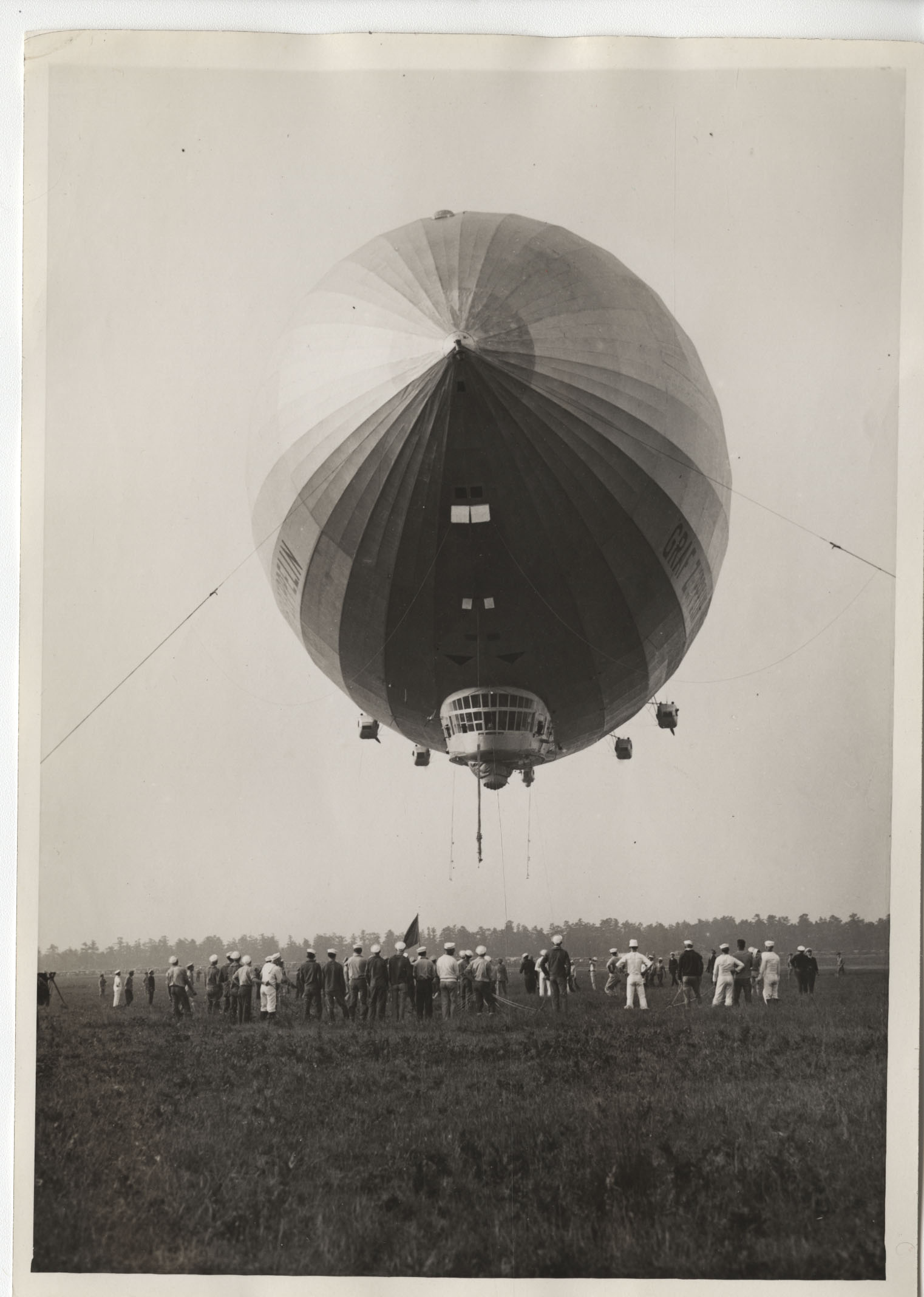
Front view of the Graf Zeppelin

View of the Graf Zeppelin as it lands
in N.J. after completing its
circumnavigation of the world.

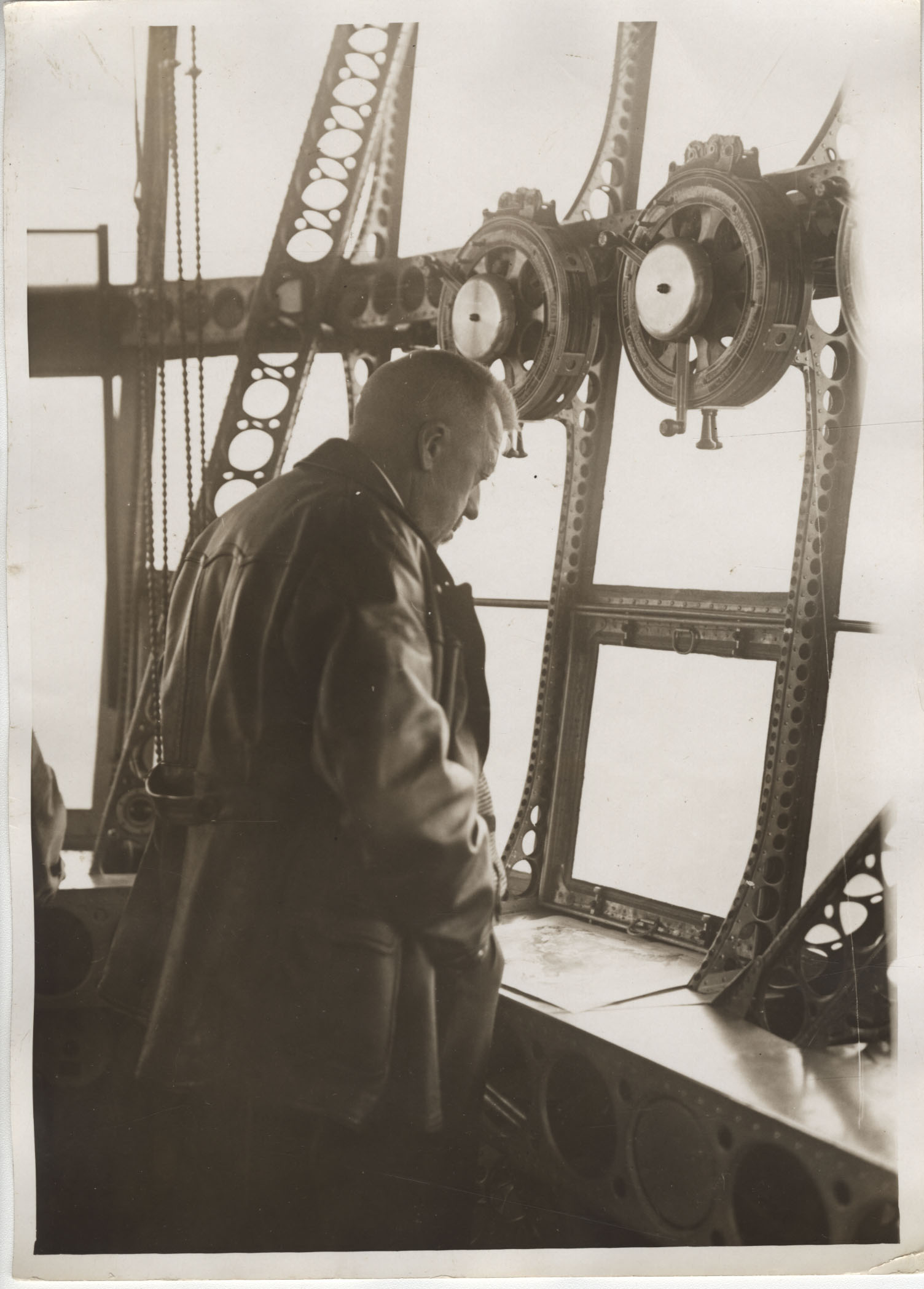
Commander Eckener in the control room.

Commander Eckener in the control
room on the Graf Zeppelin.

By this time, the Graf Zeppelin had run out of drinking water, though this did not stop Eckener from pushing forward. Instead the passengers subsisted on wine and other alcohol—substances still illegal on the U.S. soil below their feet. Upon its arrival, the Graf Zeppelin broke the record for the fastest circumnavigation of the globe and was met with massive fanfare and celebration.

George Hubert Wilkins, a famous Australian polar explorer and one of Hearst’s correspondents on the Graf Zeppelin, collected photographs and memorabilia related to the flight. Over two hundred of these images were recently acquired by The Ohio State University’s Polar Archives in 2015 and join the larger Wilkins Collection held by the repository. These images range include mass-printed German postcards; images of life aboard the airship; photos of the Graf Zeppelin in flight or in a hangar; as well as photos of crowds cheering and celebrations.

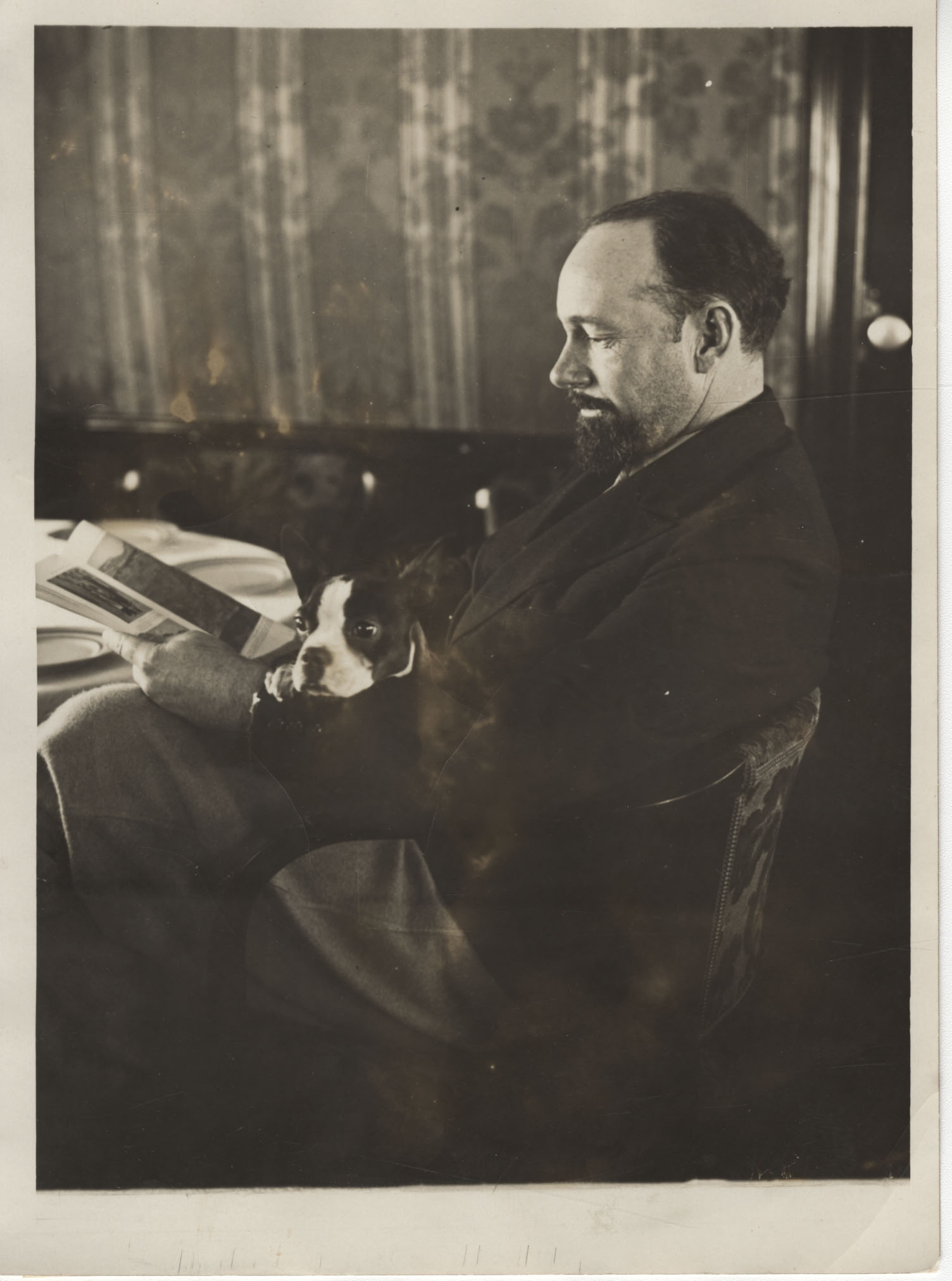
Wilkins himself is not featured in many images.  He is seen in only a few formal photographs, as well as several that depict him dining with Captain Eckener and his fellow correspondents. The exception is a fabulous photo in which Wilkins is examining a book of photographs in the dining area, with a small dog (one which greatly resembles an early Boston terrier) in his lap.

Wilkins, reading, with his dog in his lap.

Wilkins, reading, with his dog in his lap.

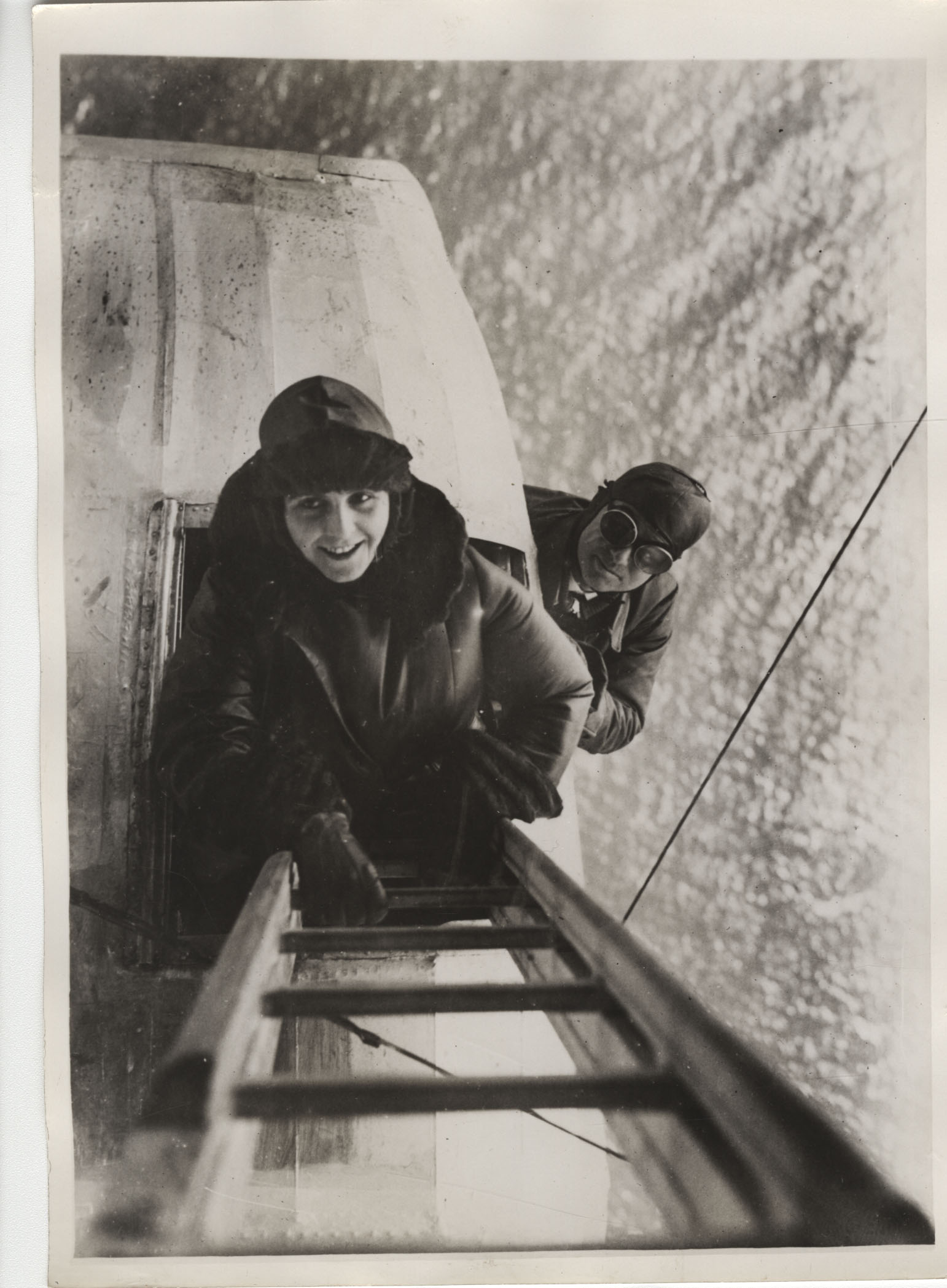
Such depictions of life aboard the ship are numerous among the collection and cover everything from work to play. There are images of one crew member rather smugly playing the piano accordion; the radio operator Fruend precariously hanging out a window with a dangling wire; Chef Manz cooking; Commander Eckener solemnly monitoring everything on the control room; and Lady Drummond Hay happily climbing one of the gondolas while the ship was in flight.

Lady Drummond Hay climbing one of the gondolas.

Lady Drummond Hay climbing one of
the gondolas.

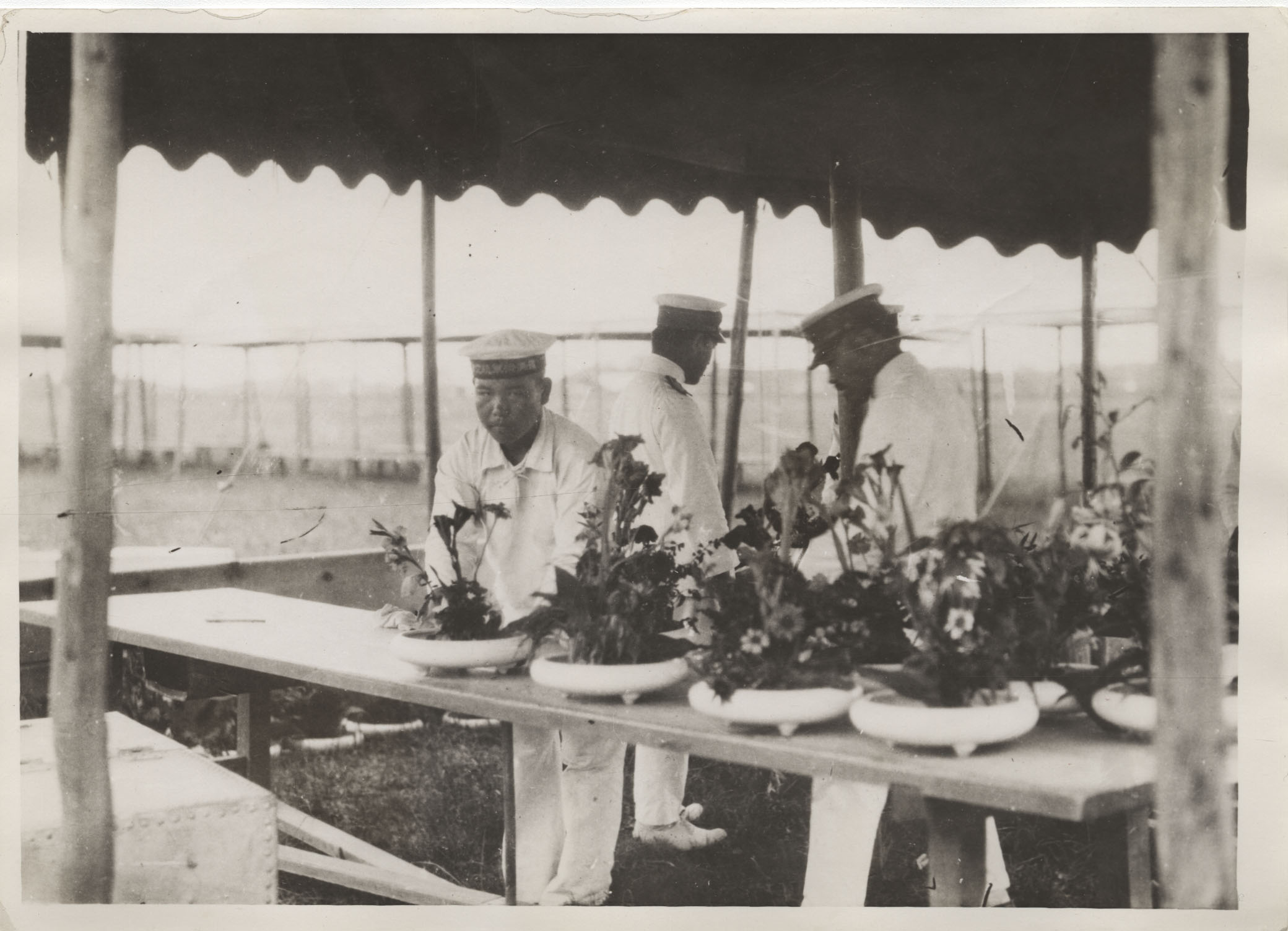
Other images show the world in relation to the massive form of the Graf Zeppelin. Several images depict the Graf Zeppelin landing or taking off, surrounded by small white smudges that only vaguely look like people.  Another photograph, apparently taken from the Graf Zeppelin itself, shows the Zeppelin’s shadow, which looks rather like a large missile, over a field. Even from the air, the Zeppelin’s shadow is several times larger than the houses and barns on the ground. Some photos display the huge impact of the Graf Zeppelin’s flight, even without the Graf Zeppelin being the subject of the image. One such photo displays two long rows of U.S. sailors feasting after aiding in the landing and departure of the Graf Zeppelin. Another shows Japanese florists preparing flowers for those visiting the Graf Zeppelin while it was moored in Tokyo.

Japanese Florists

Japanese florists preparing flowers for the arrival of
the Graf Zeppelin.

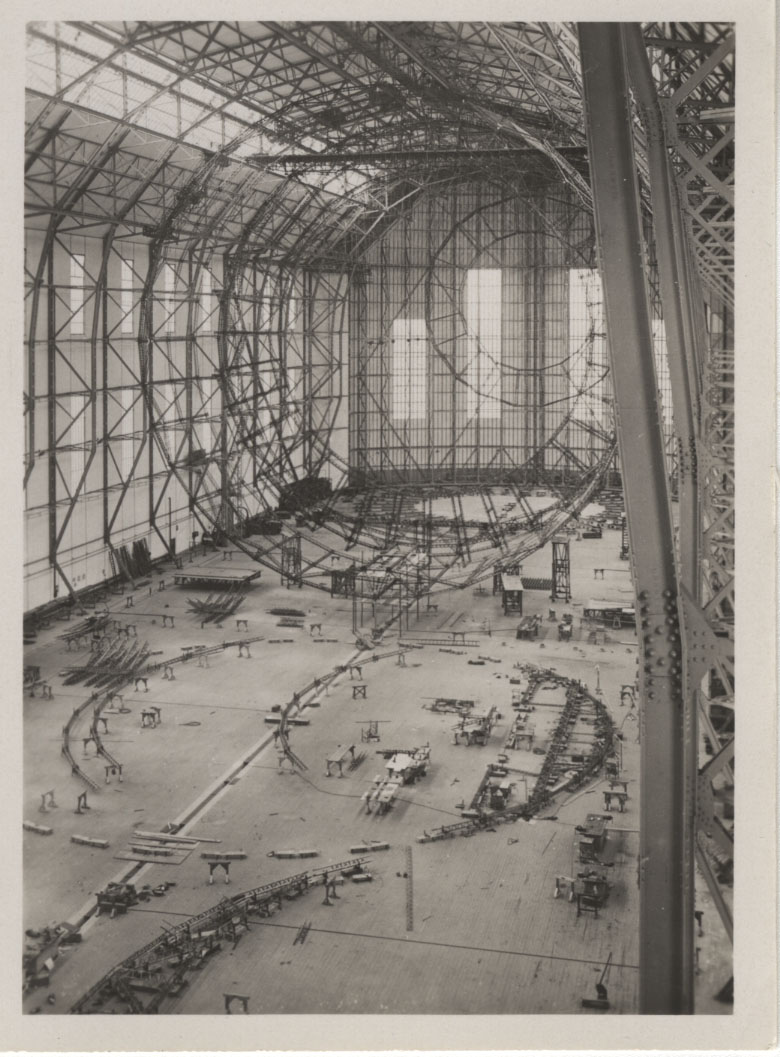
Finally, the collection has printed memorabilia that Wilkins gathered, mostly postcards and tiny printed cards. These seem to be German in origin, given that all are captioned in German, and display wonderful drawings of the Graf Zeppelin’s plans or of the luxurious cabins and dining areas inside. One tiny image shows the Graf Zeppelin when its frame is only half formed, extending out toward the viewer in a spiral fashion, while unattached parts mimic its swirls on the ground.

frame of the Graf Zeppelin

The Graf Zeppelin as it was being built.

For more information about Sir George Hubert Wilkins, please visit the Polar Archives website: https://go.osu.edu/polararchives.

[i] Nasht, Simon. 2005. The last explorer: Hubert Wilkins : Australia’s unknown hero. Sydney: Hodder Australia.pg, 195

[ii] These gorillas inspired one of the passengers, Merian Cooper, to create the movie King Kong.


[metaslider id=5246]

Older posts Newer posts