

Forty-seven years ago today, the Ohio National Guard opened fire at a crowd of Kent State University students, injuring nine and killing four.[1] The shooting at Kent State University would have national effects, the most prominent of which affected schools around the country. The Ohio State University was among the many college and university campuses to see a rift between students and school administrators.
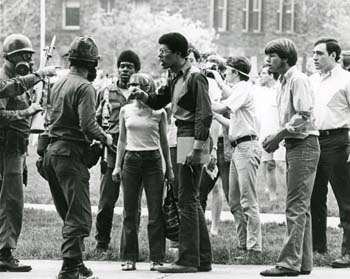
Students confront members of the National Guard.
Student demonstrations had become commonplace on the Columbus campus in the months leading up to May. The African American student group Afro-Am Society was one prominent group in these demonstrations, demanding better treatment of African American students by the university. Issues of race, sex, feminism, student involvement in the administration of the university, and the Vietnam War drove many students into demonstrations, disrupting the day-to-day operations of the university.[2]

Guardsmen with bayonets ready in front of Hayes
Hall.
The Ohio State University Archives began collecting eyewitness accounts on the fortieth anniversary of the demonstrations in 2010. One anonymous student recalled “Seeing National Guard vehicles riding around the Oval.” They were armed and “no one was sure if guns were loaded.” Another witness remembers participating in a student demonstration at the 1970 ROTC May Day review: “Very quickly several busloads of Ohio National Guard arrived. They kneeled in front of the protestors with rifles pointed at us. Angry words were shouted, and for a moment it looked like violence could ensue.”[3]
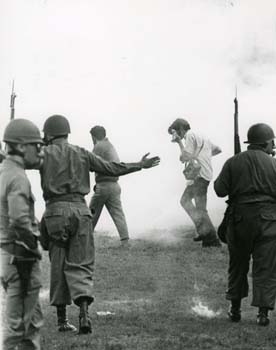
National Guard members shoot tear
gas onto the Oval.
After the shootings at Kent State University and following consultation with Ohio’s governor, the administration at Ohio State decided to close the campus in an attempt to prevent a similar scenario. Starting on May 7, 1970, the university shut down until May 19 that same year. Although no one was killed at Ohio State during the demonstrations, there were numerous injuries and property damage.[4]
For more information about this time period at The Ohio State University, Bill Shkurti’s book “The Ohio State University in the Sixties” covers these demonstrations and more. Please also see these resources from the University Archives:
Spring of Dissent: https://library.osu.edu/projects/spring-of-dissent/
The Lantern archives: http://digital.olivesoftware.com/Olive/APA/Ohio/#panel=home
Written by John Hooton
[1] “Spring of Dissent,” The Ohio State University Libraries Exhibitions, accessed May 2, 2017, https://library.osu.edu/projects/spring-of-dissent.
[2] “Spring of Dissent,” The Ohio State University Libraries Exhibitions.
[3] “Spring of Dissent,” The Ohio State University Libraries Exhibitions.
[4] “Spring of Dissent,” The Ohio State University Libraries Exhibitions.



Recent Comments