From Woody's Couch

Our Playbook on OSU History

Page 26 of 105

As Woody Hayes would say, fan paid it forward with his love of Buckeyes football

Here at the Archives we come into contact almost on a daily basis – particularly during football season – with devoted Buckeye football fans. Most are looking for photos or statistics or articles about

Woody Hayes commemorative plate

Woody Hayes commemorative plate, 1970

their favorite players or coaches. In fact, we have a whole collection of materials related to Woody Hayes, the head coach with the longest tenure and most wins in the history of the program. We have letters, speeches, photos, artifacts, and lots of other material related to Hayes’ life and career. The collection is open to fans and serious researchers alike.

Now we add a commemorative plate of Coach Hayes to the collection, and while this would not appear to be unusual, the family who donated it – the Pattis of Akron – took the time to contact the Archives and to send the artifact to us in order to preserve the legacy of love that Michael Jerome Patti, who passed away last April at the age of 67, had for Buckeye football for more than 50 years.

Mike came into possession of the donated plate in 2003 at about the time of the Buckeyes’ National Title win over Miami when his nephew, Andy Flores, a resident of Lewis Center and ardent Buckeye fan, gave the plate to him. Andy had found the plate on eBay and chose it for his uncle Mike since he was sure he would treasure it, which he most certainly did, displaying it reverently in his home. When Mike’s son, Keith, wrote to us in September that he would like us to consider adding the plate to our collections, he wrote that “it would mean so much to my family that Ohio State carries on my dad’s legacy of a loyal fan.”

Mike Patti, wearing his OSU cap, and his wife, Lynn, congratulate their son, Keith, at his Air Force graduation in 2009

Mike Patti, wearing his OSU cap, and his
wife, Lynn, congratulate their son, Keith, at his Air
Force graduation in 2009.

And loyal he was. Mike, a native of Akron who never attended OSU, earned his bachelor’s degree in mathematics education from the University of Akron. While attending school with a full course load, he also worked as an assistant manager at a local McDonald’s to finance his education.  He graduated in 1971.

Despite Mike’s time constraints, he always made time to cheer on the Buckeyes, especially during the 1969 Rose Bowl where the team clinched the National Title. Mike also was as steadfast in his devotion during the losses as with the wins. Fast forward to 2000, during the fourth quarter of the game

against South Carolina, when the Patti clan was sitting down to eat. Mike, according to his other nephew, Ben, another loyal Buckeye, would not leave the television “even during what felt like the worst loss in the history of OSU football.”

Ben also recounted a similar story about Mike wanting to share his enthusiasm with the family: “I will never forget him driving me home from his neighborhood one year. I must have been eight, maybe nine years old. I know it was hard for him to not watch the Buckeyes football game, but nevertheless, he was happy to take me home even after a long night of trick-or-treating. I tried so hard to keep my eyes open in the car and listen to the
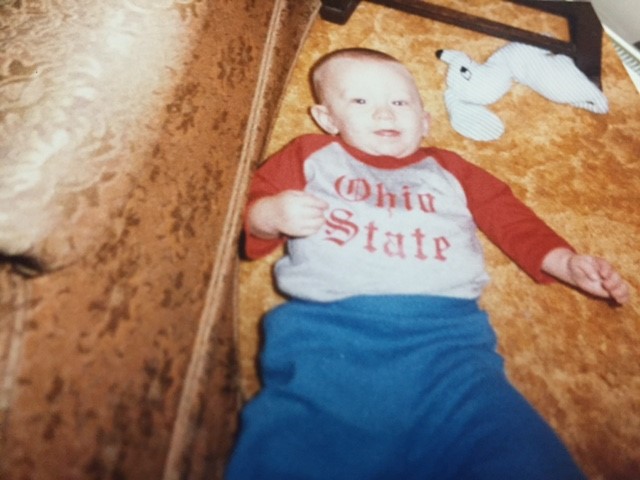
Keith Patti displays an outfit chosen by his father, Mike, in 1984.

Keith Patti displays an outfit chosen by his
father, Mike, in 1984.

game. He was so excited, cheering for every play and cursing at every penalty. Eventually I was awakened by him shaking me and yelling, ‘Ben, wake up – the Buckeyes are going to the Rose Bowl!’ Even in October, he was so optimistic.”

For the three of them – Keith, Ben, and Andy – the inclusion in the Archives of one of their respective father and uncle’s most prized possessions of his Buckeye fandom is very gratifying, since all three carry on Mike’s dedication to the Buckeyes.

An autographed photo from then-coach Jim Tressel.

An autographed photo from then-coach Jim
Tressel.

Over the years, we have received many commemorative artifacts related to OSU football – pins, buttons and even drinking glasses. We are thankful for each of them because they demonstrate in a tangible way the connection that fans have to their treasured team. But we rarely have the opportunity to hear such a wonderful tale of a truly dedicated fan who was so beloved by his family.

When you watch The Game this weekend, think of all the devoted fans who have been there for the Buckeyes through thick and thin, and whose loyalty we help preserve here at the Archives. And of course, Go Bucks!

Frozen Fridays: ‘C’ is for Cook!

cook34_2a

Dr. Frederick A. Cook in 1908.

This blog post is part of the Frozen Friday Series, an A-Z journey of the Polar Archives.  Each week, we will feature some aspect of the history of polar exploration with a blog post written by our student authors.

During the Antarctic winter of 1898, Dr. Frederick A. Cook found himself trapped on the ship Belgica in the Antarctic with eighteen other men. The dark and damp conditions drove some men insane and brought each man to a state of depression and irritability. Later, his shipmates would recall Cook as “most popular man on the expedition…Upright, honorable, capable and conscientious in the extreme.”[i] History, however, was much harsher. Frederick Cook is typically remembered as the con man that tricked the world into believing that he had scaled Mount McKinley in 1906, and reached the North Pole in 1909.  Both claims would be contested.  As the Reader’s Digest explains, “the enigmatic Dr. Frederick Cook is either one of the greatest explorers of all time or a confidence man of exceptional talent.”[ii]

As a young man, Cook was a doctor with a small medical practice. Business was slow for the new doctor, and in his spare time, Cook began studying the Arctic. This interest led Cook to join Robert Peary’s 1891 expedition to Greenland. With the stated goal of defining the northern limit of Greenland, the expedition, with Cook as a star member, was a resounding success. It was on this trip that Cook demonstrated the resourcefulness and the adaptability that would prove his worth. Besides dealing with general medical problems. Cook set about studying everything he could about the Arctic including how to ski, speak the native language, and finding a solution to scurvy.

cook34_7e

The Belgica on its 1897 expedition to Antarctica.

Like many polar explorers, though, one adventure was not enough. In 1897, Cook joined the crew of the Belgica at the request of Commander de Gerlache. Due to travel delays, the Belgica did not reach Antarctica until January—very late in the exploring season. At the end of February, the ship entered the pack ice and was trapped. The crew found themselves stranded on an unprepared and under-equipped ship for the entirety of an Antarctic winter. Cook kept the crew healthy and in positive spirits, earning their praise. Based on his experience in the Arctic, Cook convinced his companions to eat fresh meat, warding off a plague of debilitating scurvy. Cook also found a solution for the “form of anemia peculiar to the polar regions,”[iii] which could cause insomnia, digestive concerns, and an erratic pulse that attacked the crew as the months without sight of the sun progressed. Deciding that this was due to lack of sunlight, Cook proscribed a “baking treatment”[iv] where the afflicted would lay nude in front of an open fire for several hours. This treatment raised spirits, cured symptoms. and gave the men more energy.

Cook also gave full expression to his improvising talents. He designed and built a light polar sled and a tent which one men could set up in five minutes. Cook’s ingenuity also freed the Belgica from its icy prison. As the polar summer approached, and the ice began to think about thawing, Cook proposed cutting two trenches stretching from the ship to the water. After several fits and starts, the plan worked and the Belgica broke free, making the crew the first to successfully winter in Antarctica.

cook34_17c

Denali (then Mount McKinley) as
photographed by Dr. Cook on one
of his expeditions to the mountain.

In 1903, Cook set out to scale North America’s highest mountain—Mount McKinley (now known as Denali and will be featured in our next post). Along with several others, Cook became the first to circumnavigate the mountain, but failed to reach the peak. Cook tried again in 1906 when he was initially thwarted by the weather and mislaid plans. After his original plans fell through, Cook and his companion Edward Barrill lingered on the mountain, looking for another route. Then, according to Cook, the weather changed and he and Barrill found a line of paths right up to the summit. They then, in only four days, descended from the mountain. When Cook returned from Alaska he received multiple awards and an overflow of praise for this accomplishment.

cook34_31q

News of Dr. Cook’s “success” in 1907.

Cook’s claim to have reached the summit was questioned almost immediately.  But Cook was off again on another adventure.  In 1907, he set off with sleds and dog harnesses of his own design, to reach the North Pole, something his old friend Peary had been trying and failing to do for years. Cook reached the Pole in late April with two Eskimos, but it took him over a year to return to his base camp and journey home.  In September of 1909, when Cook finally returned, he announced his success to the world. Several days later, Peary contested Cook with his own claim of success. Both men traveled to the pole with only a few companions, none of whom could take the necessary navigational readings to back up either Cook or Peary. Ultimately, neither could provide the necessary positive proof of their achievement. Nevertheless, Peary set out to thoroughly discredit Cook. Cook’s reputation never recovered.

cook34_3f

Dr. Cook in his later years.

In 1917, Dr. Cook was hired by New York Oil to prospect for oil based on his knowledge of geology.  He would eventually form the Petroleum Producer’s Association, which became one of the largest employers in Fort Worth.   This success was short-lived.  Cook was indicted on mail fraud charges in 1923 in relation to his oil business, and served time in Leavenworth.  Upon his release in 1930, he lived a relatively quiet life, until his death from a cerebral hemorrhage in 1940.  Cook received a death bed pardon from President Franklin D. Roosevelt. Cook’s daughter, Helene Cook Vetter, would go on to start the Frederick A. Cook Society to defend her father’s claimed achievements.

The Polar Archives holds the records of the Frederick A. Cook Society.  To learn more about Dr. Cook’s life and achievements, as well as the controversy surrounding him, visit our virtual exhibit : https://library.osu.edu/projects/frederick-cook/.

Text written by Autumn Snellgrove and edited by John Hooton.

[i] Reader’s Digest Antarctica, page 133

[ii] Exploring Polar Frontiers, page 153

[iii] True North, page 125

[iv] True North, page 125


Dog tag found in France returns to Ohio Family

p1040002Last spring, the University Archives was contacted by Stephane Renner, a Frenchmen, who said he had discovered an American Soldier’s World War II dog tag while metal detecting in the Rosny sur alfred-l-bowlandSeine forest in northern France.  Renner hoped the Archives could assist him in tracking down the soldier’s family, so the identification tag could be returned to them.  While the Archives staff typically handles only requests that involve the University, the staff felt compelled to help Renner find the soldier’s family.

Attached to Renner’s email was a photo of his find: a rusted dog tag that had weathered almost 75 years underground.  Engraved on the tag was the soldier’s name, “Alfred D. Bowland”, and his emergency contact, which was listed as Howard Bowland (which we later found out was his father).

facebook_-2034363001In an effort to find the family, Archives staff utilized Ancestry.com, and also searched through censuses, war registration cards and city directories.  Staff soon discovered that Alfred Bowland enlisted December 9th, 1941, as a result of Pearl Harbor. Bowland survived the war, got married 1947 and had three children.  He passed away in 1995 at the age of 80.

The Archives staff located Alfred’s son, Roger Bowland, to share the news about the identification tag recovered in France.  Soon after, the men in Ohio and France 953645dsc0044were introduced and connected over the newly discovered dog tag.

Renner sent Bowland the dog tag, along with a coin purse, ammunition and a ration of lemon powder that he also found next to the tag.  In exchange, Bowland sent Renner a photo of his father during his time in the war. Renner keeps the photo on the mantle to remind him of the find.

Veteran’s Day reminds us to thank all military personnel, like Alfred Bowland and his family, for the service and sacrifices they have made for their country.

dscn8594The Archives also is thankful to Stephane Renner and Roger Bowland for keeping us informed on their story and keeping history alive. A special thank you to Stephane Renner for his dedication to returning historical material to its rightful owner.

« Older posts Newer posts »