From Woody's Couch

Our Playbook on OSU History

Page 25 of 105

Frozen Fridays: ‘F’ is for Film!

This blog post is part of the Frozen Friday Series, an A-Z journey of the Polar Archives.  Each week, we will feature some aspect of the history of polar exploration with a blog post written by our student authors.
byrd-1933-poster-short-v3

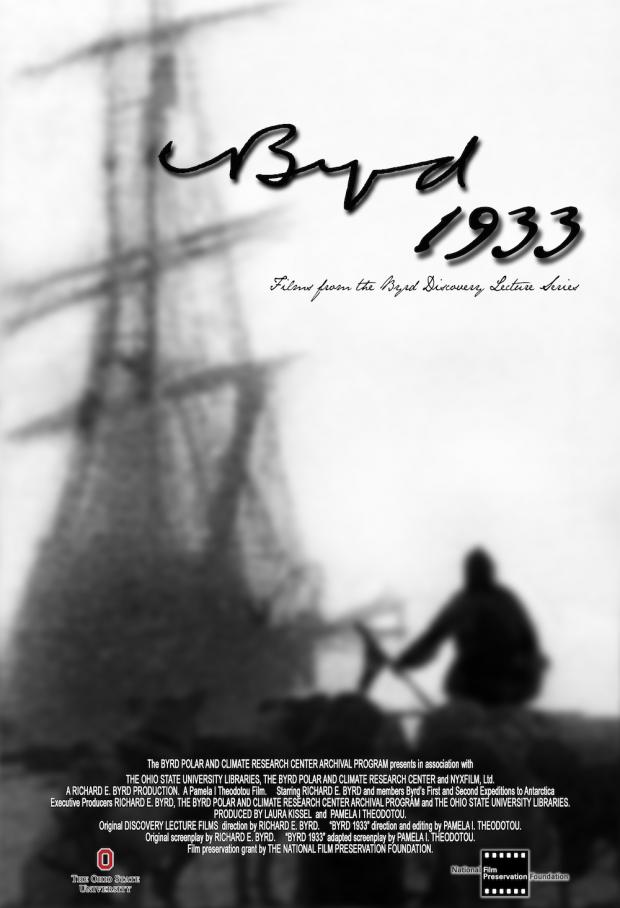
‘Byrd 1933’ was produced using
moving image film found in the Richard E. Byrd Papers.

Byrd 1933 is a documentary by filmmaker Pamela Theodotou,  created from footage filmed primarily during Byrd’s Second Expedition to Antarctica, 1933-1935. Originally known as the “Discovery Lecture Series,” preservation of the original films was made possible by a generous grant given by the National Film Preservation Foundation to the Byrd Polar and Climate Research Center Archival Program in 2013.

In the twenty-first century, it is easy for us to forget the work that goes into the production of a film. We live in an age where computer generated graphics can create special effects that otherwise would have existed in our imaginations alone. Though there are those filmmakers who go to great lengths to create spectacles by using ‘practical’ effects (which are in no way practical), even they are advantaged by modern technology. Much of the danger associated with traditional film-making is nonexistent in a digital environment, making the very concept of ‘film’ mean something different to us now than it did before. The great ‘exploration’ films and television shows of our time, such as The Revenant or Star Trek, differ in one very significant way when compared to the exploration films of the past: the worlds being ‘explored’ are well known to us or are simple constructions of technology and imagination. The ‘Wild West’ has been tamed for at least a century and man cannot yet travel through space with relative ease, for example. We know that the men and women working on those projects were safe for the entirety of production. The same cannot be said, however, for those cameramen shooting footage during Byrd’s Second Antarctic Expedition in 1933-1935.
2015-10-19-1445239989-7831860-byrdpolaradmiralbyrdcollectionpups

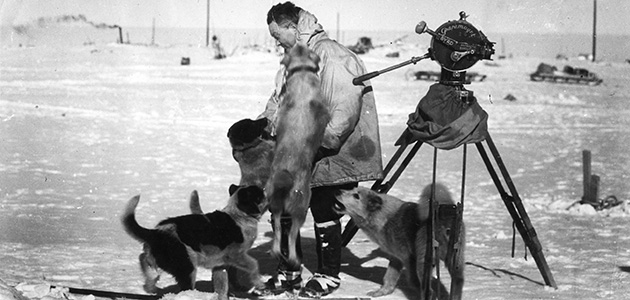
A still from ‘Byrd 1933’ featuring
Byrd and some dogs.

Several  cinematographers from Paramount Pictures[1] accompanied the famed explorer Richard E. Byrd on the expedition, with the purpose of bringing Antarctica back to the public. The aim was to create a feature film of the expedition, one that would rival that of a film produced in Hollywood. While moving images of Antarctica had been brought back to the United States before, it was not of this caliber[2].  The Antarctic, with its freezing conditions and other environmental hazards, was in many respects the last ‘frontier’ for mankind. Relatively little was known about the continent.

According to Pamela Theodotou, creator of Byrd 1933, the imagery captured by this film crew is best compared to famed photographer Ansel Adams.
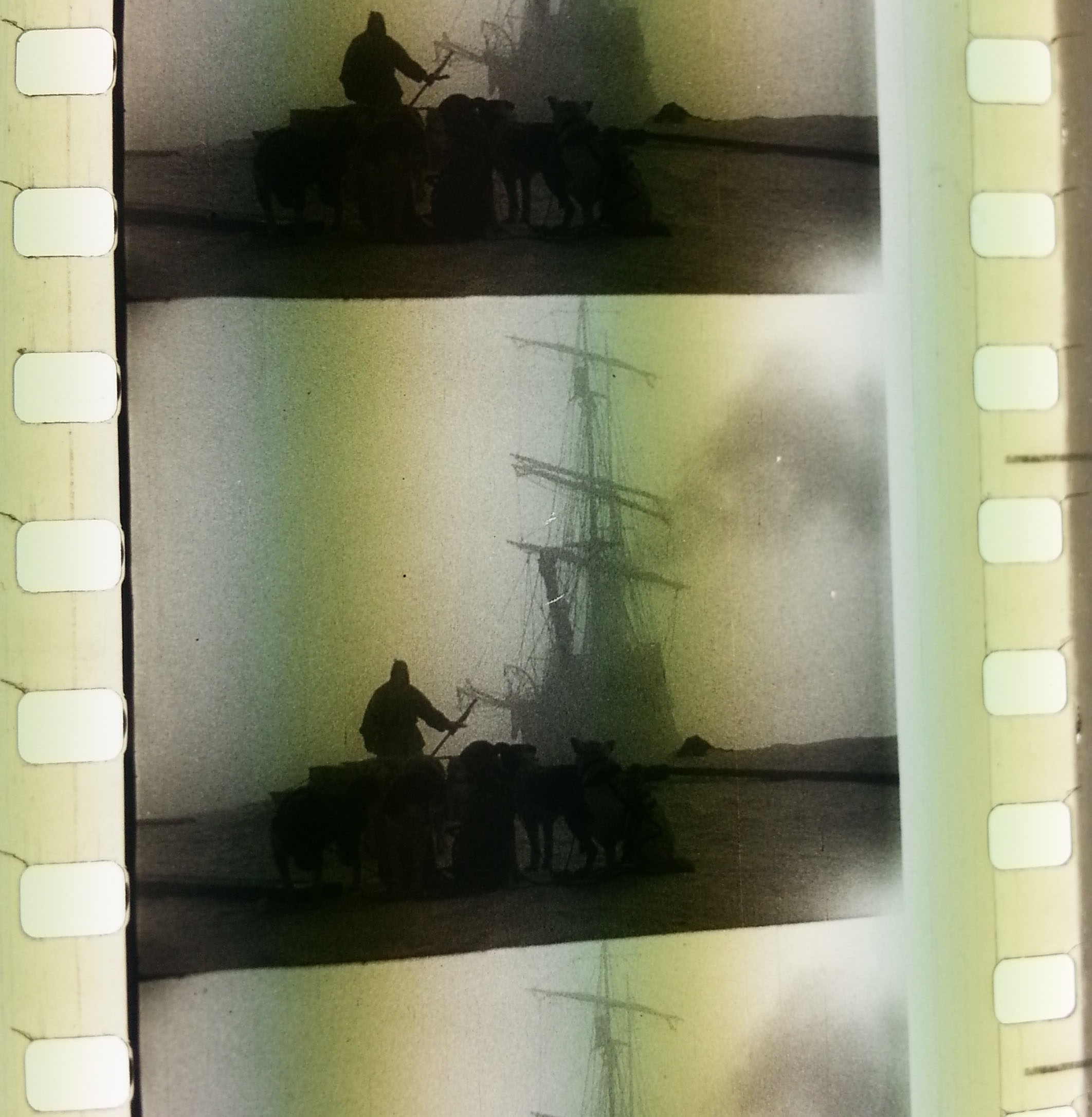
image-from-8517

Film used in ‘Byrd 1933’.

But what is truly remarkable is the work and struggle that went into the production of this footage. Filming is difficult under the best of conditions. One must worry about lighting, angles, and exposure times. Film development is a difficult and time consuming task. Now, imagine doing all of this in Antarctica, under freezing and dangerous conditions not only to yourself, but the film that often contains shots that may be irreplaceable. Pamela Theodotou writes on the process:

With temperatures at times 75 below zero, mechanics don’t work well and freeze solid; never mind the danger of film emulsion staying intact as it is wound around a spool inside the camera as it is turned. There were many reports of the camera freezing up, the oil used to lubricate them notwithstanding the cold, and lenses crusting over with ice crystals constantly if you breathed too close to them… The extreme cold complicated everything, equipment froze within minutes, mechanics ceased up, lenses fogged quickly if not handled carefully. And that was just the process of shooting. Complicating matters was the process of developing the film in those conditions… Never mind the developing of motion picture film. In photography you might have a roll of 36 pictures to develop into 36 images. These cinematographers had to develop hundreds of thousands of frames because one second of film is generally 24 frames a second.[3]

dsc_0016

Many reels made on the
Second Byrd Antarctic Expedition
(1933-1935) have become dust.

The actual process of filming and developing that film was a daunting task. Developing meant eighteen hours of work in absolute darkness to preserve the images on the film.[4]

The filmmakers endured the same conditions as the other members of the expedition. They faced the same cold, the same hazardous terrain, the same threats brought by ice. The film crew worked in these conditions with tools and resources that were not meant for the freezing cold.

It can be awe-inspiring when one considers what had to be done in order to shoot this film.  If one is in the local Columbus area, please consider joining us at the Westerville Public Library when Byrd 1933 is screened there on Friday, March 24 by the Westerville Historical Society. One can also view Byrd 1933 this coming April at the Ohio History Connection as part of its “Exploration Weekend.”

For more information on both events and the eventual release of Byrd 1933 to the public, please visit the Polar Archives.

For more information about filmmaker Pamela Theodotou and the process of creating Byrd 1933, please visit the film’s website .  Video content is featured, including the trailer, an introduction to the film given by Pamela Theodotou herself, and several featurettes!


[1] Pamela Theodotou, e-mail message to author, November 03, 2016.

[2] Pamela Theodotou.

[3] Pamela Theodotou.

[4] Wallace West, Paramount Newsreel Men with Admiral Byrd in Little America (Racine: Whitman Publishing Company, 1934), 32


Works Cited

West, Wallace. Paramount Newsreel Men with Admiral Byrd in Little America. Racine: Whitman             Publishing Company, 1934),


Written by John Hooton.
Frozen Fridays: ‘E’ is for Explorer!

This blog post is part of the Frozen Friday Series, an A-Z journey of the Polar Archives.  Each week, we will feature some aspect of the history of polar exploration with a blog post written by our student authors

09_10_2013_shackleton-e1378828023512

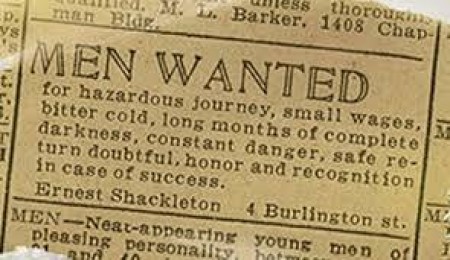
The famous ‘advertisement’ in the Times

“Men wanted for hazardous journey, small wages, bitter cold, long months of complete darkness, constant danger, safe return doubtful, honor and recognition in case of success.”[1] And so read an advertisement supposedly printed in the London newspaper The Times[2], submitted by the famed polar explorer Sir Ernest Shackleton sometime in the early twentieth century. The ad might also have read something like “men needed for mission to boldly go where no man has gone before,” and would retain no less accuracy or meaning. Simply, the advertisement is a call to arms, asking young men to set aside their lives at home for the exotic, the dangerous, and the unknown in the name of personal glory and adventure. Although this advertisement likely never existed as it has been presented,[3]it does capture something of the mentality required by the explorer: a willingness to endure harsh conditions for great amounts of time, courage in face of possible injury and death, and extended time apart from loved ones, all for the sake of a chance for personal heroism. These real-life Captain Kirks existed well into the modern era.

wilkins36_6_55

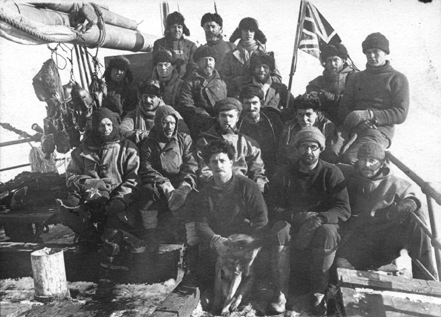
The members of Shackleton’s 1921 expedition
to the Antarctic.

By 1900, the world had shrunk significantly. Europeans had mapped the ‘darkest’ parts of the world; plunging into the heart of Africa and the mountains and deserts of Asia seeking to expand the breadth of Western knowledge.[4] Those blank spaces on the map had all but been filled in, apart from the cold, harsh Antarctic. In the toilsome and disheartening years of the Great Depression, the words “Dicky’ Bird is going south again” inspired in the hearts of many Americans, “tired of the deadly squabbles between Europe’s dictators and democrats and ground down by the daily effort to make or find a living in the midst of constant privation”, a feeling of romantic wonder and national pride[5]. The collections of the Polar Archives at the Ohio State University has the papers of many such polar explorers, including Admiral Richard E. Byrd and Sir George Hubert Wilkins, men who could be considered the embodiment of polar heroism and held the deep adoration and fascination of the American public.

wilkins35_9_1

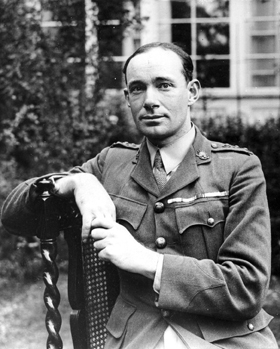
Sir George Hubert Wilkins

Not only were Byrd and Wilkins considered heroic in the eyes of the public, the men with whom they served also saw them as heroes. One man serving under Wilkins described him in 1933 as “a wonderful leader” and wrote that Wilkins “never made decisions without giving us the opportunity either of making suggestions or of declining to undertake tasks if we felt unable to carry them out. But I think that most of us trusted Sir Hubert so implicitly that we gladly followed his ideas.”[6] Another member of that same expedition claimed that he “looked up to Sir Hubert as a dog does to his master. It was a tremendous honour to serve under such a great explorer.”[7] Wilkins always put the needs of the crew in their proper place of importance. When his plane, the Polar Star, was ruined before it could be flown over the Antarctic, Wilkins worked diligently with young men half his age to transport, by hand, heavy sledges of supplies for ten hours each day in thirty degrees Fahrenheit below zero against heavy winds for the purpose of another flight attempt the next spring[8].

byrd7640_4

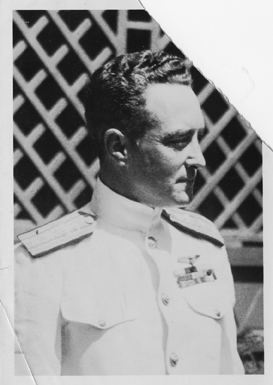
Admiral Richard Evelyn Byrd

Admiral Richard Byrd held those characteristics one would find common amongst the greatest of leaders and explorers of any generation. Claude Swanson, a lifelong friend of the Admiral, found that Byrd’s “father’s indignant denunciations of foolhardiness were more than justified”[9]. A childhood friend of Byrd who accompanied a young Byrd on his travels across the globe, “attributes some of his gray hair to the anxiety accompanying his efforts to locate the young daredevil who had managed to slip away on his Filipino pony and join a sheriff’s posse…who were…rounding up a group of desperate bandits.”[10] Along with this proclivity towards adventure imbued in Byrd seemingly at birth was a profound sense of duty to others. This manifested itself best in relation to the men of Byrd’s First Antarctic expedition, 1933-1935. When a party of geologists left Little America I on a mission, their plane and only method of transport was swept away and destroyed in a storm with winds of over hundred miles per hour[11]. The men were stranded for several days before they heard Byrd, flying above on a mission of rescue[12]. Upon returning to the United States and the lands of warmth (or at least not eternal cold) after his expedition, Byrd was likely to be voted a special medal of honor by Congress[13]. Byrd then asked that medals be awarded to his men instead, to which Congress agreed[14].

byrd7763_4

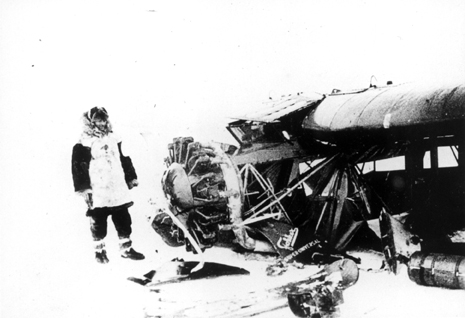
The ruins of the plane destroyed in Byrd’s
First Antarctic Expedition (1928-30).

Wilkins and Byrd were the explorers of their time. To their men and to the public, they were reincarnations of the mythical explorers of old. Their actions spoke louder than their words, but that is not to say that their words were not already heard and appreciated.

One can learn more about Byrd and Wilkins and their incredible lives of exploration and adventure at the Polar Archives at the Ohio State University.


[1] Colin Schultz, “Shackleton Probably Never Took Out an Ad Seeking Men for a Hazardous Journey”, Smart News, September 10, 2013, http://www.smithsonianmag.com/smart-news/shackleton-probably-never-took-out-an-ad-seeking-men-for-a-hazardous-journey-5552379/?no-ist.

[2] Shultz, Shackleton “Probably Never Took Out an Ad”.

[3] Shultz, Shackleton “Probably Never Took Out an Ad”.

[4] Lisle A. Rose, Explorer (Columbia and London: University of Missouri Press, 2008), 2.

[5] Rose, Explorer 1.

[6] Simon Nasht, The Last Explorer (Sydney: Hodder Australia, 2005), 260

[7] Nasht, The Last Explorer 261

[8] Nasht, The Last Explorer 260-261

[9] Claude A. Swanson, introduction to Discovery, by Richard E. Byrd (New York: G.P. Putnam’s Sons, 1953), vii.

[10] Swanson, introduction vii.

[11] Antarctica, 2nd ed., s.v. “Conquest by Air.” (Surry Hills: Reader’s Digest, 1990)

[12] Antarctica, “Conquest by Air”

[13] Swanson, introduction xiii

[14] Swanson, introduction xiii

Works Cited

“Conquest by Air.” In Antarctica, 2nd ed. Surry Hills: Reader’s Digest, 1990.

Nasht, Simon. The Last Explorer. Sydney: Hodder Australia, 2005.

Rose, Lisle A. Explorer. Columbia and London: University of Missouri Press, 2008.

Schultz, Colin. Shackleton Probably Never Took Out an Ad Seeking Men for a Hazardous Journey. Smart News, September 10, 2013. http://www.smithsonianmag.com/smart-news/shackleton-probably-never-took-out-an-ad-seeking-men-for-a-hazardous-journey-5552379/?no-ist.

Swanson, Claude A. Introduction to Discovery, by Richard E. Byrd, vii-xv. New York: G.P. Putnam’s Sons, 1953.

Written by John Hooton.

Frozen Fridays: ‘D’ is for Denali!

This blog post is part of the Frozen Friday Series, an A-Z journey of the Polar Archives.  Each week, we will feature some aspect of the history of polar exploration with a blog post written by our student authors

cook-ovs-2acrop

Denali, as photographed by Dr. Frederick Cook.

Mount Denali, located in central Alaska, is the highest mountain in North America. First sighted in 1794,
the mountain is in such a remote area that it would not appear on any maps of the area until 1830, and it would not be summited until 1913.

In 1897, gold prospector William Dickey called it Mount McKinley after Ohioan William McKinley, who had just been named the Republican presidential candidate. This officially became the name after McKinley was assassinated a few years later. The mountain was officially called McKinley until 2015, when President Barrack Obama officially returned the mountain to its Athabascan name, Denali, which means “the great one.”

national-park-service-2

Denali is the highest mountain
peak in North America.

The mountain has two distinct peaks: a shorter northern peak which reaches 19,470 feet and a southern peak which tops out at 20,320 feet. At such a height, Mt. Denali is one of the highest mountains in the world based on the traditional measurement, which is the mountain’s height above sea level. Measured from base to peak, however, and Denali becomes the tallest land-based mountain at eighteen thousand feet—much taller than Mt. Everest’s twelve thousand feet.

Denali’s height and location play a monumental role in the mountain’s weather and shape. Because the Earth’s atmosphere curves around the planet unevenly, Denali nearly reaches the edge of the troposphere and comes very close to the jet stream. Under certain conditions, the jet stream can unleash winds of over one hundred miles per hour at the peaks. These winds can triple in velocity while traveling down the mountain. Anything unfortunate enough to be in the wind’s path—climbers, loose rocks, snow—is stripped off the mountain.

national-park-service-1

A modern-day view of Denali.

In addition, because the summit is so close to the lower atmosphere, oxygen levels only reach about sixty percent of the oxygen available at sea level. Added to the perpetual snowfall, frequent avalanches, hidden fissures under the ice, endlessly steep terrain, and a reputation for sudden storms, this makes Denali one of the world’s most difficult mountains to climb.

The first attempt to climb the mountain came in 1903. Five men, led by James Wickersham and aided by numerous locals, tried to scale the Northern Peak but had the misfortune to pick the most challenging route. They turned back after eight thousand feet.

Just a few months later, experienced polar explorer Dr. Frederick Cook decided to make his own attempt at the summit. Cook believed that his knowledge of polar regions—which are remarkably similar to the conditions on the mountain—would give him an edge. This first attempt failed, however, due to Cook’s poorly chosen route, bad planning and an amateur crew. Cook and his party did manage to circumnavigate the mountain, which was a major accomplishment, and would not be repeated for fifty years.

cook34_29-fake-peak

The “summit” of Denali as
photographed by Dr. Cook.
This photo, along with his claim of
reaching the peak,
were proved to be false.

Cook opted to try again three years later. This attempt did not fare much better than his 1903 expedition. Cook had extensive trouble ferrying his men and horses across the streams, passes and swamps of the lower mountain. Realizing in late July that further climbing would be futile, Cook instead prepared for a scheduled big game hunt with a sponsor. When this sponsor did not appear as planned, Cook took the opportunity to return with two men to further explore the mountain. That September, Cook returned claiming to have reached the summit and return in mere twelve days (eight to ascend and four to return). It would not be long before Cook’s claim was contested by those who had attempted to climb the mountain themselves, including members of Cook’s own expeditions.  Yet, at the time, there was no hard evidence to prove otherwise.  Cook returned to the continental U.S. a hero, and quickly turned his attention to the North Pole.  On July 7, 1907, he and a wealthy benefactor set off for Greenland, and a subsequent attempt to reach the North Pole.  Cook would not return to civilization until 1909 – and thus, he was unavailable to answer any questions or respond to any scrutiny about his Mt. McKinley claim.

Meanwhile, doubters tried to repeat Dr. Cook’s route to prove that he had not summited McKinley as he had claimed.  It wasn’t until June 7, 1913, that Walter Harper, Harry Karstens, Hudson Stuck and Robert Tatum achieved the summit.


To learn more about this amazing and beautiful place, visit the National Park Service’s website here.

And to learn more about Dr. Cook and his role in the history of Mt. McKinley, visit our online exhibit about Dr. Cook here.

Finally, for a book that lays out the controversy, including photographic evidence, we recommend The Dishonorable Dr. Cook, by Bradford Washburn.

Written by  Autumn Snellgrove and edited by John Hooton.

« Older posts Newer posts »