From Woody's Couch

Our Playbook on OSU History

Page 24 of 105

Frozen Fridays: ‘I’ is for Igloo!

This blog post is part of the Frozen Friday Series, an A-Z journey of the Polar Archives.  Each week, we will feature some aspect of the history of polar exploration with a blog post written by our student authors.
g733c985r

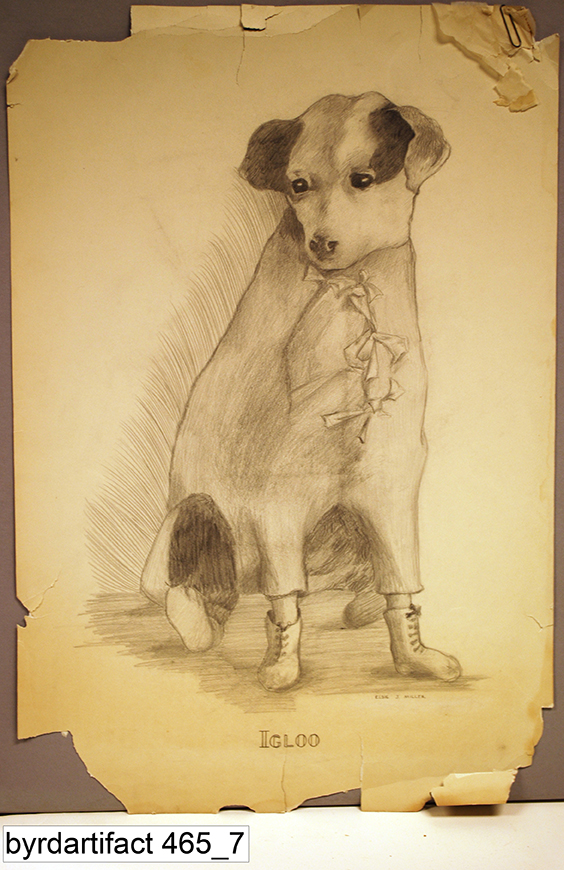
A sketch by Elsie J. Miller of Igloo
in his signature jacket and booties.

A decade before the Second World War, America’s second most famous contemporary polar explorer passed away, leaving a loving nation and a heart broken family in grief[1]. This little American polar explorer had gone to the farthest reaches of the Earth, travelling with his companion, Admiral Richard E. Byrd, experiencing all of the hardships associated with polar expeditions. He was a fox terrier and his name was Igloo.

While dogs were a common sight on polar expeditions in the early twentieth century, fox terriers were not. Put simply, one would not want to rely on such a small animal for transportation. Sled dogs have been used throughout history for transportation purposes in cold, snow covered areas of the world, particularly in Siberia and Alaska[2]. They often resemble their wolf ancestors and have several traits that make them particularly useful in exploring the Arctic and Antarctic regions[3]. Sled dogs have thick coats with greasy long hair for better insulation as well has fluffy, curly tails for the purpose of covering their paws and noses while sleeping[4]. Sled dogs also have an arrangement of blood vessels in their limbs to protect against freezing. Interestingly, they have also developed webbed feet that act as a sort of snowshoes in addition to the habit of eating practically anything provided to them[5]. One could say, quite aptly, that these sled dogs were bred to pull sleds.

byrd7780_5

Two sled dogs take a break during
Admiral Byrd’s first Antarctic Expedition (1928-1930).

The value of dogs in Antarctic expeditions was exemplified in Roald Amundsen’s expedition to the South Pole in 1911 [6]. He utilized ninety-seven dogs, including fifty-five Eskimo dogs (considered to be the best breed for use in the Antarctic), and used Inuit methods (methods deemed most efficient for the Antarctic and allowed extreme efficiency for the use of the dogs’ energy) to achieve a whopping seventeen miles per day[7].  Dogs would continue to be used as a necessary part of Antarctic expeditions until around the 1960s[8].

As all dog lovers are sure to understand, there is a certain comfort to be gained from the presence of man’s proverbial “best friend”.

byrd7785_1

Igloo makes a new friend.

This is their secondary function on polar expeditions. The dogs themselves, while often aggressive towards one another, are “very tame and affectionate towards humans”[9]. Indeed, “dogs continued to have a valued place on Antarctic bases, where the companionable dogs made the sometimes hard life more bearable”[10]. This was the purpose of our little Igloo. He was small, not like the sled dogs. He didn’t have the fur or the blood vessel arrangement necessary to survive unaided in the cold. He had to wear little shoes and a little dog jacket[11]. Igloo served as an object of adoration, not only for the crew on Byrd’s expeditions, but for millions of Americans[12]. One can plainly see the creature of joyful curiosity that was Igloo upon his discovery of the sort of snow that exists up north:

byrd7676_3

Igloo gladly meets his adoring public.

“The soft, yielding resistance of the snow was delicious to his paws. He sniffed it gingerly, then a red tongue emerged for a tentative lick. The sharp coldness took him by surprise… he emerged in a flurry of crystals, made a bee-line dash to the shack at the crest of the slope, then swept into a series of concentric circles that ultimately ended in his becoming a whirling dervish, enveloped in a minor snow storm of his own making.

He rolled in this delicious substance; he burrowed in it until his eyes were rimmed with frost.”[13]

So while not a sled dog, Igloo does serve as the example for non-transport related roles of dogs on Antarctic journeys. Boosting crew morale was essential to an expedition’s success during the isolation of a long expedition at the bottom of the world.
byrd7676_4

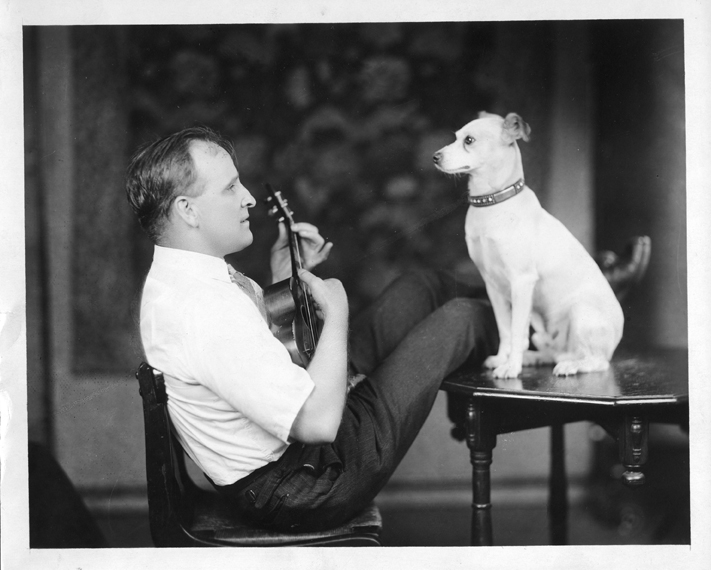
Igloo is serenaded by Richard Konter
(“Ukulele Dick”), a veteran of numerous Byrd
expeditions.

The use of dogs in the Antarctic was drastically reduced in the latter half of the twentieth century. By the 1960s, the dog sled teams had been replaced with “tin dogs”, more commonly known as snow mobiles and other mechanical methods of transport[14]. In fact, the use of dogs was banned from Antarctica by the Protocol on Environmental Protection to the Antarctic Treaty in 1992[15]. Despite this, our canine friends have certainly had a deep and lasting impact on mankind’s exploration of one of our planet’s most challenging environments.

Written by John Hooton.

[1] “Igloo, Byrd’s Pet Dog, Dies in Boston,” Lewiston Evening Journal, April 21, 1931, 2.

[2] William James Mills, “Dogs,” Exploring Polar Frontiers, (Santa Barbara: ABC-CLIO, 2003).

[3] William James Mills, “Dogs.”

[4] William James Mills, “Dogs.”

[5] William James Mills, “Dogs.”

[6] Antarctica, 2nd ed., s.v. “Sled Dogs.” (Surry Hills: Reader’s Digest, 1990).

[7] William James Mills, “Dogs.”

[8] Antarctica, “Sled Dogs.”

[9] Antarctica, “Sled Dogs.”

[10] William James Mills, “Dogs.”

[11] Jane Brevoort Walden, Igloo (New York: G.P. Putnam’s Sons, 1931), 54.

[12] “Igloo, Byrd’s Pet Dog, Dies in Boston,” Lewiston Evening Journal.

[13] Walden, Igloo, 54-55.

[14] Antarctica, “Sled Dogs.”

[15] William James Mills, “Dogs.”

Frozen Fridays: ‘H’ is for Highjump!

This blog post is part of the Frozen Friday Series, an A-Z journey of the Polar Archives.  Each week, we will feature some aspect of the history of polar exploration with a blog post written by our student authors.

The year is 1946. The United States is embroiled in the most dangerous international conflict in its brief history: The Cold War. The United States, hot off the Allied victory against Nazi Germany and Imperialist Japan in the Second World War, stands toe-to-toe with its former ally, the Soviet Union. For forty-six years, the world watched as these two giants fought each other in every conceivable manner, save yet another world war. Every continent in some way felt the chilling effects of the Cold War, even the frozen continent of Antarctica.  Antarctica felt “Operation Highjump.”

Admiral Richard Byrd, once again
returning to Antarctica.

“Operation Highjump”, officially the United States Navy Antarctic Development Project, 1946-1947, was the largest expedition into the Antarctic to date, perhaps even to the present.[1] It was the first expedition to Antarctica officially sponsored by the United States in over a century.[2]  

Four thousand and seven hundred men, led by none other than Admiral Richard Evelyn Byrd, carried out a “benign assault” on the frozen continent.[3] Task Force Sixty-Eight, the fleet assigned to the mission, consisted of a communications ship, two supply ships, two ice breakers, two seaplane tenders (a form of light aircraft carrier), two tankers, two destroyers, an aircraft carrier, and a submarine.[4] The communications vessel, serving as the flagship of the task force, was named the Mt. Olympus and was specially outfitted with fifty radio operators[5].

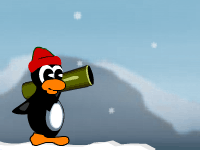
592183_200x150_1972_penguin_wars

An artists rendition of how a
penguin soldier may have looked.

Those poor penguins never stood a chance. That was a joke. Those thirteen ships and nearly five thousand men did not sail to Antarctica with the purpose of showing the penguins and seals the what’s what. Rather, the massive force was meant to accomplish what could be categorized into three broad goals: to train personnel and equipment under Antarctic conditions, to consolidate and expand United States claims in the Antarctic while investigating potential sites of United States bases and developing techniques for the establishment and maintenance thereof,  and finally to extend scientific knowledge of the Antarctic[6].

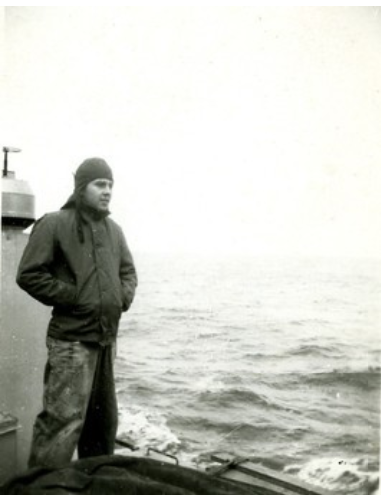
One of the thirteen ships taking part in "Operation Highjump".

One of the thirteen ships taking part in
“Operation Highjump”.

This was clearly and overtly a military mission in Antarctica. The Pentagon, realizing that a war with the Soviet Union would be chilling (to say the least), recognized that any war with the USSR would require polar combat.[7] Furthermore, the Pentagon wished to keep itself in the public eye. By launching a mission of such a spectacular size, the United States military insured that it would firmly remain within the public’s field of vision.[8]

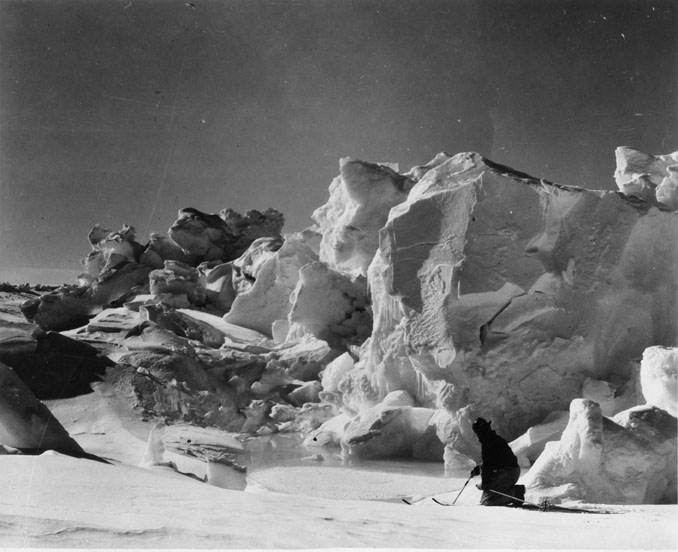
Though “Operation Highjump” was a success in that respect, the mission was, as a whole, a mixed success. While personnel were trained in the harsh conditions of Antarctica and several pieces of technology were tested in the freezing weather, the men of Task Force Sixty-Eight failed to produce aerial photographs

One of the images taken during "Operation Highjump".

One of the images taken during “Operation Highjump”.

capable of being used for the production of maps.[9] Though the photographs were successfully taken, a lack of ground control points made them nearly useless for mapping.[10] The icebreakers of the fleet proved to be incredibly effective, but the submarine brought to the Antarctic demonstrated that subs could not be used in the cold waters of the southern continent.[11] The expedition also contributed to the scientific community the first sufficient observations of Antarctic weather to produce twice-daily synoptic weather maps of Antarctica.[12]

“Operation Highjump” was the first time that the US sent a fleet into the Antarctic. It was perhaps the largest expedition to Antarctica in history.

Carl Hicks, a member of the "Operation Highjump" expedition.

Carl Hicks, a member of the “Operation
Highjump” expedition.

It is the only truly and completely benign invasion in history and was born in the cold-blooded Cold War. For more information on “Operation Highjump”, Admiral Byrd, or other incursions into the Antarctic, check out the Byrd Polar and Climate Research Center Archival Program! The Polar Archives has collections for several men serving in “Operation Highjump”, including Carl Hicks, George Kosco, and Anthony Morency.

Written by John Hooton.

[1] Kenneth J. Bertrand, Americans in Antarctica 1775-1948. (New York: American Geographical Society, 1971) 483.

[2] Antarctica, 2nd ed., s.v. “Operation Highjump.” (Surry Hills: Reader’s Digest, 1990).

[3] Antarctica, “Operation Highjump”.

[4] Bertrand, Americans in Antarctica 1775-1948, 485-487.

[5] Bertrand, Americans in Antarctica 1775-1948, 485.

[6] Bertrand, Americans in Antarctica 1775-1948, 485.

[7] Antarctica, “Operation Highjump”.

[8] Antarctica, “Operation Highjump”.

[9] Bertrand, Americans in Antarctica 1775-1948, 485.

[10] Bertrand, Americans in Antarctica 1775-1948, 485.

[11] Bertrand, Americans in Antarctica 1775-1948, 490-491.

[12] Bertrand, Americans in Antarctica 1775-1948, 484-485.

Frozen Fridays: ‘G’ is for Geographic South Pole!

This blog post is part of the Frozen Friday Series, an A-Z journey of the Polar Archives.  Each week, we will feature some aspect of the history of polar exploration with a blog post written by our student authors.

cook34_5b

Amundsen stands in Antarctica on the Belgian
Expedition (1897 to 1899).

The Geographic South Pole is, simply, the furthest south one can go. Located at simple latitude of 90⁰ South, this cozy little bottom of the world is surprisingly difficult to get to. Explorers tried for years to reach that easy-to-remember coordinate and it was not until a mere one hundred and five years ago that man finally reached the Pole. In fact, just last Wednesday, December 14, was the anniversary of famed explorer Roald Amundsen’s conquest of the South Pole in 1911. As with most tales of the heroism and determination by polar explorers, Amundsen’s achievement deserves more than a brief line in chronicles of Antarctic exploration or a brief word above a textbook timeline.

evans-scott-rep-a193

Robert Falcon Scott (right)
and Edward Evans, his
second-in-command, on
the deck of the Terra Nova.

It’s a classic tale of exploration: impossible conditions, a high stakes race, a great victory, and a tragic demise. In 1910, two expeditions led by veterans of the frozen continent arrived with the same goal in mind: to be the first to reach the Geographical South Pole. Roald Amundsen, leading nineteen men, commanded the Norwegian expedition.[1] Robert Falcon Scott, a relative upstart compared to his opponent, commanded the Terra Nova expedition to secure ‘for the British Empire the honour of that achievement’.[2] Though Scott received the adoration and respect from the British people upon returning from his first expedition to Antarctica six years prior, Amundsen had been a player in the polar circles since the 1890s when he joined the famous Belgian Antarctic Expedition, along with Dr. Frederick A. Cook (see our post about Dr. Cook for more information on the good doctor). These two men were embroiled in a competition of a most dangerous nature.

But this race was more than a competition between two men. It was a fight for the future of Antarctic exploration. Scott utilized a new technology, one that would prove later in the century to dominate the frozen fields of the Antarctic: the motor sledge.[3] Though not as efficient or effective as later motorized vehicles, the motors on Scott’s final expedition no less added to the dramatic nature of this struggle. Amundsen, on the other hand, relied on traditional methods, using dogs for equipment and personnel transportation.[4] Though Scott also used dogs to some degree on his expedition, he used them with less skill and thus they proved ineffective.[5] For Amundsen, however, his dogs proved vital to his victory (for more on the use of dogs in Antarctica, see our upcoming blog post for the letter ‘I’).

Both expeditions began on the frozen ice of the Ross Ice Shelf.[6] Having landed on January 14, 1910 and January 4, 1910, respectively, the crews of the Fram, Amundsen’s ship, and Scott’s Terra Nova prepared to winter until the next Antarctic Summer. 145135-004-402da76aEight men from the Fram left with eighty-six sled dogs on the eighth of September, 1911.[7] They reached the Pole almost four months later, [8] and Amundsen proved the victorious explorer.

In truth, the real drama lay not in the race itself, but rather in the story of Scott and his men, whose expedition was wrought with problems. And while they did eventually reach the Pole, that would only be one part of their journey.

Scott’s trek began with a limp; they could not leave their camp until late October, 1911,  a full two months after Amundsen had left his camp.[9] By mid-December, they were forced to kill off the last of their animals and were left hauling their own sledges.[10] The horses, weakened beyond use by the frigid conditions and difficult terrain, were shot on December 9th while the dogs were killed some time later for food. The men were exhausted, much more exhausted than Scott had anticipated in his planning.[11]The leader of his team, Teddy Evans, came down with scurvy before they completed their journey to the Pole.[12]

img-z21112245-0001

The cover of a welcoming guide to
the Amundsen-Scott South Pole
Station (circa 1970).

Scott and his men reached the South Pole on January 17, 1912; nearly two weeks after Amundsen had claimed his victory for Norway.[13] Needless to say, Scott was devastated. “The worst has happened,” he stated as he gave the news to his crew.[14] Unfortunately, this would not be the worst occurrence for Scott on this expedition. Scott and his men would not return to warmer lands. The expedition perished on their way back from the South Pole.[15] They were exhausted and froze in the harsh Antarctic conditions. Scott’s triumph and tragedy became a national symbol for the United Kingdom and several locations often visited by subsequent Antarctic explorers are named for Scott and have monuments to his journey.[16]

byrd7774_1

Admiral Richard Byrd in the Floyd
Bennett, the plane in which he made
his historic flight in 1929.

The Geographic South Pole represents one of the final terrestrial locations of exploration and achievement. Men competed for the honor reaching it. They gave up their safety, their time, their resources, and in all too many cases, their lives in pursuit of the honor of being first to reach its frozen point. Reaching the Pole did not become any less a point of yearning with Amundsen’s success. Admiral Richard E. Byrd reached the Pole by air in 1929. Many explorers to this day travel to the Pole to seek their own accomplishment and conduct crucial research in the study of global and polar climate.

For more information about Scott and his exploration, visit the Scott Polar Research Institute.  For more information on Amundsen, check out the Fram Museum in Oslo, Norway. Information on other explorers, including Admiral Byrd, can be found at the Byrd Polar and Climate Research Center Archival Program.


Written by John Hooton.

[1] Antarctica, 2nd ed., s.v. “A Professional in the Age of Amateurs.” (Surry Hills: Reader’s Digest, 1990).

[2] Antarctica, 2nd ed., s.v. “Scott’s Last Expedition.” (Surry Hills: Reader’s Digest, 1990).

[3] Antarctica, “A Professional in the Age of Amateurs.”

[4] Antarctica, “A Professional in the Age of Amateurs.”

[5] Antarctica, 2nd ed., s.v. “Sled Dogs.” (Surry Hills: Reader’s Digest, 1990).

[6] Antarctica, “Scott’s Last Expedition.”

[7] Antarctica, 2nd ed., s.v. “Amundsen Wins the Race to the Pole.” (Surry Hills: Reader’s Digest, 1990).

[8] Antarctica, “Amundsen Wins the Race to the Pole.”

[9] Antarctica, 2nd ed., s.v. “Triumph and Tragedy.” (Surry Hills: Reader’s Digest, 1990).

[10] Antarctica, “Triumph and Tragedy.”

[11] Antarctica, “Triumph and Tragedy.”

[12] Antarctica, “Triumph and Tragedy.”

[13] Antarctica, “Triumph and Tragedy.”

[14] Antarctica, “Triumph and Tragedy.”

[15] Antarctica, “Triumph and Tragedy.”

[16] Antarctica, “Triumph and Tragedy.”

« Older posts Newer posts »