From Woody's Couch

Our Playbook on OSU History

Category: Polar Archives (page 6 of 11)

Frozen Fridays: ‘P’ is for Penguin!

This blog post is part of the Frozen Friday Series, an A-Z journey of the Polar Archives.  Each week, we will feature some aspect of the history of polar exploration with a blog post written by our student authors.

‘Little Mo’ sits atop his post in the
University Archives.

‘P’ is for penguin. One penguin in particular. ‘Little Mo’, as we call him, was probably born somewhere in the Antarctic some eight or nine decades ago. He enjoys chilling at the Ohio State University Archives when he is stuffed. You see, that was a joke. ‘Little Mo’ is a stuffed (as in taxidermy) chinstrap penguin. ‘Mo’ was brought back to the United States from Antarctica at the end of the United States Antarctic Service Expedition (1939-41), but passed away in transit. Expedition member Anthony Morency then had the poor little penguin preserved and kept him as a family heirloom. ‘Little Mo’ found his way to the Polar Archives by way of Virginia Rich, daughter of Anthony Morency. Morency, who served under Admiral Richard E. Byrd on the United States Antarctic Service Expedition (1939-41), Operation Highjump (1946-47), and Operation Deep Freeze (1955-56), has a fascinating collection of artifacts housed at the Byrd Polar and Climate Research Center Archival Program. ‘Mo’ is but one example of the unique artifacts held within the archives. This blog post will highlight some of Morency’s most unusual artifacts.

The members of the East Base of the United States
Antarctic Service. Anthony Morency (second from
left, top row) and possibly ‘Little Mo’ (front row).

First, a cartoon. This cartoon (below) representing a portion of Task Force 68 of Operation Highjump (1946-47). The scene, playfully drawn in the fashion of a Disneyesque cartoon, depicts the supply ship Yancey of the Central Group (Task Force 68.1) of the Highjump fleet. Possibly meant to represent the mooring of the Yancey in the Bay of Whales and the unloading of supplies for the construction of Little America IV, the artist has drawn several concerned penguins and a scurrying crew of men dressed in Antarctic coats.  A scroll of text sits at the bottom of the cartoon. The text written on this scroll is a familiar sight in the Morency Collection: a tongue-in-cheek declaration commemorating the achievements of the relevant expedition (in this case Operation Highjump).

The public is encouraged to come to the archives and check out cool artifacts like this one!

“To all ye farers of the deep” (as on the cartoon) or some variant thereof marks the beginning of several certificates found in the Morency Collection. These declarations come from fictitious governments or organizations, such as the Imperium Neptuni Regis and the Silent Occult Mysteries of the Far East. The artwork on the “documents” is not uniform. Some depict Western legends such as mermaids and King Neptune, whereas others feature Eastern-style dragons and sea serpents. Others depict contemporary images of steel ships and expedition related images, like penguins. All of these certificates (below), presumably acquired by Morency on his many voyages, feature a common theme of nautical imagery and language.

Several of these certificates exist and can be found in the Morency collection.

These certificates often commemorated traversing a geographical feature, in this case the 180th meridian latitude.

This certificate utilizes Western nautical imagery that is common in the Morency certificates…
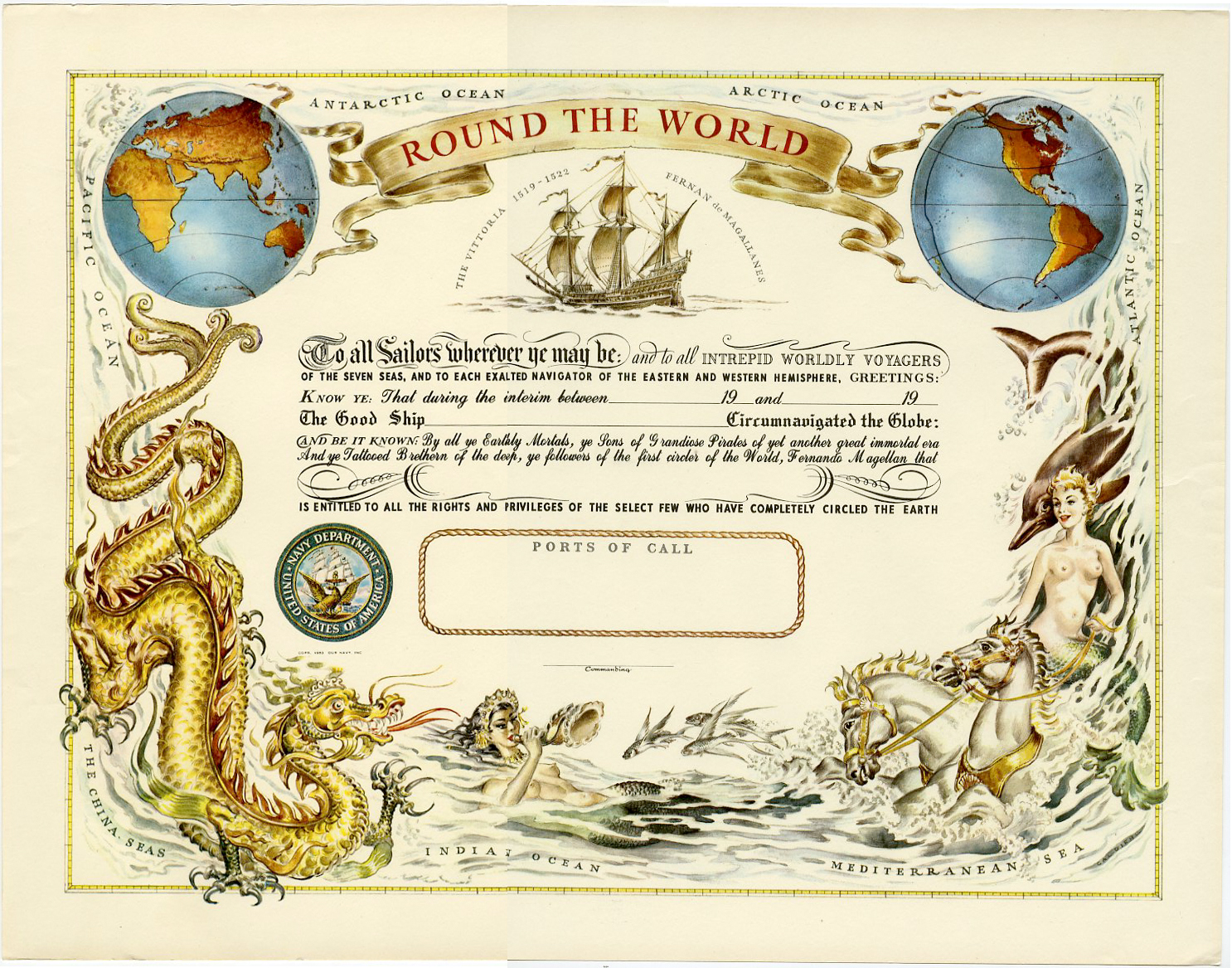
…whereas this one utilizes both Eastern and Western imagery to commemorate the circumnavigation of the globe.

The aforementioned cartoon rests in a large, thin booklet, humorously titled Bergy Bits after the chunks of ice not quite large enough to be icebergs. Published in April of 1947, Bergy Bits contains from cover to cover photographs taken during Operation Highjump. Bergy Bits tells the story of Task Force 68 through these photographs, from photographs of the force traveling to, working in, and traveling from Antarctica. The booklet itself is lighthearted and nostalgic, often making jokes relating to the photographs it holds. Bergy Bits contains images of majestic Antarctic landscapes, fun crew antics, curious wildlife, playful sled dogs, and even a Maori Poi dance party.
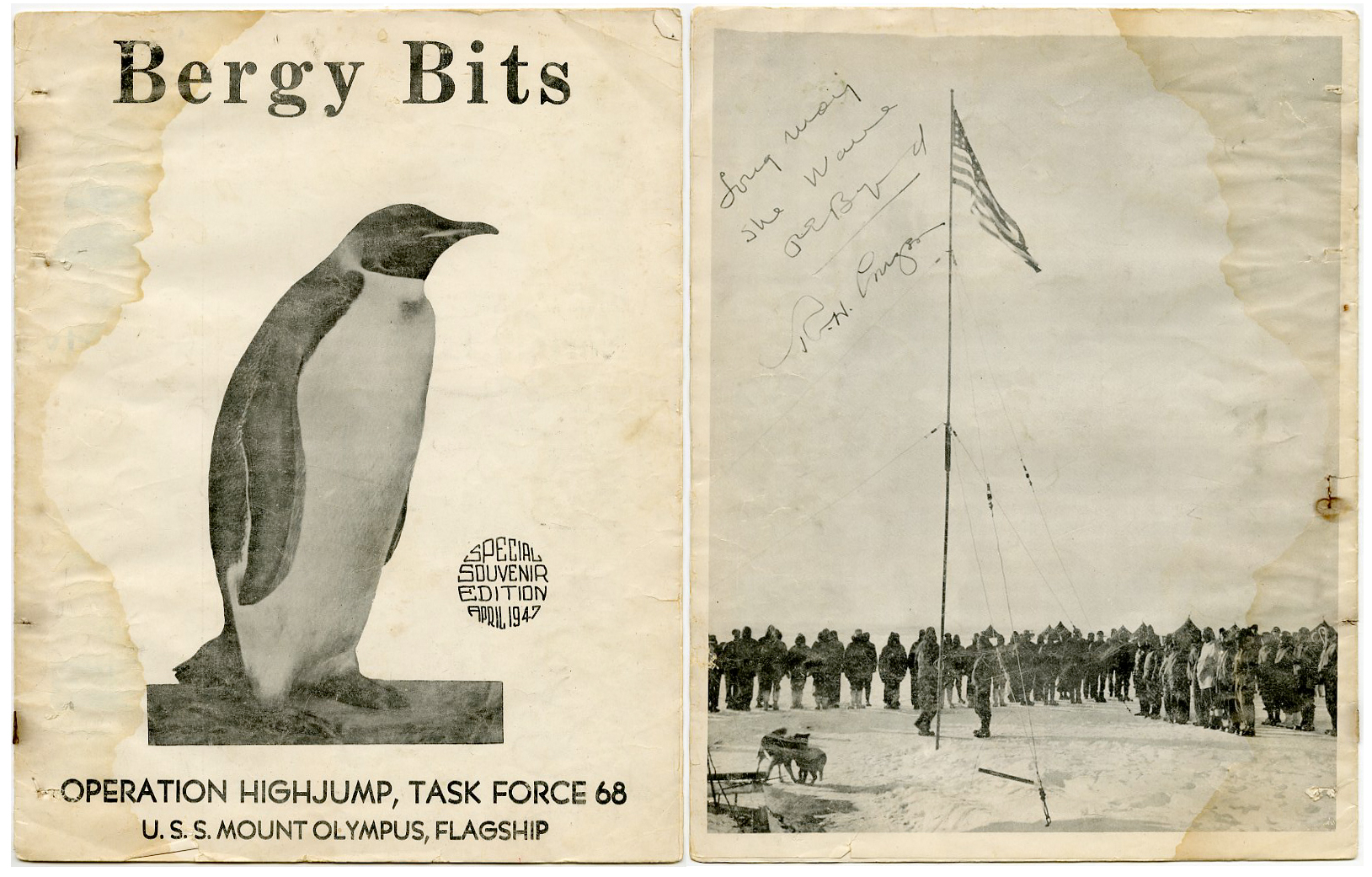
The front and back covers of ‘Bergy Bits’. The back cover (right) features the signature of Operation Highjump
leader Admiral Richard E. Byrd.
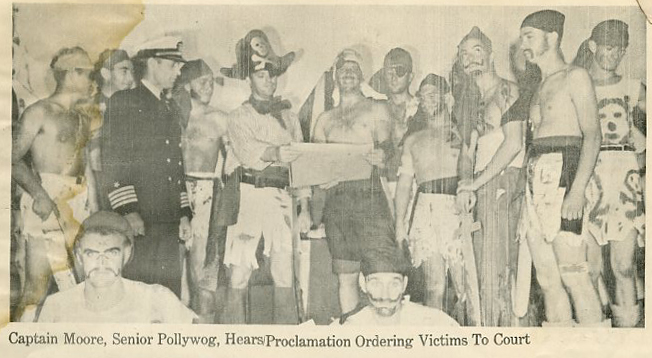
An example of humor in ‘Bergy Bits’. To err is human, to arr is pirate.

The Anthony Morency Papers, despite the name, do not just hold papers. Obviously, ‘Little Mo’, is not a three dimensional model constructed of paper. The Morency collection has, for example, a stunning pair of Operation Deep Freeze sunglasses (with case), a Deep Freeze engraved lighter, a United States Antarctic Program/National Science Foundation clothing patch, and even a placemat from Covey’s Little America, a travel center named for Admiral Byrd’s bases in Antarctica.
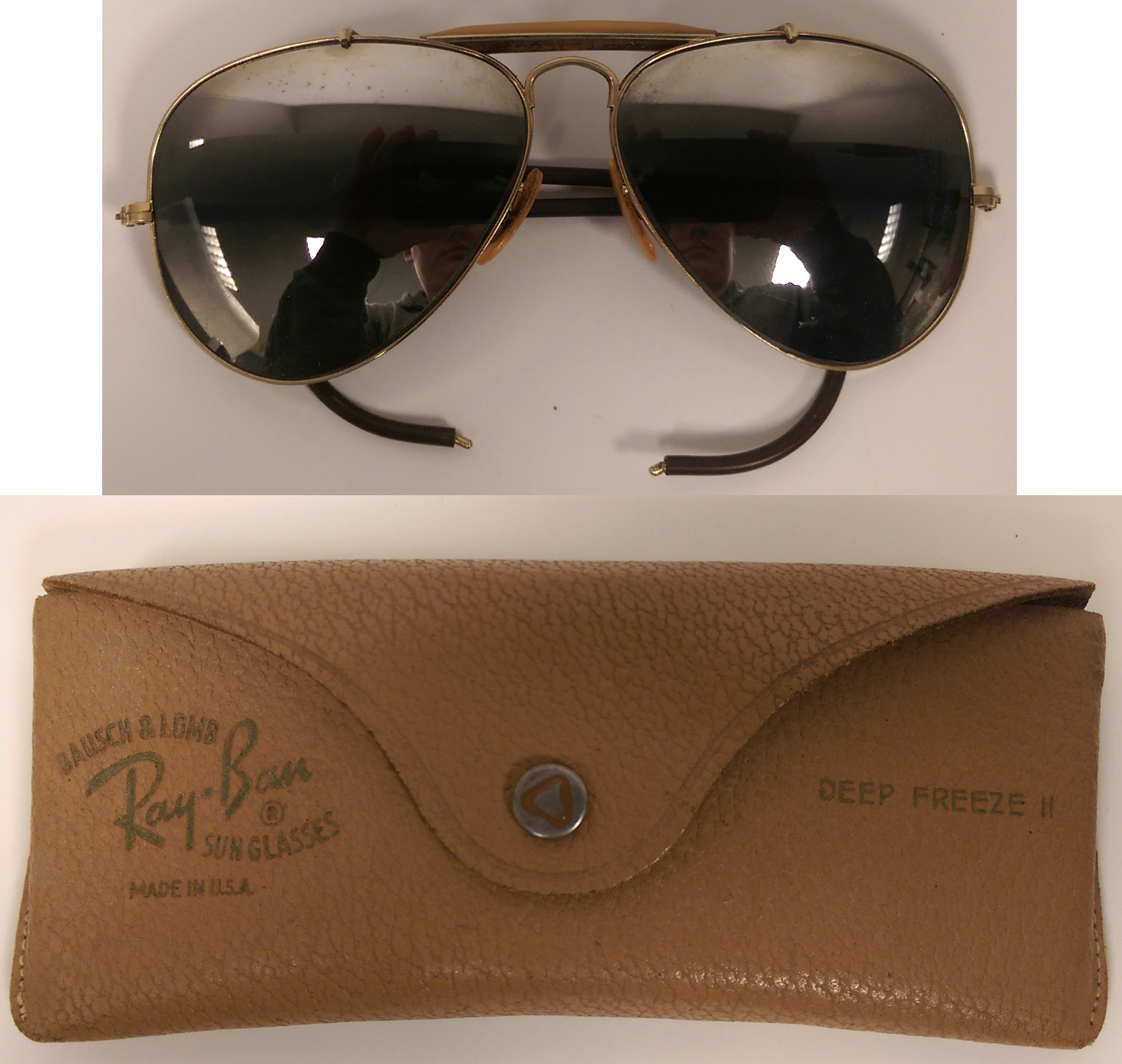
The sunglasses and their case that were used by
Anthony Morency during Operation Deep Freeze.

This lighter is engraved to
commemorate Operation Deep Freeze
II (1957-58), part of the continuing
missions to Antarctica by the United States
Military for the purpose of
maintaining an American presence on
the continent.

The Anthony Morency Papers is an eclectic collection of materials that, like many other collections in the Polar Archives, contain a great number of amazing artifacts. It is well worth a trip to the Byrd Polar and Climate Research Center Archival Program to check out our amazing materials!

Written by John Hooton.

Frozen Fridays: ‘O’ is for Outreach!

This blog post is part of the Frozen Friday Series, an A-Z journey of the Polar Archives.  Each week, we will feature some aspect of the history of polar exploration with a blog post written by our student authors.

‘Mysteries in Ice’ celebrated the 25th anniversary of the Byrd Polar and Climate Research
Center Archival Program.

Outreach has always been an important part of the efforts of polar explorers. For those individuals that would brave the frozen conditions of the most northern and southern regions of the world, there were two seasons: exploration season and funding season. In the words of famed explorer Admiral Richard E. Byrd, campaigning “follows a certain remorseless pattern- an exhausting period of preparation and begging, a heavy field campaign, and on top of that a dreary struggle to pay off accumulated debts, piling up like the layers of a cake.”[1] To Byrd, the effort was  worth it, as it was “a thousand times better…to face ruin in New York than accept the dreadful responsibility of starting south lacking a single bit of equipment… necessary for the safety of the men.”[2] This campaign often took the form of lecture tours, designed to present the scientific findings and experiences of Byrd’s exploits. Byrd would ‘vanish’ for months, going on lecture tours around the nation. He would spend half of his nights on a train and the rest of his time attempting to catch-up on correspondence he had received while away. Many of the letters came from children asking questions about the Poles. Byrd devoted much time to responding to these letters.[3]

Lynn Lay of the Goldthwait Polar Library engages
with young people at the ‘Mysteries in Ice’ exhibit.


The Byrd Polar and Climate Research Center (B.P.C.R.C.) and its Archival Program has continued this tradition of educational outreach.  Outreach takes a variety of forms, and includes exhibitions, tours, lectures, presentations of film and other media, classroom visits, and even lesson plans.  Of course, this blog is part of this outreach! In 2008, the B.P.C.R.C. Archival Program worked with teachers to create lesson plans for middle school and high school teachers. Cold Cases intends to teach students how to think historically in regards to sources and research methods. Cold Cases utilizes a wide range of sources, including diary entries, letters, photographs, reports, and memoirs, to accomplish this goal. Cold Cases can be found here!

Eileen McSaveney and Terry Tickhill take a breather
in Antarctica in early 1970.


For the twenty-fifth anniversary of the Byrd Polar and Climate Research Center Archival Program, the Thompson Library Gallery hosted a large exhibit of materials featuring historical archival materials as well as items that document current and past polar science. Running from October 5, 2015 through January 3, 2016,  Mysteries in Ice displayed clothing worn in Antarctica, an ice core from China, rock samples from remote regions, and more. The wider anniversary celebration featured footage from Admiral Byrd’s previously mentioned lecture tours, a panel of experts discussing the 2015 Paris Climate Negotiations, and even a talk given by Terry Tickhill Terrell, a member of the first all-women expedition to Antarctica.

This image of the ‘Byrd 1933’ poster
has been posted to this blog before,
but it is no less cool to look at!

Of course, the Byrd Polar and Climate Research Center and its Archival Program has more events coming up in the near future:

Check out one or more of these events and like our Facebook page!

Written by John Hooton.

[1] Richard E. Byrd, Discovery (New York: G.P. Putnam’s Sons, 1935), 9.

[2] Richard E. Byrd, Little America ((New York: G.P. Putnam’s Sons, 1930), 9.

[3] Sheldon Bart, Race to the Top of the World: Richard Byrd and the First Flight to the North Pole (Washington, D.C.: Regnery History, 2013), 419.

Frozen Fridays: ‘N’ is for North Pole!

This blog post is part of the Frozen Friday Series, an A-Z journey of the Polar Archives.  Each week, we will feature some aspect of the history of polar exploration with a blog post written by our student authors.

In this image celebrating the
reaching of the North Pole by
Cook and Peary, a jolly Uncle Sam
sits atop a smiling globe.

To reach the North Pole, adding their names to the short roster of great polar explorers, was the ardent desire of innumerable men in the 20th century. These men “dreamed the dream of accomplishing one last heroic deed—to breath the frozen winds of the unknown North—to seize the White Grail—to exhale the last great heroic gasp before the spirit of the romantic age departed…”[i]  Yet the prize these men sought, fought, and died for is nothing more than a point on the shifting Arctic ice.

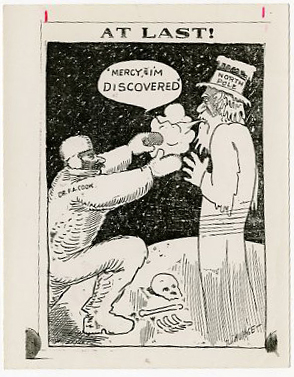
The first Arctic explorers were not actually seeking the North Pole at all. Instead, they wanted a passage through the Arctic to Asia (then called the Orient). It took over three hundred years to find such a passage—though there are actually two: the Northeast Passage and the Northwest Passage. Later explorers sought any land hidden amongst the ice, slowly extending the ‘furthest north’ record on their quest. Soon, the Pole itself became the ultimate goal and men realized whoever got there first would be enshrined in history. Today, the identity of who reached the North Pole first is one of the greatest controversies in Arctic scholarship. Amazingly, there are four different contenders spread over a twenty-eight year period.  Finding the North Pole is not easy.  There are no distinct geographic features and the ice pack is constantly shifting.  In the days before GPS technology, how do we prove that we were where we say we were? Verification must come from the explorers’ journals, their ability to navigate with tools, their observations, their character, and corroborating evidence from any companions.

In another contemporary postcard, Dr.
Cook reaches the elusive North Pole.

The first contender for discovery of the North Pole is Dr. Frederick Cook (check out our previous post about Dr. Cook). After a few previous expeditions, Cook began his attempt on the Pole in 1907. Preparing carefully for the journey—including a newly designed type of sled and a collapsible boat—Cook and two Eskimo* companions set out for the Pole with eighty days’ worth of food in March of 1908. Cook was not seen or heard from again until April of 1909.

In the meantime, the explorer Robert Peary, obsessed with becoming the first to reach the North Pole, was in his fifth expedition. Peary began in February of 1909 with a large party. Neglecting to bring a boat to cross leads in the ice, Peary and his party were halted by open water on a number of occasions. Several hundred miles from the Pole, Peary sent all but five companions back to camp, and then made his dash to the Pole in April. However, when Peary returned to civilization in August and announced his success, he found that Cook had returned from his own expedition and was claiming that he had reached the pole in 1908.

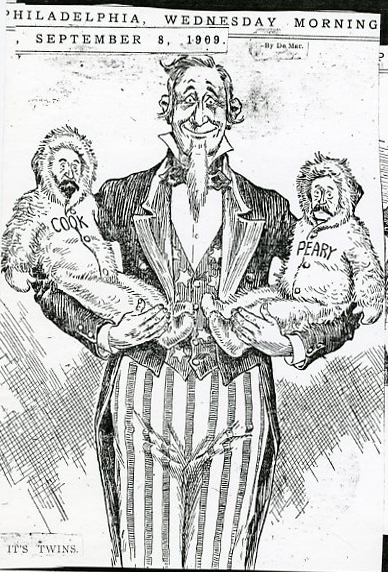
A proud Uncle Sam displays the
twin American explorers that
reached the North Pole.

Peary refused to accept Cook’s claims and set out to systematically discredit him. In short, Peary accused Cook of deliberate fraud. There is evidence that Peary and his well-placed friends may have bribed one of Cook’s previous companions to speak against Cook. Additionally, Peary interviewed one of Cook’s Eskimo companions, yet he refused to allow neutral witnesses to interview that same Eskimo when the Eskimo supposedly claimed that Cook had never left the sight of land. Peary’s discrediting of Cook coincided with public doubts about Cook’s claim to have summited Mt. McKinley several years earlier. While several of Peary’s accusations do not hold up to scrutiny, Cook was unable to provide any positive proofs—such as sextant readings in his journals—that showed he had reached the North Pole. In the end, history took Peary’s side, yet Peary’s own accountability soon came into question. Like Cook’s account of events, Peary’s claim also had some holes. He refused to submit several of his original documents to scrutiny and many believe his claimed speeds while traveling to the Pole are nearly impossible. Peary also never produced any positive proofs—no soundings or sextant readings. A United States Senate subcommittee granted Peary official recognition for reaching the North Pole but by a four to three margin and with several members claiming significant doubts. Recent scholarship on the subject indicates that it is unlikely that either man actually reached the North Pole.

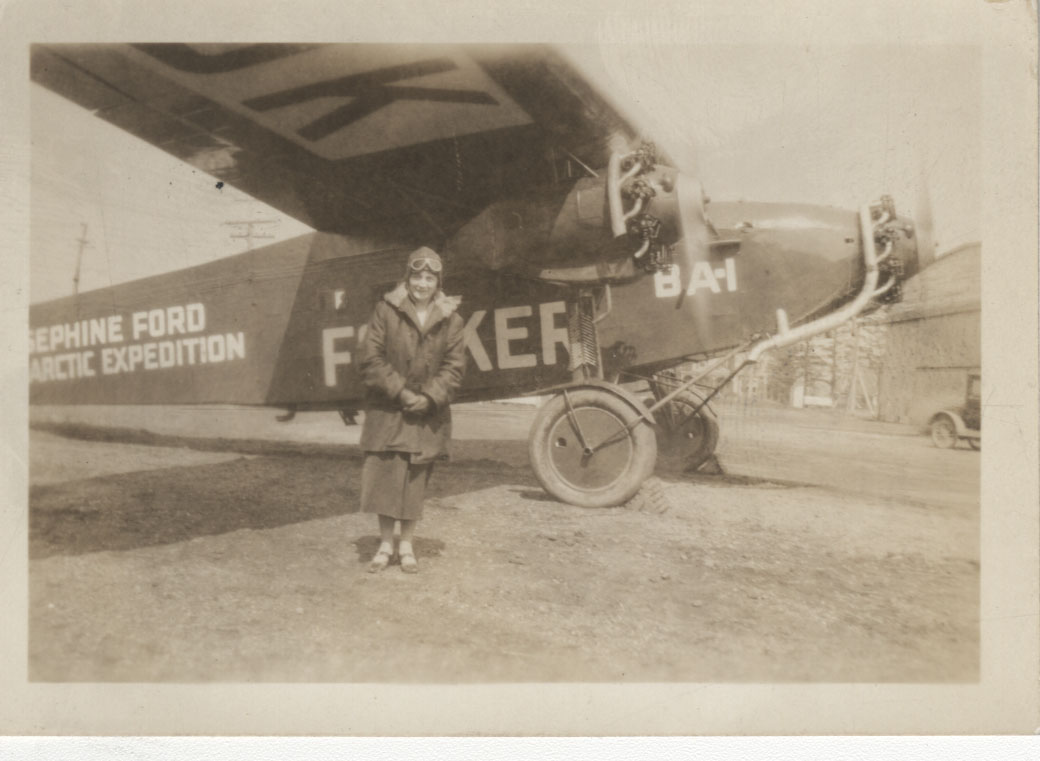
If neither Cook nor Peary was the first, it could have been Richard Byrd. In 1926, after one previous trip in the Arctic, Byrd sought to become the first man to fly over the North Pole. An excellent campaigner, Byrd quickly gained the necessary money and equipment and sailed off to King’s Bay, Spitzbergen, Norway. Already encamped there was the veteran polar explorer Roald Amundsen, preparing for his own flight over the Pole. Byrd, while the second to reach Spitzbergen, was the first to set out. He and his pilot Floyd Bennett flew to the North Pole, some 700 miles away, and back in just over fifteen and a half hours. The only hiccup in the flight was a minor oil leak. Upon their return, both to King’s Bay and to the U.S., Byrd and Bennett were lauded as heroes and treated accordingly.

Marie Byrd stands with the Josephine Ford, the
plane of her husband, Admiral (then Captain)
Richard E. Byrd.

Soon, however, doubts began to form. Critics claimed that Byrd had not been gone long enough to reach the Pole, given his plane’s maximum speed, and that Byrd had lied rather than face failure. Byrd attributes his record speed to a tailwind to and from the Pole. One of Byrd’s later companions would later claim that pilot Floyd Bennett had admitted this fraud. In 1996, this controversy sparked again after The Ohio State University’s Archivist Raimund Goerler found Byrd’s flight journal within the massive Byrd collection. Researchers and scholars quickly examined this important document and noted that some figures appeared to have been erased and adjusted by Byrd during his flight. Byrd’s critics claim this as deliberate attempts to fake his way to fame. Byrd’s supporters point out that if they were incriminating, Byrd could have completely removed these pages from the journal rather than just lightly erase them. Nevertheless, the case against Byrd has never been proven and remains of interest to historians and scholars of the history of polar exploration.  Unlike Cook and Peary, whose reputations were tied to their North Pole expeditions, Byrd would go on to lead numerous successful expeditions to Antarctica and would become the first man to fly over the South Pole in 1929.

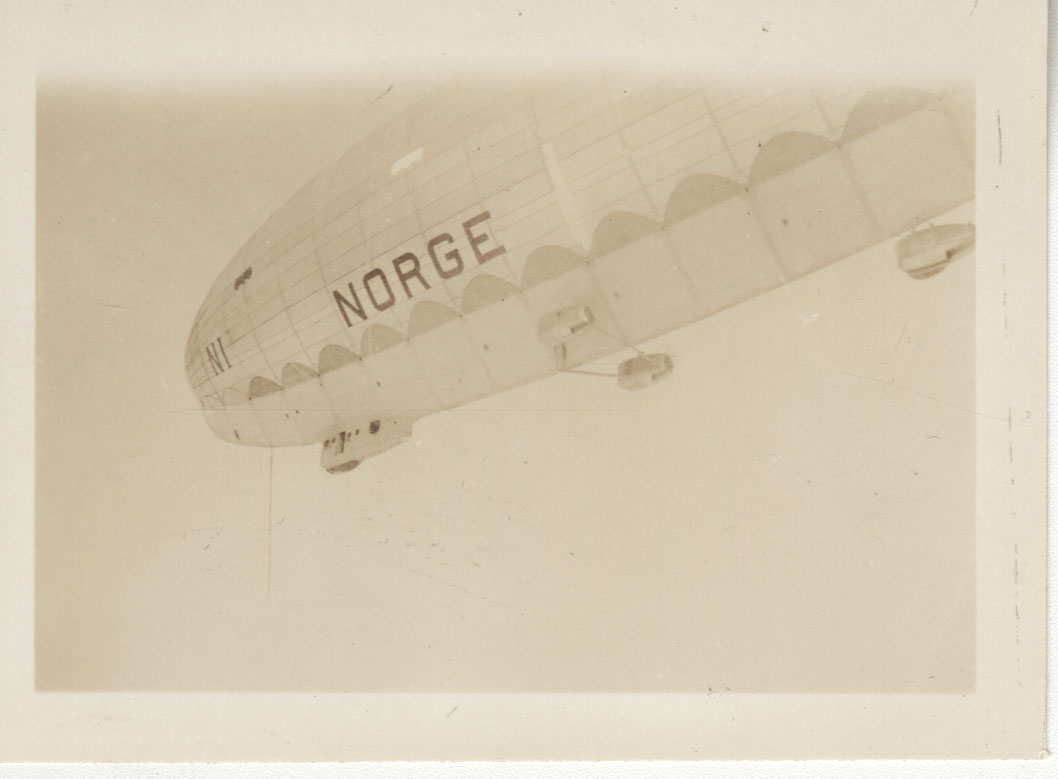
Roald Amundsen’s airship, the Norge.

If Byrd was not the first man to the North Pole, then the credit for this achievement goes to Roald Amundsen and the crew of his airship Norge. The Norge left King’s Bay within hours of Byrd’s return and spent two days traveling to Alaska, traveling over the North Pole in the process. With this accomplishment, Amundsen and his crew made the first Arctic crossing and Amundsen became the first man to reach both Poles. Amundsen’s claim to crossing the North Pole on the way to Alaska is currently undisputed. If neither Cook nor Peary made it to the Pole, then the first successful overland trip was not until 1968 by a team on snowmobiles.

Without a time-machine or more definitive evidence, it is unlikely that we will ever truly know who first reached the top of the world. Our mission in the Polar Archives is to provide researches and scholars with the primary resources about these controversial achievements, so they can decide for themselves!  If we have piqued your interest about Richard Byrd, Frederick Cook, or polar exploration please visit the Byrd Polar and Climate Research Center Archival Program.

Written by Autumn Snellgrove and edited by John Hooton.

[i] Cook and Peary, Prologue

* ‘Eskimo’ is considered a derogatory term by many to native inhabitants of northern North America. Although it would not be appropriate to use it in this blog under any other context, we are using it here as it is the term used by the explorers mentioned in this blog. More information on ‘Eskimo’ as a slur can be found here.

Older posts Newer posts