From Woody's Couch

Our Playbook on OSU History

Category: Polar Archives (page 7 of 11)

Frozen Fridays: ‘M’ is for McMurdo!

This blog post is part of the Frozen Friday Series, an A-Z journey of the Polar Archives.  Each week, we will feature some aspect of the history of polar exploration with a blog post written by our student authors.

Residents of McMurdo Station enjoy the festivities of
Icestock 2017.

A group of people gather in front of the stage. They are bundled up in puffy coats and warm winter hats or hoods. It is a motley group and the largest gathering of people anyone in the crowd has seen for months. There’s a certain nip in the air, although the temperature is higher than usual. The band on stage seems to have chosen to abandon their fingers to the cold as they refuse to put on gloves for fear of tarnishing their performance. In all, the excitement for the much anticipated performance and the heat of the moment will warm them. The planning committee did their work well. They picked a good day for Icestock this year.
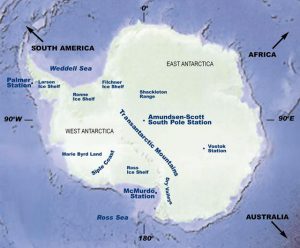
McMurdo Station is located on the cost of the Ross
Sea, represented here.

Icestock has become something of a tradition at McMurdo Station, Antarctica. Every year around the first of January, a stage and audio equipment are set up for musicians to demonstrate their talent in front of a small crowd of the station’s occupants. Several genres of music are played for McMurdo’s mostly scientist population, including rock, funk, electronica, and even bluegrass.[1] The event also includes a chili cook-off, a welcome meal for the eager audience.[2] It is unknown whether this pun was intentional or unintentional at this time.

McMurdo Station’s Main Street with Observation Hill in the
background, circa 1960.


That the New Year is regularly welcomed by a music concert on Antarctic soil is something of an anomaly. Then again, the idea that there could be a permanent human settlement on the coldest of continents might also seem absurd to the less informed. McMurdo Station is located on the ice-free tip of Ross Island, just around eight hundred miles away from the South Pole, and houses over one thousand people (mostly Americans) every Antarctic Summer.[3] Though the population drops significantly in the Antarctic Winter as residents cycle out, the station is still maintained and operated by the smaller population of around two hundred individuals.[4]
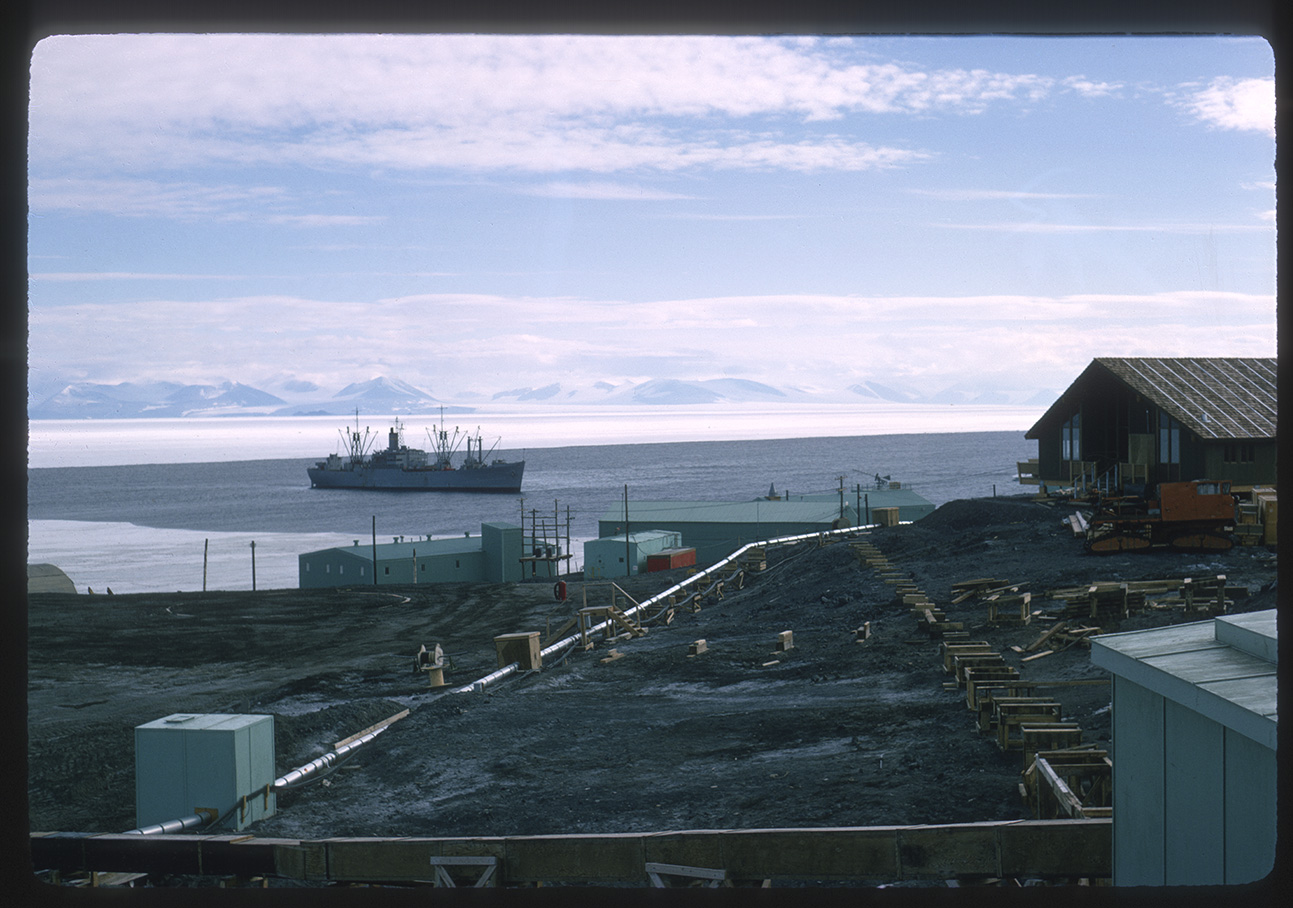
McMurdo Station has the capability of receiving
boats as well as aircraft.

McMurdo Station, named for the nearby McMurdo Sound (which is in turn named for Lieutenant Archibald McMurdo of the HMS Terror), is an up-to-date scientific research station and includes all of the necessary facilities required for a modern-day human presence in Antarctica.[5]  In addition to the world’s southernmost seaport, Winter Quarters Bay, McMurdo Station operates two runways and a skiway (a runway designed for use with ski-equipped planes).[6] McMurdo is also typically equipped with six C-130s, two Twin Otter aircraft, and four helicopters.[7] The station has working telephones, email, and internet, allowing the population to remain in contact with the outside world.[8] The United States Antarctic Program even has several live web cameras from McMurdo Station posted on their website! Diesel engines generate energy while also providing heat to buildings.[9] In terms of scientific instruments, McMurdo has a large multidiscipline laboratory with various facilities meant to support and house scientific work.[10]

McMurdo Station also has a
monument to the great polar
explorer, Admiral Richard E. Byrd.

McMurdo Station is crucial in human Antarctic activities. While McMurdo serves as the primary United States base in Antarctica, it also serves as a support center for other research stations in and around the continent.[11] Located near many natural sites of scientific interest, McMurdo Station is ubiquitous to the modern Antarctic explorer’s experience. Many such scientists, such as Lois Jones and Henry Brecher, have spent time in its halls and many of their collections can be found in the Byrd Polar and Climate Research Center Archival Program. Also, check out our digital collections page, where you can find images of McMurdo!

Written by John Hooton.

[1] Jeremy Day, “Mid-Summer Holidays,” The Antarctic Sun, January 05, 2017, accessed January 18, 2017, https://antarcticsun.usap.gov/aroundTheContinent/contentHandler.cfm?id=4292

[2] Day, “Mid-Summer Holidays.”

[3] Encyclopedia of the Antarctic, s.v. “McMurdo Station,” New York: Routledge, 2007.

[4] Encyclopedia of the Antarctic.

[5] The Geographic Names Information System is our authoritative source on geographic location information in Antarctica.

[6] Encyclopedia of the Antarctic.

[7] Encyclopedia of the Antarctic.

[8] Encyclopedia of the Antarctic.

[9] Encyclopedia of the Antarctic.

[10] Encyclopedia of the Antarctic.

[11] Encyclopedia of the Antarctic.

Frozen Fridays: ‘L’ is for Little America!

This blog post is part of the Frozen Friday Series, an A-Z journey of the Polar Archives.  Each week, we will feature some aspect of the history of polar exploration with a blog post written by our student authors.

byrd7803_2

Several buildings in Little America under
construction.

What do you think of when you hear the name “Little America?”  Perhaps a quaint little neighborhood in a bustling European city where American emigrants have made a home? You’d be wrong.  Picture instead, a small upstart “village” near of the Bay of Whales on the Ross Ice Shelf  in Antarctica[1]. The air is frigid and the ground covered in snow. You can see buildings in the snow, prefabricated structures meant to provide the most basic housing and shelter for their inhabitants and their tools. Yes, this was Little America I, the base of operations for the First Byrd Antarctic Expedition (1928-1930), the first American expedition into Antarctica in almost a century (the last being the U.S. Exploring Expedition under the command of Lieutenant Charles Wilkes and ending in 1840)[2]. The purpose of the expedition was geographical exploration and to secure for the United States the prestige of being the first nation to fly to the South Pole[3], a feat that, to many, seemed a foolhardy endeavor[4].

byrd7801_15

Little America had radio contact with the outside
world. Radio broadcasts were both received in and
broadcasted from Antarctica.

Despite the skepticism of the time, then-Commander Richard Byrd (later Admiral) and his motley crew of just forty-one men set out to winter in Antarctica[5]. As one would expect, the conditions were harsh. The mean temperature at Little America for the month was often recorded as below zero[6]. On July 28, 1929, it was reported that the temperature was -72° Fahrenheit[7]. It was also recorded that in that same month, one day saw a combination of a temperature of -64° Fahrenheit with winds reaching speeds of twenty-five miles per hour[8]. The winds were such a problem that one of three planes brought by the expedition was picked up and carried almost nine-hundred yards away from camp[9].

byrd7773_5

Admiral Byrd and some of his men gather around a
sound system, presumably to listen to a radio
broadcast from the United States.

The inhabitants of Little America I consisted of Byrd, four trained pilots, “three aircraft mechanics, three radio operators, five dog drivers, a doctor, three surveyors, a tailor, a carpenter, news media experts, a cook, and general hands”[10]. There were also four scientists, including the geologist Dr. Larry Gould, Byrd’s second-in-command[11].  Together these men of “varying temperaments, skills, and backgrounds” would function and accomplish their mission in one of the harshest environments on the planet[12]. Though their purpose was one of exploration and science, the men walking in the tunnels of snow connecting the buried structures of Little America still managed to find amusement on the frozen continent[13].

byrd7801_2

The site of Little America I would be used again in
subsequent expeditions.

Radio broadcasts from WGY, Schenectady and KDKA, Pittsburgh were beamed directly to Little America every Saturday at 4 PM local time[14]. The men would gather to feel that so desired connection to the outside world[15].   The first radio broadcast from Little America, Antarctica, was on February 3, 1934.

byrd-box-475-folder-19-item-2

“Little America” became a cultural icon in the United
States. Many businesses took on its name, including
this place in Wyoming, which still operates today.

The First Byrd Antarctic Expedition (1928-1930) was a success, in part due to Little America itself. The site of Little America I would even be used again several times as Little Americas II-IV (Little America V would be at a different location father east)[17]. Richard Byrd would be the first man to fly to the South Pole and much of the interior of Antarctica itself[18]. The success of the expedition recaptured the American fascination with the southern continent and it proved the usefulness of the airplane, aerial camera, the radio, and the snowmobile[19]. It was this expedition that brought man’s exploration into the Mechanical Era[20]. The site of Little America is now under water, as the ice on which the site was settled has long broken apart.[21]

Written by John Hooton.


[1] Kenneth J. Bertrand, Americans in Antarctica 1775-1948. (New York: American Geographical Society, 1971) 296-97

[2] Bertrand, Americans in Antarctica 1775-1948, 290

[3] Bertrand, Americans in Antarctica, 292

[4] Antarctica, 2nd ed., s.v. “Conquest by Air.” (Surry Hills: Reader’s Digest, 1990)

[5] Bertrand, Americans in Antarctica, 292

[6] Bertrand, Americans in Antarctica, 300

[7] Bertrand, Americans in Antarctica, 300

[8] Bertrand, Americans in Antarctica, 300

[9] Antarctica, “Conquest by Air”

[10] Encyclopedia of the Antarctic., s.v. “United States (Byrd) Antarctic Expedition (1928-1930)” (New York: Routledge, 2007)

[11] Encyclopedia of the Antarctic, “United States (Byrd) Antarctic Expedition (1928-1930)”

[12] Encyclopedia of the Antarctic, “United States (Byrd) Antarctic Expedition (1928-1930)”

[13] Bertrand, Americans in Antarctica, 297

[14] Paul A. Carter, Little America (New York: Columbia University Press, 1979) 101

[15] Carter, Little America, 101

[16] Antarctica, “Conquest by Air”

[17] William James Mills, “Ross Ice Shelf Antarctica,” Exploring Polar Frontiers, (Santa Barbara: ABC-CLIO, 2003).

[18] Bertrand, Americans in Antarctica 1775-1948, 292

[19] Bertrand, Americans in Antarctica 1775-1948, 290

[20] Bertrand, Americans in Antarctica 1775-1948, 290

[21] On the Current Location of the Byrd “Snow Cruiser” and Other Artifacts from Little America I, II, III and Framheim,” Taylor and Francis Online, Accessed January 26, 2016, http://www.tandfonline.com/doi/abs/10.1080/789610142.

Frozen Fridays: ‘K’ is for Konter!

This blog post is part of the Frozen Friday Series, an A-Z journey of the Polar Archives.  Each week, we will feature some aspect of the history of polar exploration with a blog post written by our student authors.

A life in the Antarctic is a life most difficult. Penguins spend every moment of their lives fighting the conditions, beating the worst nature can throw at them, all with the singular purpose of surviving just long enough to successfully produce the next generation. That generation, in turn, does the same. Penguins and other Antarctic animals have not one moment to spare.

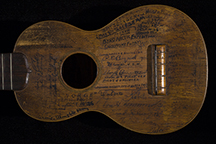
‘Ukulele Dick’ and his famous
instrument.

Humans, on the other hand, developed the ability to create tools that allow ourselves to adapt to even the harshest of environments, including the mighty Antarctic realm. As humans developed more and more tools, free time became more and more abundant. Even as polar explorers worked on difficult, tedious, and vital tasks necessary to survive in the freezing conditions of Antarctica, there was down time as well. Relaxation time is considered critical to the functioning of humans; something to do to unwind and feel the familiar feelings of the warmer climate back home.

Canon 5D Mark II with Coastal Optics 60mm APO UV-VIS-IR lens

The top of Konter’s ukulele.

That is where our friend, Richard Konter, or, as another Richard would know him, ‘Ukulele Dick,’ comes in.  Konter was primarily a crewman on several of Admiral Byrd’s expeditions, but also happened to play the ukulele.  Admiral Byrd, Roald Amundsen, Calvin Coolidge, Thomas Edison, and many other contemporary celebrities would sign this ukulele by the end of Konter’s life. [1] Konter used his musical skill to do his best to entertain his fellow crewmembers, playing into the larger history of Antarctic entertainment practices.

7891_1

Movie Night during the Second Byrd Antarctic
Expedition (1933-35).

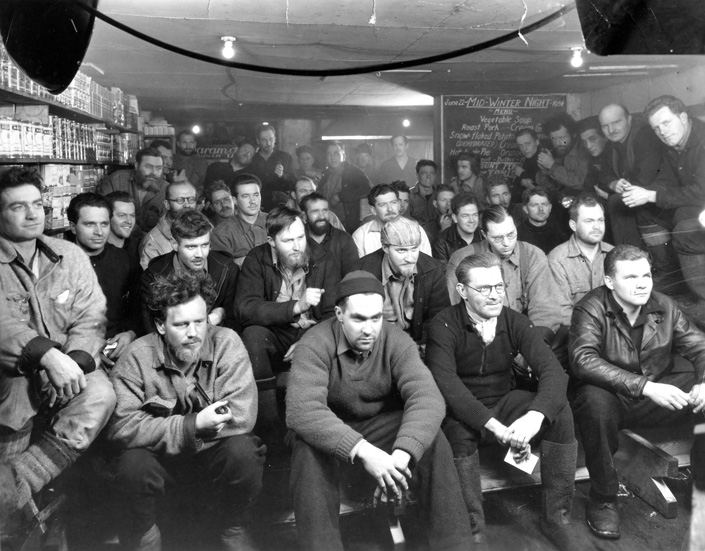
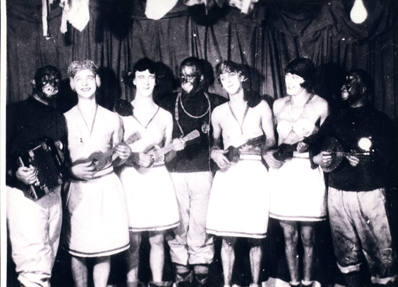
Unlike most entertainment industries, this one focuses on a small audience, yet it serves perhaps the greatest non-life-sustaining role in the lives of said audience. Boredom is known to drive men mad, or, at best, cause them to make mistakes. The men and women who dare brave the Antarctic winds and freezing temperatures have taken many strategies to combat the isolating conditions they face. As might be expected, card games, darts, and books are staples of Antarctic life.[2] Of course, not all expeditions have been so fortunate to even have a single book. Gunnar Andersson of the Swedish Antarctic Expedition (1901-1904) remarked that, in the absence of any books, the crew began to recount literature that they had read previously.[3] That was, of course, after they grew weary of reading the labels of their food containers.[4] Crew cabins could become something of a salon, where men would gather around and discuss the great issues of the day. Dr. James Hunter Harvey Pirie of the Scottish National Antarctic Expedition (1902-1904) wrote that the crew would sit near the stove and discuss such topics as evolution, the “Irish Question,” art, and even socialism.[5] These sorts of activities, while fulfilling the need for some kind of entertainment, also created further bonding and camaraderie among the crewmembers. Demonstrating this community building was the ‘Fourth of July Talent Quest,’ a kind of talent show put on by the men of Admiral Richard Byrd’s First Antarctic Expedition (1928-1930).[6] The show featured a variety of acts, including a musical comedy made up of crew in costume.[7] Four men dressed in drag for the act, while three others donned blackface, a practice which was considered acceptable at the time*.[8]

The chorus "girls" of the Antarctic Follies. Left to right: Jack O'Brien, Freddie Crockett, Eddie Goodale, Norman Vaughan, Ken Bubier, Jim Feury and Pete Demas

The chorus “girls” of the Antarctic Follies. Left to
right: Jack O’Brien, Freddie Crockett, Eddie
Goodale, Norman Vaughan, Ken Bubier, Jim Feury
and Pete Demas

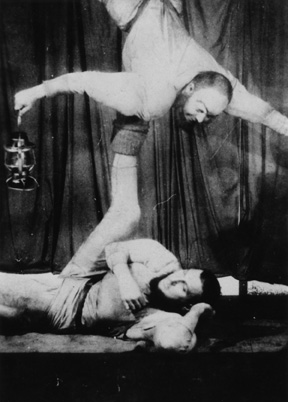
Byrd’s expedition even had a singing and instrumental group known as the Knights of the Grey Underwear.[9] The Stuart D. Paine Papers at the Byrd Polar and Climate Research Center Archival Program contains issues of “The Barrier Bull,” a “noncontroversial, nonpolitical, and nonsensical” magazine published and written by the men of Little America.  The BPCRCAP also has in its vaults images of Byrd putting records on the turntable for his men, as well as evidence of a movie night. Of course, alcohol was also a common pastime, although there is a great discussion among polar historians as to whether the drinking reached problematic levels. These sort of activities gave the crew some semblance of the norm, allowing them to feel, at least for a moment, that they were not on the loneliest continent.

byrd7808_22

Two men of Byrd Antarctic Expedition
I (1928-30) demonstrate their
strength.

Conditions for modern Antarctic explorers have improved since the very first trips to the continent. Even in the 1970s, just four decades after Admiral Byrd’s historic flight over the South Pole, the Amundsen-Scott South Pole Station was complete with a station store that offered such items as beverages (both alcoholic and not), tobacco, toiletries, candies, and even tourist items. Modern explorers often have the luxury of a well-stocked library and have been known to even play golf out on the frozen terrain.[10]

As time has gone on and expeditions gain more advantages in funding and technology, they have become equipped with greater numbers of resources to keep the crews entertained. The earliest explorers relied on each other’s company and, to some degree, this has not changed. Group activities remain essential to the wellbeing of not only individual crewmembers, but also the very expedition itself.


*As archivists, we hold and protect historical materials to insure that they are available to the public. Regardless of today’s cultural expectations, the archivist’s job is to provide primary sources for research and education and to encourage discussion about events of the past.

Written by John Hooton.

[1] “The Konter Ukulele,” The Smithsonian Museum Conservation Institute Imaging Studio, accessed January 23, 2017. https://si.edu/MCIImagingStudio/KonterUke

[2] Antarctica, 2nd ed., s.v. “Passing the Time.” (Surry Hills: Reader’s Digest, 1990).

[3] Antarctica, “Passing the Time.”

[4] Antarctica, “Passing the Time.”

[5] Antarctica, “Passing the Time.”

[6] Antarctica, 2nd ed., s.v. “Conquest by Air.” (Surry Hills: Reader’s Digest, 1990).

[7] Antarctica, “Conquest by Air.”

[8] Antarctica, “Conquest by Air.”

[9] Lisle A. Rose, Explorer (Missouri: University of Missouri Press, 2008), 351.

[10] Antarctica, “Passing the Time.”

Older posts Newer posts