From Woody's Couch

Our Playbook on OSU History

Category: Administration (page 6 of 6)

Where the Presidents Live

OSU’s 13 Presidents have lived in only five different residences since the University opened in 1873.

Rickley House, 1892

The first University Residence, known as the Rickley House, had a total of 18 rooms (five bedrooms) and was nearly 7,200 square feet. It stood at the corner of 15th and High, where Mershon Auditorium now stands. It originally was the home of William Neil, for whom Neil Avenue is named, and whose farm was bought as the location for the then-new University. A businessman named J.J. Rickley bought it in 1866, then sold it to the University in 1871. By the 1920s, it was decided High Street had become too busy for a president’s house, so after Pres. Thompson moved out, it served as the home for the School of Music until it was torn down in 1949.  (See article below for more information on the Rickley House.)

The last President to live on campus was Pres. Novice Fawcett, specifically at the mansion now known as the Kuhn Honors and Scholars House on 12th Avenue above Mirror Lake. The house was first built to be the residence of the astronomer at McMillan Observatory, which used to occupy the site just about where the Faculty Club stands now. OSU Architect Joseph Bradford (see our first “Bleeds Scarlet and Gray” posting) designed it. President George Rightmire and his family were its first occupants, and the Fawcetts vacated the residence in 1972.

President's House, n.d.
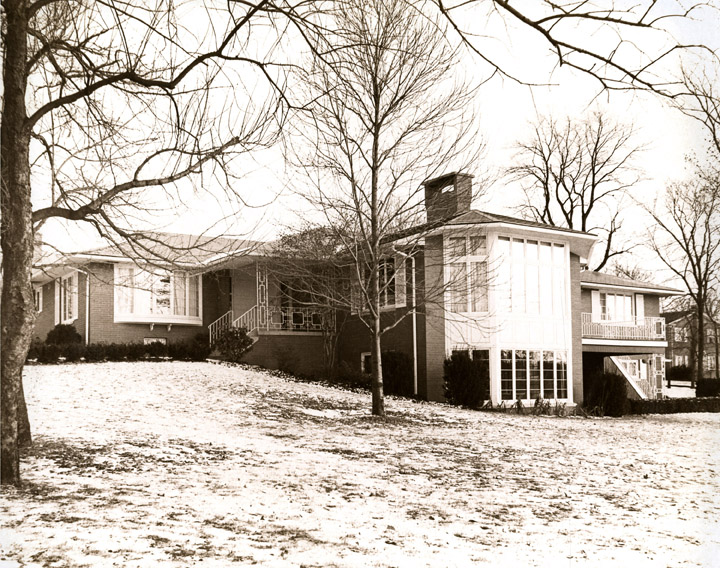
President's Home on Croswell Road, 1973

The next OSU President, Harold Enarson opted not to live on campus, so a residence was procured in 1972 at 285 Croswell Road in Clintonville, just north of Whetstone Park. At the time it was bought for the president, the house was eight years old, had three bedrooms and a total of 7,000 square feet. Pres. Edward Jennings also lived there, but the house was sold prior to President E. Gordon Gee’s first term, because it was no longer considered suitable for hosting University events, both in space and parking.

A house on Commonwealth Park in Bexley (not pictured) was then purchased with University Foundation funds. President E. Gordon Gee, the new president at the time, wanted a home spacious enough for entertaining but one that was also located in a residential neighborhood. It had five bedrooms and 4,800 square feet and was more suitable to hosting University events. After Gee’s term ended, Pres. William Kirwan moved there, in 1998.
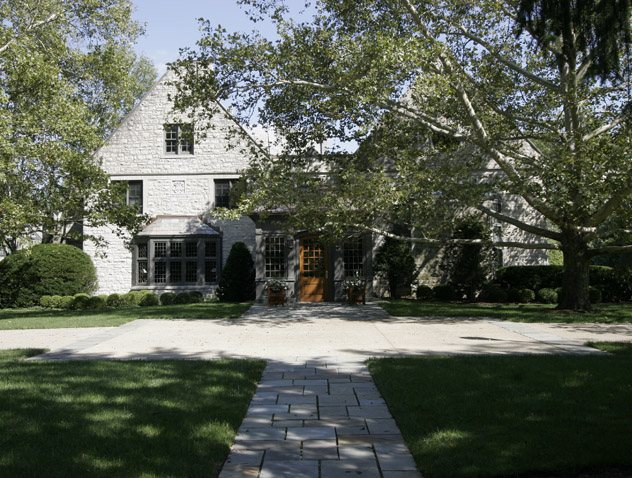
President's Home on North Drexel Avenue in Bexley, 2005

Kirwan then moved into the current University Residence, on North Drexel Avenue in Bexley, in 2000. Ron and Ann Pizzuti donated the house to the university in exchange for the OSU residence at Commonwealth Park.  The house is nearly double the Commonwealth House in size, at approximately 8,900 square feet.

Check out Buckeye Stroll for more information on the two on-campus residences!


Article on first president's house, 1970
Bleeds Scarlet and Gray: Edward “Beanie” Drake

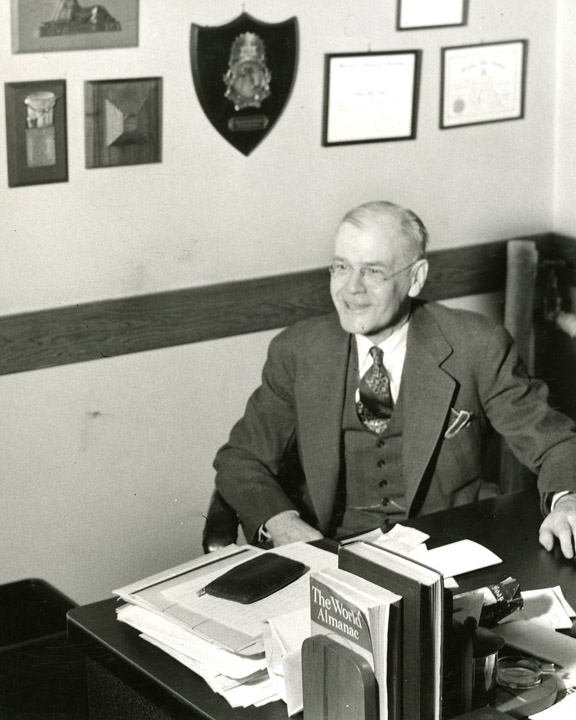
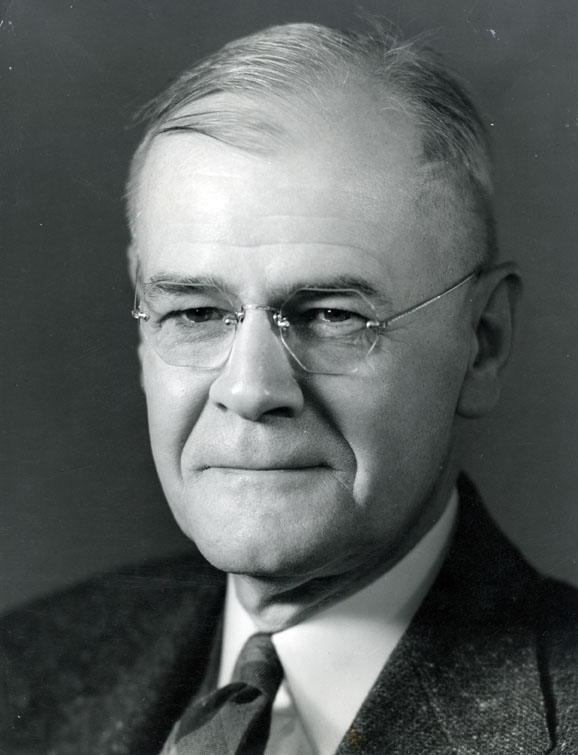
Beanie Drake, 1941

(Editor’s Note: This post is part of a series of profiles of life-long Buckeyes who have had a notable impact on the University. In other words, they bleed scarlet and gray.)

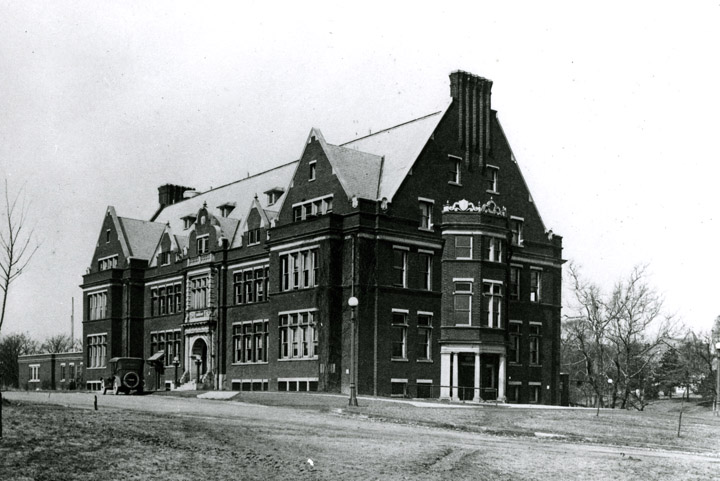
Drake Union, which was dedicated 39 years ago this week, (See OSU Archives’ Facebook page) was named after Edward S. Drake, known affectionately as “Beanie” Drake. He was the manager of the first Ohio Union (now Enarson Hall) when it opened in 1913, and he served in that capacity until his retirement 33 years later, in 1946. However, Drake’s involvement at OSU went far beyond his role as a business manager.

From 1936-1946 he supervised the ballot counting for all campus elections, including Homecoming Queen and USG elections. For 11 years he bought all of the food and planned the menus for the Ohio Union cafeteria, as well as Scholarship Housing (the dorms formerly housed in the Stadium), and for many years the football camp. He served as advisor for as many as 11 student organizations at any given time, and kept financial records for many even after his retirement. He helped to found Romophos, the sophomore honorary society, as well as Ohio Staters, Inc., of which he was a life-long member. But even beyond that he was known as a friend and counselor to generations of students. His kindness, generosity of spirit, and sound advice led many students to think of him as a father figure or a “father confessor.”

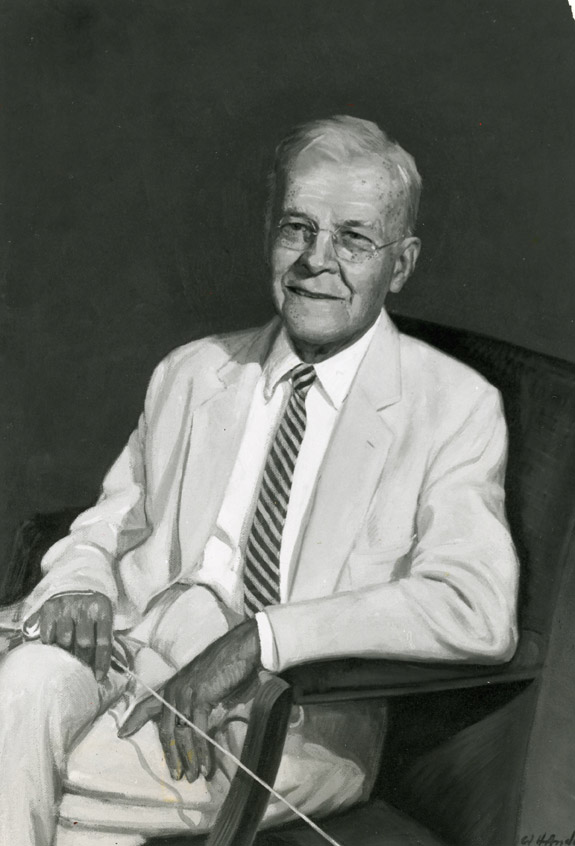
Upon his retirement, the Ohio Staters gave him the gift of a silver baton, to replace the pencil that he always used when conducting “Carmen Ohio,” which he did quite frequently. (He was very strict on the tempo of the piece, because he said that to play it too slow made it sound like a dirge.) His portrait hung in the Ohio Union for many years, and in his hand is that silver baton. A collection was taken up to pay for the painting, and it raised $2,000 more than was necessary. That money went on to establish the Beanie Drake Scholarship Fund, which is still awarded annually.

In 1958 Beanie received a Distinguished Service Award, to honor his many contributions to the University. Beanie passed away on March 23, 1967, at the age of 91.

filed by C.N.

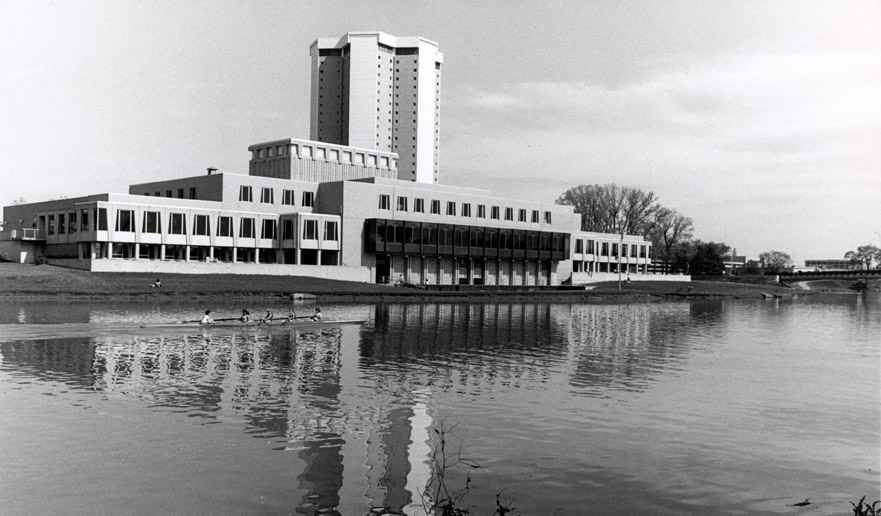
Drake Union

Enarson Hall (former Ohio Union), c1918

Beanie Drake leading Carmen Ohio at award banquet given by the Ohio Staters, 1955

Obituary: Frank W. Hale Jr.

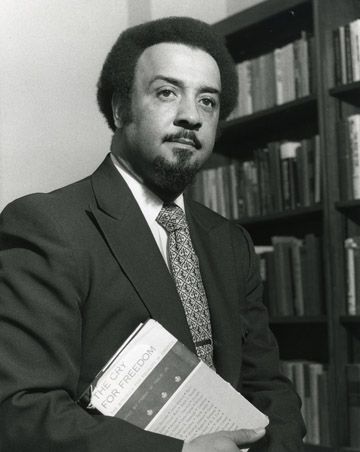
We were saddened to hear of the passing Wednesday morning of Frank Hale, OSU’s former vice provost of minority affairs, so we thought we would share a few photos and a little bit about his career at OSU.

Born in 1927, Hale received his bachelor’s and master’s degrees from the University of Nebraska in 1950 and 1951, then taught English and speech until 1954 at Oakwood College in Huntsville, Ala. That year he came to Ohio State to earn a Ph.D. in speech and political science. After receiving his doctorate in 1955, Hale left to teach, both at Oakwood and at Central State University in Wilberforce, Ohio. He eventually became president of Oakwood College before returning to Ohio State in 1971.

Frank W. Hale Jr., 1972 portrait

That year, he was named associate dean of OSU’s Graduate School, playing an active role in increasing the number of minority students at OSU and making the University the top producer of African-American doctorates by the end of that decade. In 1978 he was named Vice Provost of Minority Affairs, which enabled him to help establish the Young Scholars Program in 1982.

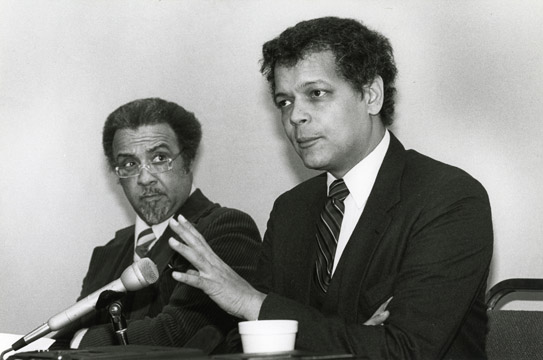
Hale listens to then-Georgia State Sen. Julian Bond, an educator and civil rights activist who later became chairman of the NAACP (1984).

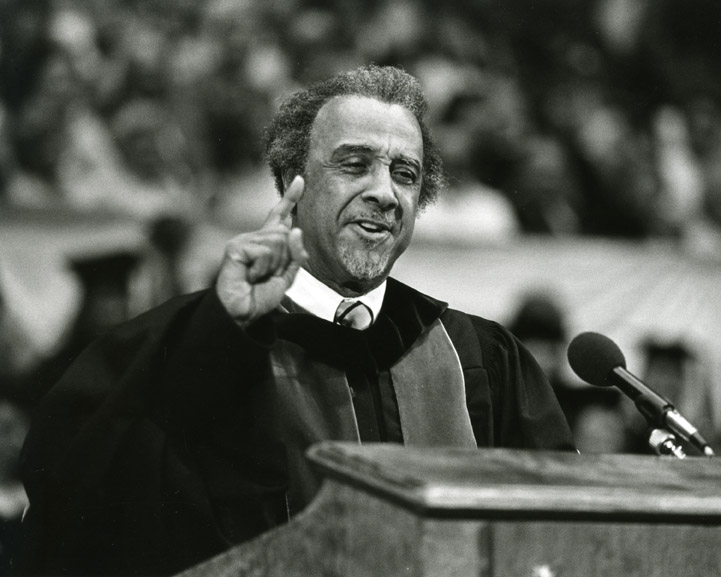
After 18 years of service, Frank Hale retired from the University in 1988, giving the summer commencement speech that August.

Hale speaks at the summer commencement ceremony, 1988.

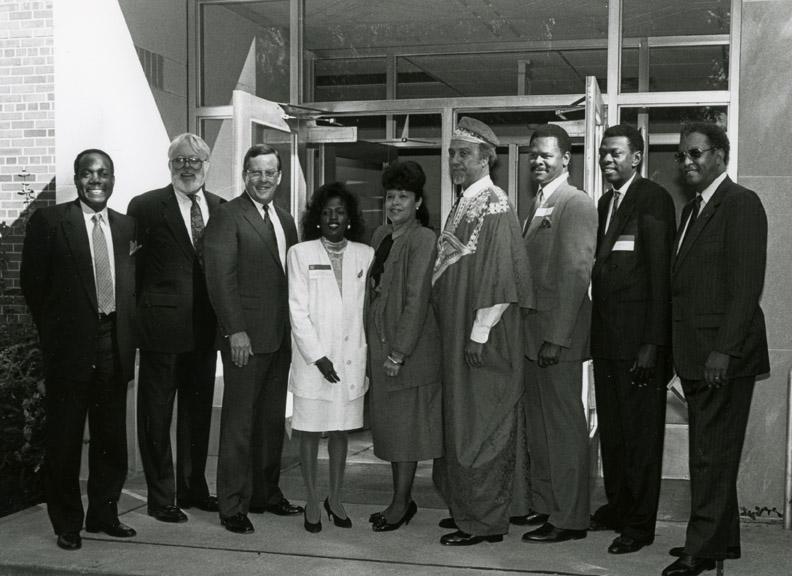
That same year, the Board of Trustees voted to rename the Black Cultural Center as the Frank W. Hale Jr. Black Cultural Center in his honor, citing Hale’s “commitment to the highest standards of quality and equality and for service as a teacher, an educator and a humanitarian.”

Hale and others attend the formal dedication in 1989 of the Frank W. Hale Jr. Cultural Center.

Material featuring Dr. Hale is now on display outside the exhibit gallery at the Thompson Library.

filed by C.N.


Newer posts