From Woody's Couch

Our Playbook on OSU History

Category: Activities (page 6 of 16)

Twelve Days: Having the right ‘supplies’ key to planning OSU’s centennial party

(In celebration of the University Archives’ upcoming 50th Anniversary in 2015, we bring you “The Twelve Days of Buckeyes”. This is day four in a series of 12 blog posts highlighting the people who were instrumental in the creation and growth of the Archives.)
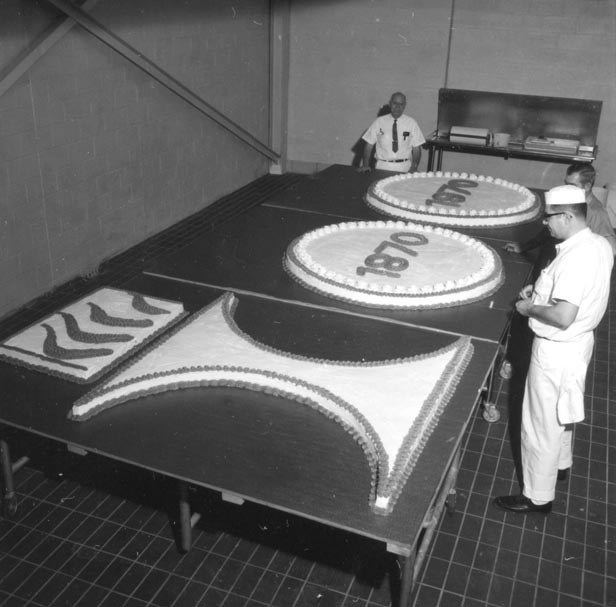
Cake made for the University's Centennial Celebration, 1970

The University’s centennial celebration cake, 1970

When you are planning a party, you always make sure that you have everything ready before it starts, right? In the case of a regular party, you see that you have enough food, beverages, plates, napkins, etc.

Same thing with the University’s centennial celebration in 1970, only in this case it had to make sure it had the historical papers, photos and artifacts to commemorate the 100th anniversary of its founding in 1970. Five years earlier, in 1965, the first University Archivist, Bruce Harding, was hired; a professional archivist was needed to properly manage the historical records as the University prepared to show off the legacy of its first 100 years. Particularly, photos were important, as they offered the basis of the “The First Hundred Years” book that was widely distributed for the event.
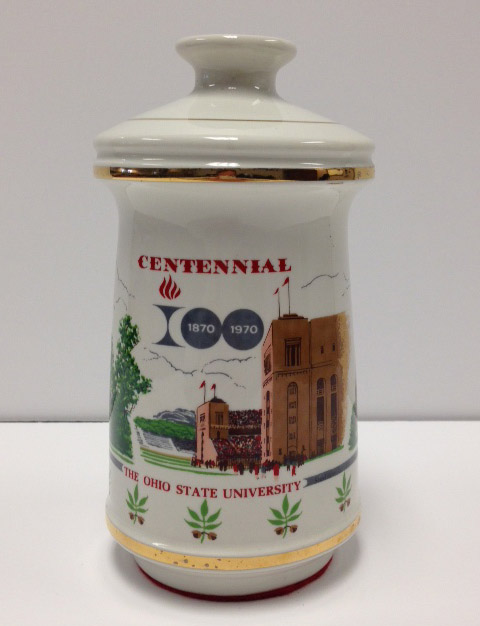
Centennial celebration container

Centennial celebration container

Coincidentally, as the University used the Archives to help it display its many historical legacies, the process of celebrating produced much-needed – and now often used – historical documents to be housed at the Archives. For instance, many OSU departments created centennial histories, which remain key resources for those doing administrative historical research.

And the celebration produced its own historical record: Not only does the Archives retain the various reports, proposals and other materials documenting the planning process, but it has a lot of really cool artifacts that demonstrate the way the University celebrated, such as a porcelain whiskey container with images of Orton Hall, Ohio Stadium and University Hall on it (at left).

Just an FYI: The University celebrates its 150th anniversary in 2020. It’s never too early to plan a party!
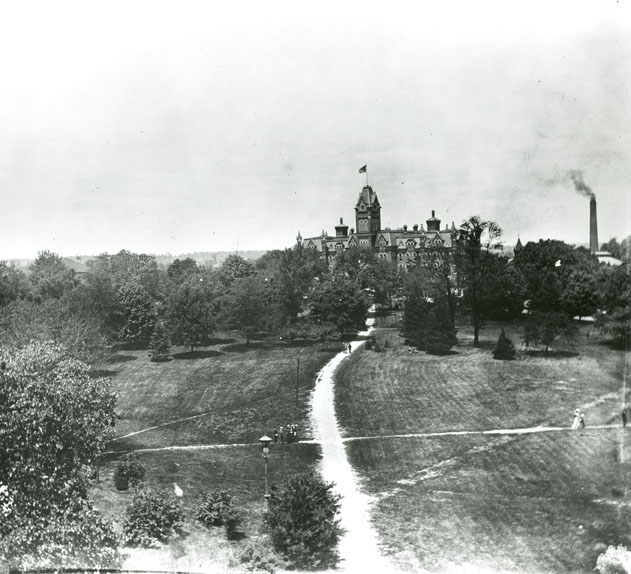
The Oval’s Long Walk has paved way for students for a century

University Hall, 1897

University Hall, 1897

It’s hard to imagine OSU without an Oval or a Long Walk, but it turns out that both of these were purely accidental when it came to the early shaping of the University’s design.

The layout of early campus actually followed that of an English Manor, with the manor house, (the original University Hall), on high ground and set back from the road. Access to High Street was by a path that ran diagonally across what is now the Oval to the site of Page Hall.

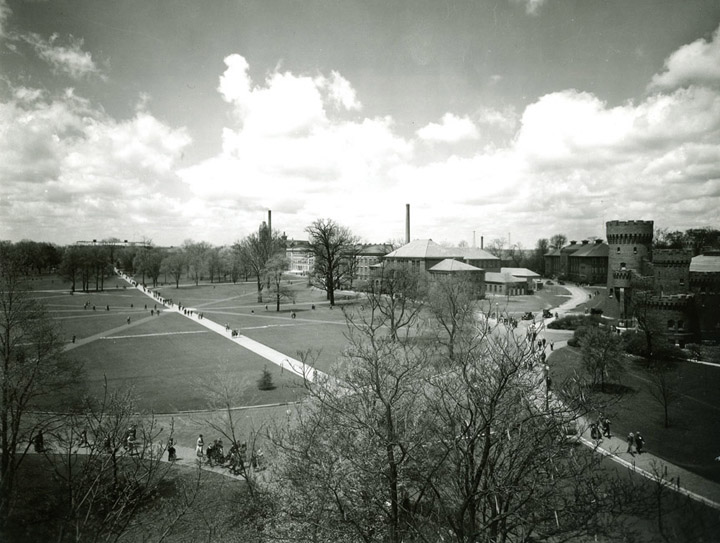
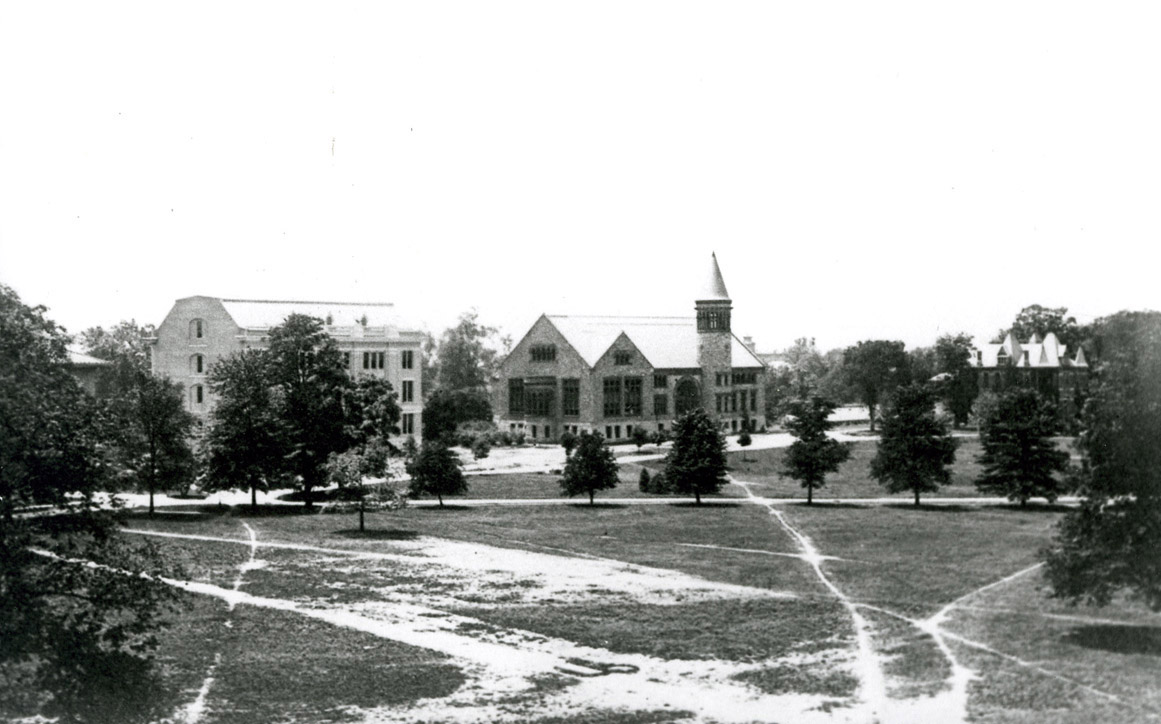
Early campus planning of the University did not include an Oval in the middle of campus, and certainly no “Long Walk.” But, in the early 1890s, as some of the first campus buildings were built in certain spots, it created a central green area. In 1893, a new master plan was proposed that created a layout for a “central open space around which buildings could be arranged, and which would not be crossed by any roads.” By 1901, this space had closely evolved into the shape of today’s Oval.

Oval, 1905

Oval, 1905

As buildings continued to go up, students began creating their own walking paths, trekking across the grass to their destinations. Their walking paths partly led to the current design of sidewalks, including the Long Walk.

Joseph N. Bradford, who became University Architect in 1911, was the next piece of the puzzle in the Long Walk’s creation. Bradford was committed to a formal arrangement of campus. In fact, the campus plan he created in early 1914 showed a very formal, geometric pattern of walks within the Oval. By the fall of 1914, the Long Walk was constructed.

Proposed map by Joseph Bradford

Proposed map by Joseph Bradford

However, the construction of the Long Walk did not seem to elicit the fanfare one might expect today from the media. A Lantern article dated September 15, 1914, includes a paragraph about the new walk in a story about two new buildings on campus:

Oval and the Long Walk, 1927

Oval and the Long Walk, 1927

“A broad walkway, of dark red cement has been built from the main entrance to the Library across the oval to the Fifteenth avenue entrance. Walks to the Chemistry building and to Orton Hall extend from it…..”

Not everyone on campus benefited from the Long Walk. In the 1920s and 1930s, freshmen were forbidden to use the Long Walk. The penalty for being caught on the path – which was enforced by the upper-classmen honorary Bucket and Dipper – was to be thrown in Mirror Lake.

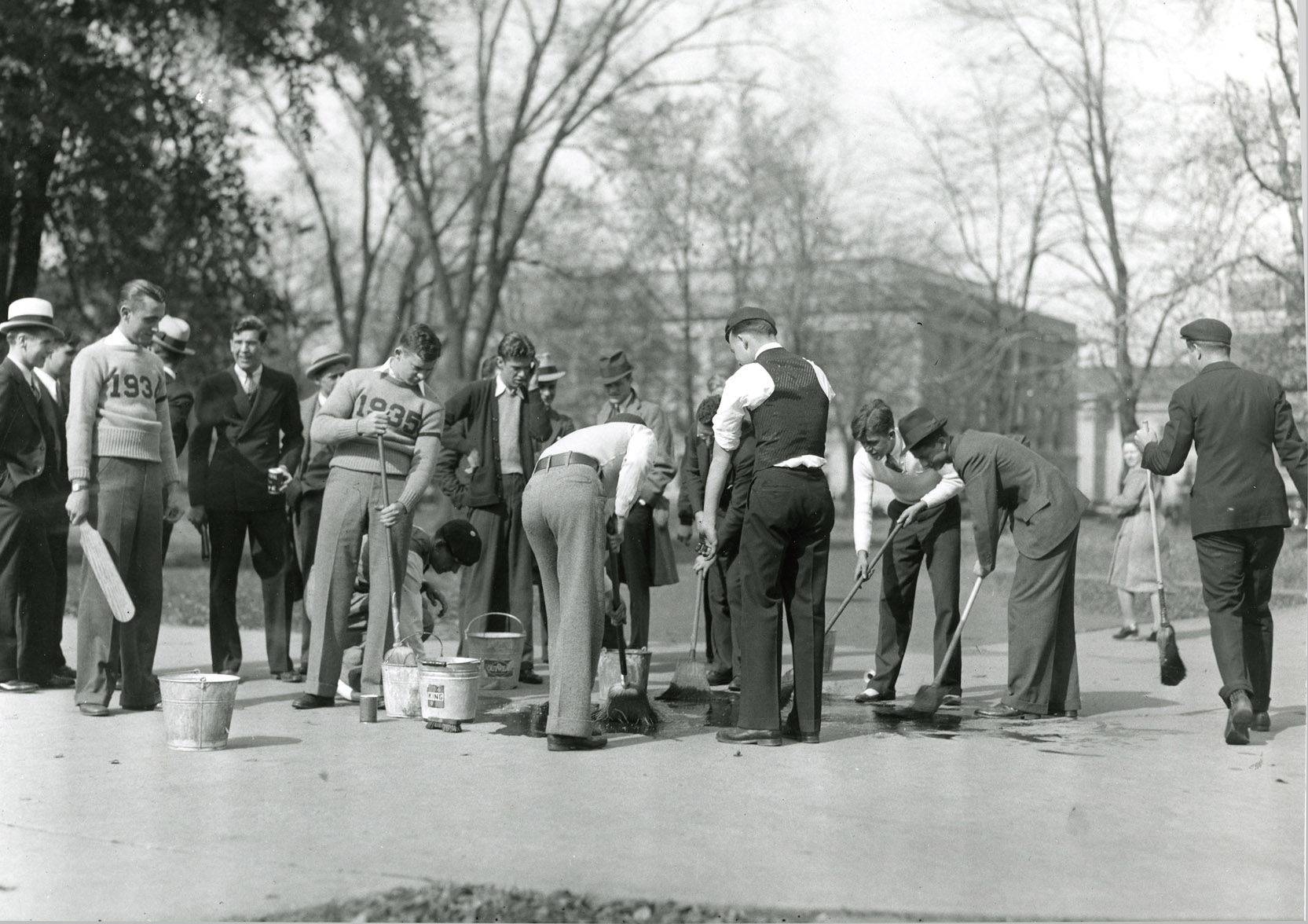
In 1931, freshmen of the class of 1935 were in hot water after Bucket and Dipper members found the class emblem of 1935 painted all over the Long Walk. All of the freshmen suspected in the painting were told to report to the Oval every day at 12:30 p.m. for an hour’s worth of cleanup, until all of the painted numerals were gone.

Freshmen cleaning the Long Walk, 1931

Freshmen cleaning the Long Walk, 1931

One suspected freshman, who had been assigned the task of bringing buckets of water from Mirror Lake to the Long Walk for the cleanup, said “I’d rather carry the water from the lake than be tossed into it.”

Students, on their way to classes during the Long Walk cleanup, apparently gathered around to watch the freshmen at work. It was reported that up to 60 spectators were observing the action, while other freshman on the way to classes steered clear and avoided the scene altogether.

The Oval and the Long Walk have been home to many other student activities over the years. Check out our Oval gallery on Flickr to see how the campus spot has changed over the years.

Block “O” manager was ‘letter’-winner in many ways

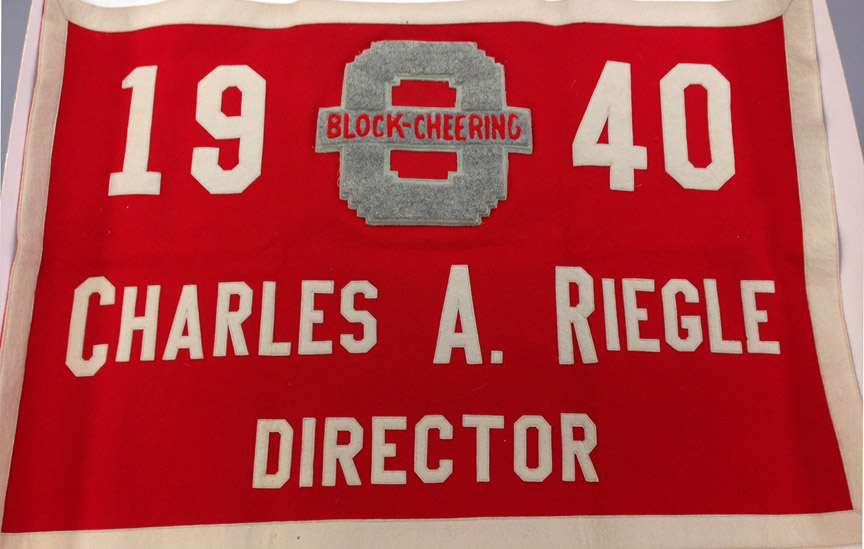
bannerRecently, the Archives received a scrapbook, a Varsity sweater, a Block “O” banner and several other items from the family of Charles Riegle, a student who earned a bachelor of science degree in Agriculture in 1941. Not only are we excited about this very kind donation because of the cool artifacts we received, but because we learned about this extraordinary student who truly was a man of many talents.

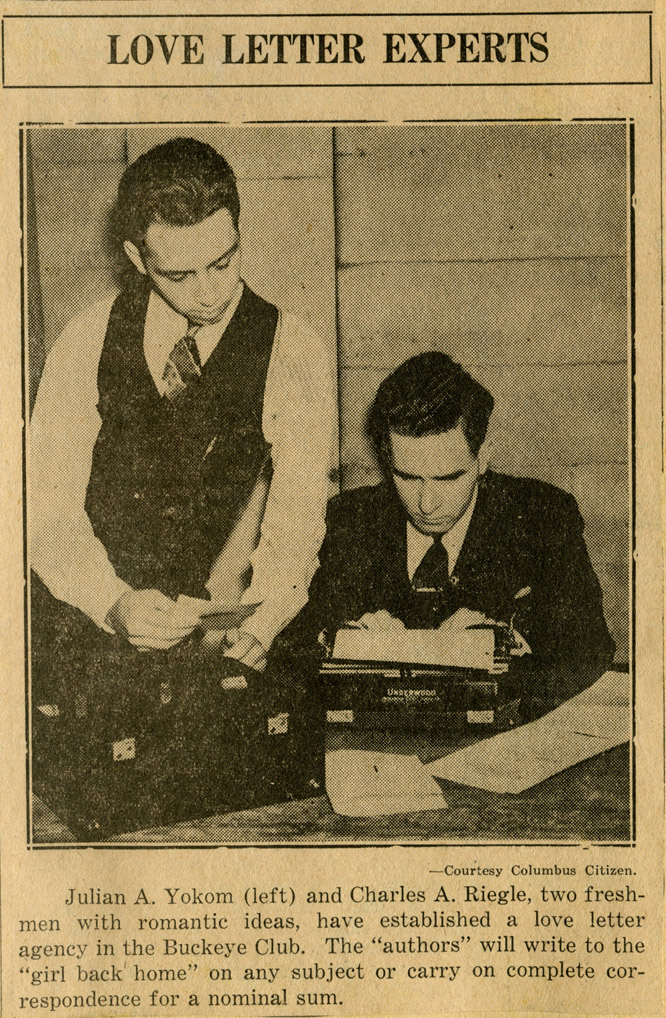
1938_reigle_yokom_newsclippingFirst, there was the letter-writing business he started with a friend in order to make money for school. Today, letters written home or to a significant other or even a family member are a rarity since communication mostly relies on texts, sometimes emails, and if you’re lucky, a phone call. Back in the 1930s, though, letter-writing was a prime means of communication. Some students, though, apparently were too busy to write home, so Riegle and a friend started a business writing letters for them. While clients had to supply their own stamps, Riegle and fellow freshman Julian A. Yokom charged 10 cents per 50 words. Riegle and Yokom’s motto was, “Give Us a Chance and the Girl Back Home a Break.” While some customers wanted letters written home to “doting parents,” most preferred a letter home to a sweetheart. And in that department, Riegle and Yokom might even use their word expertise to “break off relations with a girlfriend tactfully but don’t know how to do it,” according to a 1938 Lantern article on the pair.

In addition to his letter-writing business, Riegle also was a member of the OSU Cheerleading Squad, The Buckeye Club, the Men’s Dormitory Association and Gamma Sigma Delta, an honorary society for agriculture students. Being a member the Buckeye Club actually meant that Riegle lived in the Stadium Scholarship Dorms, which at that time were for male students who couldn’t otherwise afford to go to college (hence, the letter-writing business).

Charles Riegle, Cheerleading, c.1939-40

Charles Riegle in his OSU Cheerleading uniform, c1939

And of course, he was a very dedicated member of Block “O.” During the 1938-39 academic year, Riegle became Junior Manager of the Cheering Section and by the following year became Manager. Riegle managed three juniors, six sophomores, and six freshmen, while the cheering section had a total of roughly 1,200 men and women wearing scarlet capes against a grey background to create the impression of a block “O.” Each person would participate in different cheers while holding up different colored cards and singing along to certain songs and yells. There were 30 designs and 10 were used in a single game. By the end of the season, 3,000 cards were used. For his role as manager, Riegle received a Varsity “O” sweater in 1940.

Riegle’s energy and management skills served him well after his time at OSU: He joined the military and served in three wars: World War II, the Korean War, where he worked after the war on the establishment of the De-Militarized Zone between North and South Koreas; and the Vietnam War. He retired in 1968 as a U.S. Army Colonel and died several years later.

We very much appreciate the kind donation made by Dwight and Mary Helen Tuuri of the materials once owned by Riegle. It is because of people like the Tuuris that we have such wonderful stories to tell about OSU history, so we thank them very much!

Older posts Newer posts