From Woody's Couch

Our Playbook on OSU History

Category: Activities (page 7 of 16)

Lantern celebrates 100 years of daily coverage

Lantern front page, 1881

Lantern front page, 1881

This week marks the 100th year that The Lantern, OSU’s award-winning student newspaper became a classroom laboratory for journalism students to learn how to report and write the news on a daily basis. Its origins, though, were much more literary.

In January 1881, Volume 1, No. 1 of The Lantern appeared. Its editors picked the name after “La Lanterne,” a popular French magazine published in Paris at the time, and it started as a monthly appearing during the academic year only. In the initial issue, the editors promised to “represent the interests of our institution and student life as we find them.” And that’s been the goal ever since.

When it started, the newspaper was more like a literary magazine, publishing essays, and other writings that were submitted to the staff. In 1884, the newspaper began to appear every two weeks, and it was published by the Alcyone, Horton and Browning Literary societies. Seven years later, in 1891, the publication became a weekly.

Lantern students, 1914

Lantern students, 1914

The next year, members of the literary societies managing The Lantern decided to breathe new life into the publication and changed the name to “Wahoo.” Alumni were not so keen about the change apparently and demanded the return of the old name. The then-“Wahoo” editors seemed perplexed in a Nov. 29, 1892 editorial: “Since so few of the alumni formerly subscribed for the paper, it was surprising to see the sudden interest manifested when the name was changed. So “The Lantern” returned to the masthead – just 20 issues after “Wahoo” had appeared.

In 1914, journalism students took over the newspaper and it became a daily. Over the years, it has covered all kinds of historic moments on campus, from presidential inaugurations to student riots to NCAA championships.

To mark its historic 100th anniversary, we decided to give snippets of what appeared on the front page of the inaugural daily Lantern:

Lantern front page: September 15, 1914

Lantern front page: September 15, 1914

A now-forgotten OSU tradition called Cane Rush – where the freshman class and sophomore class battle to get a cane over the other’s goal line (sort of a combination of football and rugby) – would be held on Ohio Field that week. Strict new rules were in place to prevent winning by “strategy;” apparently, the year before, the sophomore class won when “Karl McComb dressed as a janitor walked down the cinder track with the cane concealed and climbed the goal posts on the freshman end of the field before the freshman discovered him.”

The Women’s Council was trying something new by providing each female freshman a “Big Sister” from the junior and senior classes. Each of these advisors had been given a name of three freshmen expected to enter OSU and had arranged to meet them at the train depot and help them secure lodging and finalize their class schedules. They would also introduce them to upper-class members and other freshmen. “By means of this every freshman girl will get started in school with little or no trouble or worry to herself.”

And finally, the staff reported that the honor of being the first to subscribe to the Daily Lantern went to Lowry F. Sater, president of the Ohio State University Association. In a letter to the newspaper that enclosed a check for his year’s subscription, Lowry wrote: “May your stock of oil never run low. I hope the Lantern will outshine any other luminary of its kind.”

Interested in seeing past articles of The Lantern? Go to the Lantern Archives and browse to your heart’s content. You’ll learn a LOT about OSU history along the way.


Welcome to the dog days of summer

Did you know that the University’s first unofficial mascot was a dog?  His name was Chris, and he was a performing police dog.  Owned and trained by Richard Armel, then a member of the OSU cheerleading squad, he was introduced in the fall season of 1941 to jump through hoops and perform other tricks at football and basketball games and rallies.

OSU's unofficial mascot, Chris, jumps through a cheerleader's paper drum, 1941

OSU’s unofficial mascot, Chris, jumps through a cheerleader’s paper drum, 1941

Chris barks at the opponent's mascot, 1941

Chris is not impressed by the Pitt Panther mascot, 1941

Chris appeared to have made it through only the fall season at OSU, but he certainly made an impression on the other team mascots. (See above.)

Okay, that’s enough of the history portion of our blog for this week.  Now, let’s see the doggies!

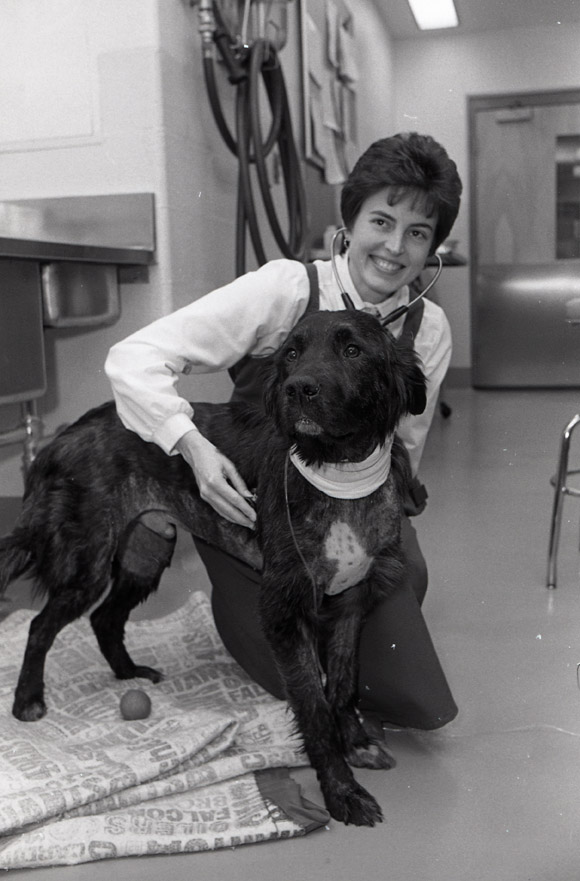
A dog is checked by veterinarians at the OSU Clinic, 1984

A dog is checked by veterinarians at the OSU Clinic, 1984

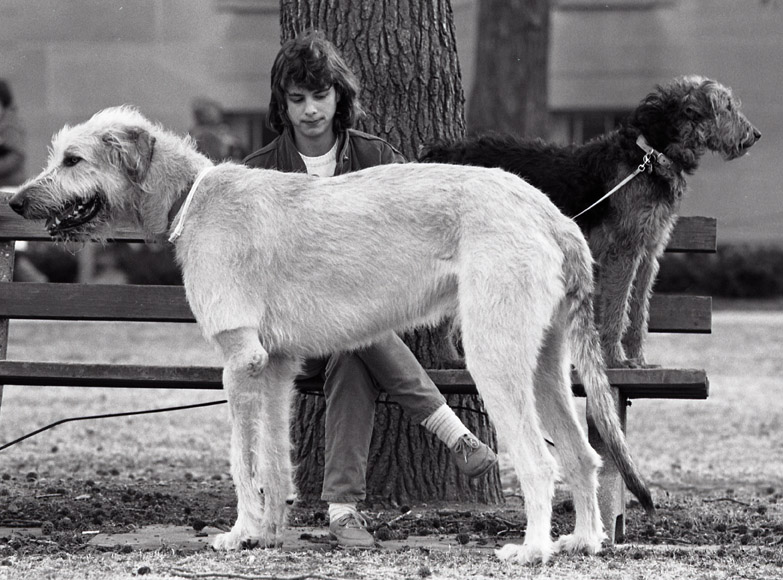
Student sits on bench on the Oval with two dogs

1986

An OSU vet performs a check-up, 1986

An OSU vet performs a check-up, 1986

OSU Vet School dog wash, 1987

OSU Vet School dog wash, 1987

1987, Dog carries a students backpack for her

1987

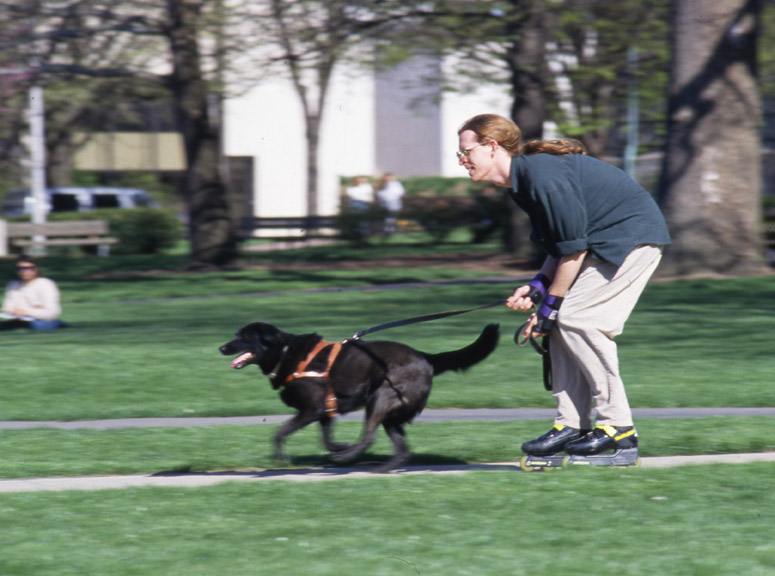
Student on rollerblades being pulled along by his dog

1990s

Student sitting with a puppy

no date

For nearly a decade, OSU women said “I do” to Bridal Fairs

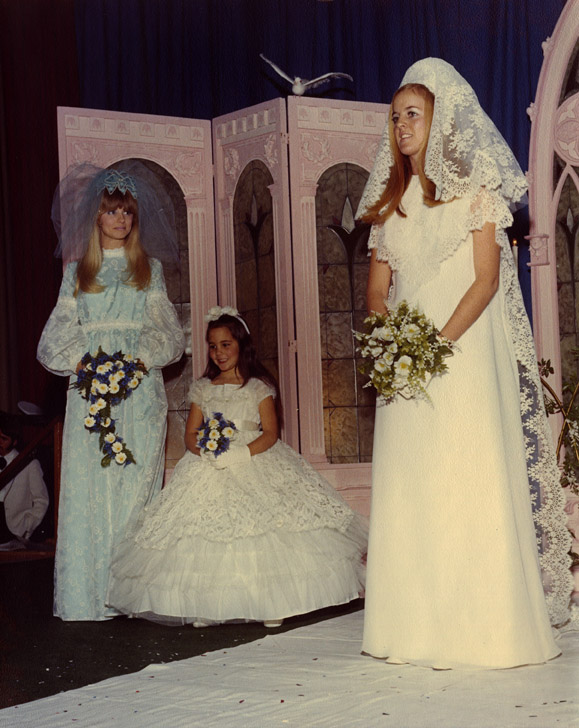
Women pose at the Ohio State University Bridal Fair, 1970s

Women pose at the Ohio State University Bridal Fair, 1970s

These days, couples who don’t have the energy to leave home can scour the Internet and cable TV for ideas on what to wear, eat and even dance at their weddings. Years ago, though, the only way to find out which fashions were in style and what kind of luggage to buy for the honeymoon were at bridal fairs. In the early 1960s, the events were popular on a number of college campuses; OSU held its first fair in 1966.

Sponsored by the Women’s Self Government Association and Bride and Home Magazine, hundreds of mostly hopeful co-eds attended the annual event, held at the Ohio Union. The fairs included displays of silver, china, crystal, linen, flowers, jewelry, cosmetics, men’s clothing, luggage, housewares, photography, gifts, and furniture. There were also usually two fashion shows held where OSU students would model different dresses and tuxedos, ranging from semi-formal to ultra-formal.  Each fair welcomed its attendees with a shopping bag filled with pamphlets regarding the merchants and displays as well as door prizes including a raffle for a honeymoon in New York City.

Crowd at bridal fair, 1972

Crowd at bridal fair, 1972

Each year brought a new theme for the Bridal Fairs, such as “April Showers Bring Wedding Flowers,” “Rings and Romance,” “White Lace and Promises,” and “We’ve Only Just Begun.” (Clearly, lyrics from songs by The Carpenters were helpful in creating these themes.) At the first fair, 650 students showed up, while 1,000 attended the following year. Attendance had hit 2,000 by 1969.

The fashions were always au courant: in 1970, for instance, the “in” look for bridesmaids were pastel culottes (garments that appear like skirts but are actually pants), with the brides wearing matching shades. And the events were definitely geared toward women – one male student who stopped by the Union to see what all the commotion was about told The Lantern he was mortified by all the fuss, and claimed that he decided that marriage was an expensive proposition.

Couple at bridal fair, 1973

Couple at bridal fair, 1973

But the organizers also appeared to ignore the then-widespread feminist movement:  A “mistress” urged girls at the fair to “be as feminine as they can if they want a husband.”  By 1971, though, protests over the event had started to occur. While nearly 4,500 attendants were expected that year, OSU’s Women’s Liberation group handed out pamphlets outside of the fair claiming it was “a tradition that should be dropped,” according to The Lantern. In 1972, more protests ensued, this time involving the Gay Activists Alliance as well as Women’s Liberation. Three women, dressed as a man, a bride and a house wife pushed a cake covered in Monopoly money through the fair.

The Bridal Fair tried to be more progressive, however, by inviting adoption agencies, counseling services, and Planned Parenthood to the events. By 1973, the fair also added a discussion panel about alternative lifestyles. But by 1974, the fair had been dropped. A representative of the Women’s Self Government Association told The Lantern in December 1973 that no event would be held the following spring because attendance had dwindled considerably from 1972, and it was becoming a hassle for WSGA to co-host the event.

– Filed by B.T.

Older posts Newer posts