From Woody's Couch

Our Playbook on OSU History

Author: John Hooton (page 5 of 12)

Frozen Fridays: ‘T’ is for Thompson! Part II

This blog post is part of the Frozen Friday Series, an A-Z journey of the Polar Archives.  Each week, we will feature some aspect of the history of polar exploration with a blog post written by our student authors.

Over the next few weeks, we will be publishing one of four blogs highlighting portions of our interview with Dr. Lonnie Thompson, a leading glaciologist and outspoken climate scientist at the Byrd Polar and Climate Research Center. Each post will focus on a theme from the interview and feature highlights of that particular section.  A full transcript of the interview can be found here.

This week, we are focusing on the difficulties he faced when beginning the Ice Core Paleoclimatology group at the Byrd Polar and Climate Research Center. Next week, we will be focusing on where Dr. Thompson’s research has taken him and why he does it.

Obviously, one might not expect to find a glacier in the tropics. How does that happen?
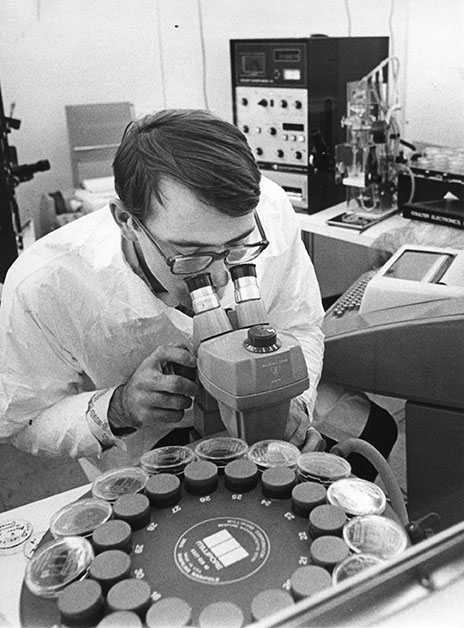
Dr. Lonnie Thompson at work in the
Institute of Polar Studies’ clean room
at OSU, 1977.

Well, it was one of our biggest issues even getting started in the lower latitudes. When I was a graduate student at what was then the Institute of Polar Studies here at Ohio State, there was a fellow, John Mercer, who was a geographer and he had made these atlases of the glaciers of the world (northern hemisphere, southern hemisphere) and he had these boxes of aerial photos. In one of those boxes we found this Quelccaya Ice Cap in the Andes of Peru….Our initial concept was very simple: they were drilling in Antarctica at Byrd Station and in Greenland at Camp Century and the idea was “Can we connect the climate history from Antarctica to Greenland through something in between in the tropics?” But when we went to National Science Foundation, to Polar Programs, which was the only place that funded ice core research, the program manager listened to us and he looked at me and he said, “You know Lonnie, that’s sounds very interesting but you know I can’t fund it because it’s not north of the Arctic circle or south of the Antarctic Circle.” There was no agency to fund that type of research.

I was at Byrd Station in Antarctica in 1973/74 and in February I got a telex from the program manager saying that he had funded all of his real science projects and that he had seven thousand dollars left… The following summer we made our first trip to the Quelccaya Ice Cap. It turned out to be a fantastic place: very remote, very difficult to get to. None of the logistics that had been developed for the Polar Regions would allow you to drill in these remote, high mountain regions. There had to be an engineering part of this to develop new drills, so we developed the first solar powered ice core drill to drill that icecap because the drills from Antarctica were a two day journey by horse from the nearest road. There was no way you could get one of those heavy drills from Antarctica or the generators from Antarctica to power it.
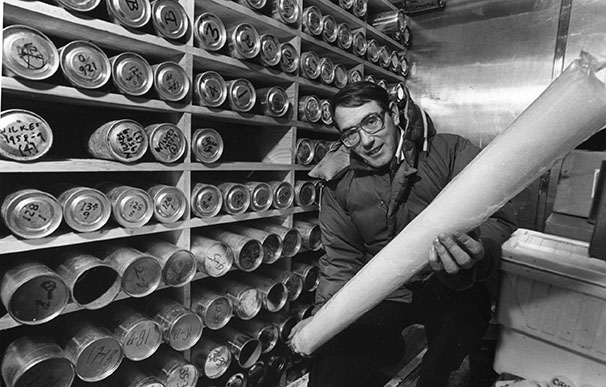
Dr. Lonnie Thompson shows off one of his ice cores
in 1980.

There wasn’t even an agency to fund that type of research but the science, if you think about it, the things that really impact climate on this Earth come out of the tropics, things like El Niños, things like the monsoons that affect so many billions of people on the planet…If you have a major eruption of a volcano in Alaska, it will impact the Arctic part of the globe, or if you’re down in South America in Argentina or Chile and there’s an eruption it will impact Antarctica, but if you want to impact the climate of the Earth, you put it in the tropics… The tropics make up between thirty degrees north and thirty degrees south, fifty percent of the surface area of the planet because we live on a sphere, and about seventy percent of the seven point three billion people on the planet live in the tropics, so it’s a place where we need to understand both natural and human driven changes. It’s part of a big system. We need those polar cores but we need to connect the system.

But you did receive some skepticism from the beginning.
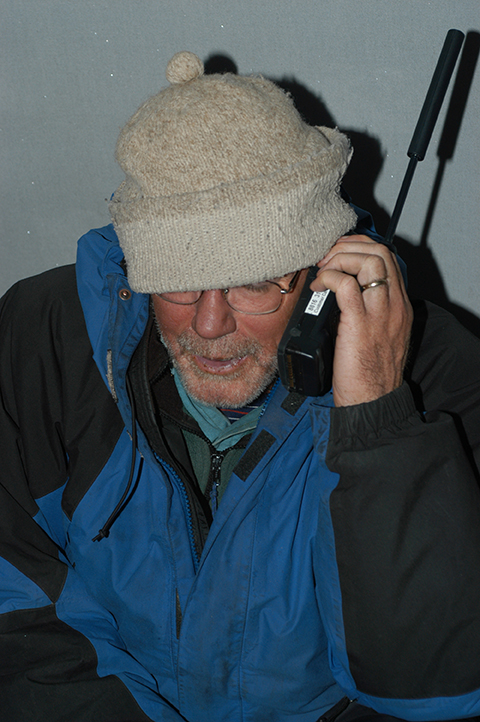
Dr. Thompson radios from the
Coropuna base camp in 2003.

Oh, absolutely. I am a firm believer that it doesn’t matter what area you’re in, you’ve got to be willing to put in ten thousand hours (that’s about eight years of your life) and I’ve put in about eight and a half years trying to figure out how to drill the Quelccaya Ice Cap in the Andes of Peru… Being young and naive, we just brought a drill from Antarctica and its power system. We made a contract with the Peruvian air force for a Bell 212 twin engine helicopter. No airport up there, we had to fly it thirteen hours to get it up to the area. We had to bring in fuel by boxcar on a train. We staged out of the back of a hotel in this little town of Sicuani. But at nineteen thousand feet this helicopter just falls. There’s no way we’d get near the surface…Of course, the first time we tried we failed…The second time, we tested some solar panels…we drilled not one but two cores to bedrock. One set of samples we sent to Willi Dansgaard’s lab in Denmark. He analyzed them and he was so excited. It was such a phenomenal result and he became one of our greatest supporters of why we should drill mountain regions…How did that eight and a half year process between the concept and actually being able to accomplish it is what launched all of our work in the low latitudes. It takes a special team…. It’s tough. There’s not very much oxygen. There are places very difficult to get into, very hard to drill and get the ice cores out while keeping them frozen. A lot of effort. And then, if you’re working in a place like Tibet, you need these permits to get in and be allowed to drill there and to take the cores back to your lab. We drilled in Tanzania, Kilimanjaro in Africa which is a national park, a World Heritage Site. We had twenty-four permits we had to get in order to drill. A lot of time and effort goes into just getting the ability to try. Then there’s all kinds of issues with things that could go wrong, why this could be a real big failure.

Published by John Hooton.
Frozen Fridays: ‘T’ is for Thompson! Part I

This blog post is part of the Frozen Friday Series, an A-Z journey of the Polar Archives.  Each week, we will feature some aspect of the history of polar exploration with a blog post written by our student authors.

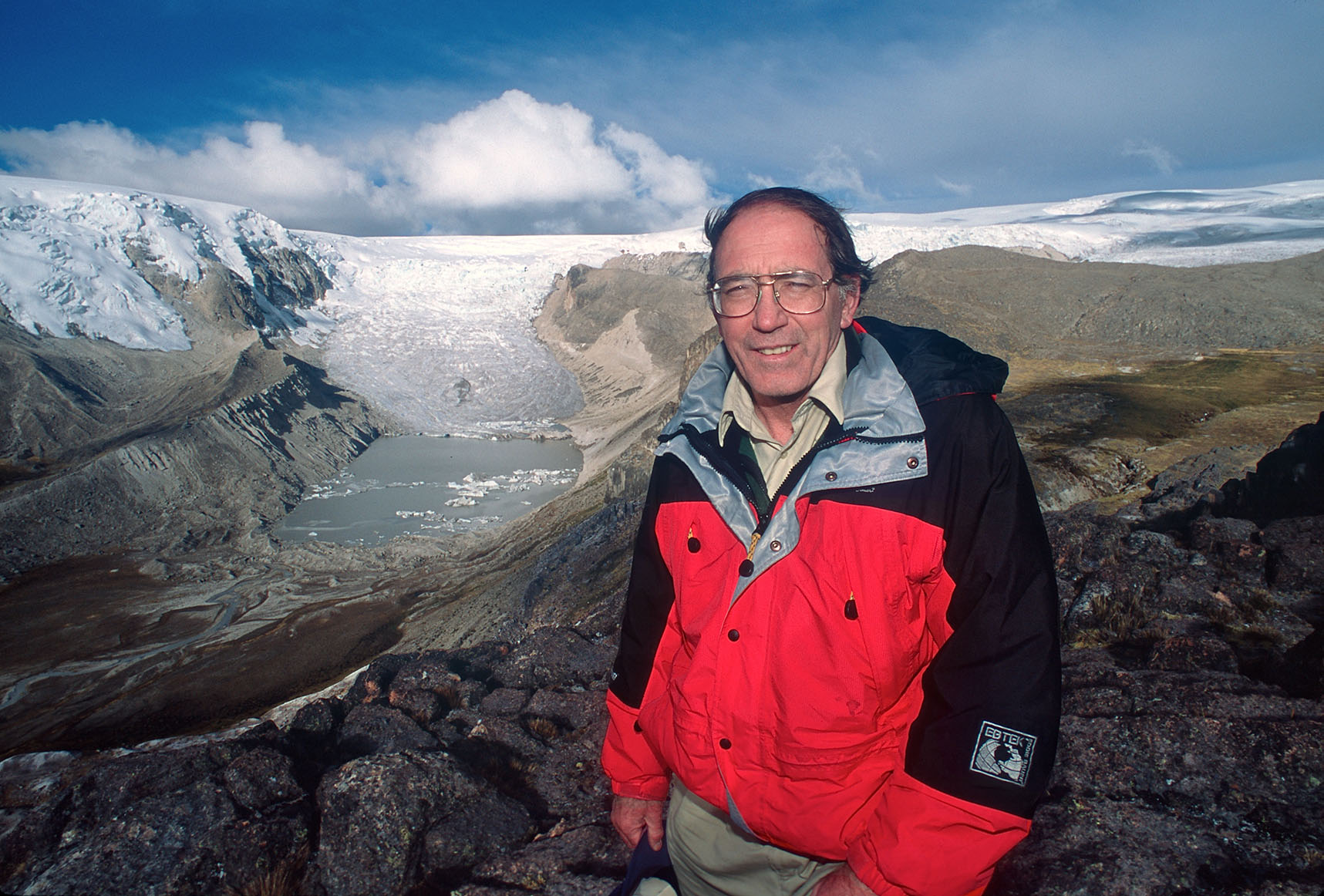
Lonnie Thompson at Qori Kalis glacier. His research
team has been measuring the melting of this glacier
over the last 20 years. Elevation of the Quelccaya ice
cap is 18,700 feet. Peruvian Andes, August 2000.

We would like to apologize for last week’s hiatus. We were in the process of producing a very special mini-series within this Frozen Friday blog series. I had the pleasure and honor to interview Dr. Lonnie Thompson, a leading glaciologist, an outspoken climate scientist, and one of the friendliest, most approachable men I have ever met.  The interview lasted for over one hour and was, in all honesty, one of the most interesting and fun experiences I have had while working with the Polar Archives. The reason we had decided to conduct an interview for this post is because Dr. Thompson is a living, breathing explorer. While we can guess at what drove Admiral Byrd or Dr. Cook to explore, we can easily ask Dr. Thompson why he does what he does. So, that is what I did. A full transcript of the interview can be found here.

Over the next four weeks, we will be publishing one of four blogs highlighting portions of the interview. Each post will focus on a theme from the interview and feature highlights of that particular section. This post will focus on introducing Dr. Thompson, in his own words, to those who might not already know of him. Next week will be about the difficulties he faced when beginning the Ice Core Paleoclimatology group here at the Byrd Polar and Climate Research Center.

How would you describe what you do and what you study to someone who wouldn’t know, just in your own words?

Dr. Thompson’s team extracts an ice
core from Mount Huascaran in the
Andes of Peru at 20,000 ft.

I’d say, first and foremost, we study glaciers… Glaciers are wonderful recorders in that every year, if you’re high enough, cold enough, or in high latitudes where it’s cold enough, you get an annual layer of snow deposited. You can measure that layer through measurements of isotopes of oxygen and hydrogen that tells us the temperature of the past so you can actually see the seasonal cycle in these areas…Every dry season, if you’re in the tropics, you get a layer of dust. You can measure the thickness of those dust layers through time and you can reconstruct precipitation… Literally anything in the atmosphere is recorded in the ice and that’s including the atmosphere itself. In the little bubbles (capsules) in the ice is capsules of the atmosphere of the past so we can extract the gasses from those bubbles so we can measure carbon dioxide, methane, and nitrous oxide; all the greenhouse gasses we’re concerned about today. We can look at how natural variation has changed through time. That record now goes back over eight hundred thousand years… But glaciers also respond to climate change. They’re indicators. If it gets warmer or drier, the glaciers will retreat. When it’s colder or wetter, they advance…They’re a visual recorder of how the system is changing… So they record so many variables and they’re the richest recorder that we have on the planet. Unfortunately in today’s world, those recorders are disappearing because the Earth is getting warmer.

I know you do a lot of travel and studying. I know the Byrd Center prides itself on having ice cores from various places. You said you’ve been to Greenland, where else have your studies taken you?

Another image of Dr. Thompson’s team extracting an
ice core, this time from the Quelccaya ice cap.

Well we have drilled the ice fields of Kilimanjaro in Africa, the highest tropical mountain in Africa. We’ve drilled the ice fields down in through the Andes of Peru, Bolivia, and Ecuador. The highest tropical mountain on Earth is Huascarán. It’s one of our drill sites in the Andes in Peru. We’ve drilled in places where people don’t even know there’s a glacier. For example, in Papua, Indonesia in what used to be called New Guinea, in the middle of a tropical rain forest, there’s a glacier, very difficult to get to and that glacier is disappearing very rapidly in today’s world but we were able to drill there in 2010. A lot of what we do is like a salvage mission to capture the history in the ice before it disappears. China, Tibet: we went into that part of the world right after relations were normalized between the U.S. and China. We’ve now been working there for thirty-three years and drilling in the Himalayas and across the Tibetan plateau. We just completed a project in 2015 in the far western Kunlun Mountains where we expect to have the oldest ice archive outside of the Polar Regions recovered on earth. We don’t know yet how old it is, but it might actually be the oldest ice on earth. That’s the beauty of what we do: we go to places where no one has gone before and in those areas you are almost guaranteed to find something new and exciting when you start reading that record.

Published by John Hooton

Frozen Fridays: ‘S’ is for Siple!

This blog post is part of the Frozen Friday Series, an A-Z journey of the Polar Archives.  Each week, we will feature some aspect of the history of polar exploration with a blog post written by our student authors

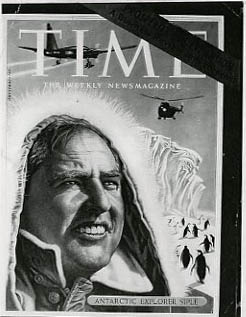
Dr. Paul Siple on the cover of Time
Magazine in 1956.

While doing research for another Frozen Fridays post (“‘O’ is for Outreach”), I came across a source written by a familiar name: Siple (as in Dr. Paul Siple). Puzzled by the familiarity, I summoned the “Googler” and sought to solve my self-created mystery. Upon skimming Paul Siple’s Wikipedia page, I arrived at my answer: Paul Siple, apart from his significant contribution to the development of what would commonly be known as the wind-chill factor, was also the famous Boy Scout that went with then Commander Richard E. Byrd on his first expedition to Antarctica (1928-30). With some excitement at this discovery, my curiosity succeeded in derailing me from my research and drove me to the Polar Archive’s website, seeking a short biography of the man. While Dr. Paul Siple did have a collection in the Polar Archives, to my disappointment, no such bio yet existed. With this week’s blog, I intend to rectify that by writing a bio pro tempore that will bring attention to one of the many interesting individuals within the Byrd Polar and Climate Research Center Archival Program.

A young Paul Siple in his scouting
uniform in 1928.

Paul Allman Siple, born on 18 December 1908 in Montpelier, Ohio, would be one of the few men to have the distinction of serving under Admiral Richard E. Byrd on all five of his Antarctic expeditions.[1] On the first of these expeditions, the young Paul Siple was a plucky nineteen year-old, fresh from his first year of college.[2]  In June 1928, Chief Scout Executive James E. West announced that Commander Richard Byrd was looking for a single Boy Scout to serve with him on his upcoming journey south.[3] Of the 826,000 scouts, eighty-eight were recommended to the National Office of the Boy Scouts, which in turn narrowed the selection pool to seventeen. A further committee narrowed the seventeen to six finalists.[4] The most basic considerations for any scout applying for this coveted position were rigorous: at least two years of First Class or Able Sea Scout rank in the Scout Movement, two recommendations from “qualified authorities” on his character and skill, and Merit Badges in various skills such as Aviation, Hiking, Machinery, and Taxidermy.[5] Obviously, the final six Scouts held all of those qualifications and more. The final selection memo sent to Chief Scout Executive James West detailed each of the six, listing the strengths and weaknesses of each boy.  Paul Siple received more than double the average number of strengths while fewer than the average number of weak points. Described in the memo as having “a good strong physique” and an “excellent character with the highest ideals,” Siple appeared to the selectors to be intelligent, sincere, respectful, and generally very well suited to the tasks of the expedition. Even his weak points were positive: “He is not a rapid thinker. He takes time, but is usually right. He is a little too serious…He accepts criticism appreciatively, however.”[6]  It appears that Paul Siple was the clear choice for the expedition.

Dr. Paul Siple in 1937, nearly
ten years after Byrd’s First
Antarctic Expedition
(1928-30).

Siple nearly missed the opportunity to winter on the continent. “‘Nobody knows who is going to stay on the ice,’” said Siple, quoting then Commander Byrd. “‘Everyone who does will have to have a reason. Besides, we do need crew members to bring the ships back for us at the end.’”[7] Luckily, Siple’s training as a Boy Scout came once again to his aid. Larry Gould, second in command of the expedition, “had promised the American Museum of Natural History that he would bring back a barrel each of seal and penguin skins,” an obligation that Gould no longer felt he could complete. Thus, when Gould sought someone to take on the messy task, Siple was first to volunteer. After pleading to the good Commander to allow the boy to winter on the ice, Siple joined the winter party as a “taxidermist, dog driver and naturalist.”[8] Siple would also become the driver of his own dog team when one the expedition’s dog handlers suffered “an unfortunate accident.”[9] Siple recounted his adventures as a Boy Scout with Byrd in his books,  A Boy Scout with Byrd and 90⁰ South. Perhaps the most amusing of these tales is the story of how he gained a “knighthood”. Siple was a founding member of the “Knights of the Grey Underwear” when, out of necessity the winter party engaged in a process known as “dry washing”. Siple explains: “In the cold of the winter the process we called ‘dry washing,’ or exchanging soiled clothes for almost equally soiled garments which had previously been set aside for laundering but which now looked somehow cleaner than those being worn, came into existence. And so the “Knights of the ‘Grey Underwear’ was born.”[10]

Dr. Paul Siple in Antarctica, nearly thirty years after
he first visited the continent.

Upon returning to the United States, Mr. Siple would become Dr. Paul Siple after completing a doctorate in geography from Clark University. He would serve on all of Admiral Byrd’s expeditions to the Antarctic and devised, with Charles Passel, the wind-chill index that measures the effect of moving air on the human body.[11] Paul Siple lived an incredible live and had the privilege of serving with Admiral Byrd for nearly the entirety of his adult life. Paul Siple’s collections and the collections of other Polar Explorers, including the good Admiral, can be found at the Byrd Polar and Climate Research Center Archival Program.

Written by John Hooton.

[1] Jeff Rubin, “Siple, Paul,” Encyclopedia of the Antarctic (New York: Routledge 2007).

[2] Information taken from the Papers of Admiral Richard E. Byrd.

[3] Information taken from the Papers of Admiral Richard E. Byrd.

[4] James E. West,  “With Byrd to the Antarctic”, Boys Life, October 1928, 17.

[5] Information taken from the Papers of Admiral Richard E. Byrd.

[6] Information taken from the Papers of Admiral Richard E. Byrd.

[7] Paul Siple. 90⁰ South (New York: Putnam 1959), 40.

[8] Paul Siple. 90⁰ South, 41.

[9] Paul Siple. 90⁰ South, 42.

[10] Paul Siple. 90⁰ South, 43.

[11] Jeff Rubin, “Siple, Paul.”

Older posts Newer posts