From Woody's Couch

Our Playbook on OSU History

Author: drobik.5@osu.edu (page 9 of 62)

Twelve Days: Pollard’s passion for the past helped keep OSU’s history intact

(In celebration of the University Archives’ upcoming 50th Anniversary in 2015, we bring you “The Twelve Days of Buckeyes”. This is day two in a series of 12 blog posts highlighting the people who were instrumental in the creation and growth of the Archives.)

James Pollard, 1959

James Pollard, 1959

Though James Pollard’s main expertise was in journalism, his most important impact on OSU was because of his interest in history. Particularly OSU history, which would make sense since he was a three-time graduate of the University (B.A. 1916, M.A. 1917 and Ph.D. 1939).

Pollard first served as a Political Science teaching assistant from 1920-21, then Director of Ohio State’s News Bureau from 1923-33. He was an Associate Professor of Journalism from 1932-38, and Director and Professor of Journalism from 1938-58. Finally, he served as University Historian from 1958 until his retirement in 1965. After his retirement, however, he continued to work part-time as a consultant for the Office of Educational Services.

Along the way, Pollard wrote many articles and books, but he was especially interested in the history of OSU. In 1952, his book, History of the Ohio State University, 1873-1948 was published. It chronicled the formation of the Ohio Agricultural and Mechanical College, and its growth and development up to 1948. Soon after, Pollard also wrote biographies on former University Presidents Howard Bevis and William Oxley Thompson. By 1959, Pollard published yet another book about the University, this time about the history of athletics. Ohio State Athletics, 1879-1959 discussed how athletics were established at the university as well as how individual sports were developed.

Pollard (right), goes through filing cabinets in the Administration Building's basement, 1960

Pollard (right), goes through files in the Administration Building, 1960

Pollard was not only interested in writing about OSU history, but – and the Archives staff is eternally thankful for this – he was interested in preserving its history. To write his books on OSU history, he had gone through correspondence and other historical documents that were spread all over the University at the time in vaults, basements and attics. Pollard knew that in such places, these unique materials would deteriorate with age. In one basement, in fact, he found records whose boxes had collapsed, and the contents were spilled in a heap on a damp floor. In another, he found a collection of records that had become shredded by the gnawing teeth of rats setting up house in them, according to a September 1960 Alumni Monthly article.
1960

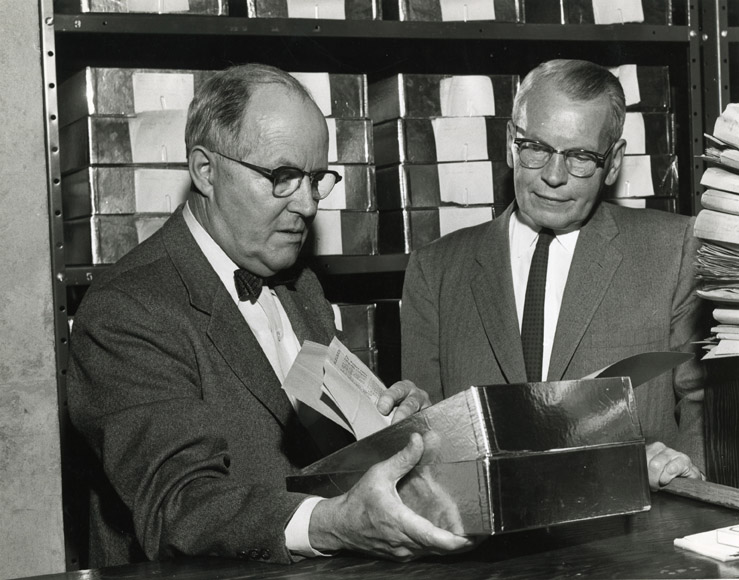
Pollard and Frederic Heimberger, Vice President for Instruction and Research, go through University Records stored at the Main Library, 1960

It took Pollard two years, but he finally convinced the administration to establish an archives where he could store and organize University materials, to be located on the top floor of the Thompson Library. His first task was to go through old file cabinets in the basement of Bricker Hall (then known as the Administration Building). There, he retrieved 24 file drawers of what would become the William Oxley Thompson Papers, now one of the most frequently used collections here at the Archives.

Twelve Days: Without Reuben Cannon, there might not be a Buckeye Nation

(In celebration of the University Archives’ upcoming 50th Anniversary in 2015, we bring you “The Twelve Days of Buckeyes”. This is day one in a series of 12 blog posts highlighting the people who were instrumental in the creation and growth of the Archives.)

Reuben P. Cannon, 1870

Reuben P. Cannon, 1870

When Congress passed a law in 1862 establishing the nation’s land-grant university system, it didn’t mean it was a done deal that there would be such a college in Ohio. The law allowed states to sell federal land out west to create endowment funds that would be used for university instruction in agriculture, mechanical arts (now known as engineering) and military science. But the whole thing was voluntary, so after the law passed, legislators in individual states began arguing over whether to take up the feds’ offer.

It was a long debate in Ohio, because there was much to consider. One of the biggest questions was, if Ohio sold the land and raised the money, would it be used for a new school or go to one currently in existence? After all, there were a number of colleges, such as Ohio and Miami universities, that would gladly use the money for instruction in agriculture and mechanical arts.

Enter Reuben Cannon.

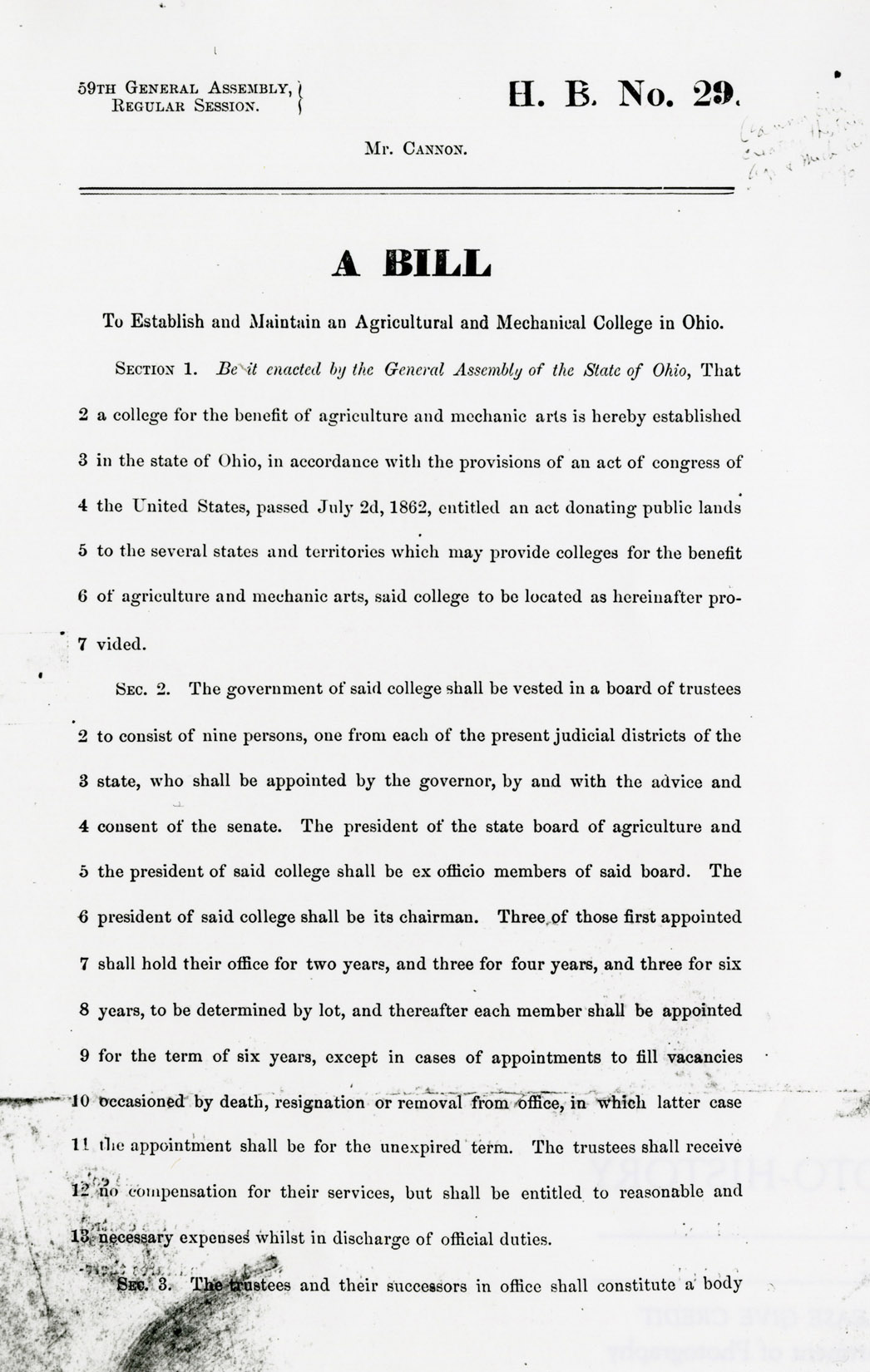
The Cannon Act

The Cannon Act

In 1870, Cannon, a General Assembly member from Portage County, proposed a bill to establish a brand-new university: the Ohio Agricultural and Mechanical College.

The Cannon Act of March 22, 1870, proposed a board of trustees of 19 members—one from each congressional district in Ohio—who would make decisions regarding this institution. These decisions included its curriculum, faculty, administration, and location.

Some specifics that the trustees implemented were that the location must not be less than 100 acres; it had to be in the center of the state, and it had to be accessible by railroad from parts of Ohio. This new college would have to be open to those over 14 years old, and it would have to have, at the very least, four departments: agriculture, mechanic arts, military science, and literature. Neil Farm, between Olentangy and Worthington Road, was chosen for the new campus.

In September 17, 1873, the Ohio Agricultural and Mechanical College would open its doors to 24 of its 40 applicants, including two women, from eleven counties.

Cannon is now known as the “father of Ohio State,” for without him, we may not be here at all!

1873

1873

The Oval’s Long Walk has paved way for students for a century

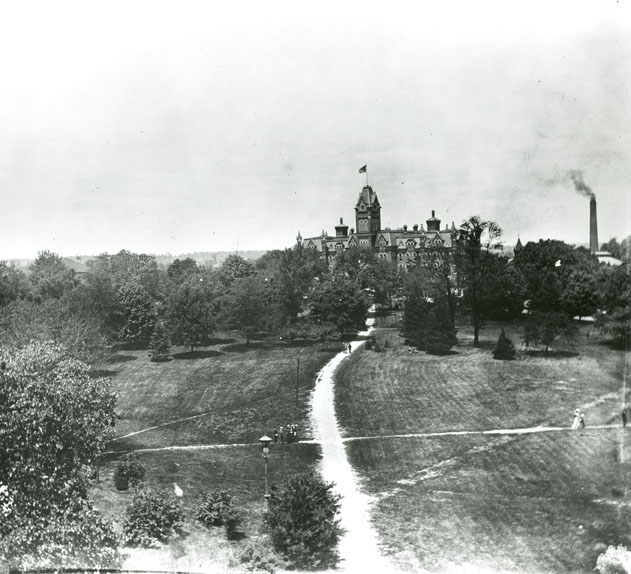
University Hall, 1897

University Hall, 1897

It’s hard to imagine OSU without an Oval or a Long Walk, but it turns out that both of these were purely accidental when it came to the early shaping of the University’s design.

The layout of early campus actually followed that of an English Manor, with the manor house, (the original University Hall), on high ground and set back from the road. Access to High Street was by a path that ran diagonally across what is now the Oval to the site of Page Hall.

Early campus planning of the University did not include an Oval in the middle of campus, and certainly no “Long Walk.” But, in the early 1890s, as some of the first campus buildings were built in certain spots, it created a central green area. In 1893, a new master plan was proposed that created a layout for a “central open space around which buildings could be arranged, and which would not be crossed by any roads.” By 1901, this space had closely evolved into the shape of today’s Oval.

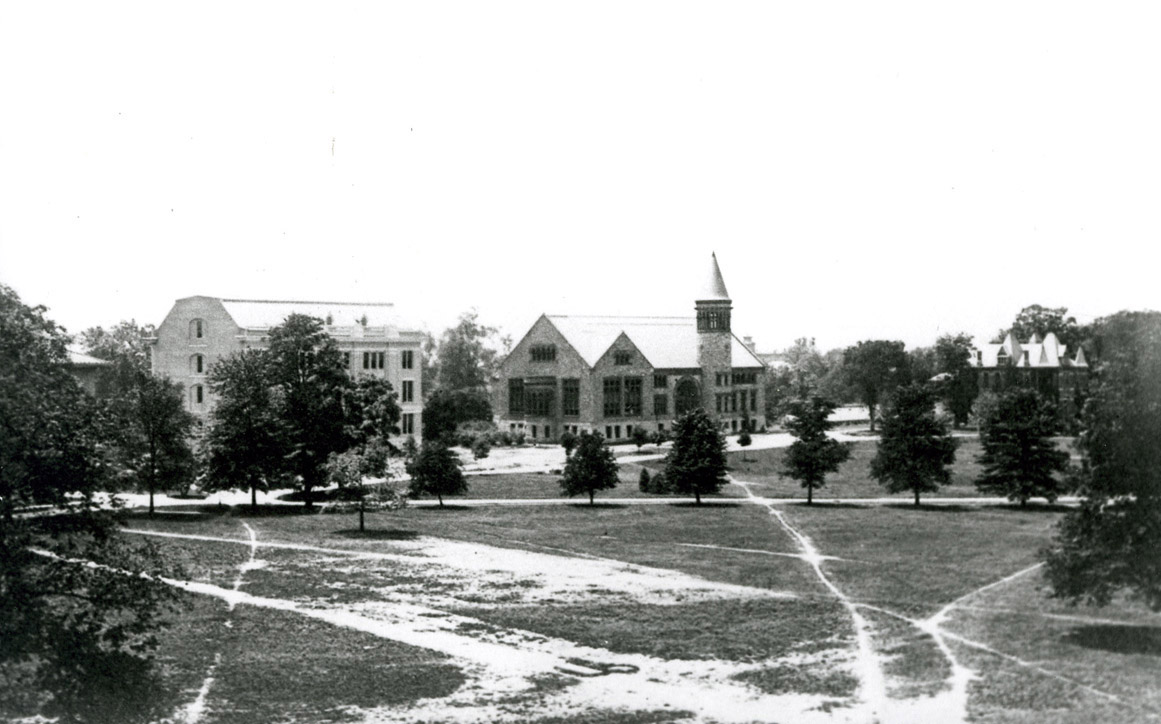
Oval, 1905

Oval, 1905

As buildings continued to go up, students began creating their own walking paths, trekking across the grass to their destinations. Their walking paths partly led to the current design of sidewalks, including the Long Walk.

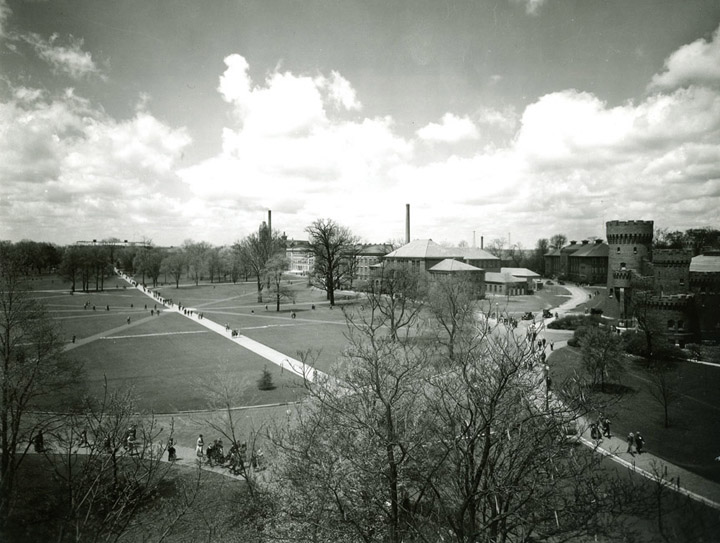
Joseph N. Bradford, who became University Architect in 1911, was the next piece of the puzzle in the Long Walk’s creation. Bradford was committed to a formal arrangement of campus. In fact, the campus plan he created in early 1914 showed a very formal, geometric pattern of walks within the Oval. By the fall of 1914, the Long Walk was constructed.

Proposed map by Joseph Bradford

Proposed map by Joseph Bradford

However, the construction of the Long Walk did not seem to elicit the fanfare one might expect today from the media. A Lantern article dated September 15, 1914, includes a paragraph about the new walk in a story about two new buildings on campus:

Oval and the Long Walk, 1927

Oval and the Long Walk, 1927

“A broad walkway, of dark red cement has been built from the main entrance to the Library across the oval to the Fifteenth avenue entrance. Walks to the Chemistry building and to Orton Hall extend from it…..”

Not everyone on campus benefited from the Long Walk. In the 1920s and 1930s, freshmen were forbidden to use the Long Walk. The penalty for being caught on the path – which was enforced by the upper-classmen honorary Bucket and Dipper – was to be thrown in Mirror Lake.

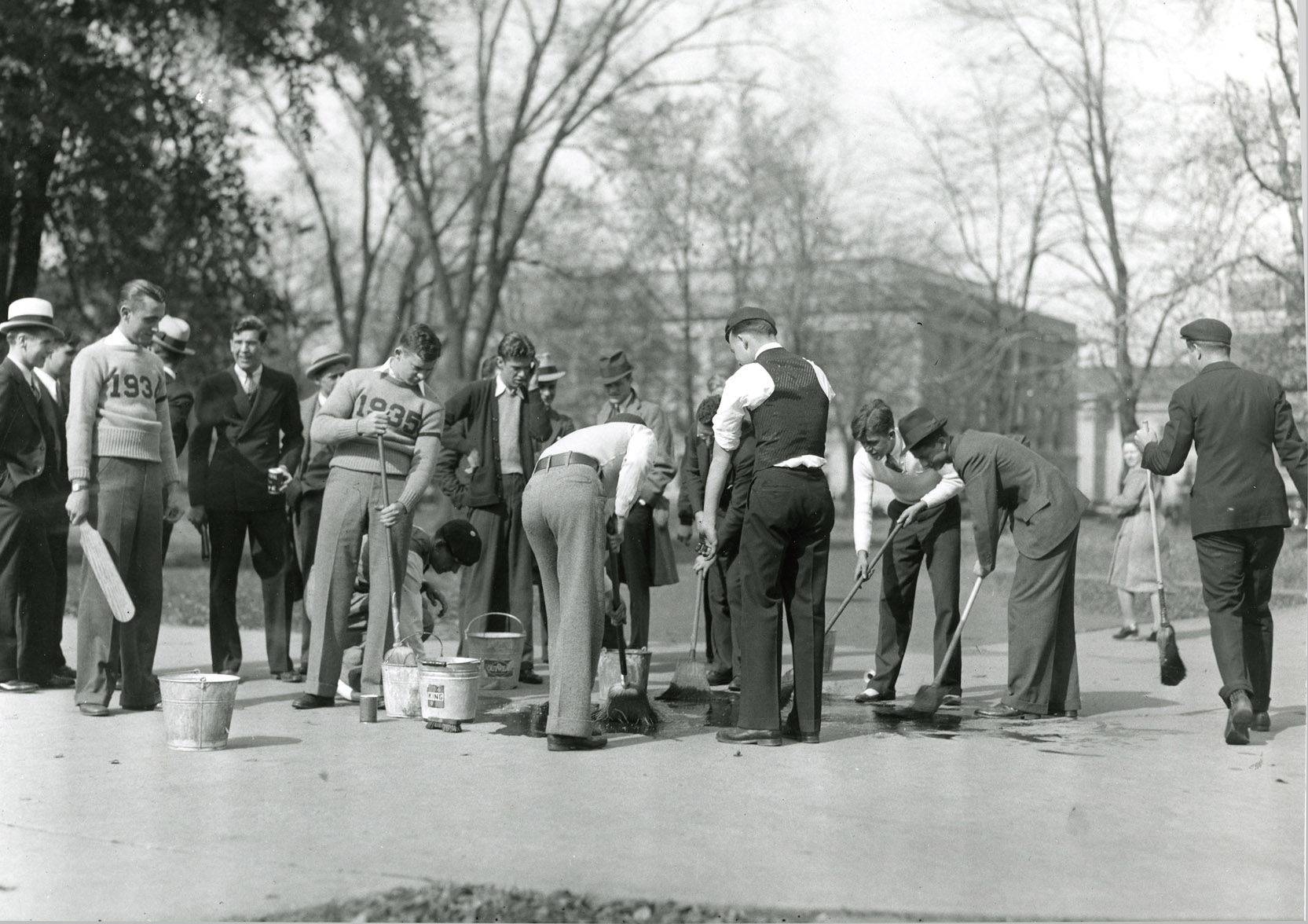
In 1931, freshmen of the class of 1935 were in hot water after Bucket and Dipper members found the class emblem of 1935 painted all over the Long Walk. All of the freshmen suspected in the painting were told to report to the Oval every day at 12:30 p.m. for an hour’s worth of cleanup, until all of the painted numerals were gone.

Freshmen cleaning the Long Walk, 1931

Freshmen cleaning the Long Walk, 1931

One suspected freshman, who had been assigned the task of bringing buckets of water from Mirror Lake to the Long Walk for the cleanup, said “I’d rather carry the water from the lake than be tossed into it.”

Students, on their way to classes during the Long Walk cleanup, apparently gathered around to watch the freshmen at work. It was reported that up to 60 spectators were observing the action, while other freshman on the way to classes steered clear and avoided the scene altogether.

The Oval and the Long Walk have been home to many other student activities over the years. Check out our Oval gallery on Flickr to see how the campus spot has changed over the years.

Older posts Newer posts