From Woody's Couch

Our Playbook on OSU History

Author: drobik.5@osu.edu (page 8 of 62)

Twelve Days: Harding gave Archives official role in preserving OSU’s history

(In celebration of the University Archives’ upcoming 50th Anniversary in 2015, we bring you “The Twelve Days of Buckeyes”. This is day five in a series of 12 blog posts highlighting the people who were instrumental in the creation and growth of the Archives.)

Bruce Harding and an unidentified staff person pose in front of an Archives display, 1965

Harding and an unidentified staff person at the Archives, 1965

You may not know this but the University has an Operating Manual, which is nothing like the owner’s manual you receive with a new car, but instead is a compilation of policies, procedures and guidelines that help determine how OSU conducts business.

Inside, thanks to Bruce Harding, is a section that makes the Archives the official repository of University materials of permanent value, and gives it the authority to decide on the disposition of all of the University’s records.

Sounds pretty cool, huh?

Page from the operating manual

Page from the operating manual

Fine, it might not sound very cool, but it is, in fact, very important. Without that designation and authority, the University’s history might be spread willy-nilly all over campus or, heaven forbid, disposed of without a thought or care. Imagine the first registrar’s book – the only record of the first students who attended OSU – being tossed in the trash. Unthinkable, isn’t it? But without the Archives being the official developer of individual departments’ and other units’ records retention policies, important historical materials might be lost forever.

With its place in the Operating Manual, the Archives has an official role in preserving OSU’s historical record, and it was because of Bruce Harding that it’s there. As the first official archivist appointed to that role in 1965, Harding worked to get guidelines on records disposition into the Operating Manual as early as 1969.

Harding, 1967

Harding, 1967

Harding had been hired in 1965 from Michigan’s state archives, and he had previously worked at the Ohio Historical Society. He was the University’s first professional archivist – he had certificates in archives management and preservation administration from Harvard and American universities, respectively – but he left in 1969, saying the archives was still low on OSU’s priority list and that funds were insufficient. “Of course, the University’s primary responsibility is to teach, and the archives is naturally of far less importance,” he told The Lantern in February 1969.

It couldn’t have helped that while he was archivist, the Archives moved three times, from the top floor of Thompson Library to the law school’s basement and Hitchcock Hall. Harding subsequently worked for the National Archives and Records Service in Chicago as a field regional archivist responsible for much of the Midwest.
Twelve Days: Having the right ‘supplies’ key to planning OSU’s centennial party

(In celebration of the University Archives’ upcoming 50th Anniversary in 2015, we bring you “The Twelve Days of Buckeyes”. This is day four in a series of 12 blog posts highlighting the people who were instrumental in the creation and growth of the Archives.)

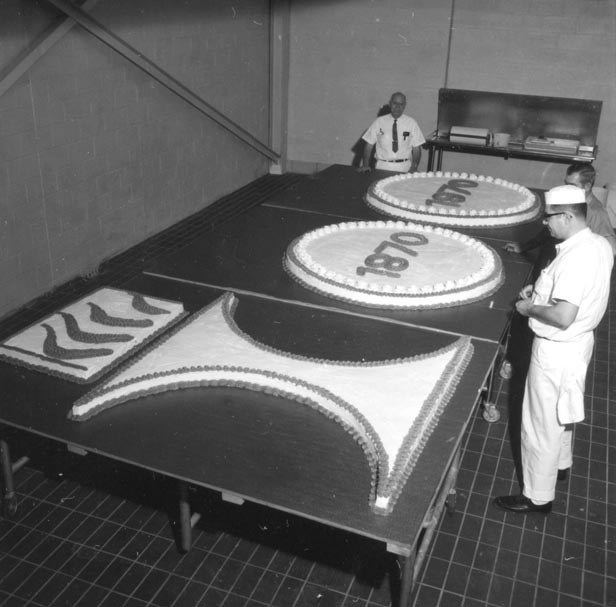
Cake made for the University's Centennial Celebration, 1970

The University’s centennial celebration cake, 1970

When you are planning a party, you always make sure that you have everything ready before it starts, right? In the case of a regular party, you see that you have enough food, beverages, plates, napkins, etc.

Same thing with the University’s centennial celebration in 1970, only in this case it had to make sure it had the historical papers, photos and artifacts to commemorate the 100th anniversary of its founding in 1970. Five years earlier, in 1965, the first University Archivist, Bruce Harding, was hired; a professional archivist was needed to properly manage the historical records as the University prepared to show off the legacy of its first 100 years. Particularly, photos were important, as they offered the basis of the “The First Hundred Years” book that was widely distributed for the event.

Centennial celebration container

Centennial celebration container

Coincidentally, as the University used the Archives to help it display its many historical legacies, the process of celebrating produced much-needed – and now often used – historical documents to be housed at the Archives. For instance, many OSU departments created centennial histories, which remain key resources for those doing administrative historical research.

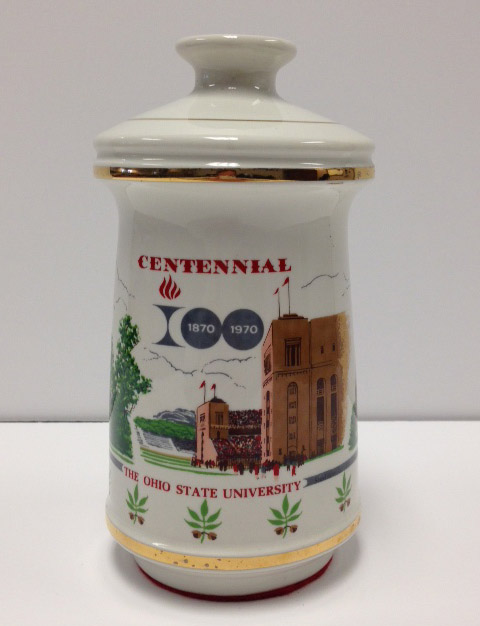
And the celebration produced its own historical record: Not only does the Archives retain the various reports, proposals and other materials documenting the planning process, but it has a lot of really cool artifacts that demonstrate the way the University celebrated, such as a porcelain whiskey container with images of Orton Hall, Ohio Stadium and University Hall on it (at left).

Just an FYI: The University celebrates its 150th anniversary in 2020. It’s never too early to plan a party!

Twelve Days: Bradford had picture-perfect dedication to University photographs

(In celebration of the University Archives’ upcoming 50th Anniversary in 2015, we bring you “The Twelve Days of Buckeyes”. This is day three in a series of 12 blog posts highlighting the people who were instrumental in the creation and growth of the Archives.)

Joseph Bradford, c1883

Joseph Bradford, c1883

When University officials first asked Joseph Bradford to join the faculty, he turned them down. Thank goodness they named him an instructor anyway, or the Archives might not now have photos of the University from its early days.

Bradford was actually a graduate of OSU, earning a degree in Mechanical Engineering in 1883. He was a draftsman with the Pennsylvania Railroad when he was asked by the College of Engineering to organize a course in engineering drawing. Having no interest in being an instructor, he declined the offer. Nevertheless, the Board of Trustees named him an instructor in mechanical and freehand drawing in 1885, with a salary of $1,000 a year.

As a member of the faculty, he taught engineering drawing and architecture, and pioneered instruction in photography, with the first course in “picture-making” offered in the United States in 1890. By 1903 he had published “Photographic Notes for Students in the Ohio State University,” which explained the technical aspects of photography and gave helpful hints on how to be a better photographer.

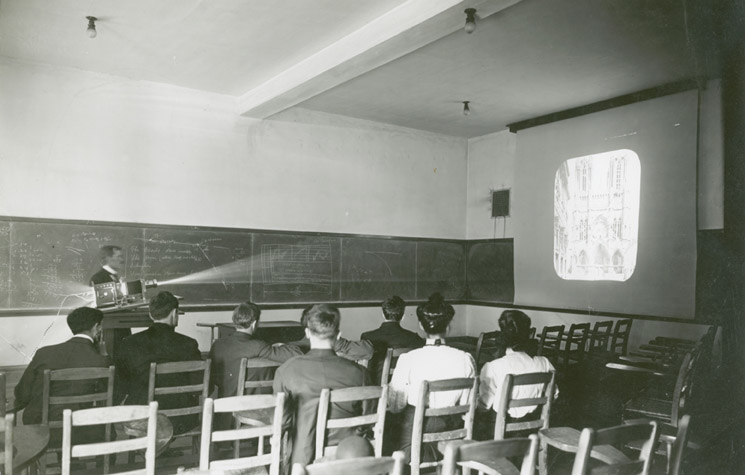
Bradford is shown here teaching a History of Architecture Class using the first electrical lantern slide projector at OSU. This class was held in Hayes Hall in 1895.

Bradford is shown here teaching a History of Architecture Class using the first electrical lantern slide projector at OSU. This class was held in Hayes Hall in 1895.

In 1911, Bradford was named University Architect, and he built an impressive portfolio in that area, designing 40 buildings on campus. His work includes such landmarks as Derby Hall, Jennings Hall (then the Botany and Zoology Building), the Kuhn Honors and Scholars building (then the president’s residence), Starling-Loving Hospital, and Sullivant Hall.

But his love of photography is what makes him special to the Archives.

F.W. Davis, Chair of the Department of Photography, and Joseph Bradford in the Photo History Vault in Brown Hall, 1940

F.W. Davis and Joseph Bradford in the Photo History Vault, 1940

In 1931, Bradford received approval from the Board of Trustees to start a Photographic History Unit in the Department of Photography. The unit’s purpose was to “make a complete photographic pictorial record of the progress of the University, its departments, and changes in its personnel,” according to a February 1931 Alumni Monthly article.

Bradford, who had been associated with the University since 1877 when he matriculated as a freshman, was made Emeritus Professor in 1932 and at that point took full charge of the Photo History Division. Bradford worked tirelessly organizing, filing and cataloging historical University photographs. He collected the earliest images from local photographers while also soliciting photographs from University staff and former students. By 1935, Bradford had accumulating about 16,000 prints and negatives. This collection was to eventually become the beginning of the University Archives’ photographs collection.

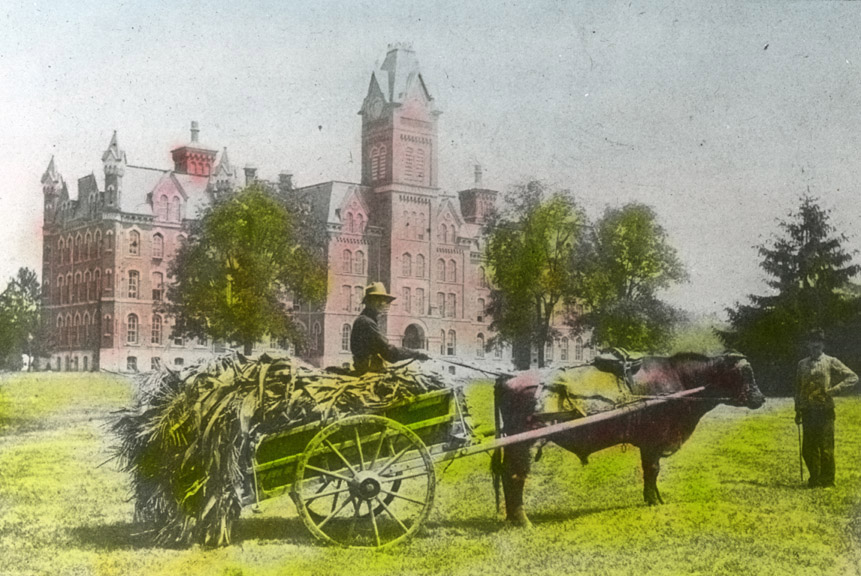
A hand-colored glass slide from Bradford's collection.

A hand-colored glass slide from Bradford’s collection.

Bradford also used his own campus photographs, even coloring some of them by hand. He was well known for giving his “Campus Memories” presentation, a Lantern slide show, which highlighted the early history of the University and included photos of buildings, geography, athletics, events, faculty and classrooms. You can see a sampling of the images from his Campus Memories slide show on the Archives’ Flickr gallery.

Bradford died in 1944. However, the Department of Photography continued to add to the collection he had worked so hard to build, photographing the buildings, faculty and grounds of the University.

In 1972 the photographic archives became part of the University Archives and now contains more than two million photographs depicting the history of the University from 1870 to the present time. Because of Bradford’s love of photography and his obvious dedication to the University, we can witness the enormous growth of a campus through his extensive collection of photos that are housed here at the Archives.

Older posts Newer posts