Page 78 of 166

New Exhibits: LITTLE NEMO and GOOD GRIEF!


OSU-UNITNAME-2c-Vert2-PANTONE

Contact: Caitlin McGurk
The Ohio State University
Billy Ireland Cartoon Library & Museum
1813 N High St.
Columbus OH 43210-1393
614-292-0538
cartoons@osu.edu

FOR IMMEDIATE RELEASE: May 3, 2016 

Upcoming Exhibitions at The Billy Ireland Cartoon Library & Museum:

LITTLE NEMO: DREAM ANOTHER DREAM
&
GOOD GRIEF! CHILDREN AND COMICS

June 4, 2016 – October 23, 2016

The Billy Ireland Cartoon Library & Museum will debut two new exhibits in June to run through October 2016. These exhibits are free and open to the public Tuesday – Sunday from 1:00 – 5:00 p.m.

LittleNemo-Yuko-lowres

Little Nemo: Dream Another Dream
Winsor McCay (186? – 1934) was one of the most significant American artists of the 20th century, known best for his groundbreaking newspaper comics and early animated films. Much of his most beloved work appeared in Little Nemo in Slumberland, a full-page comic that ran every Sunday from 1905 to 1926. It was on these pages that McCay expanded the world of visual narrative: his stunning sequences, expressed through vivid illustrations and inventive panel compositions, became a cornerstone of modern comics.

In 2014, Locust Moon published Little Nemo: Dream Another Dream, a full-color anthology featuring work by 100 comic artists and illustrators. Each of these artists was asked to create a new version of McCay’s famous strip, resulting in a rich and diverse collection of homages to a remarkable man.

This exhibit presents original artwork from the book, and featured artists include Peter Bagge, David Mack, Paul Pope, Carla Speed McNeil, Farel Dalrymple, and more. Ohio State’s iteration of this traveling exhibit, curated by Josh O’Neill, Andrew Carl and Chris Stevens, will also include McCay originals from The Billy Ireland Cartoon Library & Museum collection.

nancy

Good Grief! Children and Comics
Young people have a long, rich, and complicated history with comics in the United States.  Many of the most beloved comic strip characters have been children.  Similarly, boys and girls have also constituted one of the primary readerships of, as well as target audiences for, this artistic form.  Comics and children just go together, like Nancy and Sluggo, Archie and Jughead, or Calvin and Hobbes.

Good Grief! Children and Comics examines the history, role and tensions of child characters in comic strips and comic books.  The exhibit explores questions such as the following:  In what ways do child characters in comics represent actual children, both their explorations of fantasy and their realistic lives? In contrast, how do child characters serve as stand-ins for adult concerns and desires, becoming mouthpieces for engaging with adult topics? Likewise, how have comics navigated the seemingly competing objectives of providing simple escapist fun and serving as substantive educational reading?

In exploring these and other themes dealing with the child, Good Grief! Children and Comics features characters, cartoonists, and strips spanning the history of American comics.  The exhibit includes well-known titles such as Peanuts, Little Orphan Annie, Calvin and Hobbes, Archie, Dennis the Menace, and Little Lulu, along with lesser-known gems like Madge the Magician’s Daughter, Luther, and Space Kid. Curated by Karly Grice and Michelle Abate, with assistance from Jenny Robb and Caitlin McGurk.

GeneLuenYang-www.faizaphoto.com

Gene Luen Yang

FREE EVENT: On Friday, June 10th the Billy Ireland Cartoon Library & Museum will host an opening reception from 5:30-7:00 pm in the museum galleries. At 7:00 pm, in partnership with the Wexner Center for the Arts, award-winning cartoonist Gene Luen Yang will present on “Asian Americans and Comics” in the Wexner Center Film/Video Theater. Yang, National Ambassador for Young People’s Literature, is the author of the award –winning graphic novels American Born Chinese and Boxers and Saints. Book signing to follow.
For more information visit: http://cartoons.osu.edu/events/asian-americans-and-comics/


About the Billy Ireland Cartoon Library & Museum:  The BICLM is one of The Ohio State University Libraries’ special collections. Its primary mission is to develop a comprehensive research collection of materials documenting American printed cartoon art (editorial cartoons, comic strips, comic books, graphic novels, sports cartoons, and magazine cartoons) and to provide access to the collections. The library reading room is open Monday-Friday 9 a.m. to 5 p.m. and Sunday 1 – 5 p.m. The museum is open Tuesday-Sunday from 1 – 5 p.m.  See http://cartoons.osu.edu/ for further information.


New Acquisitions! Early Arab Comics: Samir and Dunia al-Ahdath

Billy Ireland Cartoon Library and Museum has recently added first year print-runs of two important Arab comics magazines: The Egyptian magazine Samir (founded in 1956) and the Lebanese magazine Dunia al-Ahdath (founded in 1954). Both collections reflect early articulations of mass print culture for children in Egypt and Lebanon and reveal intriguing intersections between popular culture, nationalism, mass education, and gender in a period of early postcolonial nation building.

Samir

"Samir" cover, no. 17

“Samir” cover, no. 17

The comics weekly Samir was founded in 1956, four years after the 1952 Revolution, when Jamal Abd al-Nasser and the Free Officers overthrew the British-backed Egyptian monarchy. Published by the government-owned Dar al-Hilal, it would become the most popular comics magazine in the Arab world in the 1950s and 1960s.

The 1956-7 issues in the collection showcase the magazine’s mission of educating Egypt’s young citizens in a nationalist mold in the early years of the Egyptian republic. Some of the recurring strips feature characters created from local contexts, such as Basil, a young adventurer who battles networks of smugglers to protect Egypt’s borders, or Samira, a girl who often demonstrates the smarts and strength of female characters.  Some strips draw on internationally known characters such as Mickey Mouse and Alice and Wonderland. In other strips, the pairing of the two iconic figures Juha and Samba reveal how racialized colonial stereotypes reappeared and were re-adapted in Egyptian and Arab contexts.

Samira

Do you know Madame Curie-

Do you know Madame Curie?

Samir included educational vignettes and biographies of influential historical figures. Texts and comic strips also retell the events and aftermath of the 1952 Egyptian revolution.

The Story of the Revolution

The Story of the Revolution

In later issues, Samir would take a more critical turn. Artists such as renowned Egyptian political cartoonist Ahmed Hijazy, who joined the magazine in 1965, played a role in reshaping the direction of the magazine in the 1960s and 1970s. Hijazi’s popular strips chronicling Samir’s adventures with the comical Tanabila trio would satirize Egyptian politics and Egypt’s class culture. Some of these later issues can be accessed at other libraries: http://osu.worldcat.org/oclc/11352739

Billy Ireland holds one of Ahmed Hijazi’s original drawings in its collection:

Hijazy drawing

Ahmed Hijazi original art from the International Museum of Cartoon Art Collection at the Billy Ireland Cartoon Library & Museum

Dunia al-Ahdath

Dunia Al-Ahdath (The World of Youth) is considered the first Lebanese comics magazine. It was founded in 1954 by the poet, teacher, and children’s book author Loreen Rihany. Loreen and her husband (owner of Rihany press, which printed the magazine) were active in many organizations that promoted Lebanese cultural institutions.  Arab comics scholar Henry Matthews has suggested that the magazine’s was closely modeled on the earliest Arabic children’s comics from the 1940s and 50s. The form and content of the early issues bear a close resemblance to the Egyptian magazine Sindibad (Matthews 5).

Dunia al-Ahdath was published bi-weekly and distributed in Lebanese schools. The educational content closely followed school curriculum (Matthews 5). Many of the texts include vowels (normally omitted in Arabic) to help school children master the standard Arabic educational content.

The Story of Layla

The Story of Layla

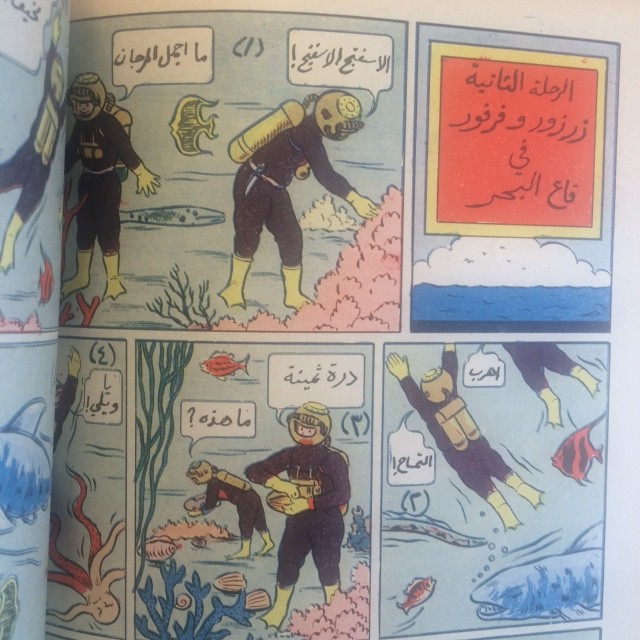
Like Samir, Dunia al-Ahdath featured both local stories and heroes, such as Hikayat Layla (The Story of Layla) and the adventures of Zarzour and Farfour as well as Lebanese re-interpretations of characters such as Tarzan and Flash Gordon.

Zarzour and Farfour

Zarzour and Farfour

In 1964 Dunia al-Ahdath changed its format and became al-Foursan (The Knights). It ceased publication in the early 1970s.

These collections of Samir and Dunia al-Ahdath issues show the beginnings of two magazines that would play central roles in the history of modern Arab comics. Come and take a look!

Guest post by Johanna Sellman, Middle East and Islamic Studies Librarian


For further reading:

Gruber, Christiane J, and Sune Haugbolle. Visual Culture in the Modern Middle East: Rhetoric of the Image. Bloomington: Indiana University Press, 2013.
http://library.ohio-state.edu/record=b7398648~S7

Douglas, Allen, and Fedwa Malti-Douglas. Arab Comic Strips: Politics of an Emerging Mass Culture. Bloomington: Indiana University Press, 1994.
http://library.ohio-state.edu/record=b4244724~S7

Matthews, Henry. Dunia Al-Ahdath: First Lebanese Comic Book. 2015.
http://library.ohio-state.edu/record=b7870761~S7

Mehta, Binita, and Pia Mukherji. Postcolonial Comics: Texts, Events, Identities. London: Routledge, 2015.
http://library.ohio-state.edu/record=b7906704~S7


« Older posts Newer posts »