

Black Women Throughout History in Comics and Cartoons: My Ongoing Dive into The Billy Ireland’s Special Collections
By Nay Brooks-Barber
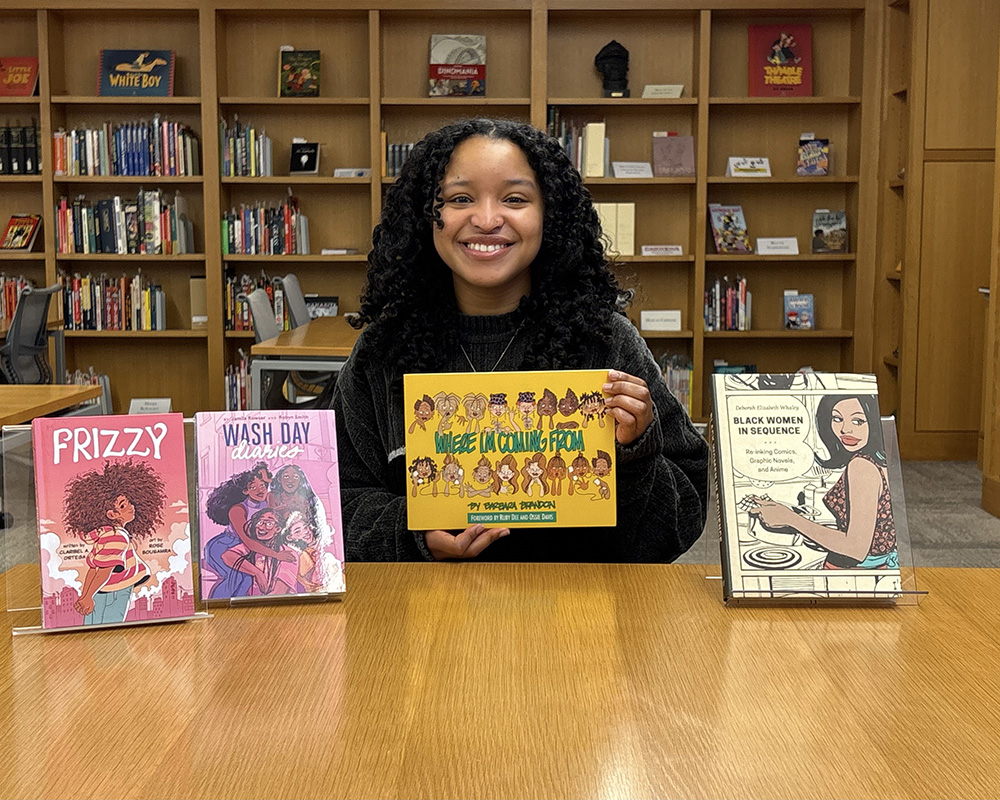
Blog post author Nay Brooks-Barber in the Lucy Shelton Caswell Reading Room
Nay graduated from The Ohio State University in December 2025 with a B.A. in Studio Art. She’s been working at the BICLM since Summer of 2025, assisting in the Lucy Shelton Caswell Reading Room and special collections stacks.
“I am a black woman in a fanboy world.”

“Black Women in Sequence” by Deborah Whaley
This is how Deborah Elizabeth Whaley opens Black Women in Sequence: Re-inking Comics, Graphic Novels and Anime, and the statement immediately brought me back to middle school. Comics and graphic novels captured my attention at every library I visited. I remained loyal to them and continuously sought out classic novel adaptations, stories exploring adolescence, and tales of lovable monsters. During this cartoon kick, I fell in and out of the feeling of belonging. As I got older and connected with more comic fans who were Black, queer, feminine-presenting, or all of the above, I felt encouraged to keep exploring the community. However, most of the graphic novels we read didn’t have protagonists who represented who we were.
Though I took a detour on my comic journey once college started, as soon as I learned about the Billy Ireland Cartoon Library & Museum being on OSU’s campus, I was pulled back in. My past four years here have done more than enlighten me about the cultural and academic significance of comics—a medium I watched receive little literary acknowledgment throughout my childhood. I’ve also learned just how integral Black artists are to the cartoon world and discovered generations of Black cartoonists and characters within the library archives.
After months of freely exploring the Billy Ireland’s archives and looking at its rich history of content from Black cartoonists, I realize that Whaley’s statement—”I am a Black woman in a fanboy world”—isn’t implying Black readers are disposable as a fanbase, but rather that we are an overlooked demographic that contributes tremendously to the art form. This journey through the museum’s Special Collections has revealed not just a growing history of representation but a lineage of defiance and imagination that demands recognition.
Black Girls Reading Comics: Evidence from 1948

Girls at the Recorder Picnic, September 4, 1948. Indianapolis Recorder Collection. Attributed to the Indiana Historical Society.
In late summer 1948, the Indianapolis Recorder published a photograph capturing five young Black girls at the newspaper’s eleventh annual picnic. I found this image and its story in Carol L. Tilley’s section of Desegregating Comics: Debating Blackness in the Golden Age of American Comics, edited by Qiana Whitted. This picnic served as both a reward for young newspaper carriers and a recreational experience for “needy youth.” The photograph’s caption noted that some of the girls “preferred to read the comics under shade trees” rather than participate in other activities.
One mere photograph illustrated the genuine significance of cartoons for Black youth. It serves as material evidence that Black readers, particularly Black girls and women, were very much part of comics culture from the medium’s Golden Age, even when the industry ignored or stereotyped them. These girls’ choosing comics as their preferred form of leisure created the foundation of demands for better representation in the comic community. These girls were choosing comics as their preferred form of leisure, validating the medium’s importance in Black youth culture decades before the industry would acknowledge them. In this post, I want to not only spotlight Black women as day-one fans of comics, but also as contributors to the form itself. Artists like Jackie Ormes, Afua Richardson, Liz Montague, and many more have expanded the range of stories told in action comics, editorial cartoons, manga, and graphic novels. After having the privilege of researching so many, I’d love to introduce some of the pioneering women who stuck out to me while exploring the BICLM resources, or maybe even expand on a few cartoonists you’ve already heard of.
The Woman All Cartoonists Should’ve Known

Photograph from front page of the Tulsa Star, February 14, 1920. Captioned “Mrs. Daisy L. Scott, our popular Cartoonist, whose artistic work for The Star has pleased thousands of readers. Watch this space for her cartoons each week”. Attributed to Library of Congress.
I give credit to anyone who came before us as Black creators, especially in a community where we aren’t as visible, and an industry that has a history of misrepresenting us. While this post aims to praise and provide background into better-known artists such as Jackie Ormes and Alitha Martinez, it would become a surface-level post without also profiling under-recognized pioneers. The first I’d like to mention is Daisy Scott- an uncommonly mentioned innovator who stepped into the cartooning industry as a Black woman, at a time when it may not have seemed possible.
Born in 1897 in Blevins, Arkansas, Scott grew to be a gentle wife, mother, milliner, and seamstress. However, Scott was always an artist and dreamed of being a cartoonist. After marrying in 1917 and settling down in Tulsa, Oklahoma, she was able to take steps towards this dream through employment at the Tulsa Star newspaper in the Greenwood District of the city. This neighborhood was referred to as Black Wall Street due to the many Black-American-owned businesses that flourished there.
Hired by A.J. Smitherman in 1920, Scott illustrated political cartoons that ran alongside the paper’s headlines, combating racial injustice and hatred through them. Even in a city filled with old attitudes fueled by its history of slavery and current segregation, Scott was a lover of cartooning who took the risk of being a Black female cartoonist in the Tulsa Star. Scott designed “stark, sketchy” comic panels that represented the mounting tensions in Tulsa, Oklahoma, between Black and white residents. Scott’s cartoons reflected her political views and recorded the events that culminated in the white residents of Tulsa terrorizing and razing the Greenwood District. The Tulsa Star news plant was included in the destruction of Black Wall Street, ending Scott’s courageous political cartooning career in the white Republican-dominated landscape that was Tulsa. After 300 lives were lost, along with the loss of countless businesses and homes, families were scattered and forced to start over. Scott had to shelve her dreams for several years, as she and her husband, Jack Scott, moved outside of Greenwood to build a house for their children, as well as two rental properties and a small market.
-
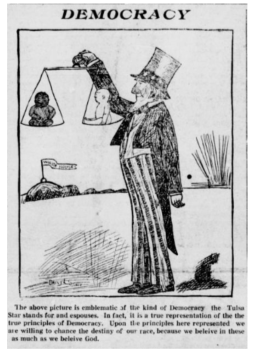
- From the Tulsa Star, January 31, 1920, by Scott. The Comics Journal #306.
-

- From the Tulsa Star, February 21, 1920, by Scott. The children have a caption reading “The Coming Generation”. Men in the foreground contain labels reading “Mobs”, “Lynching” and “Segregation” while holding a “Whites Only” Sign. The Comics Journal #306.
Like many black women and men who experienced the Tulsa riots, Jack snapped from the resulting losses and brutality. Unfortunately, he took out his anger on his family and became horribly abusive towards Scott. Jack promised to be a better man to her, but the promise was always broken. Being the gentle person that she was, despite multiple failed attempts to flee from her husband with her children, Scott continued to take care of her family.
In 1934, Scott’s dream of cartooning was ignited again after seeing the Federal Schools Inc. illustration program advertised in a local white newspaper. After applying, she was accepted with a letter that praised her mailed-in artwork. Based on her talent, she was sent an award-certificate for her “presence of artistic ability” and “good understanding of the elements of drawing.” She was also sent a booklet for the program titled “A Road to Bigger Things,” motivating her to finally continue pursuing her dream. The classes were by mail-order, so no one would know she was a woman of color, and she was willing to balance her course load with being a homemaker, regardless of the beatings she was enduring there. She had reason to dream again.
Unfortunately, Scott’s revival of cartooning was cut short in 1946. After slipping into and recovering from two comas days before, which her children and Moton Memorial Hospital tended to, she tried to tend to her homemaking duties by washing clothes outside. On this 10th day of August, two days before her daughter Altamese’s birthday, Scott died from heat exhaustion, as well as cerebral hemorrhaging. She was only 48 years old, in the beginning stages of another pregnancy, and in the midst of learning everything she could about cartooning. Many attended her funeral, as she was an admired neighbor, a gentle wife, and a loving mother, leaving behind eleven beautiful children. However, I think she should be widely recognized as a heroine for cartoonists. She was a Black woman who made the best from a system of oppression, fueled by the art of cartooning. In circumstances many artists today wouldn’t understand, Daisy Scott dreamed, and though her dreams were deferred, it’s essential to acknowledge her catalytic role in Black representation in the cartooning world. She truly was a pioneer.
How far have we come from here in the cartooning world? Well, let me get us started.
Jackie Ormes: The Pioneer

Photograph of Jackie Ormes drawing Torchy in the New York Times March, 30th 2008 issue.
A proofreader turned cartoonist straight out of high school probably knew she’d go on to make comic strips, but I’m not sure she knew how pertinent she’d be to the growth of complex Black feminine voices heard around the world. Jackie Ormes is widely noted as the first Black-American woman cartoonist. Black women’s voices have always been there, carving their way into mainstream media through various accessible formats. Ormes found her format in high school when she wrote “Hello Public!”, a column for the Pittsburgh Courier from 1929 to 1930. According to Nancy Goldstein’s research, Ormes started out as a “cub reporter,” working her way into “harder news” assignments. Ormes was then able to build her periodical portfolio while moving toward her “real passion”—cartooning. Her maneuvering from columnist work to comics allowed her to add a reportorial edge to her strips.
Though her first few stories for the newspaper rarely featured a byline, with her sharp humor, eye for fashion, illustrative skills, and familiarity with Black community struggles, Ormes made a name for herself in the Pittsburgh Courier while making way for other Black female cartoonists and even journalists. Her comics strips Dixie to Harlem, Patty-Jo ‘n’ Ginger, Torchy in Heartbeats, and Torchy Togs spanned from 1937 to 1956. Ormes would often even break the page layout by positioning her characters slightly outside of their comic panel frames. This imagery not only symbolizes her desire to step outside the perceived confines of the cartooning world but also signals a desire to really connect with readers. Ormes’s work acted as a touchstone for Black-American news, engaged in fashion commentary through her Torchy Togs paper doll cut-outs, and facilitated the creation of the first upscale Black doll in the U.S., based on her trailblazing character, Patty-Jo.
-

- Jackie Ormes’ “Torchy in Heartbeats”, Pittsburgh Courier September 22, 1951 issue. Attributed to the Nancy Goldstein Collection on Jackie Ormes Research at the BICLM
-

- Patty-Jo ‘n’ Ginger panel from The Pittsburgh Courier February 16, 1952 issue. Attributed to the Nancy Goldstein Collection on Jackie Ormes Research at the BICLM
-
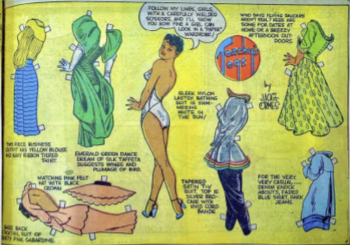
- “Torchy Togs” panel accompanying “Torchy in Heartbeats” 1954 from The Pittsburgh Courier. Attributed to the Nancy Goldstein Collection at the BICLM
Images from artists like Ormes were refreshing to Black audiences during a time when they were often drawn as minstrel caricatures like Ebony White from Will Eisner’s The Spirit. As Charles Johnson writes in Desegregating Comics, “We should remember that the pictures we are looking at, these Ur-images of Blacks, are a testament to the failure of the imagination (and often of empathy, too), and tell us nothing about Black people but everything about what white audiences approved and felt comfortable with in pop culture until the 1950s.” Ormes’s work stood in stark contrast to these dehumanizing depictions, offering Black readers characters with dignity, style, and agency.
“Where Love For Superheroes Connected Us”
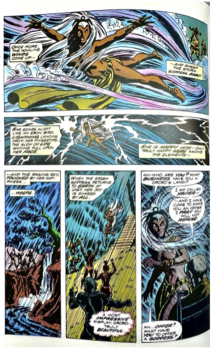
Giant Size X-Men No.1
After learning more about Black women’s roles in comic book history, I wanted to dig deeper into how we made our way into the mainstream superhero sphere. It was exciting to learn about Billy Graham’s beautiful illustrations in Marvel’s Jungle Action, kicking off the major Black Panther series alongside Luke Cage. However, it was even more interesting to see how Black women throughout comic history progressed from male-dominated departments to being credited with cornerstone work at major publishers like Marvel and DC. The inclusion of Black female superheroines in major publishers was slow, but it was happening—gradually building momentum after the Golden Age of Comics. We saw the Butterfly, a Black female superheroine in Gary Friedrich’s 1971 Hell Rider, and even got introduced to X-Men team leader, Storm, in the Giant-Size X-Men #1 1975—but how did we start making ourselves seen in the comic illustration industry?

Jungle Action #10, 1974 by Billy Graham.
Though Jack Kirby was the original creator of the Black Panther, introducing him in a 1966 Fantastic Four issue, Billy Graham and Don McGregor’s character design and world-building of Wakanda in 1973 for Jungle Action #6-24 became integral to the franchise. Their work solidified the Black Panther, aka T’Challa, as a Marvel hero for Kirby’s continuance of the character in 1977.
In the late 90s, Black Panther was in need of a revamp, along with many other Marvel storylines. Black illustrators were making a name for themselves in mainstream superhero comics for the past twenty years, as Billy Graham was recorded as the first Black man to be employed as an artist at Marvel Comics in 1972, but the first noted Black editor was Christopher Priest. This 17-year-old intern from Queens made his way into Marvel’s editorial staff in 1979, assisting under Paul Laikin. Becoming the first Black editor at Marvel in 1984, Priest worked on “iconic” properties for Spider-Man, X-Men, and Conan the Barbarian, but in my opinion, his biggest contribution came in 1998. You see—in the late 90s, Marvel Comics was in a tough spot after the Image Revolution, Chapter 11 bankruptcy, and the Toy Biz merger. Black Panther was in need of a revamp, along with many other Marvel storylines. In these efforts to create higher-quality plots, the Marvel Knights project began, tasking Priest with the relaunch of Black Panther in the lineup.
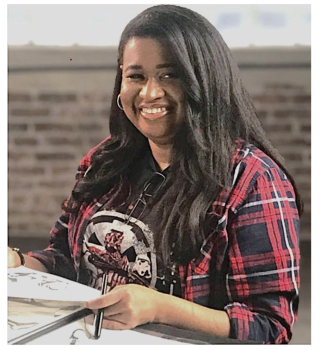
Alitha Martinez
Now, let’s rewind a couple of years and focus on a young Afro-Latina artist from New York, trying to attend the School of Visual Arts in the mid-90s. This comics lover, Alitha Martinez, faced some trouble during her time at SVA, being the only female in her cartooning department and even facing harassment. This is an artist who was deported and detained as a child, constantly facing hostility for her Honduran and Curaçaoan background, but found escape in comics. She was a cartoonist who wasn’t encouraged to read comics by her family, but mowed lawns to pay for them. She wasn’t going to give up because of her disheartening experiences at college. Instead, after leaving SVA by the end of the first semester, Martinez began teaching herself in order to build a portfolio. While she was often underestimated in her ability to draw superheroes, specifically more masculine figures, she continued to create regardless of the male-dominated industry that was consistently illustrating women’s bodies to cater to men. In 1998, attending a comics convention, Martinez met Marvel editor Joe Quesada. She walked up to him and gave him her work, landing her an assistant position under Quesada. Here, we catch up to Christopher Priest working on Black Panther’s relaunch. During her position with Quesada and Mark Texeira, Martinez created iconic and vividly detailed background art for Priest’s Black Panther 1998 #1-5.

Black Panther (1998) #1-5
Not only did Martinez become the first Black woman to have credited artwork at Marvel, but she also began illustrating for Iron Man 1998 and even DC Comics’ Batgirl Death Wish 2000. Her run from this point on has consisted of many milestones, influencing two decades of women pursuing complex careers in the illustration and storytelling field. Along with her stacked catalog of artistic work in DC and Marvel Comics, Martinez has done political cartooning for the New York Post and taught at the School of Visual Arts. She continued to provide iconic character design and cover art for major comic series, including DC’s Nubia & the Amazons, Marvel’s Miles Morales: Spider-Man, DC’s Lazarus Planet, and finally Marvel’s Black Panther: World of Wakanda, which brings me to the last Black woman in mainstream comics I’d like to mention.
Afua Richardson—after attending LaGuardia High School for the Performing Arts and participating in an undergrad program at Juilliard, Richardson has been referred to as “a Jane of All Trades.” A trained classical flutist, singer, songwriter, and world-traveled vocalist and performer, Richardson played with various groups across many different genres of music from 1997 to 2016 and even performed in the Broadway show Brer Soul [renamed An Unmitigated Truth] in 2008. However, none of her ventures stopped her from working on her passion for illustrating, as she would continue to carry a sketchbook to any project and get office jobs just to use their computer for Photoshop during lunch breaks. She already had a history of comic creation that she was continuing to hone, but used an alias first, making comics under the name ‘Lakota Sioux’ in 2004. Richardson’s “vivid colors” and “non-traditional representations of [super] humanity” only emphasized her obvious skill as a penciler.
-

- Afua Richardson
-

- Black Panther: World of Wakanda
After being featured in the Eisner award-winning Image Comics anthology, 24 Seven by Ivan Brandon in 2006, Richardson landed herself a cover art job for the horror series Half Dead at Marvel. Here, she debuted as the first Indigenous Black-American female artist to work for Marvel Comics as a penciler, inker, and colorist. From providing illustrative work on the Genius by Marc Bernardin comic series in 2007 to making prop art for HBO’s Lovecraft Country in 2020, Richardson’s work is the reason she’s received awards like the Nina Simone Young Gifted & Black Award for Artistic Excellence and the reason her projects have received awards like the Reader’s Choice Award for her work on Genius in 2008. I have to mention another award she received, though, which not only made her a heavily sought-after illustrator across DC Comics, Marvel, and HBO—the Will Eisner Comic Industry Award in 2018. “Which project received this award?”, you might ask. That would be Marvel’s Black Panther: World of Wakanda, which she collaborated on with Alitha Martinez in 2016, bringing us full circle.
Barbara Brandon-Croft: Centering Black Women’s Voices

Where I’m Coming From by Barbara Brandon-Croft
Barbara Brandon-Croft is another example of a barrier-breaking artist. She achieved multiple milestones in the industry without drawing Black women as superheroes with action-packed combat, but rather as themselves, free to discuss their community, fears, and friendships. Brandon-Croft studied illustration at Syracuse University from 1976 to 1980, often contributing to the Black Student Union’s paper The Black Voice. Two years after leaving Syracuse, she began brainstorming ideas for Elan magazine, a publication that catered to Black women. During this period, she came up with the idea of her comic Where I’m Coming From, but unfortunately, the publication fell through. Determined to be published, Brandon-Croft put together press kits, sending out her work to syndicates, cutting out the heads of her characters in the strip: Alisha, Cheryl, Nicole, Jackie, Judy, Lekesia, Lydia, Monica, and Sonya. She was rejected by all except the Universal Press Syndicate. Brandon-Croft became known as the first Black female cartoonist to author a syndicated comic in mainstream newspapers. She counts Jackie Ormes, the first Black woman to have a nationally distributed comic strip, among her greatest heroes. Where I’m Coming From (1989-2005), ran as a Detroit Free Press weekly installment and reached 1.5 million readers when it went national in 1991. Her strip Where I’m Coming From (1989-2005), ran as a Detroit Free Press weekly installment and reached 1.5 million readers when it went national in 1991.
In refusal to play into the historical objectification and sexualization of Black women’s bodies, Brandon-Croft only drew talking heads of Black women in the strips. In the New York Times, she elaborated: “We are too often summed up by our body parts…and Black women are at the bottom of the totem pole. I’m saying ‘We have opinions,’ and ‘Look me in the eye and talk to me.'” Though she respected her peers and those who came before her, she was not into action-based strips, as she wanted to also give people a representation of Black women’s lives, without having to be entertaining—”I just want these women to be talking, and I just want it to be where they’re coming from.”
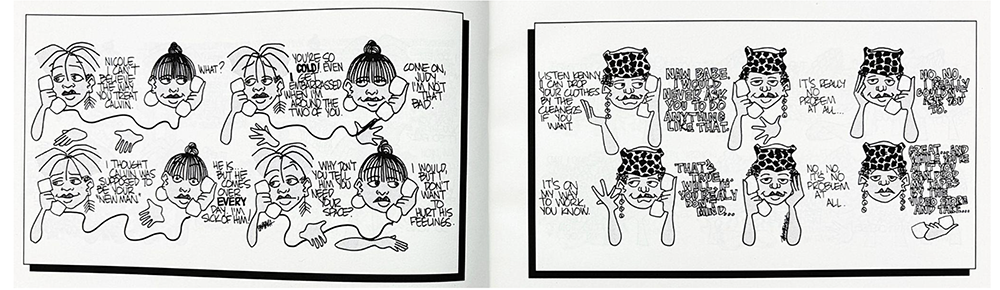
Pages 12-13 of Where I’m Coming From (1993) by Barbara Brandon-Croft. From the Mark J. Cohen and Rose Marie McDaniel Collection.
Her characters engaged with romance, politics (Clinton and Bush administrations), race, color, gender, class disparities, and human and sexual rights. This depth of social commentary shows further evidence that Brandon-Croft’s work is “an unacknowledged precursor to the popular work of comic strip writer and artist Aaron McGruder, the writer of the now defunct comic strip The Boondocks,” as Whaley notes. The pathway from Daisy Scott through Brandon-Croft to contemporary artists inspired by their work (like McGruder) demonstrates that art centering Black identity, commentary, and satire has heavily inspired comic creators since the medium’s early days—even when that centrality has been often overlooked or barred from mainstream comics history.
These women have helped Black creators explore more comic and cartoon storylines that don’t just rely on Black feminine protagonists to be scantily clad crime fighters or sharp-witted eye candy, but speakers on life, fashion, friendship, political injustice, humor, and trauma.
Where We Are Now

Liz Montague. Washington City Paper.
At the early age of 22, after graduating from the University of Richmond, Liz Montague sent a letter to the New Yorker asking editors why their illustrations rarely showcased artists of color. Not only did her note get attention, but after responding to her concern by asking her to suggest artists, she suggested herself, landing a job as a cartoonist at the New Yorker. They gained an “incisive, slyly sweet, utterly original cartoon voice” from this letter, according to cartoon editor Emma Allen in “How to Draw Social Change.” At the age of 24, Montague became one of the first Black-American cartoonists employed by the New Yorker. Not only that—within four years after her graduation, Montague has drawn for the Washington City Paper columns, developed illustrations for the Obama Foundation, and drawn for the Food Network. She has not just remained an artist for the New Yorker, but she has also published a heartfelt memoir in 2022, spotlighting the struggles of being a young Black girl in the suburbs using art to communicate and cope with dyslexia. This beautiful novel, Maybe an Artist, has been nominated for an NAACP Image Award and furthered the history of diverse representations of Black women in cartoons.

ingo Love by Tee Franklin
Since 2017, award-winning comic writer and public speaker Tee Franklin has used her own experiences to create groundbreaking stories centering Black, queer, and disabled experiences in mainstream comics. Breaking barriers for women writers in her DC and Image Comics publications, this New Jersey native transforms her commitment to authentic representation into beloved works like the bestselling queer romance Bingo Love and the GLAAD-nominated Harley Quinn: Eat. Bang! Kill Tour, where she became the first Black woman to write DC’s iconic Harley Quinn and Poison Ivy. Though she isn’t an illustrator, Franklin makes it a priority to revolutionize disability representation in comics, co-creating Violette Rainbow, a disabled pony with vitiligo and anxiety for My Little Pony, proving that nuanced, joyful portrayals of disabled characters can expand and thrive in any universe.

Resenter by Gigi Murakami (2024)
We’ve even expanded our voices in the manga-lover community, cartooning ourselves in a genre that has been loved by Black Americans as early as the mid 1960s. Authors like Gigi Murakami use their love for Japanese art and pulp aesthetics to create a range of manga-inspired stories. Murakami has specifically focused on horror media to create horror manga, including the Ignatz-nominated Resenter. She’s even won the Cartoon Crossroads Columbus Emerging Talent Award for her extensive catalog, gaining popularity in the anime industry that she loves so dearly.
From authors and cartoonists like Barbara Brandon-Croft, we even gained more stories that simply comment on real social insecurities and friendship in the community. Comics by Ebony Flowers, Jamilia Rowser, and Robyn Smith provide readers with more insight into the social lives of everyday Black women, encouraging Black feminine readers to continue speaking their minds and to feel properly represented in the comics community today. Solely by the love of the form, we’ve come a long way in the world of cartoons, showing that we aren’t just the Black girls in a fanboy industry—we are the fans, the creators, and the main characters.
A sampling of stories created by or about black women in the Billy Ireland Cartoon Library & Museum collections:
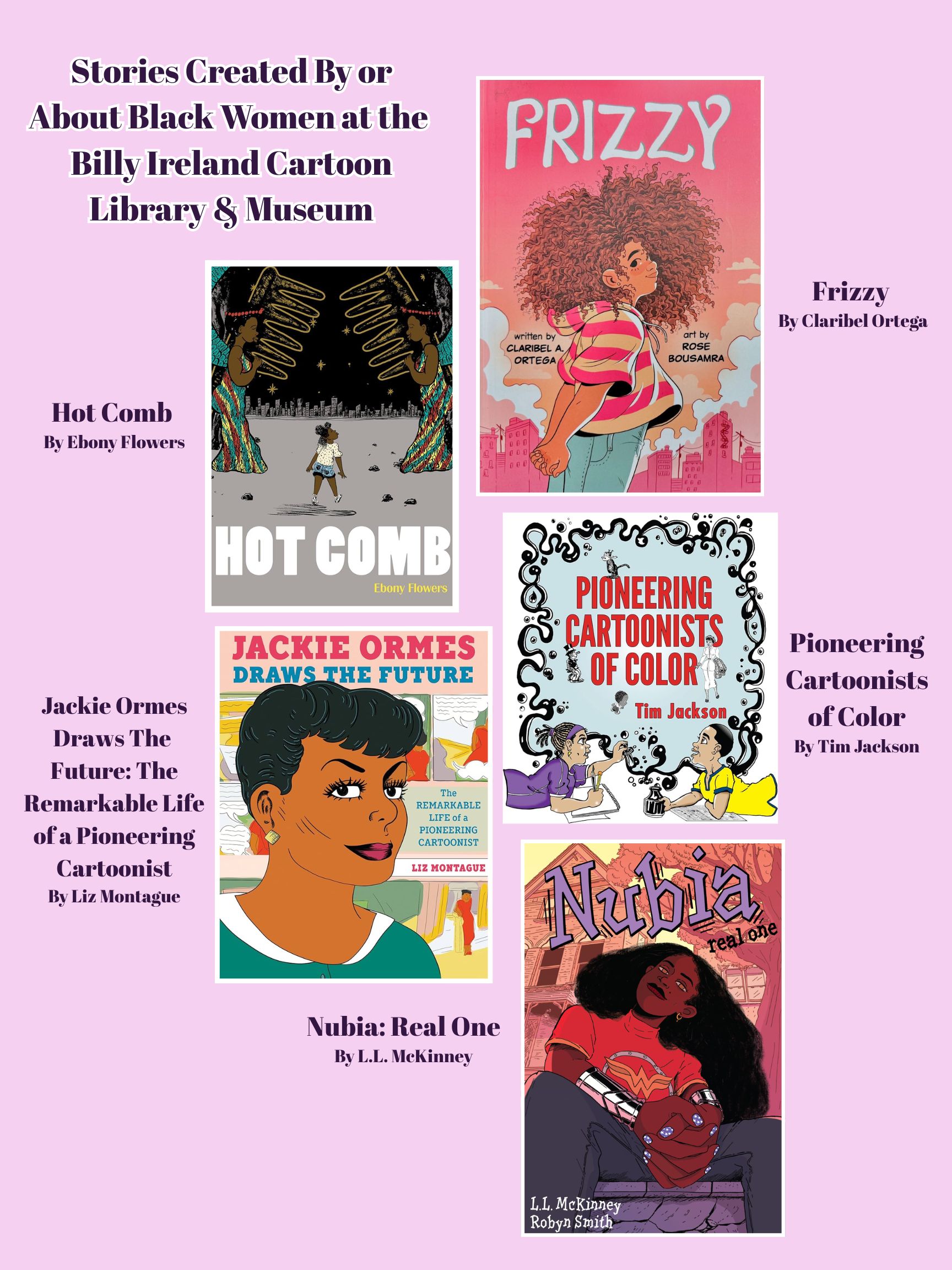
Hot Comb By Ebony Flowers, Pioneering Cartoonists of Color By Tim Jackson, Jackie Ormes Draws The Future: The Remarkable Life of a Pioneering Cartoonist By Liz Montague, Frizzy by Claribel Ortega and Rose Bousamra, Nubia: Real One By L.L. McKinney
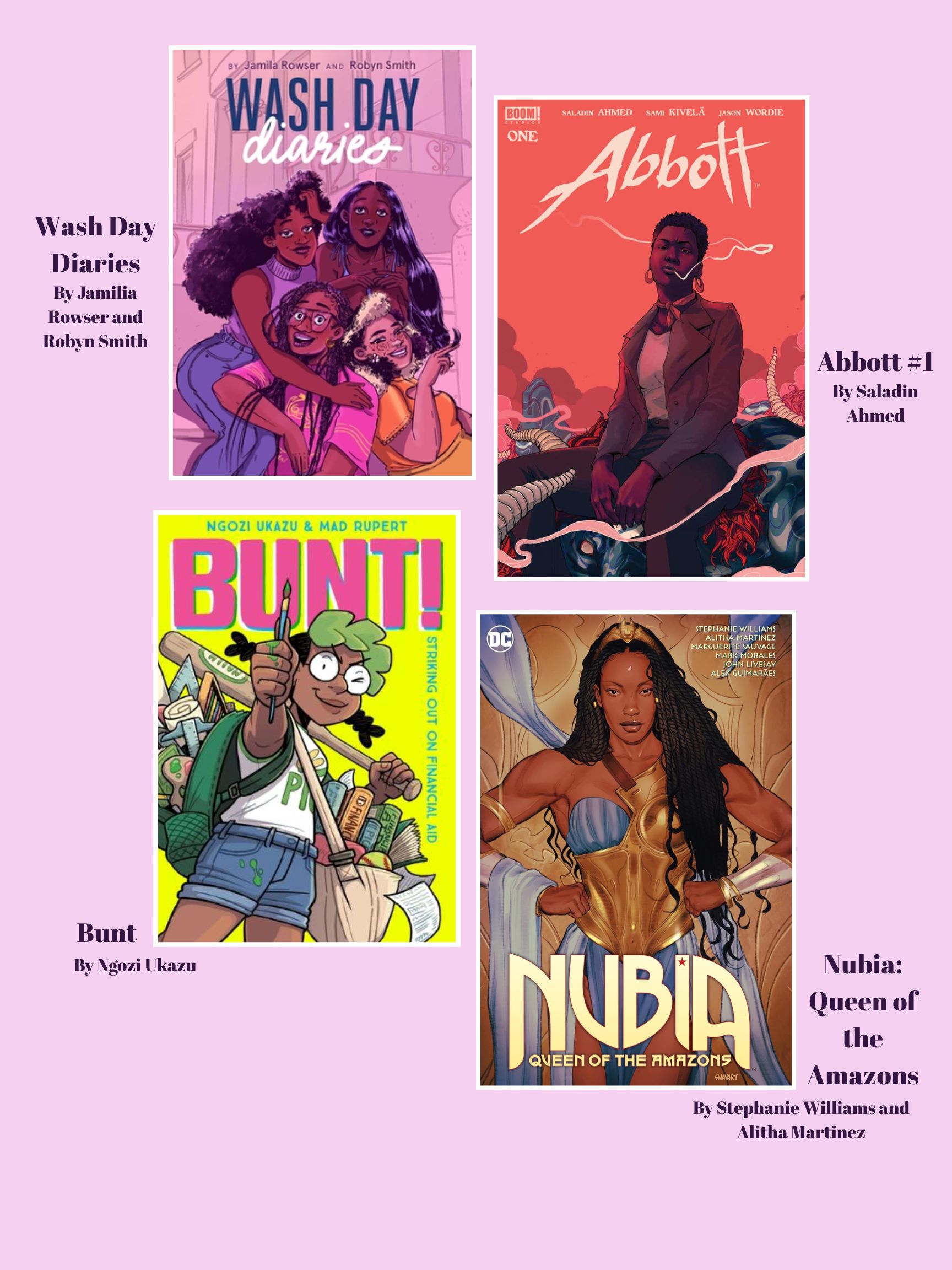
Wash Day Diaries By Jamilia Rowser and Robyn Smith, Abbott #1 By Saladin Ahmed, Bunt By Ngozi Ukazu, Nubia: Queen of the Amazons By Stephanie Williams and Alitha Martinez
Works Cited
Cash, Lea Michelle. “Daisy Scott: A Dream Deferred and a Legacy of Courage.” The Comics Journal, no. 306, edited by Gary Groth, Fantagraphics Books, 2020, pp. 148–157.
Gotcher, Steve. “‘Skinamarink,’ Barbara Brandon-Croft, Jordan Harper.” Barbara Brandon-Croft Revisits Her Trailblazing Comic Strip, “Where I’m Coming From”, performance by Doug Gordon and Barbara Brandon-Croft, episode 519, Wisconsin Public Radio, 11 Feb. 2023.
Jackson, Tim. Pioneering Cartoonists of Color. University Press of Mississippi, 2016.
Roché, Angélique. “Marvel’s Voices Highlight: Artist Alitha E. Martinez.” Marvel, Marvel Entertainment, 22 Feb. 2023, www.marvel.com/articles/comics/alitha-e-martinez-marvels-voices-wakanda-forever-interview.
Whaley, Deborah Elizabeth. Black Women in Sequence: Re-inking Comics, Graphic Novels, and Anime. University of Washington Press, 2015.
Whitted, Qiana, editor. Desegregating Comics: Debating Blackness in the Golden Age of American Comics. Rutgers University Press, 2023.




Recent Comments