Page 54 of 166

Brad Anderson Collection Donated to Ohio State’s Billy Ireland Cartoon Library & Museum

OSUheader


FOR IMMEDIATE RELEASE: January 11, 2019

Marmaduke Creator Brad Anderson’s Collection Donated to Ohio State’s Billy Ireland Cartoon Library & Museum

Look who came along!

In 2018 we received an exciting delivery: the Brad Anderson Collection! This amazing new acquisition features over 16,000 original Marmaduke cartoons from 1954 to 2010, in addition to other original art, business correspondence, fan mail, books, newspaper clippings, memorabilia, merchandise and more.
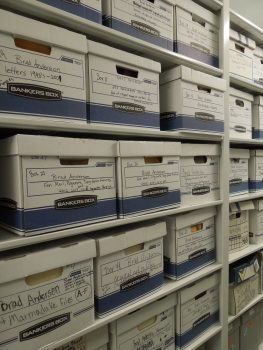
A sampling of the boxes containing the Brad Anderson Collection

Brad Anderson (1924-2015) is a cartoonist best known for the long-running family-favorite, Marmaduke, featuring a lovable Great Dane. The comprehensive body of work found in this collection allows scholars and fans alike to trace the evolution of the well- known character as Marmaduke’s scowl turned into a smile, and as he continued to wreak havoc while remaining completely lovable.

Marmaduke is one of the most beloved comic strip characters of all time. We’re grateful to the Anderson family for this generous donation. As we’ve begun cataloging the collection, it’s been wonderful to see how much the characters have evolved over the years and the breadth of Anderson’s body of work. The accompanying correspondence and archival materials will provide interesting primary source materials for future researchers,” said Curator Jenny Robb.

“He wants you to help me with the dishes.” Cartoon from 1954
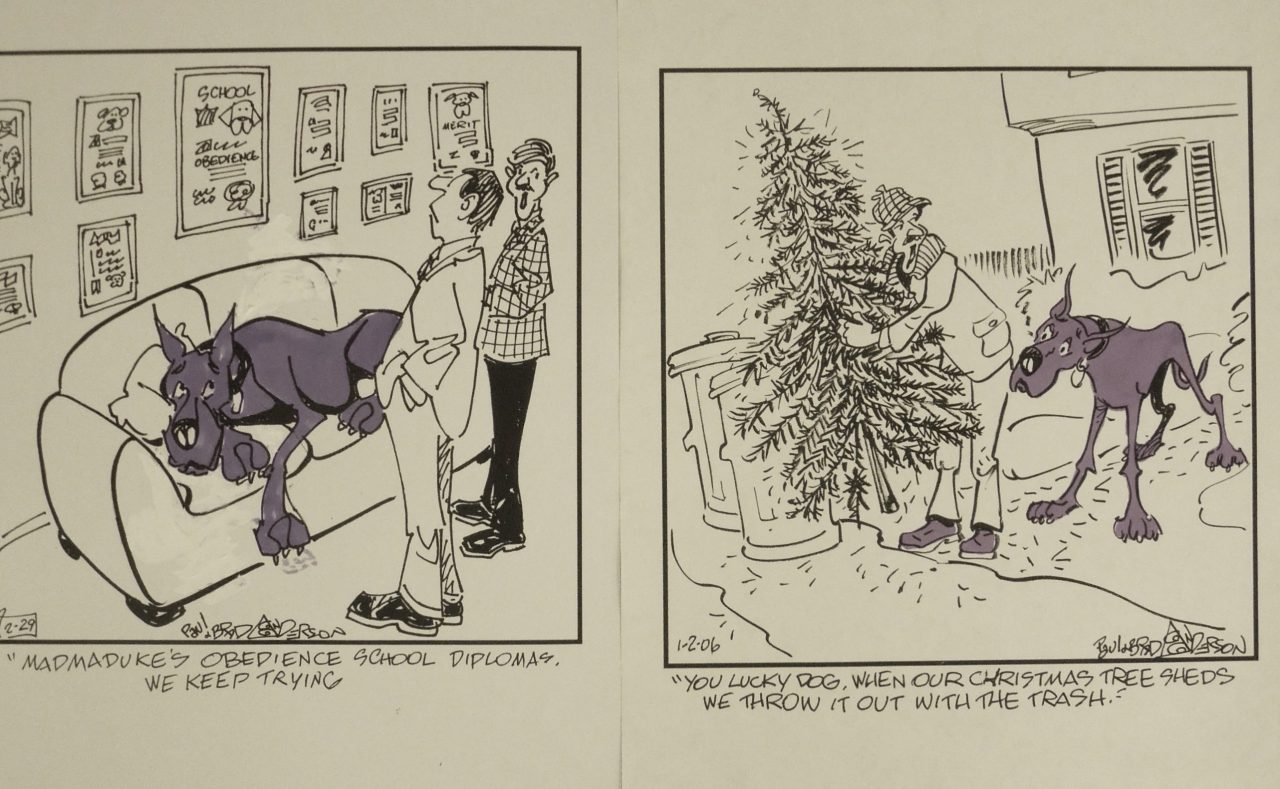
Left: “Marmaduke’s obedience school diplomas. We keep trying.” From 2006. Right: “You lucky dog, when our Christmas tree sheds we throw it out with the trash.” From 2008.

Brad Anderson grew up drawing cartoons in Jamestown, New York and sold his first cartoon at age 15 to the aviation magazine, Flying Aces. After serving in the Navy during World War II, Anderson graduated from Syracuse University in 1951 with a Bachelor’s of Fine Arts degree. While working in advertising, Anderson sold cartoons to major publications such as Collier’s magazine and Saturday Evening Post. We are fortunate enough to have over 3,000 examples of Anderson’s magazine cartoons.

Cartoons by Brad Anderson while a student at Syracuse from the university magazine The Syracusan, 1948-1949

Examples of Anderson’s artwork for advertising, circa 1952

The Anderson family had said this about the donation, “Brad Anderson’s wish was that his life work would find a home at the Billy Ireland Cartoon Library and Museum where the collection would be in a safe environment and enjoyed by kids of all ages. Our family feels privileged to fulfil his wish and donate the works of his 75 year labor of love. Some of our special memories include his earliest published airplane drawings when he was a teenager, the water color paintings from his undergraduate years at Syracuse University, the magazine cartoons from the 1940’s through the 1970’s and, of course, the Marmaduke dailies and Sundays over the decades. ”
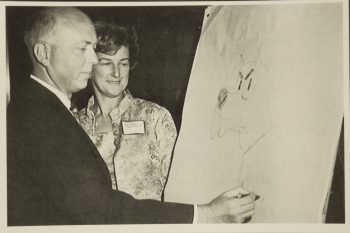
Brad Anderson and his wife, Barbara

Besides the wonderful artwork displaying a wide range of his artistic styles, the collection contains lots of fan mail demonstrating the enormous popularity of the strips. For everyone who wondered if their favorite cartoonist kept the fan letter they wrote so long ago – if it’s Anderson, he did!

Thank you letters to Brad Anderson from kids.

For such a prolific cartoonist, organizing decades of artwork is no small task. The Billy Ireland Cartoon Library & Museum will be very busy in the coming year as we work to make this treasure trove available to all to study and enjoy.


About the Billy Ireland Cartoon Library & Museum: The BICLM is one of The Ohio State University Libraries’ special collections. Its primary mission is to develop a comprehensive research collection of materials documenting American printed cartoon art (editorial cartoons, comic strips, comic books, graphic novels, sports cartoons, and magazine cartoons) and to provide access to these collections. The BICLM recently moved into its newly-renovated 30,000 sq. ft. facility that includes a museum with three exhibition galleries, a reading room for researchers and a state-of-the-art collections storage space. The library reading room is open Monday-Friday 9 a.m. to 5 p.m. and Sunday 1 p.m. to 5 p.m. The Museum is open Tuesday-Sunday from 1 – 5 p.m. See http://cartoons.osu.edu/ for further information.

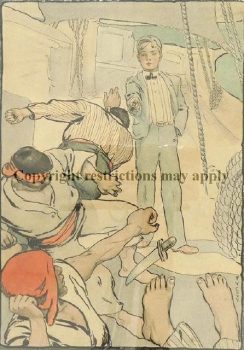
Student Post: The Life of Cartoonist and Illustrator Fanny Y. Cory

Here at the Billy Ireland we are incredibly lucky to have student employees with a keen interest in comics history. Below, OSU senior Emily Glassmeyer, a History and Women’s, Gender and Sexuality Studies major who has worked at BICLM for almost a year, shares her personal research on the life of cartoonist Fanny Y. Cory.

Children and Fairies and Ranchers – Oh My!
The Life of Cartoonist and Illustrator Fanny Y. Cory

By Emily Glassmeyer

When not working at BICLM or frantically writing for my thesis, I treat myself to a stroll through the library. Having always felt most at home surrounded by books, leisurely perusing aisles is one of my favorite pastimes. Recently, upon getting into poetry, I stumbled upon this book: written by Abbie Farwell Brown and published in 1902, A Pocketful of Posies features a whimsical cover – a bunch of little blossoming flowers, but instead of colorful blooms, they are little fairies. Granted, I was excited about the poetry, but more than that, I was drawn into the illustrations – simple, yet ethereal, and upon further investigation, done by illustrator and cartoonist Fanny Y. Cory

Image source:
Fanny Cory in her youth, from “Fanny Cory Cooney: Mother and Artist,”
by Bob Cooney and Sayre Cooney Dodgson, Montana The Magazine of Western History

Born in 1877, Cory grew up in rural Illinois with her older sister and two older brothers. Her mother Jessie was a loving and amiable lady, who sadly fell ill to tuberculosis and passed on in 1887, leaving Fanny and her siblings with their father — an ill-tempered travelling salesman with a disdain for Cory’s passion for art – even though she occasionally used it to pay their rent.. Eventually the two older brothers invited Fanny and her sister Agnes out to live in New York, and soon enough, Fanny was accepted at the Metropolitan School of Art in 1896. At an astounding five feet tall, Cory began trying to sell her illustrations to major publications such as Harper’s while still a student. When told she needed to build a reputation first in order to get published, no matter how good her work was, the diminutive Cory was furious. However, by the turn of the century she had made the covers of several major publications such as Life, Scribner’s Century, Harper’s Bazaar, Liberty and The Saturday Evening Post, as well as illustrating for Alice in Wonderland and many of the works by the author of the Oz series, L. Frank Baum. Through her illustrations of playful fairies and mischievous children, she was quickly becoming one of the finest illustrators of her time.

However, tragedy fell upon Fanny around this time. Her sister Agnes had contracted tuberculosis while caring for their mother ten years prior, and had been waning in health ever since. She died in her arms in 1897, leaving Fanny heartbroken and depressed for the next few years. Hoping that a change of scenery would do her good, her brothers Jack (a famous political cartoonist) and Bob invited her to Montana, where they planned to found the Cory Brothers Mine, hoping to strike gold. Although they weren’t necessarily successful miners, the next few years spent out in the wilderness riding on horseback and working on her art did Fanny a world of good – and led her to back to a rancher named Fred Cooney, who she had known in her youth but she “didn’t like him much then and he didn’t seem to know [she] existed.” They eloped in 1904 and began their life together.

[Sunshine Annie]
Fanny Y. Cory
Part of the Charles H. Kuhn Collection

Although Fanny continued to work from home for the next few years, her art went on the backburner, happily devoting her life to raising her children. She initially wanted thirteen kids, but she was warned by the doctor that her body would likely not be able to handle childbirth. She tried adamantly nevertheless, frantically working during her first pregnancy to secure enough funds to support her family if something went south. Cory eventually had three children. She nearly sacrificed her acclaim in the art world in order to raise her family, but not begrudgingly. She loved taking care of her children, reading to them, working on the farm – axe and all, and gardening. Her children remember her as having “always [been] ready to undertake anything that needed doing, including some that were a bit large for her tiny size.”


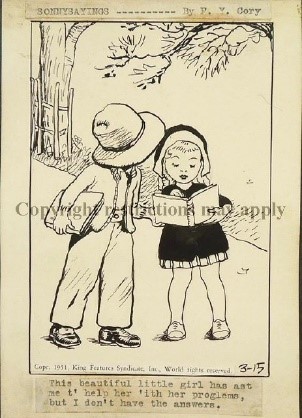
Sonnysayings
Fanny Y. Cory

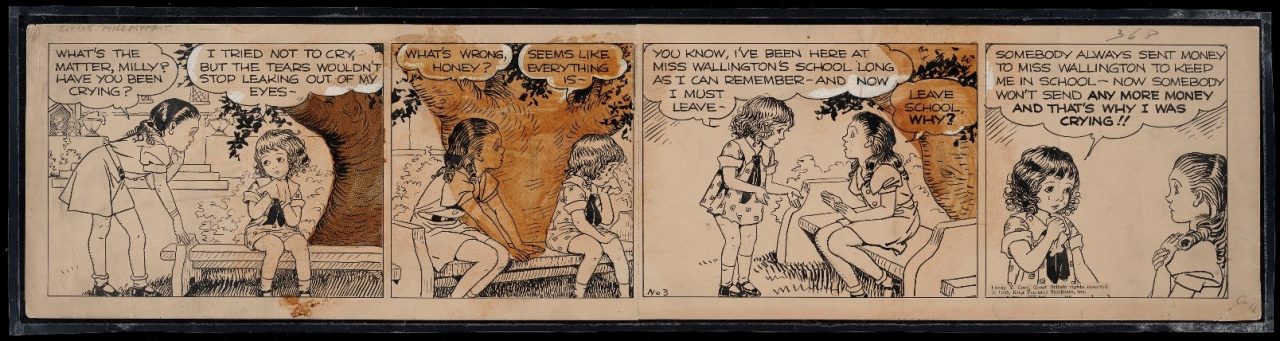
Little Miss Muffet
Fanny Y. Cory

As her kids grew to be college-aged, Cory returned to her work – creating her first syndicated comic in 1926 called Sonnysayings and later Little Miss Muffet, a competitor for Little Orphan Annie. In large part, these two cartoons were used to pay for her children’s tuition, and provided her personal satisfaction. She kept Sonny going, that sparkling young boy, until her eyes began to fail her in 1956, and she decided that “thirty years was long enough to keep Sonny five years old.” She spent the rest of her life painting for herself and spending time with her children and grandchildren, and died at the age of 94 in her daughter’s home.

This under-studied and incredibly talented woman was one of the first female syndicated cartoonists, and her incredible drive can be shown in her prolific work—capturing and nationally showcasing the whimsy and joy of childhood for over thirty years. At the Billy Ireland Cartoon Library and Museum, we are lucky enough to have some of her work: such as original art from SonnySayings, Little Miss Muffet and some of her various illustrations for books.

Image Source:
Fanny Cory, from “Fanny Cory Cooney: Mother and Artist,”
by Bob Cooney and Sayre Cooney Dodgson, Montana The Magazine of Western History


Image source: Fanny Cory, from “Fanny Cory Cooney: Mother and Artist,” by Bob Cooney and Sayre Cooney Dodgson, Montana The Magazine of Western History

Research source: Cooney, Bob, and Sayre Cooney Dodgson. “Fanny Cory Cooney: Montana Mother and Artist.” Montana: The Magazine of Western History 30, no. 3 (Summer 1980): 2-17.

For more original art by Fanny Y. Cory, check out the BICLM Art Database: https://osucartoons.pastperfectonline.com/vocabulary?keyword=Cory%2C+Fanny+Y.%2C+1877-1972&letter=C&searchtype=creator&showsearch=true

For books illustrated by Fanny Y. Cory, check out the BICLM Library Catalog: http://library.ohio-state.edu/search~S7/X?SEARCH=(fanny%20y.%20cory)&searchscope=7&SORT=D&b=cga

For original art work by her brother Jack Cory, check out the BICLM Art Database: https://osucartoons.pastperfectonline.com/vocabulary?keyword=Cory%2C+J.+Campbell%2C+1867-1925&letter=C&searchtype=creator&showsearch=true

« Older posts Newer posts »