From Woody's Couch

Our Playbook on OSU History

Page 6 of 105

No “Frills” Leadership: Barbara Gibbs Doster

From left to right: Carol Smith, Barbara
Gibbs, Ed Alford, and Jim Allen
hanging decorations.

When Barbara Gibbs started at The Ohio State University’s College of Commerce in 1952, she was captured in a chance photograph of the decorating committee for the White Christmas Celebration in action. The photo was later published in a newsletter for parents of OSU students, invoking an idyllic, almost Norman Rockwell-esque snapshot of 1950’s America. In it, Ed Alford, Chairman of the Decorations Committee, is hanging a wreath on the basketball hoop as three other students assist him: Jim Allen, Carol Smith, and Barbara Gibbs. Yet Alford isn’t the focus of this photo – the photographer instead chose Gibbs, with her jauntily cocked neck scarf, coveted saddle shoes, and immaculately waved hair. She was the perfect visual centerpiece for a photo of collegiate life at OSU, but a mere freshman who’d barely been on campus long enough to join a committee, let alone run one.

Gibbs was going to change that, and she lost no time in starting. In 1952, the only record of her passage on campus was that single photograph of her perched atop a ladder. By the time she graduated in 1956, The Lantern had mentioned her by name over 100 times and she ran for student government, tackling issues like discrimination and mental health in an era when many people still refused to acknowledge them. She was in the women’s class honoraries of Mirrors, Chimes, and Mortar Board, regularly appeared on the honor roll with a 4.0 GPA, and yet still found time to volunteer for political causes and participate in sororities like Delta Delta Delta and Phi Chi Theta. She loved the arts, swimming, and playing bridge, and was involved with the Buckeye Political Party, an organization that dominated campus government from 1953 to 1967. She was also an active member of the College Commerce Council, becoming its secretary during her junior year, and served as the Junior Class Representative for the Women’s Self-Governing Association.

Dad’s Day Committee, 1953

Gibbs, however, wasn’t merely interested in racking up accolades while at Ohio State. She had vision, and while she served on the Student Senate as a freshmen, then a sophomore class secretary, it became apparent that things needed to change. The current Senate was seen mostly as an “activities” committee rather than an actual government, and some students were unhappy with them. There had been concerns about campaigning violations, unattended ballot boxes, and an unclear recount of the votes for the Senate President during the prior year’s elections, and some students felt that the student government made rules, but didn’t follow them. In the midst of this distrust, Gibbs was promoted from the masses of underclassmen secretaries to serve as the main secretary and office manager of the Senate during her Junior year. Gibbs was only the sixth woman to hold this appointment, which had been held by men for the last eight years. When The Lantern interviewed “BG”, as many knew her, about the new promotion, she was amused at the line of the questioning reporter, Ellen Goodman, posed to her. “No, we will not have calico typewriter covers! Our office will be run as an office, and femininity won’t be brought into the picture,” she replied.

Lantern headline. March 9, 1954

Eight months later, The Lantern published a complimentary follow-up piece that noted she had kept her promises, with no “frills” evident in the Student Senate offices. Gibbs explained that the changes she had made to the regular tasks and filing system “have only been effected to improve the efficiency of the office”. Despite the relatively positive tone of the article as a whole however, The Lantern remained optimistically skeptical of her capabilities, describing her as a “woman who has her work cut out for her” and asking her if she’d had any difficulty “taking over an office previously held by men”. Gibbs was positive, responding that she had received “a great deal of cooperation from everyone … everyone’s attitude is just wonderful”. Her term as Senate Secretary went so smoothly that in her senior year, she became the 4th female Senate President, and the first since 1947. As one of her first duties in office, she attended the National Student Association’s Student Body President’s Conference, where she was ultimately elected as the National President of the Big Ten Universities.

Bumper sticker campaign, 1954

In a meeting held on September 30th, 1954, Gibbs addressed the student body in her inaugural speech, stating that the Senate “must become more than an activities committee” and urging her Senators to examine more national, pressing issues such as the welfare of students and discriminatory practices within campus legislation. When a new state tax was proposed on cigarettes to fund a $150,000,000 health bond that would benefit mental health and welfare institutions, Gibbs organized the Senate to rally the support of the student body. She enlisted the help of the Council of Fraternity Presidents and personally helped placed bumper stickers supporting the tax on over 12,000 cars during the Ohio State vs. Illinois football game later that month. In the meantime, Gibbs had another daunting task ahead her: a resolution to campus legislation that if passed, would “remove all restrictive clauses from the charters, bylaws, and constitutions of all campus organizations”. The idea of removing race and religion as discriminatory factors that might exclude students from joining some organizations had been examined previously in 1954, but no real action had been taken by the exploratory committee.

Gibbs wasn’t satisfied. Previously, the resolution had merely been aimed at eliminating race and religious discrimination from private campus clubs, Greek houses, and other organizations at OSU. That was a start, but the new Senate President felt that they needed to take a serious examination of the campus culture as a whole. Instead of merely addressing social clubs and Greek Life, Gibbs wanted the committee to examine and eliminate discrimination from all facets of campus life, including scholarships, housing, student employment, admissions, student teacher training, health and recreational facilities, and physical education. The scope was simultaneously impressive and intimidating, and The Lantern noted that this could either be a new era of effectiveness by the Student Senate or risk bogging down the entire process by widening the resolution so broadly. The end result seems to have been a bit of both, with a January 21st, 1969 article in The Lantern mentioning that the actual outcome of the referendum was never reported on, but had evidently passed, since campus organizations were no longer recognized by the University unless they had non-discriminatory practices clearly established. Unfortunately, the larger aspirations of the referendum remained unresolved, with issues like minority housing and discrimination within the wider campus culture still remaining problematic into the 1970’s and beyond. However, the anti-discrimination policy for clubs, sororities, and fraternities remains in effect today, over 65 years later.

Ultimately, Gibbs called the progress of the Senate discrimination resolution “one of the most important things the Senate has done”. The Lantern agreed with her, noting that while the problems within
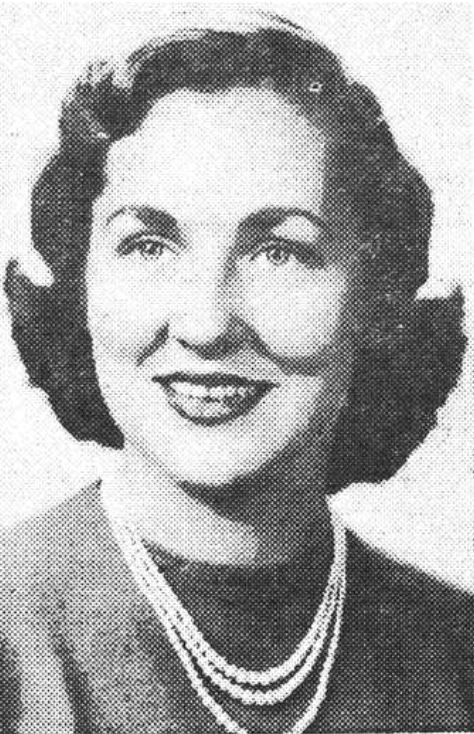
Barbara Gibbs, 1954

the Senate couldn’t be fixed in only a year, “the pendulum was swinging towards progress”. Barbara Gibbs – now Doster after her marriage in 1956 – was leaving behind a Senate that was looking forward and starting to truly consider the responsibilities they faced as elected student body representatives. Gibbs remarked in her farewell address that she was satisfied with the visible progress that had been made in the last year, and joked that she regretted that she had left “no frills, curtains, or anything feminine” to mark her term as President. Rather than urging future Senators to follow in the footsteps of her administration blindly, she encouraged them to “originate and make decisions on basic issues rather than carry on what someone else has contrived”.

As The Ohio State University looks back over its century and a half of students, innovations, and progress, arguably the most important thing the University has achieved has been to offer the opportunity for an education to all students, regardless of background, ethnicity, religion, or gender. In this regard, Barbara L. Gibbs was ahead of her time, and an example for future student governments.

Written by Beth Crowner.

Hope and Uncertainty: Celebrating Ohio State’s Centennial in 1970

Alumni magazine cover, July 1970

For many OSU students and alumni, 1970 was a year that constantly brought bad news. The Beatles broke up, the Apollo 13 mission to space almost didn’t make it home again, and President Nixon ordered more US troops into Cambodia in yet another attempt to end the Vietnam War. The Cambodian Campaign sparked protests across the nation on college campuses, including Ohio’s Kent State University, where 4 students were shot by the National Guard on May 4th following several days of protests. In the midst of this emotionally charged atmosphere, the Ohio State University started winding up for the university’s centennial celebration. For some, this was a welcome moment of optimism in an otherwise depressing year, as Marjorie Schwartz, Class of ’45, described in a letter to OSU Monthly’s July issue:

“You will note the date of this letter and understand when I say that along with millions of people I am just a bit depressed and dejected about the tone of the times. This week especially with the Kent State incident and the campus action around the country, I am alternately bewildered, angry, fearful, heartsick, etc. – it boggles the mind…

THEN the [Centennial] Monthly arrived. OHIO STATE LIVES! and the world will be all right after all.”

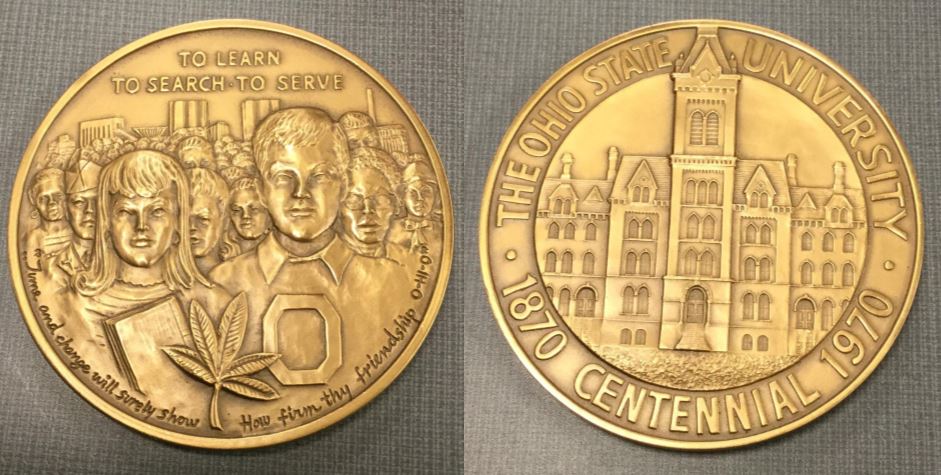
Centennial Medal, 1970

The university wanted this optimism for the future to be evident throughout the Centennial celebration, and asked celebrated cartoonist and OSU graduate, Milton Caniff, to design a commemorative medal that showcased the future of Ohio State – its students. Richard Mall, Director of Alumni Affairs, suggested to Caniff that instead of campus buildings, the medallion might feature young people, the true “product” of OSU. The medal was then used for several award ceremonies during the Centennial celebration to recognize individuals who had made significant contributions to the university, such as Jesse Owens, Milton Caniff himself, and others. Additionally, OSU awarded 24 honorary degrees and 150 centennial scholarships to students, as well as hosting over 250 different events on campus to celebrate the occasion.

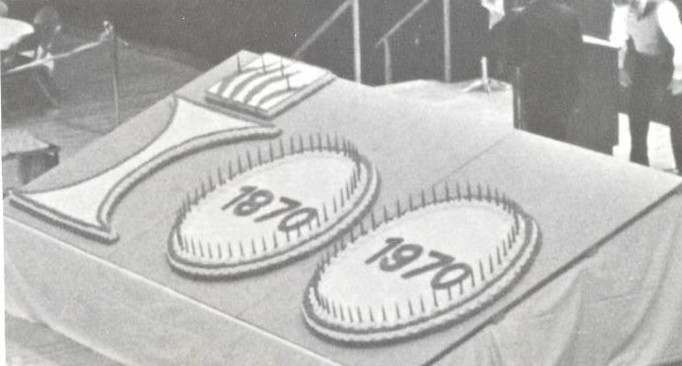
Centennial Cake, 1970

The Centennial logo itself was featured heavily everywhere, including a massive cake that faithfully reproduced the stylized torch in a recipe that called for over two thousand eggs, hundreds of pounds of flour, sugar, butter, and two quarts of vanilla extract. The cake served over 4,000 people at the “Buckeye Centennibration” held at the Ohio Union on January 10th, and the University president, Novice G. Fawcett, crowned the “Centennial Queen”, Christina Lee McClain. Christina, a junior in the Computer Science department, impressed the selection committee with her application, which emphasized the importance of reaching not only the student body and alumni of the University via her position as a University representative, but the larger communities of Columbus and Ohio. Ohio also celebrated the auspicious year statewide by designing and issuing almost six and a half million license plates that featured the iconic shades of scarlet and gray.

Centennial Logo, 1970

Despite the numerous celebrations planned for the centennial year, university leaders such as President Fawcett were concerned with not only the immediate future, but the distant one as well. In a published list of objectives for the next hundred years, 1970-2070, the university stated that its focus must be “to identify major problem areas that make the next century a critical one – problems that must be solved in this century if the viability of civilization is to continue”. Milton Caniff captured this mixture of hope and uncertainty that encapsulated the start of the seventies in a program handed out during OSU’s Centennial Ball, which included a poem he’d written in 1930 as a senior at OSU:

“No class before or since gives hoot that mine marched out to panic’s tune. Depression changed our lives, but talk about it bores, so let it pass away. Important is the fact that Orton’s chimes reached every student ear.”

Though half a century has already passed since OSU’s 100th birthday, the university’s aspirations for a better future remain unchanged, and even in the face of a constantly changing future Buckeyes refuse to settle for simply solving today’s problems. Just as our predecessors did fifty years ago, we look towards a better future: one with OSU’s students at the helm, inspiring a better tomorrow.


Timeline of OSU’s Centennial Year

OSU’s Centennial had hundreds of events throughout 1970, but these were the highlights, focused largely on Spring Quarter:

January 10 – Centennial Year Opening Program at the Ohio Union

February 12-13 – Centennial Symposium at the Mershon Center

March 20-22 – Charter Weekend, the highlight of the year’s many celebrations

March 20 – Centennial Ball

March 21 – Presentation of Centennial Awards

March 21 – Dedication of Thurber Alcove and the Thurber Collection at Thompson Library

April 21-25, April 27-May 2 – Centennial Theatre Production

April 24-25 – Centennial Conference on the Humanities at the Mershon Center

Throughout the year – A traveling exhibit of OSU’s history was displayed in over 50 places across the State of Ohio, highlighting the studies of the university’s freshmen and sophomores.

Written by Beth Crowner.

Cutting a Rug: Fifty Years of Formal Dances

Spring Dance, 1936

While formal socials and dances aren’t a part of University life anymore, they were quite popular during the early 20th Century as a way to meet people and relax. Formal dances, such as many of the military balls held from the 1900s to the 1950s, were also a socially acceptable way to date.

The formal Spring Dance was a campus wide social, where black tie suits and formal gowns were dusted off each spring for a festive gala. Here, Wesley Leas dances with an unnamed partner, stopping to smile for the camera. Wesley, or ‘Wes’ as he preferred to be called, was the president of the senior class two years later in 1938, as well as being The Best Damn Band in The Land’s drum major. An engineering major, Wes also managed to find the spare time to involve himself in a number of campus organizations and social clubs, such as the American Institute of Electrical Engineers, the Ohio Staters Inc., the Quadrangle Jesters, and the fraternities of Kappa Kappa Psi and Sigma Chi. In spite of this busy schedule, Wes still found time to focus on his studies and find a date to the Spring Dance formal!

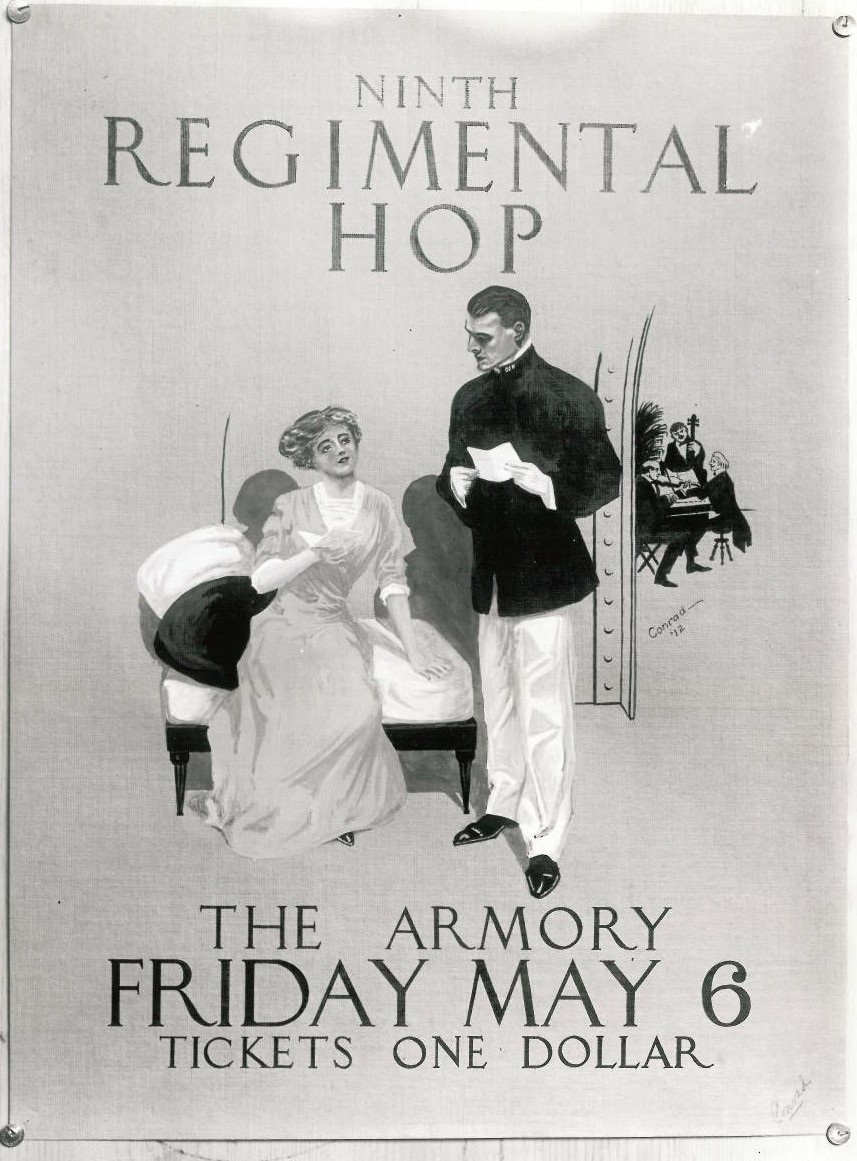
9th Regimental Hop, 1910

The “Regimental Hop” was a formal military dance held semi-annually at OSU, often a freshman’s first formal dance. The dances were put on by the regiment’s officers, and typically held at the Armory on campus. The first Regimental Hop was held on May 18th, 1906, and by 1910, the dances had become a regular feature of the social calendar. The Regimental Hop was relatively popular, often with 200 or more students buying tickets to attend despite the cost of admission – a $1 ticket in 1910 is about $25 in 2020!

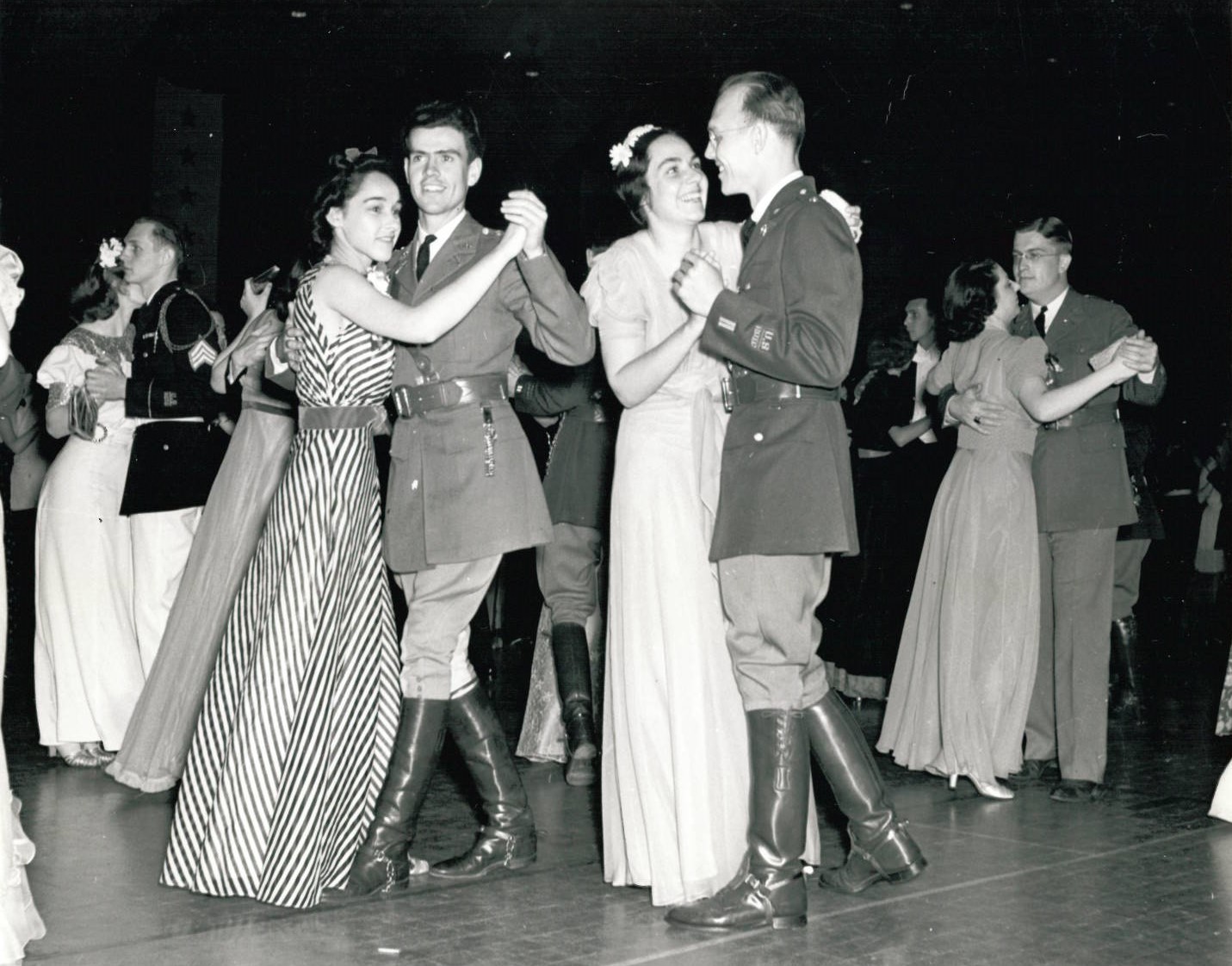
Military Ball, 1938

The annual military ball was another popular formal held at Ohio State, which anyone could attend, provided they purchased a ticket from one of the students in advanced military training. Attendance was limited to 1,000, and the tickets were $3.50 for each couple, roughly $62 in 2020! Part of the high cost of attendance for the 1938 dance may have been used to cover the cost of the musicians – $2,000, which The Ohio State Lantern reports was “more than any band has received in the history of the University”. Paying the equivalent of almost $36,000 in today’s money to hire the band is unsurprising, however, considering Hal Kemp’s popularity. The musician had become a popular jazz saxophonist, recording for songs such as “You’re the Top” and “Lullaby of Broadway”, which was a hit in 1935. The military ball was one of the last professional engagements he and his band would play, due to a fatal car crash two years later in 1940.

Military Dance Band, 1946

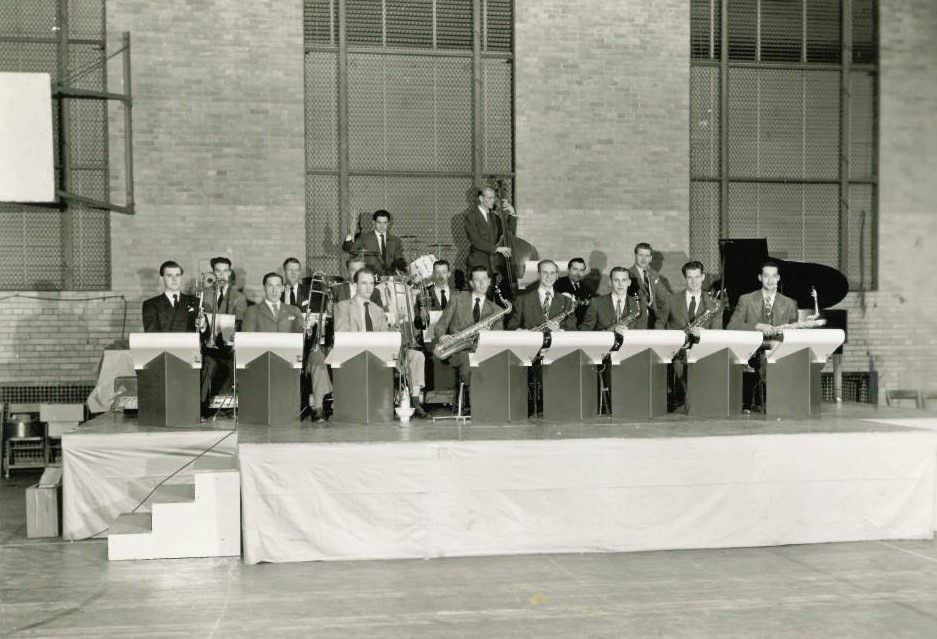
As World War II finally ended in September, 1945, many military “sociables” naturally shifted to the veterans of the war who were finally returning home after years of fighting in Europe and the South Pacific. Veteran’s groups and associations became a fixture of campus life, and one such group decided to form a dance band, holding a contest in April during the All Veterans’ Campus Mixer to determine the name. The 16 piece ensemble, led by Harry Chorpenning, became known as the “All Ohioans” thanks to William Wilson’s winning entry, and included a female vocalist who accompanied some of the pieces.

Mansfield Club Dance, 1948

Dances didn’t always center around military officers or campus-wide events, however – some were smaller, more intimate affairs that included members of a sorority or fraternity, members of campus clubs or organizations, or even social groups, such as the Mansfield Club. To be a member of the Mansfield Club, all a student had to do was prove they were from Mansfield, Ohio. The boundaries were later extended to include all of Richland County, in an effort to boost membership. This particular photo was taken during the 1948 February “Winter Whirl” dance, during winter quarter, which included a homey, small town feel in the decorations. Couples danced to Bus Brown’s trio of musicians and refreshed themselves at the bar with bottles of Coca-Cola. The dance ended at midnight, with the song “Home Sweet Home” playing.

Despite the popularity of dances in the first half of the 20th century, university sponsored dances have since fallen out of favor.

Written by Beth Crowner.

« Older posts Newer posts »