From Woody's Couch

Our Playbook on OSU History

Page 29 of 105

University Gardens plants roots for students’ education

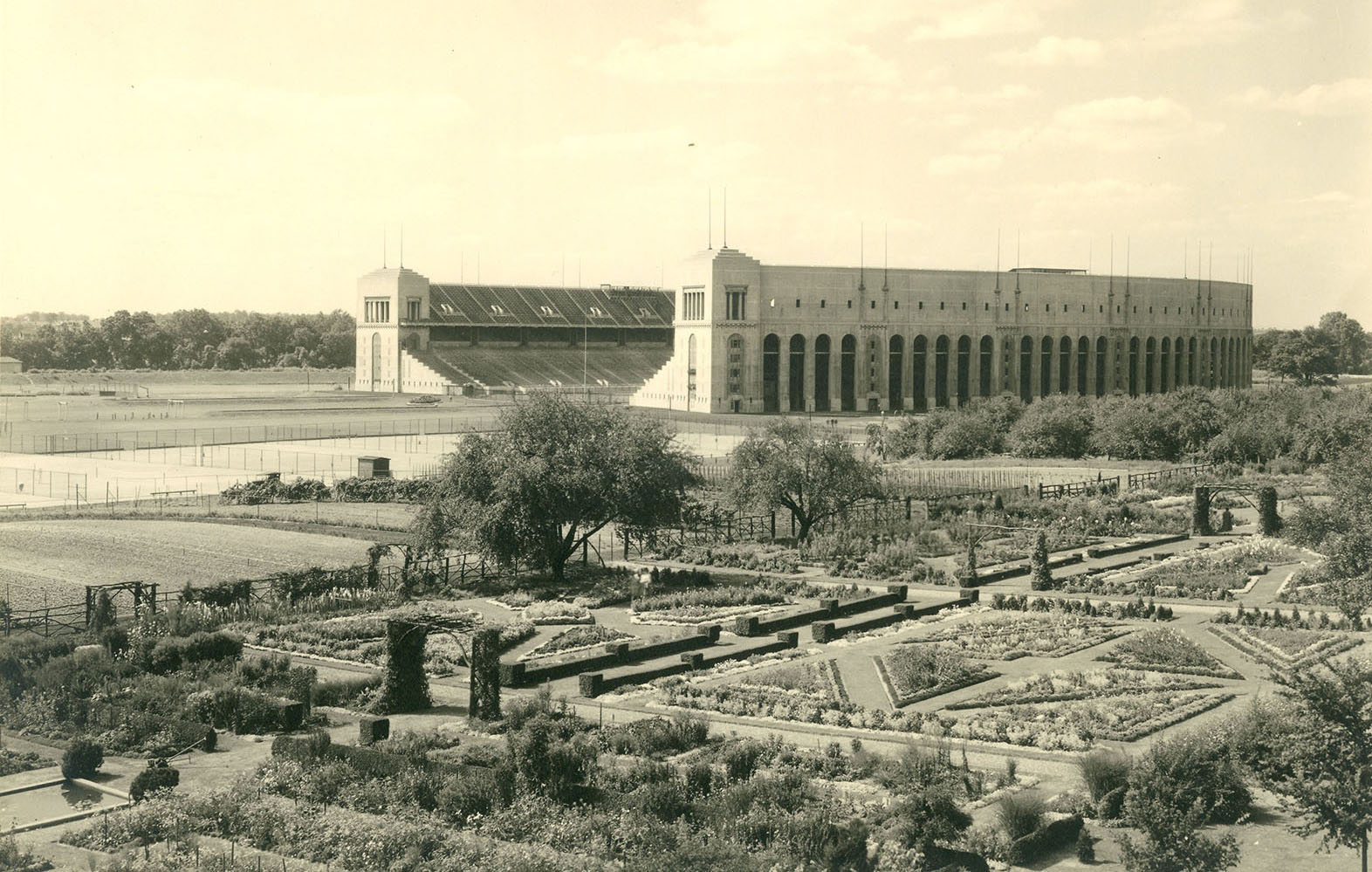
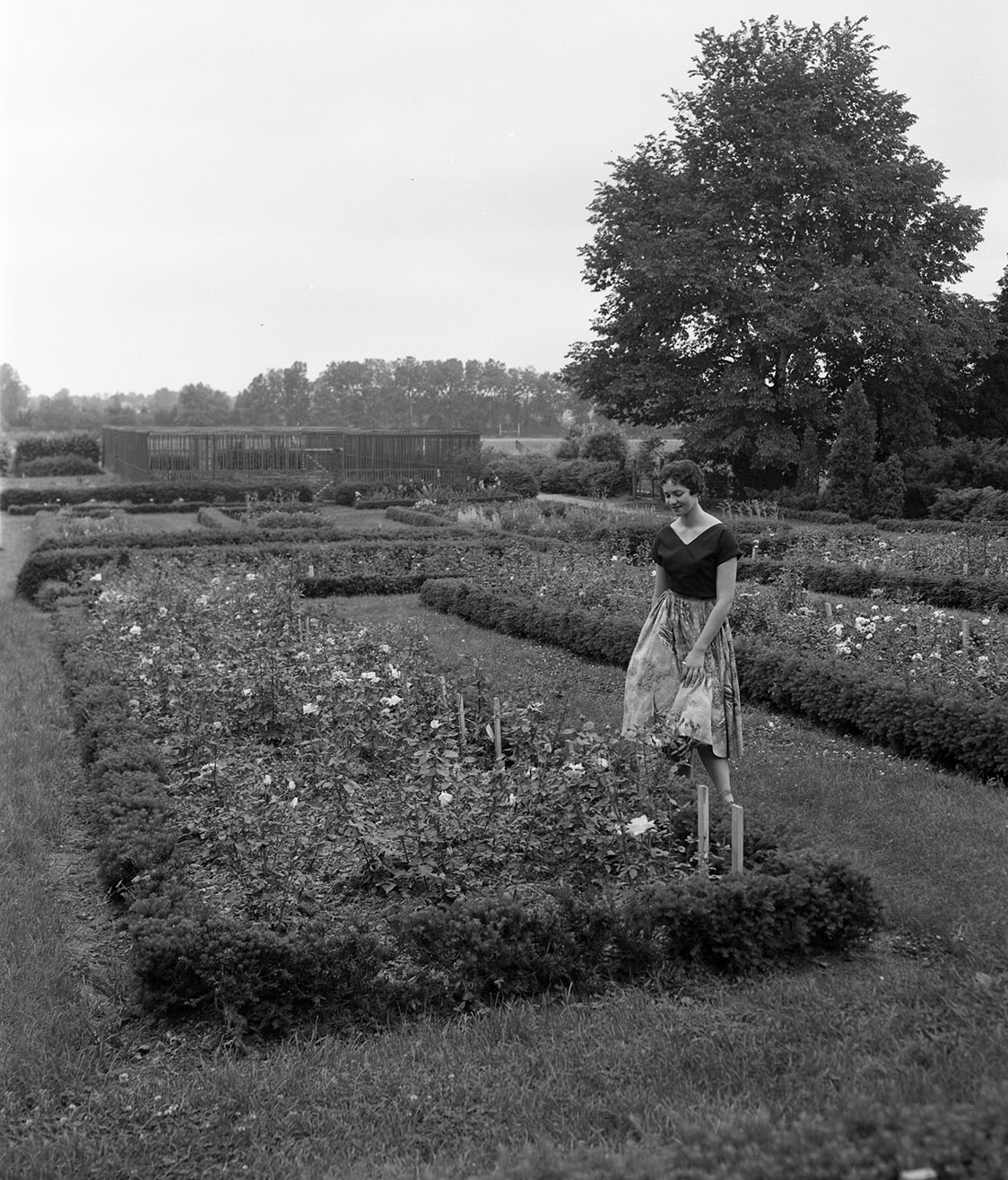
Students walking west of Thompson Library today are likely unaware of just how drastically different the campus landscape appeared in the past.  Starting in the 1920s and 1930s, the University Horticultural Gardens blanketed the campus west of Neil Avenue, presenting an array of plants, flowers, hedges, a lily pond and a number of exotic plants.

As a University largely based in agriculture, it’s no surprise that the school began to set aside a portion of the campus, as early as 1884, to be slated for garden space.  Much of the campus grounds were already covered in farmland when the school officially opened to students in 1873.  However, plans for a formal University Horticultural Garden did not surface until the 1910s, when a number of University Departments began laying out a scheme for the gardens.

At its peak, the University Gardens covered nearly 15 acres. The gardens were situated south of the McCracken Power Plant, west nearly to the Stadium, east of Thompson Library and south to the site of Jennings Hall.

At its peak, the University Gardens covered nearly 15 acres. The gardens were situated south of the McCracken Power Plant, west nearly to the Stadium, east of Thompson Library and south to the site of Jennings Hall.

c1950

c1950

The gardens presented a nearly perfect learning opportunity for students across a variety of colleges, as it served as an extension of their class work.  Landscape Architecture students were involved in the creation and formation of the gardens; Horticultural students grew experimental types of plants and recorded their results; and Botany and Zoology students were often devoted to plant-breeding experiments and the study of pest control.

The purpose of the gardens was two-fold: it not only provided hands-on experience for students, it also served to beautify the campus.  In fact, many gardening clubs and members of the public visited the gardens to learn about flowers and take a peek at unusual plants.  Some of the plants that were being tended were quite rare, reported the Lantern in 1922.  One species of gladioli had been imported from the Pacific Coast, and the bulbs cost $10 each.  Other plant species were brought from Holland, Asia and a number of other countries.

c1924

c1924

Students must have also enjoyed strolling through the gardens, especially at summer’s peak when the flowers were in full bloom. A July 15th 1927 Lantern editorial author writes: “One follows with amazement the intricate and perfectly executed designs in which the beds are planted and sighs as he recalls the bedraggled and wandering little rows which he has accomplished in the old garden at home – and asks himself if a course in horticulture wouldn’t be a valuable part of one’s education, after all.”

However, as the years wore on and campus construction progressed, the gardens were downsized.  “As size diminished, interest in the garden waned as well”, according to a 1968 Lantern article.  By the 1970s, the gardens were almost entirely gone.

Please see our Flickr page for more images of the University Horticultural Gardens.


A Journey Under the Ice: Hubert Wilkins and the Nautilus

Sir Hubert Wilkins with his wife, Lady Susan.

Sir Hubert Wilkins with his wife, Lady Suzanne.

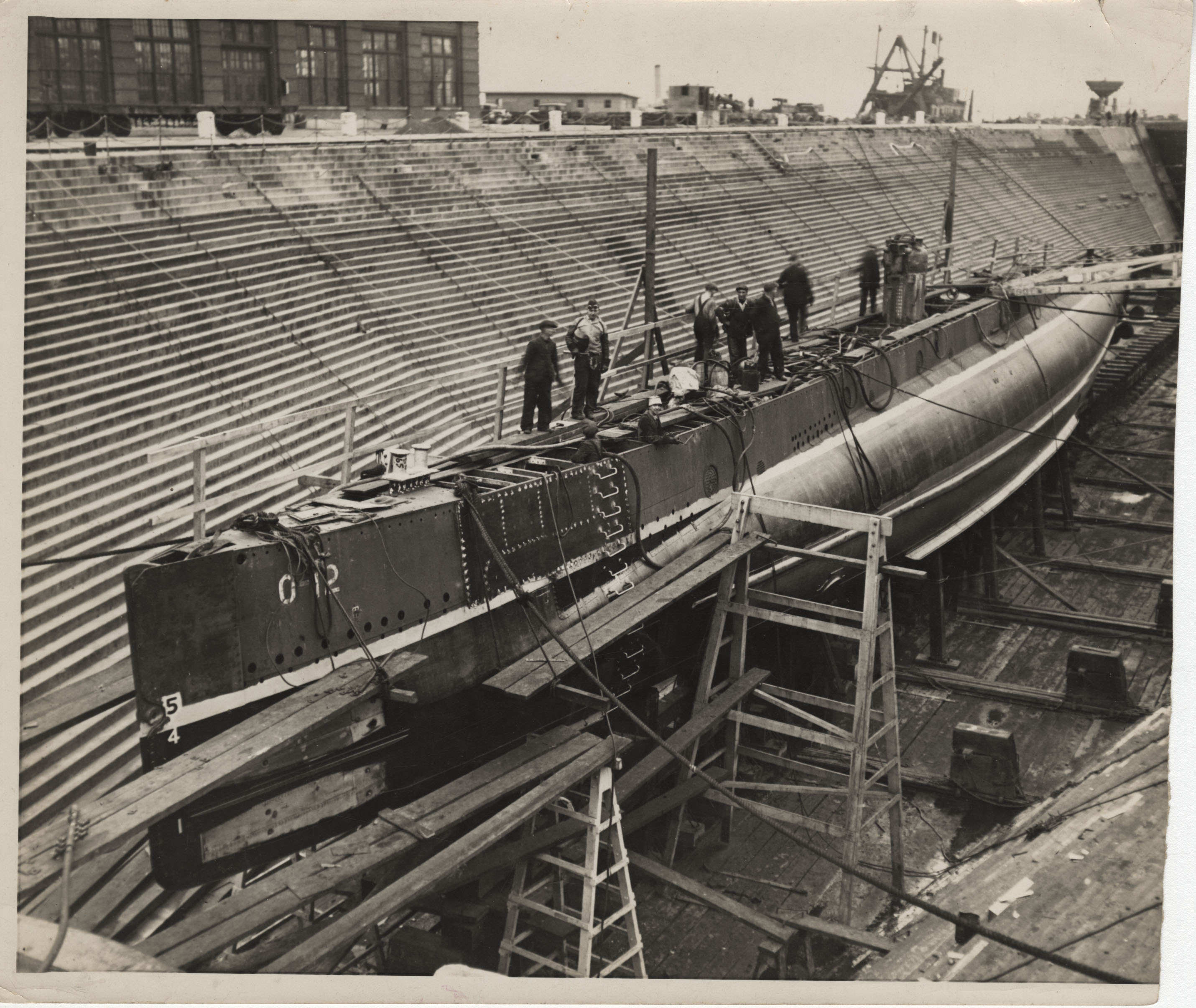
In June of 1930, the famous explorer Hubert Wilkins, accompanied by Sloan Danenhower found themselves sorting through a Navy scrapyard, examining submarines for a trip under the North Pole. The Navy had given Wilkins his pick of the scrapyard, with the chosen submarine to be leased for only one dollar. The submarine in the best condition was O-13, which also held the record for the deepest dive. The pair, however, were spooked by the number 13, so “letting superstition overcome logic, they settled on the O-12.”[i] Unfortunately, the O-12 would prove as unlucky as they feared 13 would be.

The Nautilus being outfitted in a dry dock.

The Nautilus being outfitted in a dry dock.

Wilkins proposed a trip into one of the last uncharted places on Earth. He planned to travel by submarine underneath the North Pole from Norway to Alaska. The expedition would be called the Wilkins-Ellsworth Trans-Artic Submarine Expedition. Such a journey was fraught with risks. The Arctic holds no land beneath the ice and is composed of shifting ice floes which occasionally collide and shoot spikes into the ocean. Worse, everything that sailors usually rely on to navigate —the deep basin, the currents, the thickness of the ice, the temperature,

Image of Arctic waters, taken from the deck of the Nautilus.

Image of Arctic waters, taken from the deck of
the Nautilus.

its interaction with other oceans—was uncharted in 1930. For Wilkins this was part of the attraction; the ability to aid science, to learn about weather and “to fill in the last unknown on the map”[ii] drove his ambition and excitement for the journey.Navigation in the uncharted Arctic was not Wilkins’ only obstacle, however. The O-12 itself, rechristened the Nautilus (with ice, as champagne was still illegal), proved to be one of the greatest challenges. The O-class submarines were built for coastal waters, not the Arctic or even, as Wilkins would discover, the open ocean. This meant that the submarine would have to surface every day to recharge its batteries and gain fresh air in a stretch of ocean that was uncharted and plagued with constantly shifting ice floes. If the submarine was unable to find a safe place to surface, the crew only had three days of emergency air before they would suffocate (partially explaining the trip’s nickname of “the suicide club”). These issues were compounded by the number of modifications necessary for the Nautilus, including fixing the engines, finding and caulking all leaks and preparing it for scientific experiments.

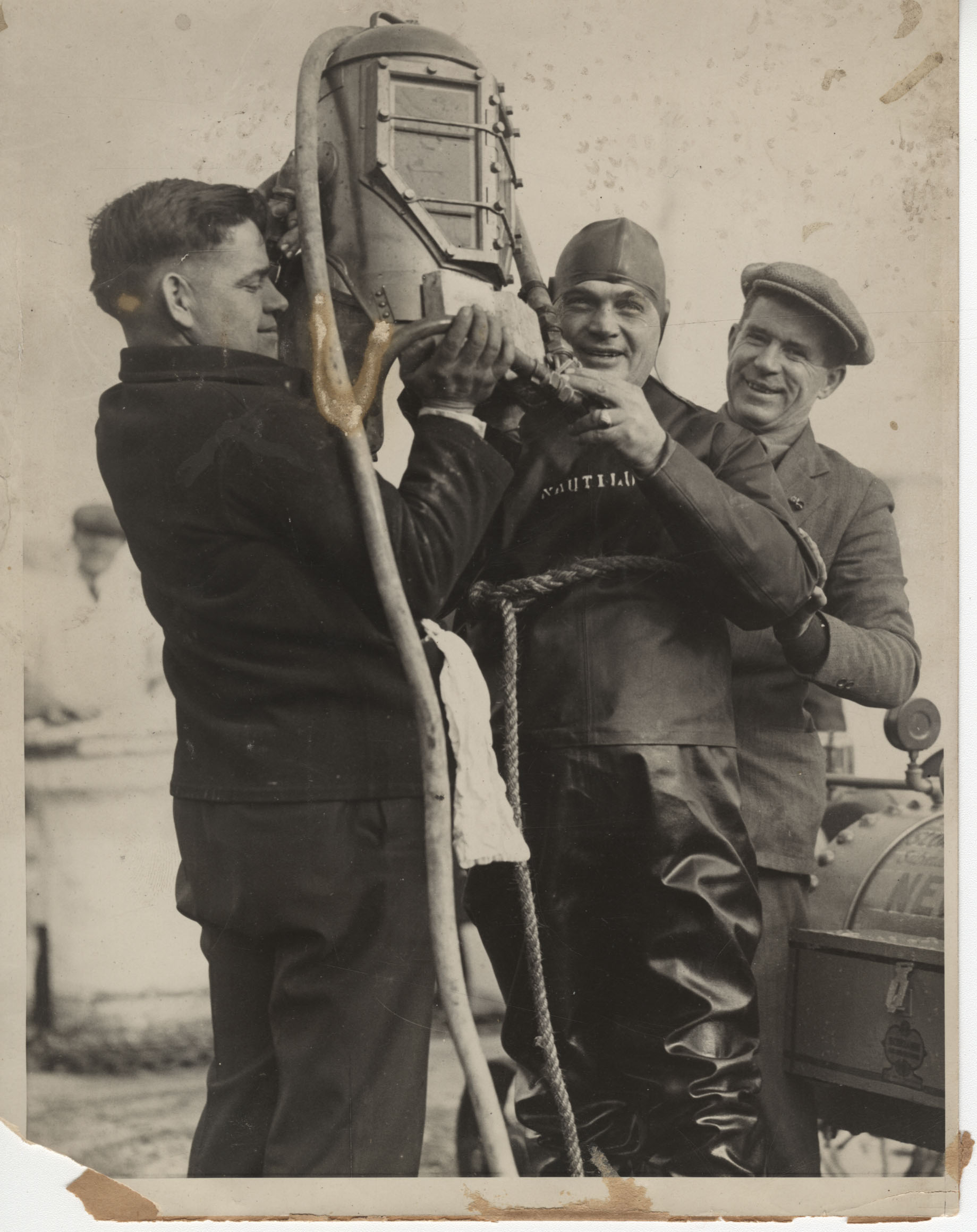
Captain Sloan Danenhower testing the Nautilus's artificial air machine.

Captain Sloan Danenhower testing the
Nautilus’s artificial air machine.

In spite of these problems, the newspapers hailed the expedition as ‘The Greatest Adventure in History.’

Postcard of the Nautilus.

Postcard of the Nautilus.

A flood of individuals applied to join the crew, children gave pennies to help fund the project, and there was a scheduled rendezvous with the Graf Zeppelin when the Nautilus resurfaced in the Pacific.  The trip itself, however, was not to fulfill the expectations of its newspaper headlines.

Tragedy befell the expedition even before the submarine departed the U.S. While entering New York, Willard Grimmer, the quartermaster, was swept overboard by battering waves and drowned.

Ray Meyers, Chief Radioman aboard the Nautilus, saying goodbye to his wife and daughter.

Ray Meyers, Chief Radioman aboard the
Nautilus, saying goodbye to his wife
and daughter.

This unfortunate accident was not the only disaster, either. During its first deep sea dive, the Nautilus sank and got stuck in the mud at the bottom of Long Island Sound. Though the submarine eventually dislodged itself, this was not the last time that the crew faced death within the Nautilus. Even with these grim events, the Nautilus set out across the Atlantic toward its destiny in the Arctic.

Stay tuned to find out what happens to Hubert Wilkins and the Nautilus…


[i] Nasht, Simon. 2005. The last explorer: Hubert Wilkins: Australia’s unknown hero. Sydney: Hodder Australia.pg, 215

[ii] Nasht, Simon. 2005. The last explorer: Hubert Wilkins: Australia’s unknown hero. Sydney: Hodder Australia.pg, 213

The Great Adventures of the Graf Zeppelin

In May of 1928, disaster hovered in the air above France. The Graf Zeppelin, a German airship marginally shorter than the Titanic, ten stories tall and filled with one hundred thousand cubic meters of hydrogen (the world’s most flammable gas) had lost several of its engines.

Graf Zeppelin above Tokyo

Graf Zeppelin flying over Tokyo on its around the
world flight.

The forward port engine had lost its main shaft and two other engines had immediately seized, leaving the ship floating on its last two engines. In response, Commander Hugo Eckener, a very skilled aviator, tried to return the airship to its base in Germany.   But then a fourth engine stopped, stranding the ship and its passengers with the Alps between themselves and safety.

Sketch of the Graf Zeppelin

Sketch of the side view and floor plan of the
Graf Zeppelin, reproduced here on a German postcard.

The choice was either to abandon ship, or to attempt an emergency landing in France. To land on the open ground would cause the ship to bounce, unless gas could be released fast enough to prevent it—a major fire risk. Instead Eckener maneuvered the Graf Zeppelin to an old French hangar, where French troops waited. The French helped the Graf Zeppelin to land but immediately locked down the base—“after all, the last Zeppelin landing in France had been a war machine.” [i]  The Graf Zeppelin and its passengers, as well as the two gorillas on board[ii], were saved.

It was an exciting time in the history of flight.  Two years before, Charles Lindbergh had flown from New York to Paris in about thirty-three hours, sparking a huge rise in popularity for aviators and a surge in the public’s interest in flight.  Commander Hugo Eckener and the Zeppelin Company wanted to build upon this fascination by using the Graf Zeppelin to circumnavigate the globe.

Freud, the radio operator aboard the Graf Zeppelin

Freud, the radio operator aboard
the Graf Zeppelin, dangling out a
window.

The problem? They did not have enough money. Their solution came from the American news mogul William Hearst. Hearst wanted to capitalize upon the excitement that aviators and grand adventures sparked in the American public and, after some haggling, he offered to fund half of the money for the trip in exchange for the rights to the story in the U.S. and Great Britain. Hearst had three reporters on board: the famous explorer Sir George Hubert Wilkins, Lady Grace Drummond-Hay, and Karl von Wiegand.

Hearst's reporters.

Hearts’s reporters from left to right: Captain
Wilkins, Lady Drummond Hay, Carl Von Weigand
and cameraman Robert Hartman.

Hearst also demanded that the trip begin and end in the U.S.  Eckener agreed, but planned to travel right back to the Zeppelin’s home base in Friedrichshafen, Germany after beginning in America, allowing for a complete circumnavigation from both Lakehurst and Friedrichshafen (thus satisfying both his home country and his primary sponsor).

This is how the Graf Zeppelin, after its inauspicious trial run in May, came to be traveling again across the Atlantic toward the U.S. on the 1st of August, 1929. Ninety hours after departure, the ship landed in Lakehurst, N.J. before returning to Germany. From Friedrichshafen, the Graf Zeppelin traversed Siberia before landing in Tokyo, Japan, and continuing across the Pacific Ocean to Los Angeles, California. The last leg was a jaunt across the United States, back to Lakehurst.

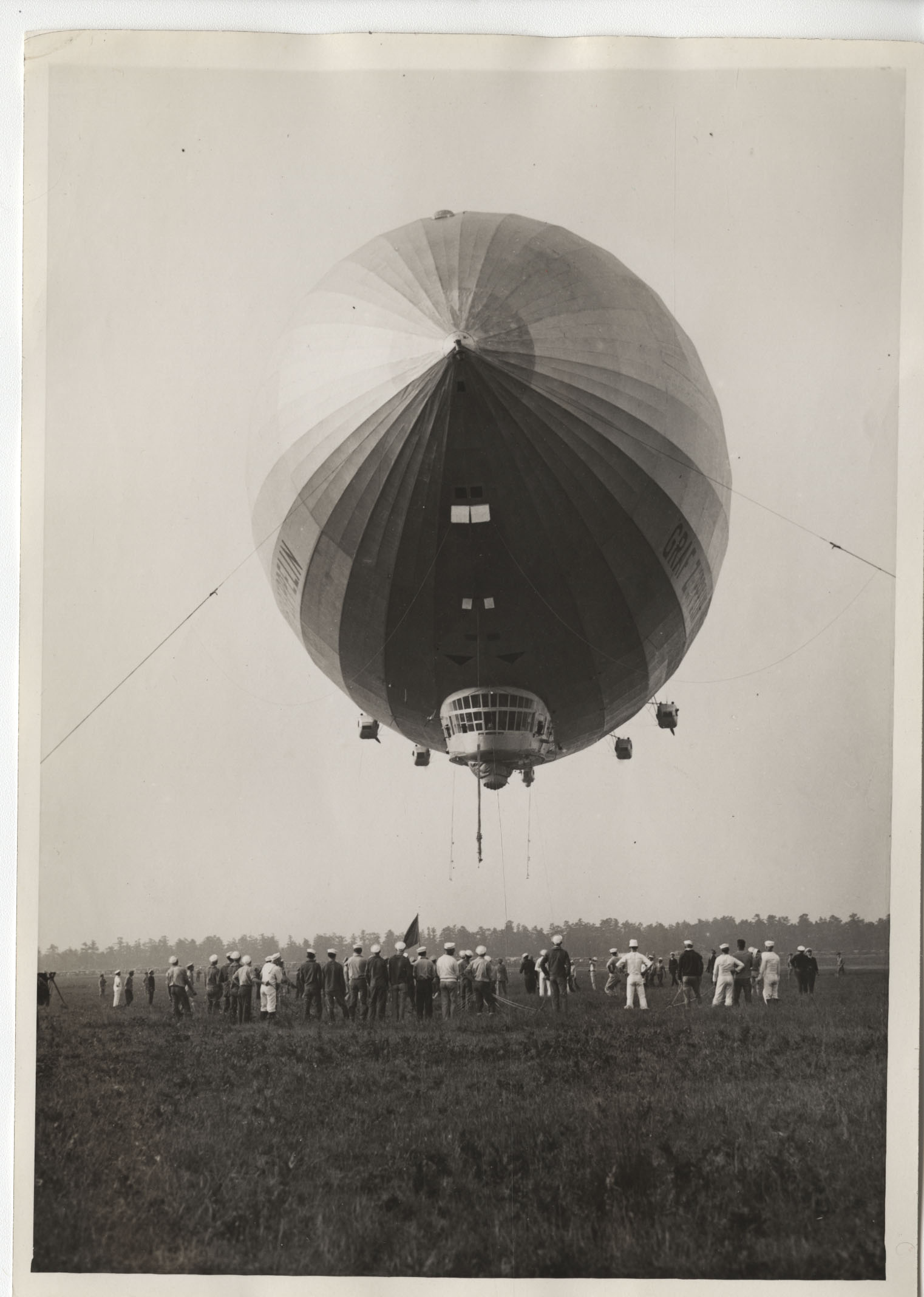
Front view of the Graf Zeppelin

View of the Graf Zeppelin as it lands
in N.J. after completing its
circumnavigation of the world.

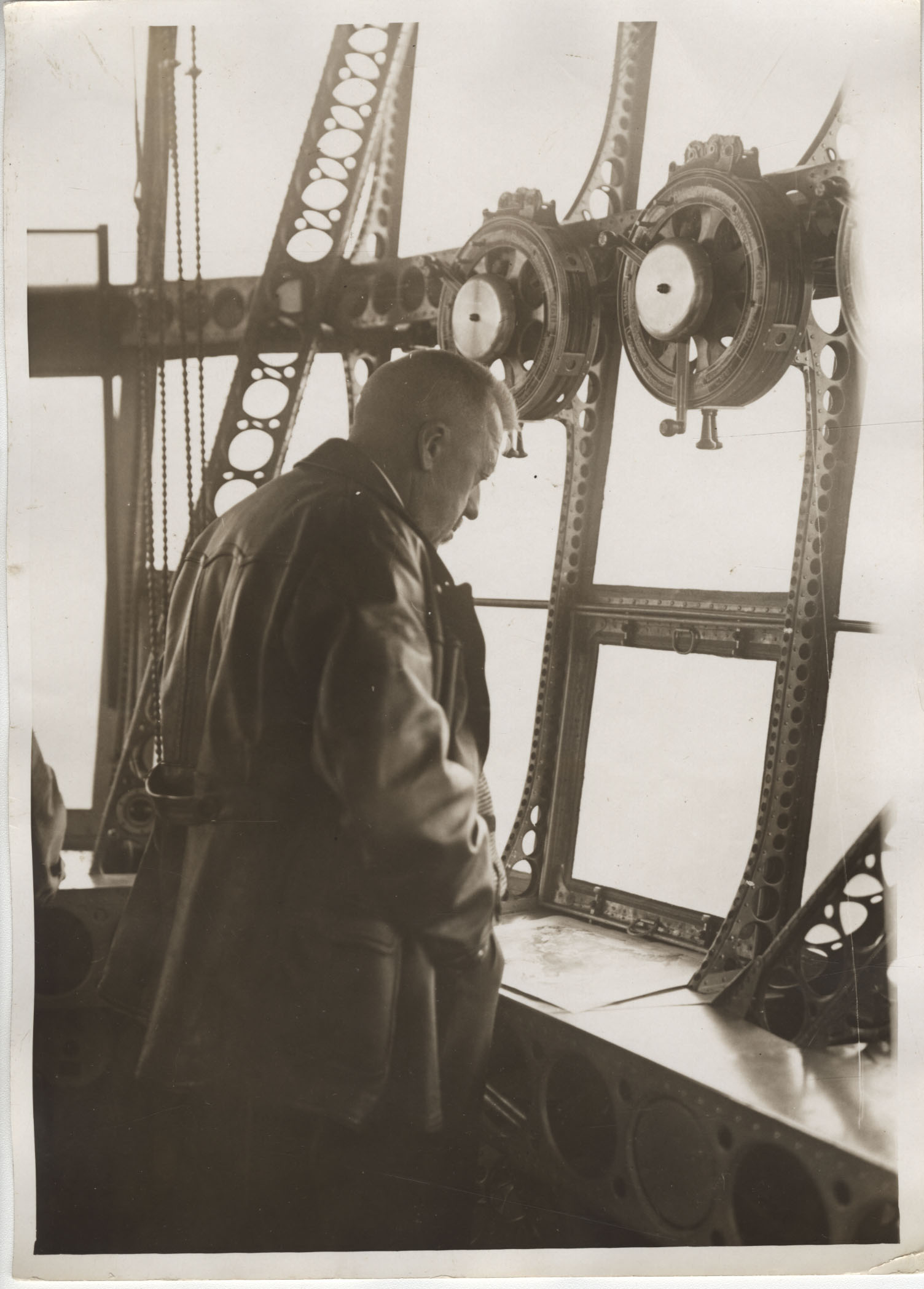
Commander Eckener in the control room.

Commander Eckener in the control
room on the Graf Zeppelin.

By this time, the Graf Zeppelin had run out of drinking water, though this did not stop Eckener from pushing forward. Instead the passengers subsisted on wine and other alcohol—substances still illegal on the U.S. soil below their feet. Upon its arrival, the Graf Zeppelin broke the record for the fastest circumnavigation of the globe and was met with massive fanfare and celebration.

George Hubert Wilkins, a famous Australian polar explorer and one of Hearst’s correspondents on the Graf Zeppelin, collected photographs and memorabilia related to the flight. Over two hundred of these images were recently acquired by The Ohio State University’s Polar Archives in 2015 and join the larger Wilkins Collection held by the repository. These images range include mass-printed German postcards; images of life aboard the airship; photos of the Graf Zeppelin in flight or in a hangar; as well as photos of crowds cheering and celebrations.

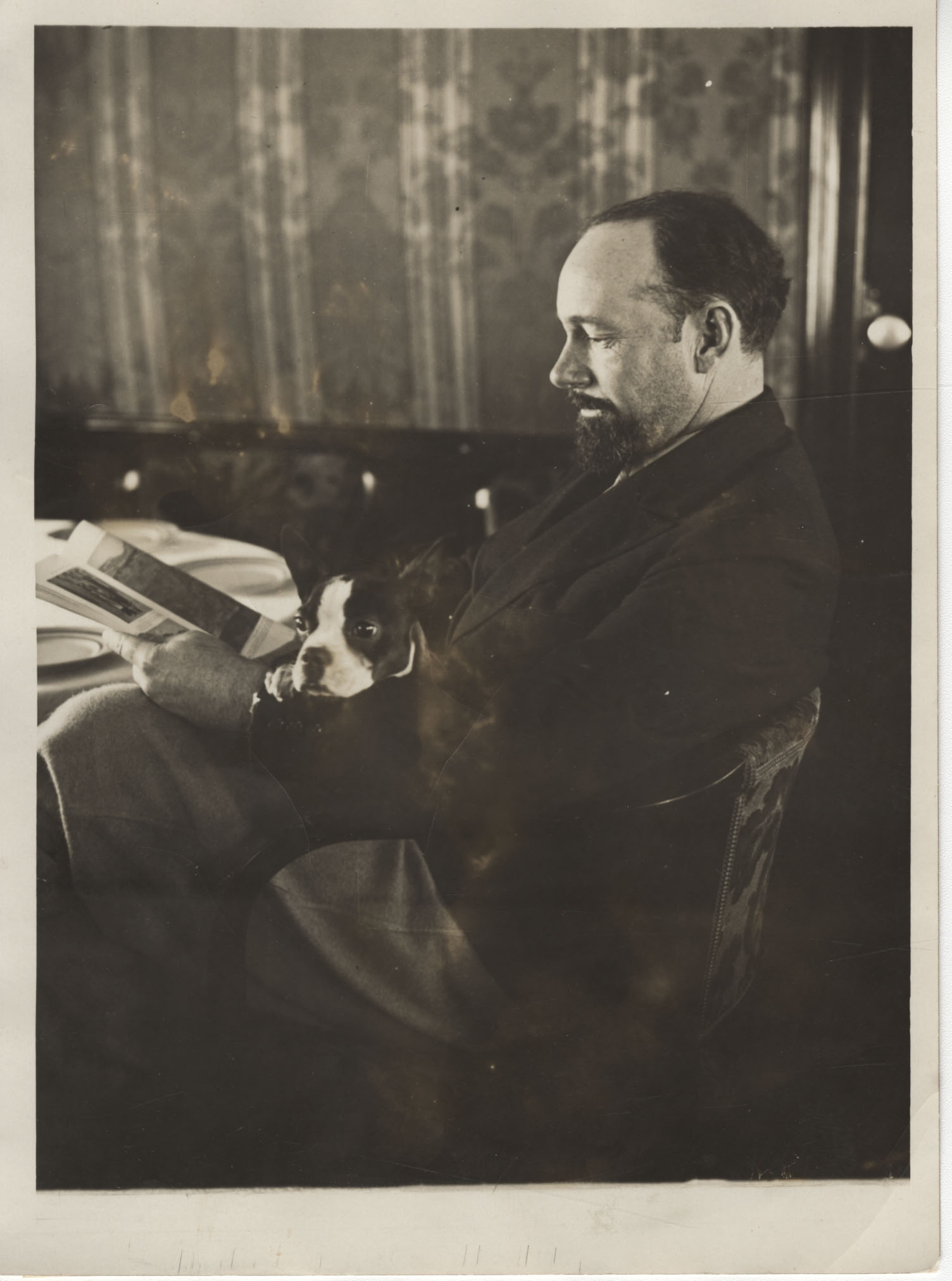
Wilkins himself is not featured in many images.  He is seen in only a few formal photographs, as well as several that depict him dining with Captain Eckener and his fellow correspondents. The exception is a fabulous photo in which Wilkins is examining a book of photographs in the dining area, with a small dog (one which greatly resembles an early Boston terrier) in his lap.

Wilkins, reading, with his dog in his lap.

Wilkins, reading, with his dog in his lap.

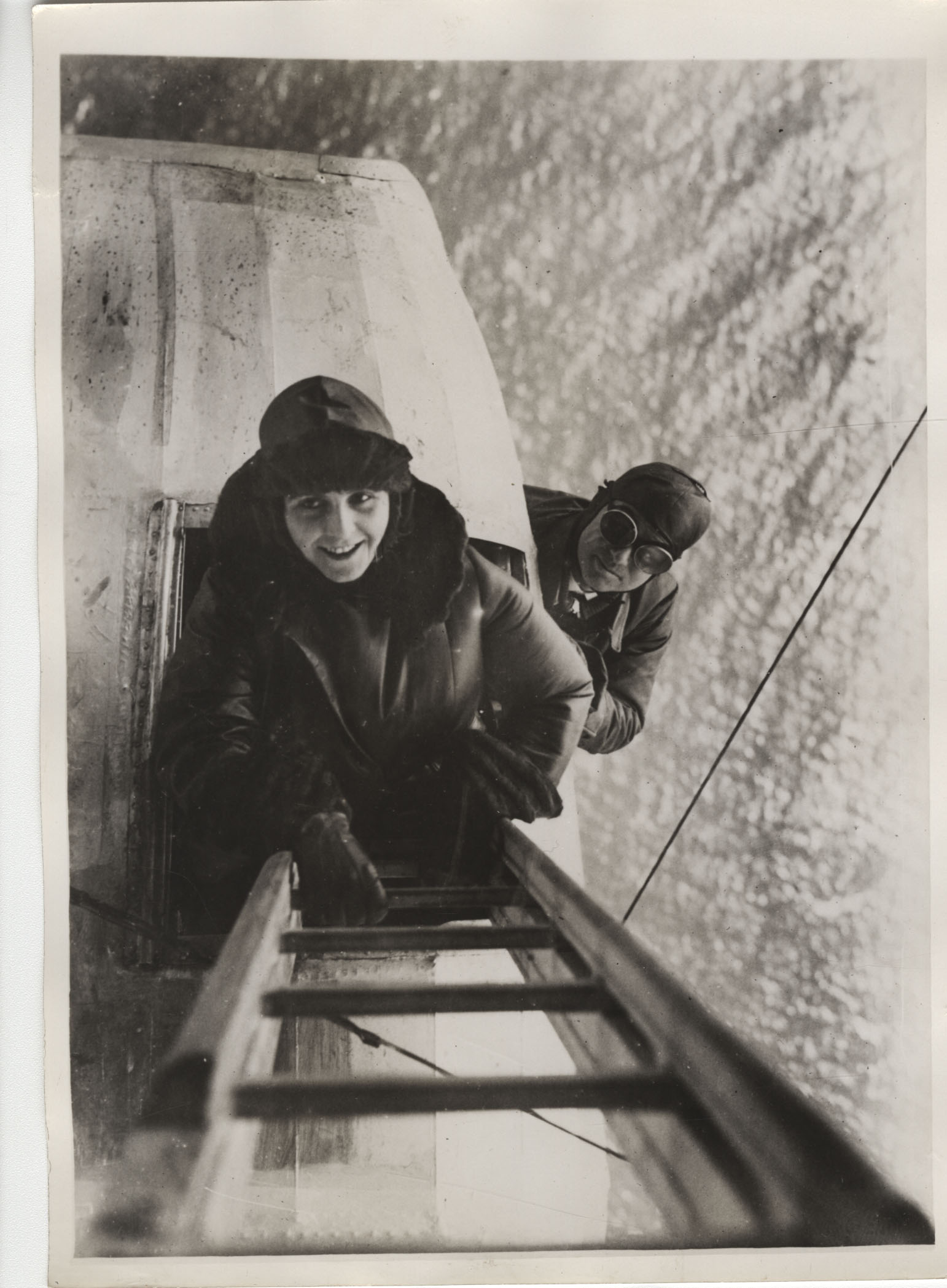
Such depictions of life aboard the ship are numerous among the collection and cover everything from work to play. There are images of one crew member rather smugly playing the piano accordion; the radio operator Fruend precariously hanging out a window with a dangling wire; Chef Manz cooking; Commander Eckener solemnly monitoring everything on the control room; and Lady Drummond Hay happily climbing one of the gondolas while the ship was in flight.

Lady Drummond Hay climbing one of the gondolas.

Lady Drummond Hay climbing one of
the gondolas.

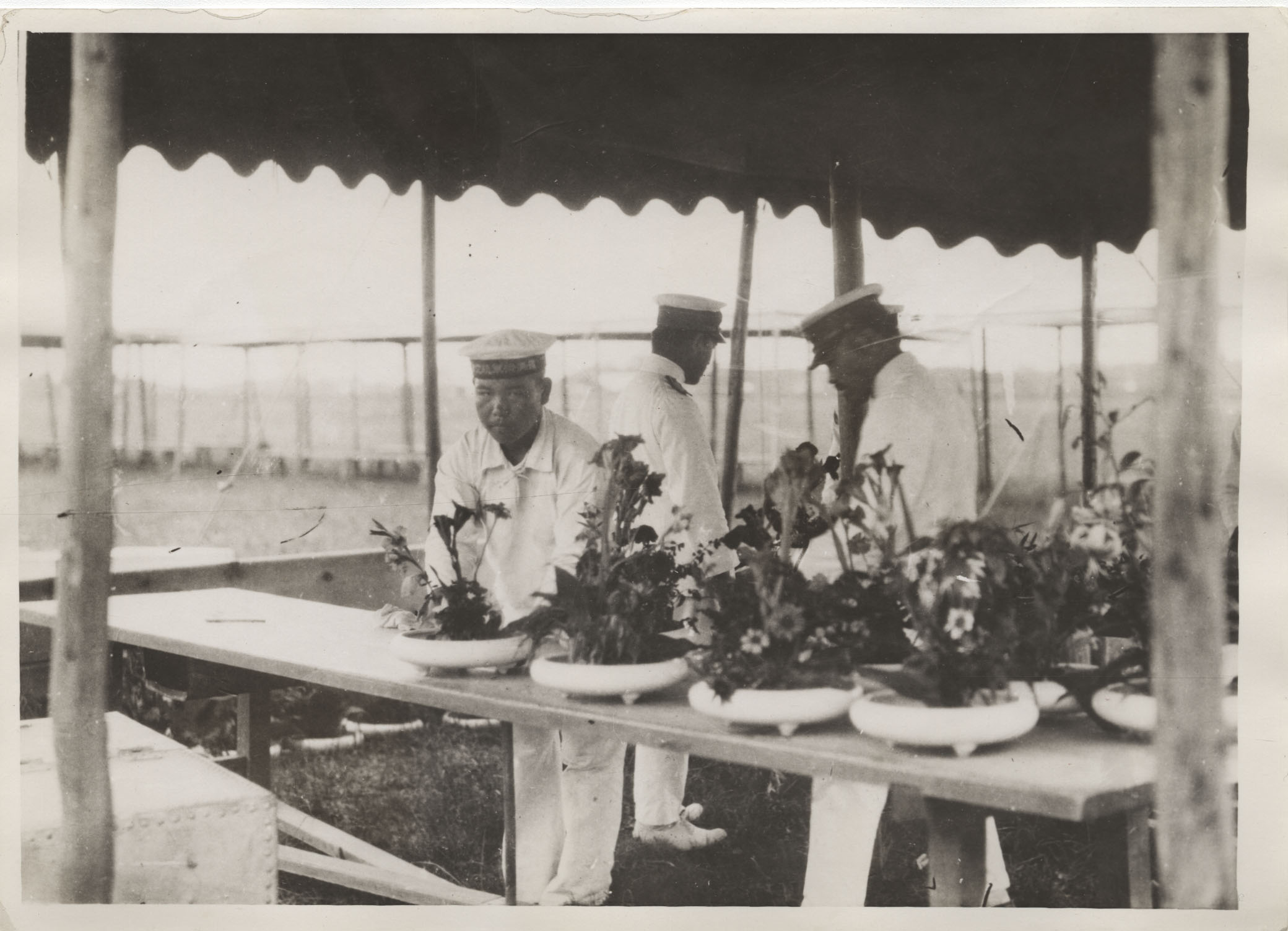
Other images show the world in relation to the massive form of the Graf Zeppelin. Several images depict the Graf Zeppelin landing or taking off, surrounded by small white smudges that only vaguely look like people.  Another photograph, apparently taken from the Graf Zeppelin itself, shows the Zeppelin’s shadow, which looks rather like a large missile, over a field. Even from the air, the Zeppelin’s shadow is several times larger than the houses and barns on the ground. Some photos display the huge impact of the Graf Zeppelin’s flight, even without the Graf Zeppelin being the subject of the image. One such photo displays two long rows of U.S. sailors feasting after aiding in the landing and departure of the Graf Zeppelin. Another shows Japanese florists preparing flowers for those visiting the Graf Zeppelin while it was moored in Tokyo.

Japanese Florists

Japanese florists preparing flowers for the arrival of
the Graf Zeppelin.

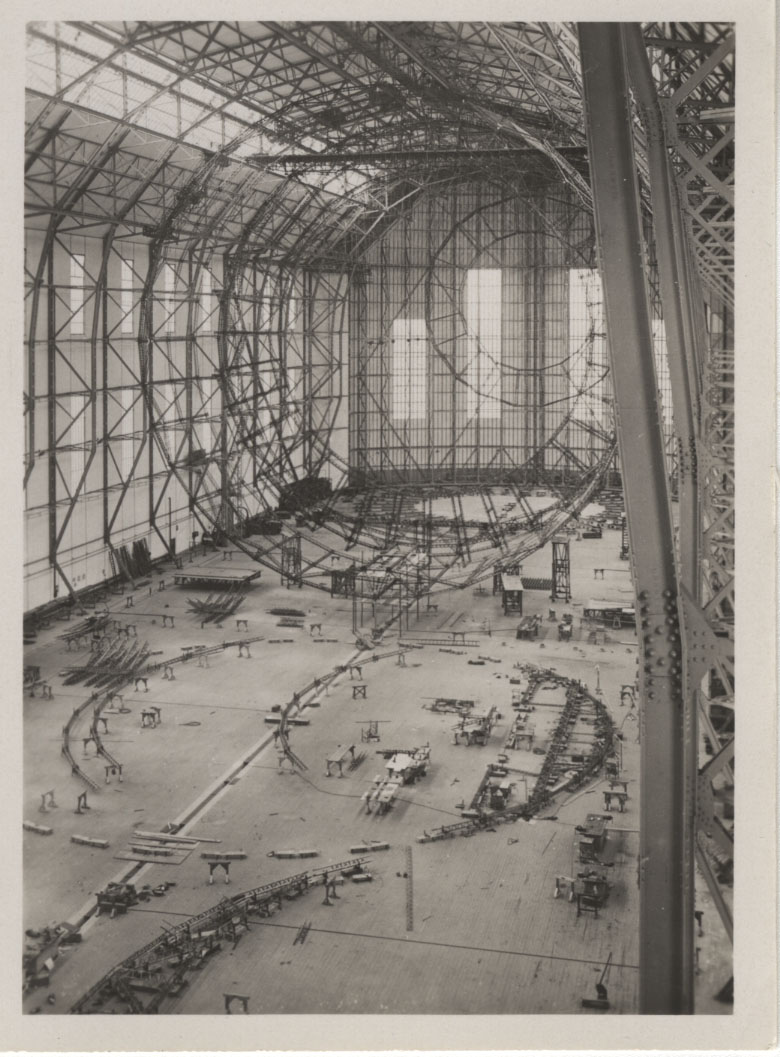
Finally, the collection has printed memorabilia that Wilkins gathered, mostly postcards and tiny printed cards. These seem to be German in origin, given that all are captioned in German, and display wonderful drawings of the Graf Zeppelin’s plans or of the luxurious cabins and dining areas inside. One tiny image shows the Graf Zeppelin when its frame is only half formed, extending out toward the viewer in a spiral fashion, while unattached parts mimic its swirls on the ground.

frame of the Graf Zeppelin

The Graf Zeppelin as it was being built.

For more information about Sir George Hubert Wilkins, please visit the Polar Archives website: https://go.osu.edu/polararchives.

[i] Nasht, Simon. 2005. The last explorer: Hubert Wilkins : Australia’s unknown hero. Sydney: Hodder Australia.pg, 195

[ii] These gorillas inspired one of the passengers, Merian Cooper, to create the movie King Kong.


[metaslider id=5246]

« Older posts Newer posts »