This blog post is the final part of the Frozen Friday Series, an A-Z journey of the Polar Archives. Each week, we featured some aspect of the history of polar exploration with a blog post written by our student authors. Last year, Autumn Snellgrove interned at the Byrd Polar and Climate Research Center Archival Program and worked with new materials acquired by the program. In short, she scanned and researched these materials and wrote two blog posts about them. This is one of them.
In May of 1937, an airship—the largest ever to fly—set out on its sixty-third flight, headed from Frankfurt, Germany to Lakehurst, N.J. This was supposed to be just another passenger flight carrying the well-to-do across the Atlantic Ocean. While landing, however, a spark ignited hydrogen leaking from a gas cell and created a huge mushroom of fire and smoke from the dirigible’s tail. In half a minute, the flames stripped the airship down to its metal frame and the carcass collapsed on the ground. Amazingly, half of the airship’s travelers survived. Sadly for those who did not survive the explosion, this particular airship was originally designed to contain non-flammable helium. The U.S., however, refused to export helium due to its trade sanctions against the Nazis. So the makers of the airship—the German Zeppelin Company—resorted to using hydrogen. The massive explosion was caught on film and promptly broadcast to the world. Today, we know this as the infamous Hindenburg Disaster.

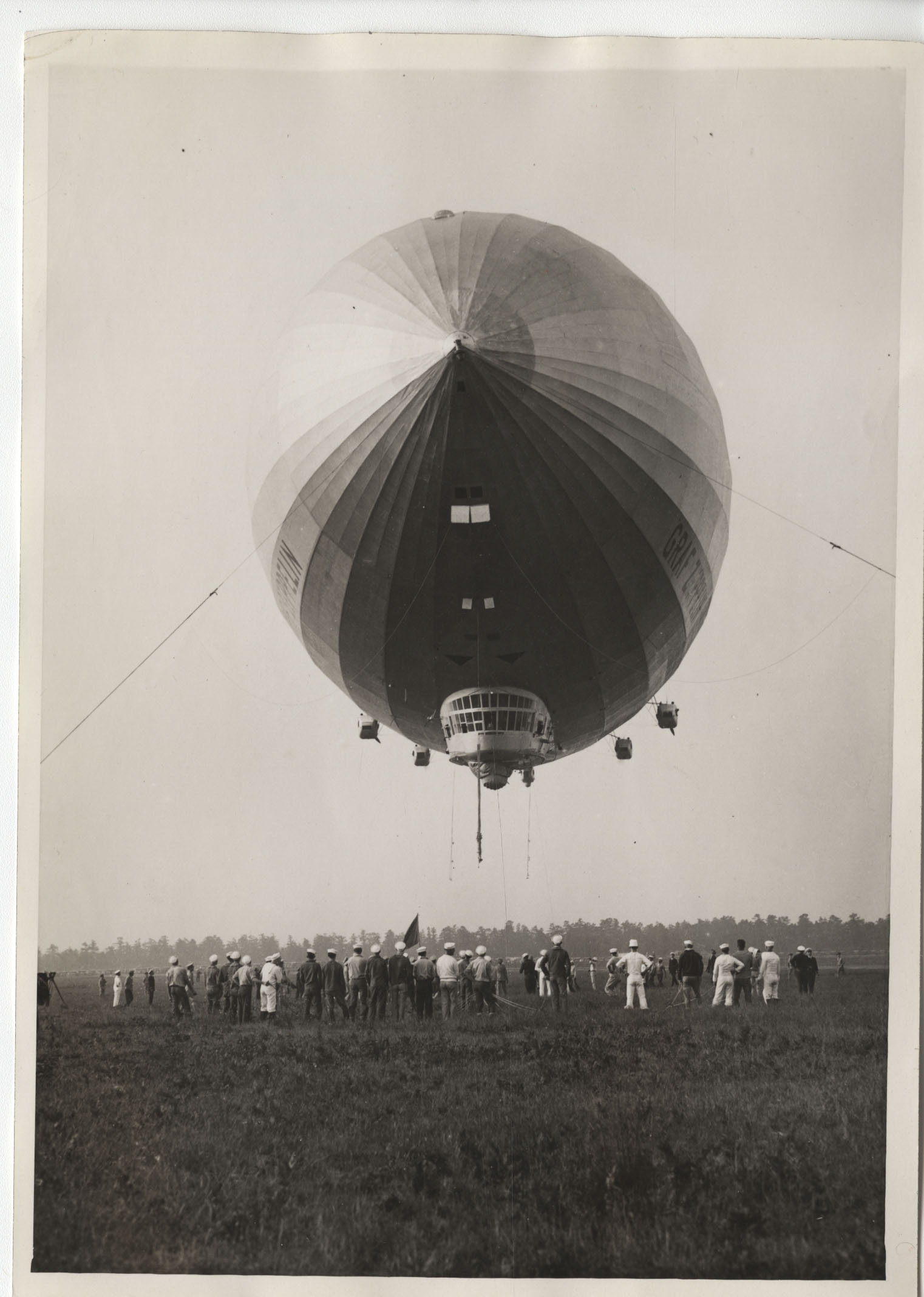
View of the Graf Zeppelin as it lands
in N.J. after completing its
circumnavigation of the world.
This disaster and the controversy surrounding it tend to overshadow the longer history of airships (also called dirigibles). An airship is a lighter-than-air craft which employs gas to fly. There are two types of airship: the ridged, metal-framed airships (like the Hindenburg) and non-ridged airships, frequently called blimps.
While airships have their origins in the 18th century, they did not really take off until World War I when Germany used its dirigibles for reconnaissance and bombing missions. While this proved largely ineffective (airships are highly susceptible to ground fires and bombing from high enough altitudes to avoid flames makes it hard to aim) the German airships lurked so large in public imaginations that they were explicitly banned from Germany by the Treaty of Versailles.
Most of the dirigibles employed by the Germans in World War I were produced by the Zeppelin Company (who were also the makers of the Hindenburg). This company and their creations have a greater legacy than simply blowing things up, however. After barely surviving Germany’s forced airship ban, the Zeppelin Company produced one of their largest and most notable dirigibles: the LZ-127, also known as the Graf Zeppelin. Like the later Hindenburg, this airship was simply massive; ten stories high and barely shorter that the Titanic, the Graf Zeppelin cast a mountain-sized shadow while flying. This became the airship which would ignite modern commercial flying.

Image from a German postcard,
showing the frame of the Graf
Zeppelin while it was being built.
In order to gain publicity and future financing for his company after years of war, Dr. Hugo Eckener (who had taken over when Count Ferdinand von Zeppelin died) planned an incomparable trip: a circumnavigation of the world. Eckener was rapidly joined by the news mogul William Hearst, who frequently publicized spectacular events to promote his own newspapers. In exchange for funding half the trip, Hearst got exclusive rights to the story in the U.S. and Great Britain. Hearst sent three reporters on the trip to cover all the bases: the famous correspondent Lady Grace Drummond-Hay, Karl von Wiegand and the Arctic explorer Hubert Wilkins. Wilkins, who has an innate love of science and weather, specialized in the technical and scientific side of flying a balloon through poorly understood skies. As the trip progressed, Wilkins became fascinated with Dr. Eckener’s understanding of the weather and how Eckener used his knowledge of the wind to catch the fastest air currents.
When the Graf Zeppelin began its record-breaking flight, it carried twenty passengers (who paid over ten thousand dollars for the privilege and who came from ten different countries), thousands of pieces of mail and all the necessary supplies for an emergency landing with it. The ship’s route took it from New Jersey across the Atlantic to Germany then over Siberia to Tokyo before flying on to California and returning to Lakehurst, N.J. This circumnavigation broke the previous record, with the whole trip lasting just over twenty-one days and the flying time clocking in at a mere twelve days.

Sketch of the side view and floor plan of the Graf
Zeppelin, reproduced here on a German postcard.
The Graf Zeppelin was luxuriously outfitted for this trip with a full kitchen, nice passenger rooms and a dining hall. The passenger accommodations, navigational room and the engines all resided in the dirigible’s gondola, which hangs below the gas cells. However, the ship was also unheated (probably a good thing as it was flammable); when it flew over Siberia, even Wilkins, who had lived in Antarctica, was forced to don a coat.
The Graf Zeppelin made another famous trip four years later, in 1931, when it flew over the Arctic. The Graf Zeppelin was far from the first dirigible to travel over the top of the world; people had been trying it since 1907. Merely five years earlier, Roald Amundsen and the Italian airship Norge had been the first to successfully cross the Arctic. Dr. Eckener, however, wanted to aid science as much as he wanted a publicity stunt. So in 1931, with a team of scientists, the Graf Zeppelin set out.

Freud, the radio operator aboard
the Graf Zeppelin, dangling out a
window.
Originally the airship planned to meet up and exchange passengers with the submarine Nautilus. The Nautilus was Hubert Wilkin’s submarine, which he proposed to take under the Arctic ice from Spitzbergen to Alaska. For various reasons, Wilkins was unable to complete this rendezvous. The Graf Zeppelin, however, proved much more successful than Wilkins. In preparation, the airship had been stripped of its luxuries to provide room for the necessary scientific equipment. Dirigibles were better equipped to handle the heavy scientific equipment than airplanes of the time, given their relative stability. While flying over the Arctic, the team of scientists made meteorological observations and studied the Earth’s magnetic field. The Zeppelin was also equipped with a pair of cameras which took nine images every few seconds. These images allowed for a better mapping and understanding of the Arctic landscape. Overall, the Graf Zeppelin’s Arctic flight was a grand success and upon its return the ship and crew found a hero’s welcome waiting for them, one that included the first man to fly over the North Pole, Richard Byrd (although, he used an airplane).
The Zeppelin’s very public successes kicked off a new era of passenger flight. In 1931, the Graf Zeppelin and the Zeppelin Company began flying from Germany to South America and back[i]. By 1936, these trips became a bi-weekly event. As the service became ever more popular (reducing the travel time from weeks to mere days) the Graf Zeppelin became “the first regularly scheduled, non-stop, intercontinental airline service in the history of the world.”[ii] The Graf Zeppelin alone would make 136 trips across the South Atlantic over its lifetime. The passenger flights of the Zeppelin Company came to an abrupt end after the explosion of the Hindenburg, however, and the legacy of commercial flying was handed over to airplanes.
For more information about Richard Byrd, Hubert Wilkins, the Graf Zeppelin or polar exploration, please visit the Polar Archives.
Written by Autumn Snellgrove and published by John Hooton.
[i] They traveled to South America because Brazil and several surrounding countries had a large German population.
[ii] http://www.airships.net/lz127-graf-zeppelin

























Recent Comments