From Woody's Couch

Our Playbook on OSU History

Category: Traditions (page 3 of 7)

The Oval’s Long Walk has paved way for students for a century

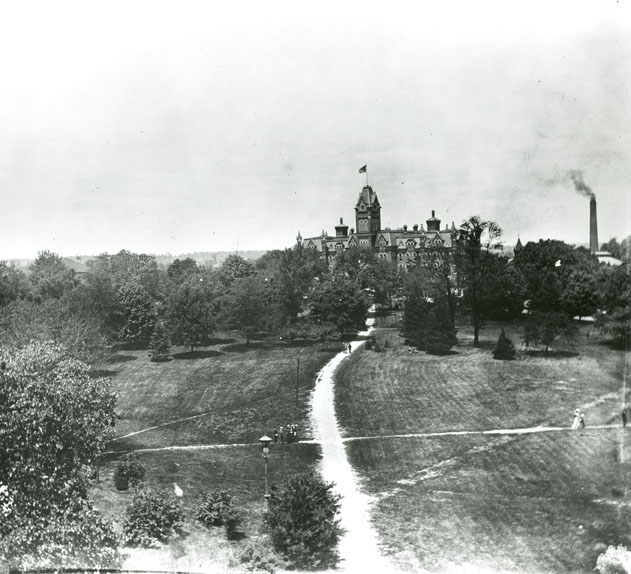
University Hall, 1897

University Hall, 1897

It’s hard to imagine OSU without an Oval or a Long Walk, but it turns out that both of these were purely accidental when it came to the early shaping of the University’s design.

The layout of early campus actually followed that of an English Manor, with the manor house, (the original University Hall), on high ground and set back from the road. Access to High Street was by a path that ran diagonally across what is now the Oval to the site of Page Hall.

Early campus planning of the University did not include an Oval in the middle of campus, and certainly no “Long Walk.” But, in the early 1890s, as some of the first campus buildings were built in certain spots, it created a central green area. In 1893, a new master plan was proposed that created a layout for a “central open space around which buildings could be arranged, and which would not be crossed by any roads.” By 1901, this space had closely evolved into the shape of today’s Oval.
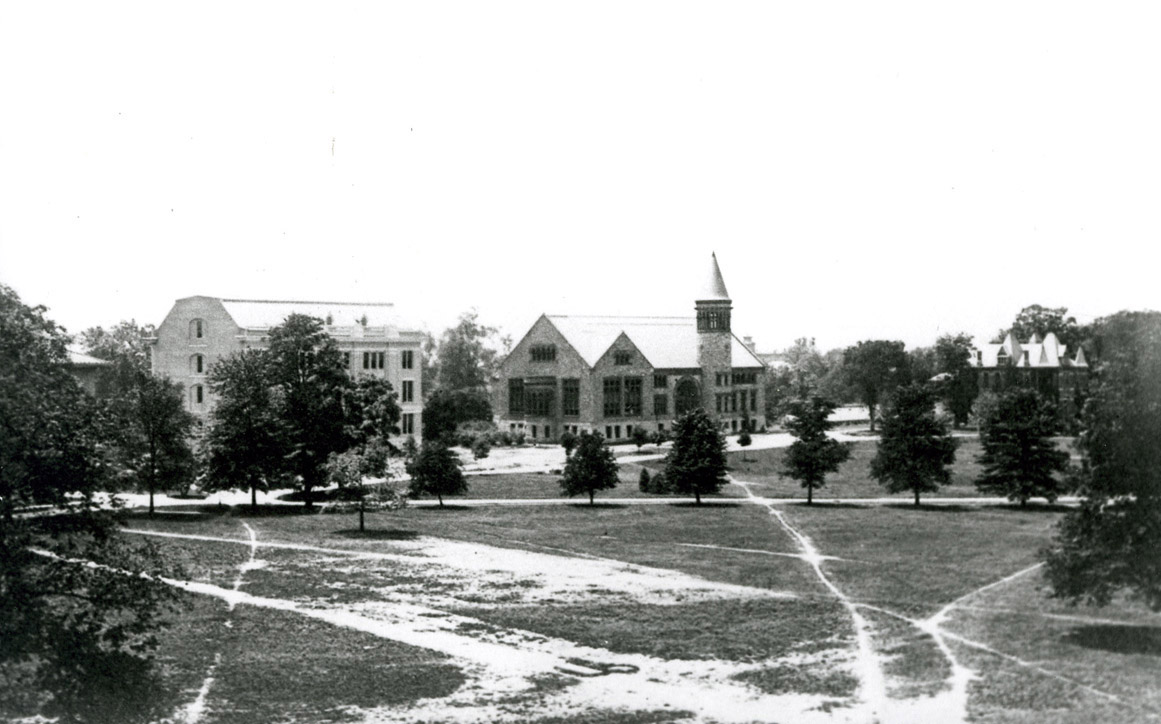
Oval, 1905

Oval, 1905

As buildings continued to go up, students began creating their own walking paths, trekking across the grass to their destinations. Their walking paths partly led to the current design of sidewalks, including the Long Walk.

Joseph N. Bradford, who became University Architect in 1911, was the next piece of the puzzle in the Long Walk’s creation. Bradford was committed to a formal arrangement of campus. In fact, the campus plan he created in early 1914 showed a very formal, geometric pattern of walks within the Oval. By the fall of 1914, the Long Walk was constructed.

Proposed map by Joseph Bradford

Proposed map by Joseph Bradford

However, the construction of the Long Walk did not seem to elicit the fanfare one might expect today from the media. A Lantern article dated September 15, 1914, includes a paragraph about the new walk in a story about two new buildings on campus:
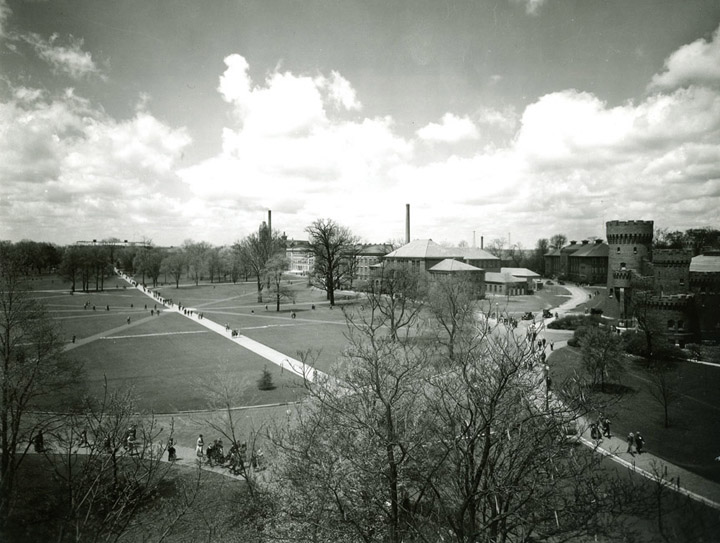
Oval and the Long Walk, 1927

Oval and the Long Walk, 1927

“A broad walkway, of dark red cement has been built from the main entrance to the Library across the oval to the Fifteenth avenue entrance. Walks to the Chemistry building and to Orton Hall extend from it…..”

Not everyone on campus benefited from the Long Walk. In the 1920s and 1930s, freshmen were forbidden to use the Long Walk. The penalty for being caught on the path – which was enforced by the upper-classmen honorary Bucket and Dipper – was to be thrown in Mirror Lake.

In 1931, freshmen of the class of 1935 were in hot water after Bucket and Dipper members found the class emblem of 1935 painted all over the Long Walk. All of the freshmen suspected in the painting were told to report to the Oval every day at 12:30 p.m. for an hour’s worth of cleanup, until all of the painted numerals were gone.
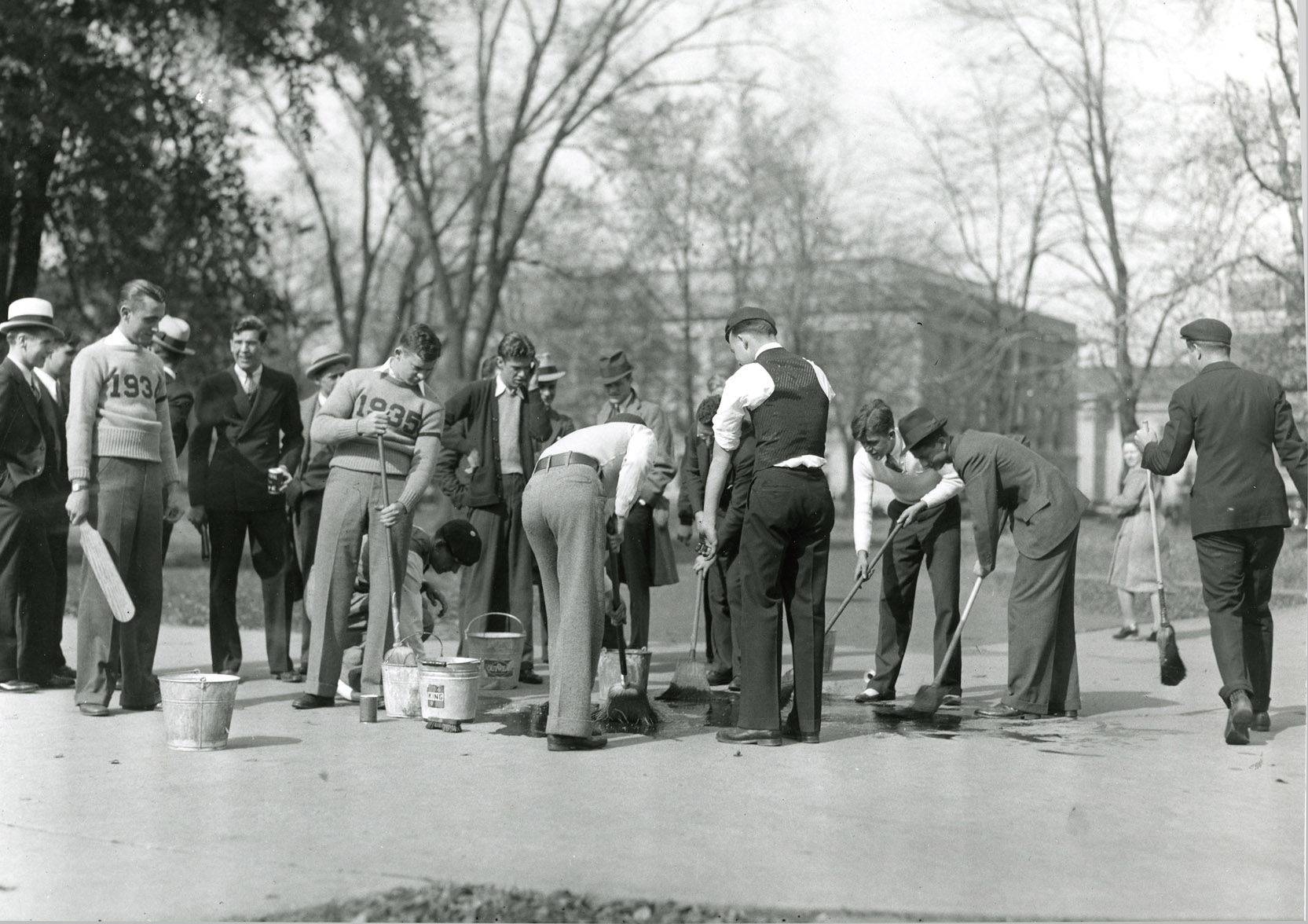
Freshmen cleaning the Long Walk, 1931

Freshmen cleaning the Long Walk, 1931

One suspected freshman, who had been assigned the task of bringing buckets of water from Mirror Lake to the Long Walk for the cleanup, said “I’d rather carry the water from the lake than be tossed into it.”

Students, on their way to classes during the Long Walk cleanup, apparently gathered around to watch the freshmen at work. It was reported that up to 60 spectators were observing the action, while other freshman on the way to classes steered clear and avoided the scene altogether.

The Oval and the Long Walk have been home to many other student activities over the years. Check out our Oval gallery on Flickr to see how the campus spot has changed over the years.
Alumni Weekend: An early class’s tale of reconnecting

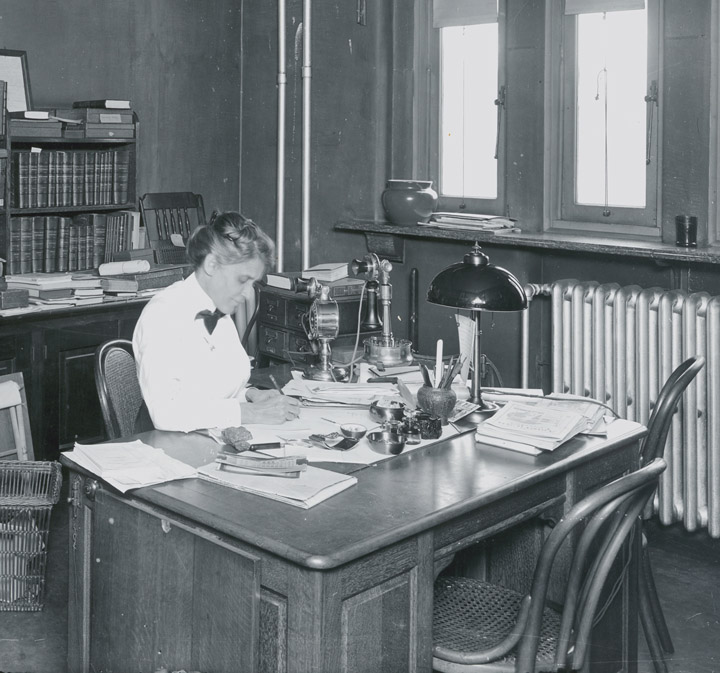
Olive Branch Jones, 1912

Olive Branch Jones, 1912

Today, with the vast number of students who graduate every year, it would be unthinkable for a class to gather in one publication the updates on lives and recollections from school days of its various members. But given the well-organized nature of the University’s librarian, it was almost pulled off for the Class of 1887’s 25th reunion.

In 1912, when the Class of 1887 was about to celebrate its 25th anniversary of graduation, Olive Branch Jones – by then the first full-time librarian for her alma mater, OSU – took on the task with a friend to publish a report on members of the class of 1887. It was actually that class’s treasurer, Joseph S. Myers, who had written to Jones telling her his plans of having a “history of ’87 prepared in this 25th Anniversary Year” and to have a sort of questionnaire sent out to all the 21 graduates. Myers and a fellow classmate, Joe Taylor, both agreed that they thought Jones, a fellow class member, could handle this job best.

Questionnaire for 1887 reunion; (Click to view larger version)

Questionnaire for 1887 reunion

For some reason, however, Jones was unable to pull it off. Maybe it was because it was the year before the then-main library was to open, and she was too busy as University Librarian preparing for that event.

But the questionnaire remains, and it is quite a relic of a bygone era. Respondents are asked what political party they belong to (Progressive or Reactionary), what church they belong to and whether they are a woman suffragist, among other things.

And Jones did receive some interesting letters from alumni, who were unable to attend the reunion but wanted to update their classmates on their current lives. One alumna, Daisy M. Scott, had for some time been a math teacher at North High School in Columbus, although there was one year when she was sent to Central and East high schools “to extricate some of their students from difficulties algebraic.” Joe Taylor marched down memory lane at first in his letter, then veered into waxing philosophic about the past: “…we don’t live there any more; we can’t stay in that familiar and peaceless place, the undergrad campus; a place so stripped of yesterdays … I am more able to say this because I have not achieved what we call great success; my own today is a very modest affair; yet so it seems, no doubt, to each of us.”

Heavy stuff. Luckily, for the class members who showed up at the actual reunion, the mood appeared to be much lighter. Along with discussions about a report, various letters were exchanged between Jones and Lucretia McPherson, wife of then-Graduate School Dean William McPherson, in which they decided also to hold a garden party in celebration. Roughly 50 people, including graduates’ family members and former faculty, apparently gathered on June 10, 1912, after which Lucretia McPherson wrote to Jones that it was “one of the most worthwhile parties, for the guests seemed to be so truly happy to see one another.”

Reunion group in front of University Hall, 1912

Reunion group in front of University Hall, 1912

– Filed by B.T.
Note: This information came from the Director of Libraries collection at the University Archives in a folder called “Class of 1887: 25th Anniversary: Correspondence for 1912 (Olive Jones)”

First women students were a surprise show but made mark on OSU

The Townshend family, 1884

The Townshend family, 1884

In 1873, when two dozen young people showed up at University Hall to enroll in the then-new Ohio Agricultural and Mechanical College, two were women – in fact, they were the daughters of the first Professor of Agriculture.

Alice and Harriet Townshend were the youngest children of OSU Professor Norton Strange Townshend, who had stepped down from the College’s first Board of Trustees to teach agriculture classes at the new school. He was an advocate for women’s rights, and believed in higher education for all.

The former Townshend home, 1902

The former Townshend home in 1902. The family resided here from 1873 to 1895.

So, on the morning of September 17, 1873, Alice and Harriet, and their older brother, Arthur, walked from their home near 15th Avenue and High Street to sign up for classes, according to an interview with Harriet Townshend published in the October 1948 issue of The Alumni Monthly. In the interview, Harriet Townshend said that College President Edward Orton Sr. “almost fainted” when the two sisters showed up because he was not expecting women to enroll in the new school. He left it to the Trustees to decide, and upon reading the legislative bill passed to establish the College, they determined that women, as well as men, could attend.

While Arthur graduated with the first class in 1878, it took two more years for Alice Townshend to earn her degree; however, Alice was one of the three students on the committee in 1878 who purchased the ribbons that adorned the first diplomas. The colors of those ribbons were scarlet and gray, and Alice helped pick them.

Harriet Townshend from when she was an assistant librarian at OSU in 1900

Harriet Townshend as an assistant librarian at OSU in 1900

Shortly after graduation, Alice married Charles Mayhew Wing; little else is written about her, except for her death on December 1, 1925.

Though Harriet Townshend never graduated, she worked as an OSU Library staff member for more than 30 years, making sure all of the materials had proper binding. Townshend never lived far from the University; her last residence was listed as 53 W. 11th Avenue, which today is across the street from the Moritz College of Law. And she continued to be an advocate of higher education for women until her death at age 92 on April 29, 1950.

– Filed by C.N.

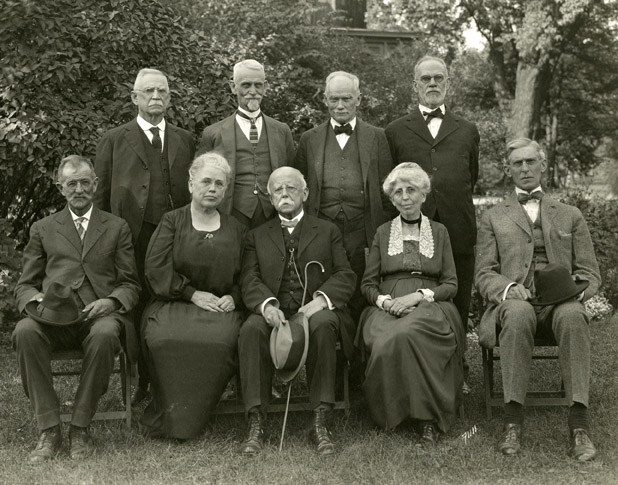
Alice Townshend-Wing (front row, second from left), and Hariett Townshend (front row, second from right), at a class reunion party in 1923

Alice Townshend-Wing (front row, second from left), and Harriet Townshend (front row, second from right), at a class reunion party in 1923

Older posts Newer posts