From Woody's Couch

Our Playbook on OSU History

Category: Traditions (page 4 of 7)

Orange and black as school colors? No thanks, we’ll take Scarlet and Gray

Curtis Howard, 1878

Curtis Howard, 1878

When the very first senior class started planning for its commencement in the spring of 1878, members decided the first diplomas issued by The Ohio State University (the Board of Trustees had just changed the name from the original Ohio Agricultural and Mechanical College) should look festive. So the class decided to tie around the diplomas ribbons that featured the school colors.

Being a young university, however, no school colors had yet been chosen. So the senior class appointed a committee of three to choose them: Curtis Howard, who graduated that year, Harwood Poole, who graduated in 1881, and Alice Townshend, an 1880 graduate.

According to a later account by Townshend, the three students went to various dry good stores in the area to sample colors and ended up choosing orange and black. They later learned, however, that these were already the colors of Princeton University.

Howard's original ribbons

Howard’s original ribbons

So they tried again and selected scarlet and gray – for no reason other than they liked the two colors together and to their knowledge, no other university or college had them as school colors. After the colors were selected, the original ribbons were cut into three pieces and given to each committee member as souvenirs.

Flash forward to 1917 when Howard is going through his personal effects and finds his souvenir ribbons. (Poole had died by then and Townshend had not kept hers.) Howard wrote to his friend, John Galbraith, that the ribbons were still “wrapped in a paper filter as I had placed the away 39 years ago. These have been in the dark and I am certain have not faded…” He donated them to the university, and according to a 1920 alumni magazine article, they were mounted in a mahogany frame and hung in Sullivant Hall.

John Kleberg poses with the scarlet and gray ribbons, 1989

John Kleberg poses with the scarlet and gray ribbons, 1989

Sometime after that, they disappeared.

Flash forward again to 1989: John Kleberg, then assistant vice president for business and administration, receives a visitor at his office who claims to represent an individual who acquired the ribbons from the resolution of an estate and wishes to remain anonymous. The ribbons were wrapped in porous paper and framed. On the back of the frame was the letter Howard had written to Galbraith.

For a time, Kleberg hung them in his office, but being the good steward of history that he has proven himself to be many times over with the Archives, Kleberg transferred them to the Archives.
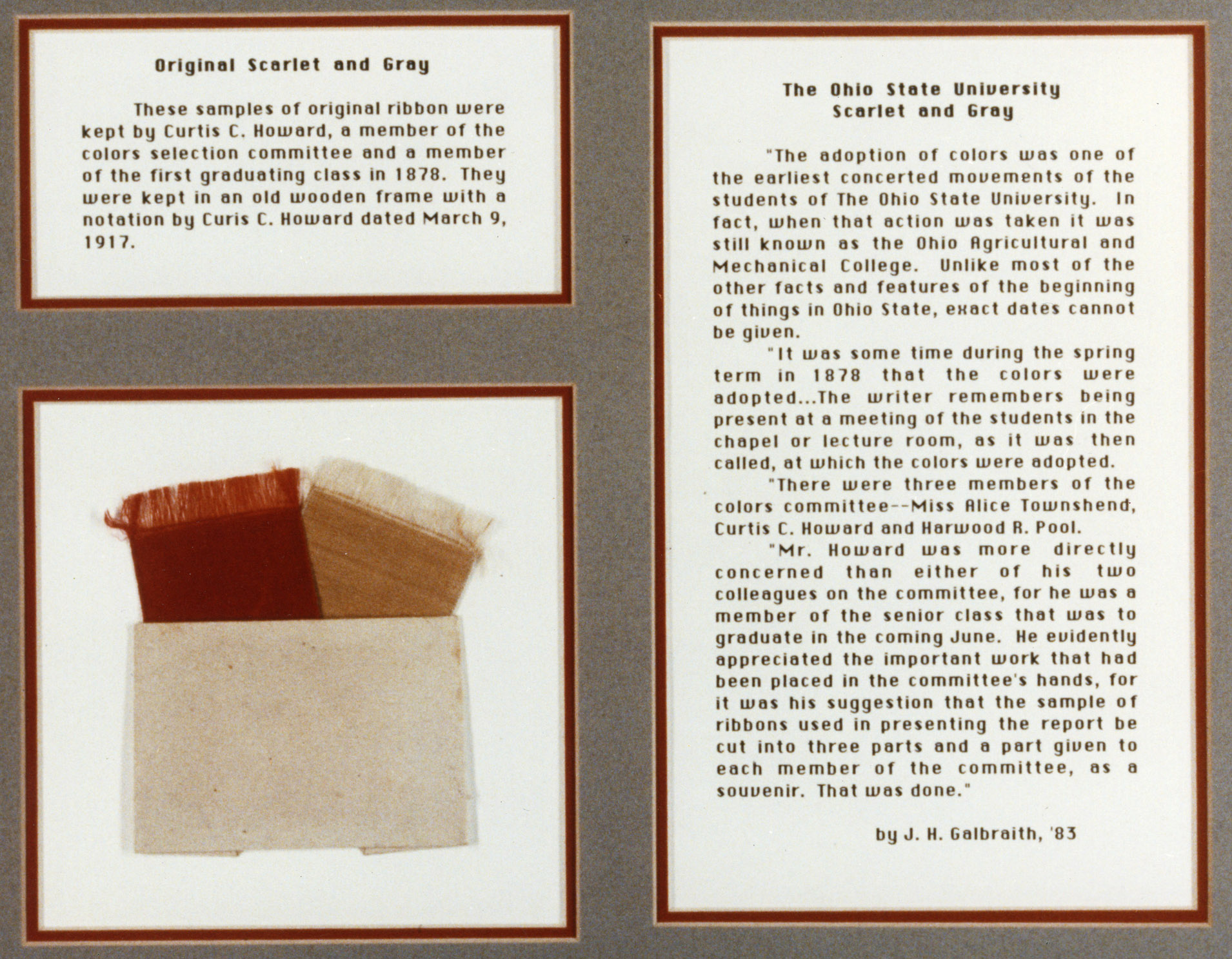
Framed scarlet and gray ribbons

Framed scarlet and gray ribbons


Filed by C.N.
Without the name, would Buckeyes be so nutty about OSU?

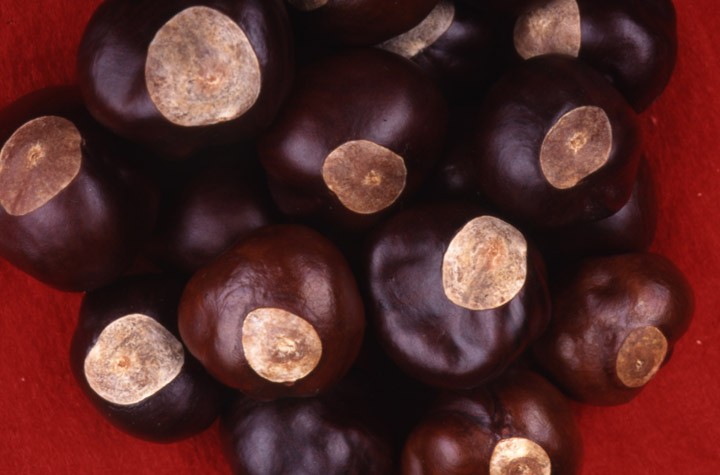
Cluster of buckeyes, ndWhy is our University mascot a poisonous nut? It starts with the nickname for Ohioans in general, obviously:

In the late 1700s, the first court in the then-Northwest Territory was opened near Marietta by Colonel Ebenezer Sproat. A tall man, usually dressed in military uniform and carrying a sword, he apparently impressed the local Native Americans so much that they started calling him “Hetuch,” which translates to “eye of the buck” or “Big Buckeye.” Buckeyes were also associated with Ohio since the first migration to the state, since the trees’ soft wood made it easier for early pioneers to clear land for farming, and fashion such items as bowls and walking sticks.

When William Henry Harrison, a former U.S. Senator of Ohio, was running for President, his campaign featured walking sticks and other carved pieces made of Buckeye wood. Even before the campaign, some members of Congress apparently referred to him as a “Buckeye” as a sign of affection.

Brutus Buckeye, 1965

Brutus Buckeye, 1965

By 1930, there was debate over whether the “Buckeye” should be the University mascot. That year, members of the Student Senate debated over the choice: Edwin Schoenleb of Marysville, stated, “the name ‘Buckeye’ does not indicate aggressiveness.” Alternative choices included sheep, goats, lions, tigers and bears. Ultimately, however Senate members decided on the poisonous nut; it is distinctive, they argued.

In 1950 famous cartoonist and alumnus Milt Caniff drew several designs to be used by the Department of Athletics for logos and uniform details featuring buckeyes and buckeye leaves. Ohio State finally got an actual “Buckeye” mascot when Ray Bourhis and Sally Lanyon created the now-ubiquitous Brutus Buckeye, who made his first appearance at a football game on October 30, 1965.

 Filed by C.N.

Long Gone Campus Traditions: Hats off to the era of freshman beanies!

1940

1940

Perhaps one of the few Ohio State traditions new students may wish to stay buried is the class cap, otherwise known as the ‘beanie.’ Freshmen (men only) used to be strong-armed into wearing caps in the name of creating school spirit and class unity. If by unity the administration meant commiseration, well then they got what they set out to achieve.

The caps and rules were in use from 1912 until the mid-century. Wearing the caps was just one of the rules enforced by “all men of the upper classes;” however, the junior men’s honorary Bucket and Dipper and its members were the only people ever authorized, by the Student Senate and the President of the University, to carry out the traditional punishment: namely, throwing offenders into Mirror Lake. Ironically, if some unauthorized person attempted to chuck a freshman in the lake, Bucket and Dipper members were honor-bound to protect the freshman.

A freshman is tossed into Mirror Lake, 1926

A freshman is tossed into Mirror Lake, 1926

Freshmen men were thus required to wear the caps from Freshman Week at the beginning of the term, until Cap Bonfire on Tradition Day, in June. Students caught without their beanies, or violating one of the freshmen rules, were punished. As one Alumni Monthly article put it, “Irregular meetings of Bucket and Dipper are held when freshmen are chased from the Long Walk and from the steps of University or Derby Hall.” These meetings convened on the edge of Mirror Lake and ended with the offending freshmen taking a swim. Other rules that could earn a dunking: skipping Chapel (which was mandatory until 1926), doing something to offend an upper classman (such as the freshman who posted signs saying “Bucket and Dipper go to Hell” near the Long Walk), or setting foot on the Long Walk.

As for Bucket and Dipper, the 14 members at that time were all junior men and had been chosen for their leadership, scholarship and service. Such greats as Chic Harley and Milt Caniff were members. During their initiation, members were thrown in Mirror Lake, so perhaps they had the prerequisite experience needed.

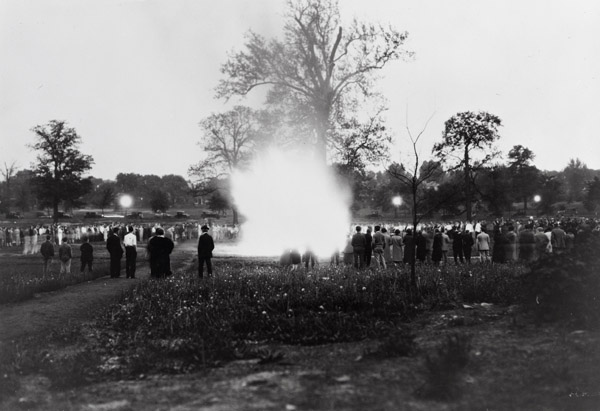
Freshman week cap burning, 1926

Freshman week cap burning, 1926

Thus, in June the freshman waged a two-day war on Bucket and Dipper. The “war” usually consisted on a tug-of-war across Mirror Lake—where the freshman consistently ended up in the lake. That night, students would gather for the Cap Bonfire, when some freshman opted to burn their beanies. (Many freshman did keep their beanies as a memento of their servitude.) Following the bonfire, many freshmen (again, ladies were excluded) went for a walk in their shirttails to cause a ruckus outside the home of then-OSU President William Oxley Thompson.

In 1926 Bucket and Dipper attempted to delay the burning; in the melee that followed, 103 freshman were thrown in the lake and the police were called. Ironically, it was a policeman that gave a freshman a concussion, not a trip into the lake. The following year, then-OSU President George Rightmire forbade Bucket and Dipper from dunking anyone, deserved or not. From then on, it seems the Bucket and Dipper initiates were the only ones to go swimming.

 As for the caps themselves, fashion in hats changed rather rapidly. Some prime examples from Ohio State include the “peanut-shaped skull cap,” “knitted toboggan” cap or “jockey-style” cap, or one with a “rolled brim topped with a scarlet button.”

Filed by C.N.

 To learn more about the tradition of freshmen beanies at OSU and other Big Ten universities, visit our web exhibit, “Beanies of the Big 10” at http://library.osu.edu/projects/beanies/.


Older posts Newer posts