Today we highlight the disparate sports of boxing and volleyball, in which the only thing in common seems to be the gold medals OSU athletes have won participating in them at the Olympics.
Although Ohio State students have pushed for boxing to be a varsity sport since the 1930s, it’s always been played on campus in intramurals and at a club level only. With the lack of support from the university, it may be surprising, then, to discover three gold medal winners from OSU’s past. Since no early records for the sport remain, though, little is known about these athletes’ participation in this sport on campus.
Charles Adkins won gold at the 1952 Helsinki Games in the light welterweight division. The win was especially memorable because it was the first boxing match between the United States and the then-Soviet Union. Adkins went on to a professional boxing career and decided to return to college to finish his education. Adkins graduated in 1974 with a bachelor’s degree in Education.
Nathan Brooks was a teammate of Charles Adkins at the 1952 Helsinki Games. Brooks boxed in the flyweight division and defeated Edgar Basel of Germany to claim his gold medal. Before the Games, Brooks was a history major at OSU but withdrew to continue boxing professionally.
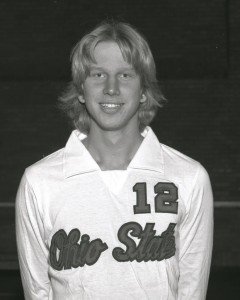
Aldis Berzins, 1977
Jeremy “Jerry” Page participated in the 1984 Los Angeles Olympic Games as a light welterweight. His gold medal came with a win over Dhawee Umponmaha of Thailand. According to Rusty Wilson’s book, The Ohio State University at the Olympics, ABC announcer Howard Cosell described the match as one of the greatest fights he had seen. Page also pursued a professional career in boxing and never graduated.
Unlike boxing, which has never achieved varsity status at OSU, men’s volleyball has been a varsity sport since 1968. During that time it has had more than thirty All-Americans, and has logged more than twenty Midwestern Intercollegiate Volleyball Association and NCAA Championships, including its latest NCAA title in 2011.
Ohio State’s team yielded three Olympic gold medalists on the 1984 Los Angeles team:
Aldie Berzins, a Latvian-American, preferred to play soccer and even earned a scholarship to play at Penn State, according to Wilson’s book. He decided to attend OSU, though, because five other Latvians were on the team. The Buckeyes used their mutual heritage to their advantage and spoke Latvian during matches to conceal their plays. While at OSU Berzins helped lead the team to four straight MIVA championships and four appearances in the NCAA Final Four. In 1978 Berzins earned his bachelor’s degree in Astronomy.

Marc Waldie, 1977
At the 1984 Los Angeles Olympics, Berzins won a gold medal with fellow Buckeyes Richard Duwelius and Marc Waldie, and OSU coach Doug Beal. Berzins went on to play professionally in Italy and returned to the United States after retiring. Berzins had three sons, all of whom followed in his footsteps and played volleyball. His one son, Mik Berzins recently graduated from The Ohio State University and helped to lead the volleyball team to the 2011 NCAA National Championship. Aldie Berzins was inducted into The Ohio State University Athletic Hall of Fame in 2002.
When Richard Duwelius arrived at OSU, he had earned a spot on the basketball team but decided he would try volleyball instead. Playing with Aldie Berzins and Marc Waldie, he helped the team make it to the 1977 NCAA Championships. Duwelius graduated in 1977 with a Bachelor of Science degree in Chemical Engineering.
After winning a gold medal at the 1984 Los Angeles Olympic Games with his fellow Buckeyes, Duwelius went on to play professionally in Italy.
Marc Waldie also played on the 1977 team and went on to play for the U.S. team where he was captain from 1982 through 1984. Waldie graduated in 1981 with a Bachelor of Science degree in Health, Physical Education and Recreation.
After Waldie finished playing volleyball, he became involved in real estate development in California. In 2001 Waldie was inducted into The Ohio State University Athletic Hall of Fame.








Recent Comments