From Woody's Couch

Our Playbook on OSU History

Category: Sports (page 9 of 13)

Gold-en Days of Summer Olympics Past: Part 4

What an Olympics so far!  Today we will highlight three more former OSU Olympians: two synchronized swimmers and a rower.
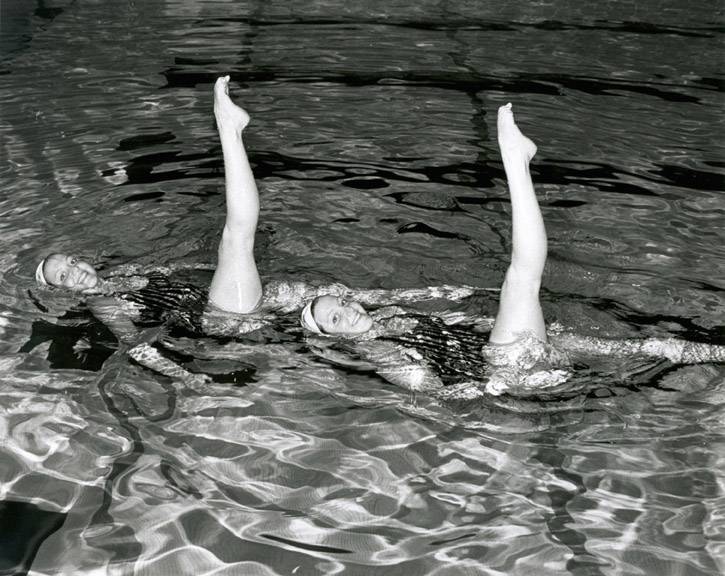
Karen and Sarah Josephson, 1984-1985

Synchronized swimmers – and twin sisters – Karen and Sarah Josephson have worked together in the pool from an early age.  Karen discussed the beginning of the dynamic duo in a 1988 Lantern interview, sayng they began competing together at age six and started in the sport because there was a local team in their hometown.

According to the OSU Alumni Magazine, while at OSU in the early 1980s, Sarah and Karen earned varsity letters for four years, helped take the team to three national championships, and each received individual honors: Karen received the USSSI Collegiate Athlete of the Year, and Sarah earned the Ohio State Female Athlete of the Year.

The sisters graduated from OSU in 1985 and went on to participate in the 1988 Seoul Olympic Games, where they won a silver medal in duet synchronized swimming. In 1992 they returned to the Olympic Games and received four perfect 10’s to win the gold medal. Karen and Sarah were named to The Ohio State University Athletic Hall of Fame in 1993, with the first class of women athletes.

The Josephson sisters arose from a team that has long history of winning at The Ohio State University.  Synchronized swimming became an NCAA-sanctioned sport in 1977, according to The Lantern, but the Buckeyes can trace their history back to the 1930s. Winning more than twenty collegiate championships, the synchronized swimming team is one of the most decorated teams on campus.

Like synchronized swimmers, experienced rowers know how to mirror their teammates exactly to move flawlessly through the water. Ironically, Bryan Volpenhein did not have much experience when he took up the sport of rowing at OSU. Rusty Wilson’s book The Ohio State University At The Olympics discusses Volpenhein’s beginning in the sport as somewhat of a fluke.  Volpenhein says he saw a flyer for the OSU Crew Club, went to a meeting, liked the team and coaches, and thus began a successful career as a rower.

Bryan Volpenhein, 2004, (Photo from OSU Alumni Magazine)

In 1998, he began rowing for the United States national team, and he later participated in three Olympic Games: the 2000 Sydney Games, the 2004 Athens Games, and the 2008 Beijing Games. A member of the men’s eight, he won gold in 2004 and bronze in 2008. In 2002, (and between Olympic appearances), Volpenhein earned his Bachelor of Arts degree in Philosophy.  In the fall of 2004, the OSU Crew Club named a boat after him, according to Wilson.

Sometimes called rowing and sometimes called crew, this sport has made its mark at Ohio State. The Ohio State University Crew Club was founded in 1978 and is open to both men and women. It  started with a boat and four oars borrowed from the University of Nebraska, according to its web site, and it has depended on private support to keep the club going. OSU women rowing athletes now have a varsity team sponsored by the athletic department. Over the years the athletes have competed in numerous regattas and Big Ten events.

As we continue looking back at past Golden Buckeyes throughout this week, the University is also following the current OSU Olympians.


Gold-en Days of Summer Olympics past: Part 3

Peter George, 1955

Although the sport of weightlifting has never achieved varsity status at OSU – students have been able to participate through intramurals and clubs – two former Buckeyes not only made it to the Olympics, but won medals. And they’re brothers, to boot.

James George, 1963

Peter and James George, both students of dentistry at OSU, were also competitive weightlifters. In fact, at the age of 14, Peter had won the U.S. Junior Championship and by 17 he won the World Championship. Entering as a middleweight, Peter won silver at the 1948 London Olympic Games. In 1952 he enrolled at OSU and earned a spot on the U.S. team competing at the Helsinki Olympic Games. There, he won gold. Four years later he won a silver medal at the Melbourne games.

His brother, James, joined Peter in Melbourne, competing in the light heavyweight category. He won a bronze medal. In 1960 James returned to the Olympic Games in Rome and won a silver medal. After returning to the United States, James received his DDS degree in 1963.

Once again, we received much assistance from Rusty Wilson’s “The Ohio State University at the Olympics,” an amazing resource for anyone who wants to know more about the University’s connection to the Olympic Games.

Gold-en Days of Summer Olympics past: Part 2

In 1930 Coach Mike Peppe introduced varsity swimming to The Ohio State University, and the sport has produced numerous champions ever since. Under Peppe the swim team earned 12 Big Ten Championships, 11 NCAA National Championships, and 10 AAU National Championships. Along with those accomplishments Peppe coached 312 individual champions, countless world record holders, and sent nine of the 25-member swim team to the 1952 Summer Olympics. The three Buckeyes who have earned gold medals in swimming are Ford Hiroshi Konno, Yoshinobu “Yoshi” Oyakawa, and William “Bill” Melving Smith, who all trained under Coach Peppe.

With much assistance from Rusty Wilson’s “The Ohio State University at the Olympics,” an amazing resource for anyone who wants to know more about the University’s connection to the Olympic Games, we can tell you more about these athletes:

Ford Konno, 1952

The son of Japanese immigrants, Ford Hiroshi Konno was named by his father, an auto mechanic, after the Model-T Ford. At age nine, Konno joined his first swimming class in Hawaii, and by high school he was setting world records.

In 1950 former OSU Olympian Bill Smith saw Konno swim in Hawaii and began recruiting him to join The Ohio State University swim team. At OSU, Konno and Peppe devised a new training program that included shining a beam of light onto the water to help Konno maintain his pace. In 1952 Konno and several other Buckeyes traveled to the Helsinki Olympic Games. There, Konno won two gold medals – one in the 1500-meter freestyle race and another in the 4×200-meter freestyle relay – and a silver medal in the 400-meter freestyle race. After returning from the games, Konno married his high school sweetheart and fellow Olympian, Evelyn Kawamoto. Four years later, at the 1956 Olympic Games in Melbourne, Konno won a silver medal in the 4×200-meter relay.

In 1957, Konno entered the U.S. Army and was stationed in Hawaii, where he coached and developed the Schofield Sharks Swim Club. By 1959 Konno had received his bachelor of science degree in Education, and had earned the most individual titles – 31 – of any OSU athlete at the time. In 1977 Konno was selected for The Ohio State University Athletic Hall of Fame.

Yoshi Oyakawa, n.d.

It took only three years for Yoshinobu “Yoshi” Oyakawa, another native Hawaiian, to go from the beginning of his swimming career – at age 16 – to winning gold at the Olympics. In 1952 Oyakawa, whom Peppe recruited at a Seattle swim meet to attend The Ohio State University, traveled with Konno and several other Buckeyes to the Helsinki Olympic Games. There, he won the gold medal in the 100-meter backstroke. While at OSU Oyakawa won six Big Ten titles, seven NCAA championships, and nine National AAU championships.

In March 1956 Oyakawa received his bachelor of science degree in Education and enlisted in the U.S. Air Force.  In 1978 Oyakawa was selected for The Ohio State University Athletic Hall of Fame.

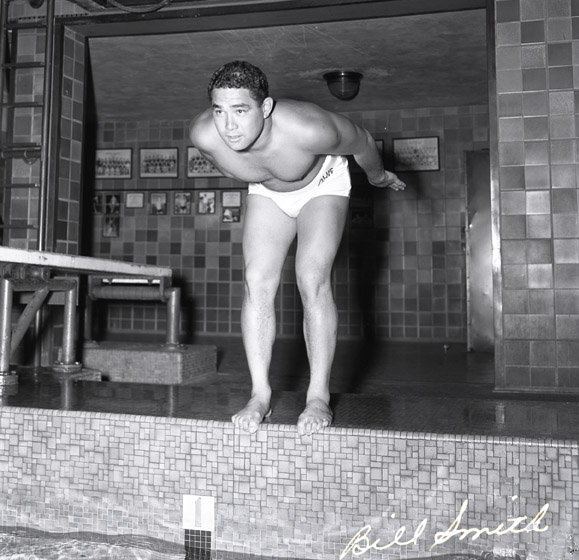
Suffering from typhoid at age 11, William “Bill” Melvin Smith first started swimming when his father brought him to the beach to help him recover. In 1942, Smith enrolled at Ohio State, and though he was not eligible to participate in NCAA sports as a freshman, he still managed to set seven world records and two American records at AAU events. While at OSU, his teammates called him “The Whale” because of his size. (He weighed 215 pounds.)

Bill Smith, 1948


Smith’s swimming career at OSU was cut short by World War II; Smith entered the U.S. Navy where he served for four years. When he returned to OSU, many wondered how well he would swim, given the long absence from the water. In 1948, though, Smith traveled to the 1948 London Olympic Games, where he won gold medals in the 400-meter freestyle race and the 4×200-meter freestyle relay. After his victories, University of Michigan Swim Coach Matt Mann was quoted as saying “Some guys can swim the greatest race of his life but ‘Smitty’ will always do just a little better.”

By the time Smith earned his bachelor of science degree in Education in 1950, he had captured seven NCAA titles and 15 AAU Championships. Smith was selected for The Ohio State University Athletic Hall of Fame in 1977 and named The Ohio State University Swimmer of the Century in 2001.


Older posts Newer posts