From Woody's Couch

Our Playbook on OSU History

Category: Polar Archives (page 9 of 11)

Frozen Fridays: ‘H’ is for Highjump!

This blog post is part of the Frozen Friday Series, an A-Z journey of the Polar Archives.  Each week, we will feature some aspect of the history of polar exploration with a blog post written by our student authors.

The year is 1946. The United States is embroiled in the most dangerous international conflict in its brief history: The Cold War. The United States, hot off the Allied victory against Nazi Germany and Imperialist Japan in the Second World War, stands toe-to-toe with its former ally, the Soviet Union. For forty-six years, the world watched as these two giants fought each other in every conceivable manner, save yet another world war. Every continent in some way felt the chilling effects of the Cold War, even the frozen continent of Antarctica.  Antarctica felt “Operation Highjump.”

Admiral Richard Byrd, once again
returning to Antarctica.

“Operation Highjump”, officially the United States Navy Antarctic Development Project, 1946-1947, was the largest expedition into the Antarctic to date, perhaps even to the present.[1] It was the first expedition to Antarctica officially sponsored by the United States in over a century.[2]  

Four thousand and seven hundred men, led by none other than Admiral Richard Evelyn Byrd, carried out a “benign assault” on the frozen continent.[3] Task Force Sixty-Eight, the fleet assigned to the mission, consisted of a communications ship, two supply ships, two ice breakers, two seaplane tenders (a form of light aircraft carrier), two tankers, two destroyers, an aircraft carrier, and a submarine.[4] The communications vessel, serving as the flagship of the task force, was named the Mt. Olympus and was specially outfitted with fifty radio operators[5].

592183_200x150_1972_penguin_wars

An artists rendition of how a
penguin soldier may have looked.

Those poor penguins never stood a chance. That was a joke. Those thirteen ships and nearly five thousand men did not sail to Antarctica with the purpose of showing the penguins and seals the what’s what. Rather, the massive force was meant to accomplish what could be categorized into three broad goals: to train personnel and equipment under Antarctic conditions, to consolidate and expand United States claims in the Antarctic while investigating potential sites of United States bases and developing techniques for the establishment and maintenance thereof,  and finally to extend scientific knowledge of the Antarctic[6].

One of the thirteen ships taking part in "Operation Highjump".

One of the thirteen ships taking part in
“Operation Highjump”.

This was clearly and overtly a military mission in Antarctica. The Pentagon, realizing that a war with the Soviet Union would be chilling (to say the least), recognized that any war with the USSR would require polar combat.[7] Furthermore, the Pentagon wished to keep itself in the public eye. By launching a mission of such a spectacular size, the United States military insured that it would firmly remain within the public’s field of vision.[8]

Though “Operation Highjump” was a success in that respect, the mission was, as a whole, a mixed success. While personnel were trained in the harsh conditions of Antarctica and several pieces of technology were tested in the freezing weather, the men of Task Force Sixty-Eight failed to produce aerial photographs
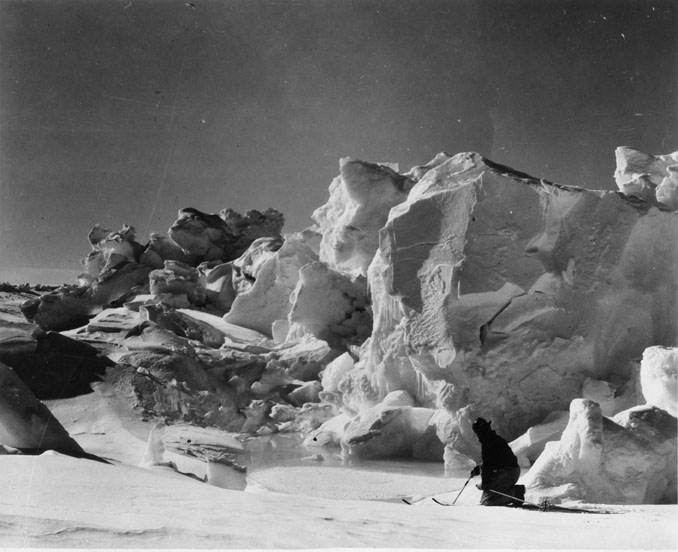
One of the images taken during "Operation Highjump".

One of the images taken during “Operation Highjump”.

capable of being used for the production of maps.[9] Though the photographs were successfully taken, a lack of ground control points made them nearly useless for mapping.[10] The icebreakers of the fleet proved to be incredibly effective, but the submarine brought to the Antarctic demonstrated that subs could not be used in the cold waters of the southern continent.[11] The expedition also contributed to the scientific community the first sufficient observations of Antarctic weather to produce twice-daily synoptic weather maps of Antarctica.[12]

“Operation Highjump” was the first time that the US sent a fleet into the Antarctic. It was perhaps the largest expedition to Antarctica in history.
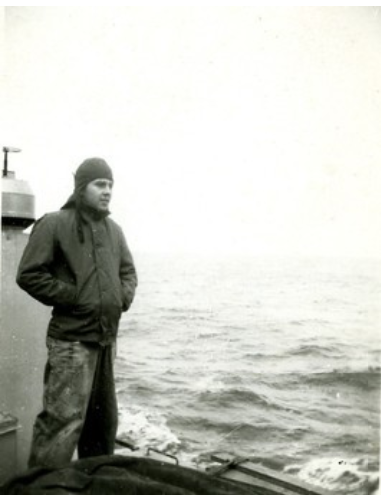
Carl Hicks, a member of the "Operation Highjump" expedition.

Carl Hicks, a member of the “Operation
Highjump” expedition.

It is the only truly and completely benign invasion in history and was born in the cold-blooded Cold War. For more information on “Operation Highjump”, Admiral Byrd, or other incursions into the Antarctic, check out the Byrd Polar and Climate Research Center Archival Program! The Polar Archives has collections for several men serving in “Operation Highjump”, including Carl Hicks, George Kosco, and Anthony Morency.

Written by John Hooton.

[1] Kenneth J. Bertrand, Americans in Antarctica 1775-1948. (New York: American Geographical Society, 1971) 483.

[2] Antarctica, 2nd ed., s.v. “Operation Highjump.” (Surry Hills: Reader’s Digest, 1990).

[3] Antarctica, “Operation Highjump”.

[4] Bertrand, Americans in Antarctica 1775-1948, 485-487.

[5] Bertrand, Americans in Antarctica 1775-1948, 485.

[6] Bertrand, Americans in Antarctica 1775-1948, 485.

[7] Antarctica, “Operation Highjump”.

[8] Antarctica, “Operation Highjump”.

[9] Bertrand, Americans in Antarctica 1775-1948, 485.

[10] Bertrand, Americans in Antarctica 1775-1948, 485.

[11] Bertrand, Americans in Antarctica 1775-1948, 490-491.

[12] Bertrand, Americans in Antarctica 1775-1948, 484-485.

Frozen Fridays: ‘G’ is for Geographic South Pole!

This blog post is part of the Frozen Friday Series, an A-Z journey of the Polar Archives.  Each week, we will feature some aspect of the history of polar exploration with a blog post written by our student authors.

cook34_5b

Amundsen stands in Antarctica on the Belgian
Expedition (1897 to 1899).

The Geographic South Pole is, simply, the furthest south one can go. Located at simple latitude of 90⁰ South, this cozy little bottom of the world is surprisingly difficult to get to. Explorers tried for years to reach that easy-to-remember coordinate and it was not until a mere one hundred and five years ago that man finally reached the Pole. In fact, just last Wednesday, December 14, was the anniversary of famed explorer Roald Amundsen’s conquest of the South Pole in 1911. As with most tales of the heroism and determination by polar explorers, Amundsen’s achievement deserves more than a brief line in chronicles of Antarctic exploration or a brief word above a textbook timeline.

evans-scott-rep-a193

Robert Falcon Scott (right)
and Edward Evans, his
second-in-command, on
the deck of the Terra Nova.

It’s a classic tale of exploration: impossible conditions, a high stakes race, a great victory, and a tragic demise. In 1910, two expeditions led by veterans of the frozen continent arrived with the same goal in mind: to be the first to reach the Geographical South Pole. Roald Amundsen, leading nineteen men, commanded the Norwegian expedition.[1] Robert Falcon Scott, a relative upstart compared to his opponent, commanded the Terra Nova expedition to secure ‘for the British Empire the honour of that achievement’.[2] Though Scott received the adoration and respect from the British people upon returning from his first expedition to Antarctica six years prior, Amundsen had been a player in the polar circles since the 1890s when he joined the famous Belgian Antarctic Expedition, along with Dr. Frederick A. Cook (see our post about Dr. Cook for more information on the good doctor). These two men were embroiled in a competition of a most dangerous nature.

But this race was more than a competition between two men. It was a fight for the future of Antarctic exploration. Scott utilized a new technology, one that would prove later in the century to dominate the frozen fields of the Antarctic: the motor sledge.[3] Though not as efficient or effective as later motorized vehicles, the motors on Scott’s final expedition no less added to the dramatic nature of this struggle. Amundsen, on the other hand, relied on traditional methods, using dogs for equipment and personnel transportation.[4] Though Scott also used dogs to some degree on his expedition, he used them with less skill and thus they proved ineffective.[5] For Amundsen, however, his dogs proved vital to his victory (for more on the use of dogs in Antarctica, see our upcoming blog post for the letter ‘I’).

Both expeditions began on the frozen ice of the Ross Ice Shelf.[6] Having landed on January 14, 1910 and January 4, 1910, respectively, the crews of the Fram, Amundsen’s ship, and Scott’s Terra Nova prepared to winter until the next Antarctic Summer. 145135-004-402da76aEight men from the Fram left with eighty-six sled dogs on the eighth of September, 1911.[7] They reached the Pole almost four months later, [8] and Amundsen proved the victorious explorer.

In truth, the real drama lay not in the race itself, but rather in the story of Scott and his men, whose expedition was wrought with problems. And while they did eventually reach the Pole, that would only be one part of their journey.

Scott’s trek began with a limp; they could not leave their camp until late October, 1911,  a full two months after Amundsen had left his camp.[9] By mid-December, they were forced to kill off the last of their animals and were left hauling their own sledges.[10] The horses, weakened beyond use by the frigid conditions and difficult terrain, were shot on December 9th while the dogs were killed some time later for food. The men were exhausted, much more exhausted than Scott had anticipated in his planning.[11]The leader of his team, Teddy Evans, came down with scurvy before they completed their journey to the Pole.[12]

img-z21112245-0001

The cover of a welcoming guide to
the Amundsen-Scott South Pole
Station (circa 1970).

Scott and his men reached the South Pole on January 17, 1912; nearly two weeks after Amundsen had claimed his victory for Norway.[13] Needless to say, Scott was devastated. “The worst has happened,” he stated as he gave the news to his crew.[14] Unfortunately, this would not be the worst occurrence for Scott on this expedition. Scott and his men would not return to warmer lands. The expedition perished on their way back from the South Pole.[15] They were exhausted and froze in the harsh Antarctic conditions. Scott’s triumph and tragedy became a national symbol for the United Kingdom and several locations often visited by subsequent Antarctic explorers are named for Scott and have monuments to his journey.[16]

byrd7774_1

Admiral Richard Byrd in the Floyd
Bennett, the plane in which he made
his historic flight in 1929.

The Geographic South Pole represents one of the final terrestrial locations of exploration and achievement. Men competed for the honor reaching it. They gave up their safety, their time, their resources, and in all too many cases, their lives in pursuit of the honor of being first to reach its frozen point. Reaching the Pole did not become any less a point of yearning with Amundsen’s success. Admiral Richard E. Byrd reached the Pole by air in 1929. Many explorers to this day travel to the Pole to seek their own accomplishment and conduct crucial research in the study of global and polar climate.

For more information about Scott and his exploration, visit the Scott Polar Research Institute.  For more information on Amundsen, check out the Fram Museum in Oslo, Norway. Information on other explorers, including Admiral Byrd, can be found at the Byrd Polar and Climate Research Center Archival Program.


Written by John Hooton.

[1] Antarctica, 2nd ed., s.v. “A Professional in the Age of Amateurs.” (Surry Hills: Reader’s Digest, 1990).

[2] Antarctica, 2nd ed., s.v. “Scott’s Last Expedition.” (Surry Hills: Reader’s Digest, 1990).

[3] Antarctica, “A Professional in the Age of Amateurs.”

[4] Antarctica, “A Professional in the Age of Amateurs.”

[5] Antarctica, 2nd ed., s.v. “Sled Dogs.” (Surry Hills: Reader’s Digest, 1990).

[6] Antarctica, “Scott’s Last Expedition.”

[7] Antarctica, 2nd ed., s.v. “Amundsen Wins the Race to the Pole.” (Surry Hills: Reader’s Digest, 1990).

[8] Antarctica, “Amundsen Wins the Race to the Pole.”

[9] Antarctica, 2nd ed., s.v. “Triumph and Tragedy.” (Surry Hills: Reader’s Digest, 1990).

[10] Antarctica, “Triumph and Tragedy.”

[11] Antarctica, “Triumph and Tragedy.”

[12] Antarctica, “Triumph and Tragedy.”

[13] Antarctica, “Triumph and Tragedy.”

[14] Antarctica, “Triumph and Tragedy.”

[15] Antarctica, “Triumph and Tragedy.”

[16] Antarctica, “Triumph and Tragedy.”

Frozen Fridays: ‘F’ is for Film!

This blog post is part of the Frozen Friday Series, an A-Z journey of the Polar Archives.  Each week, we will feature some aspect of the history of polar exploration with a blog post written by our student authors.

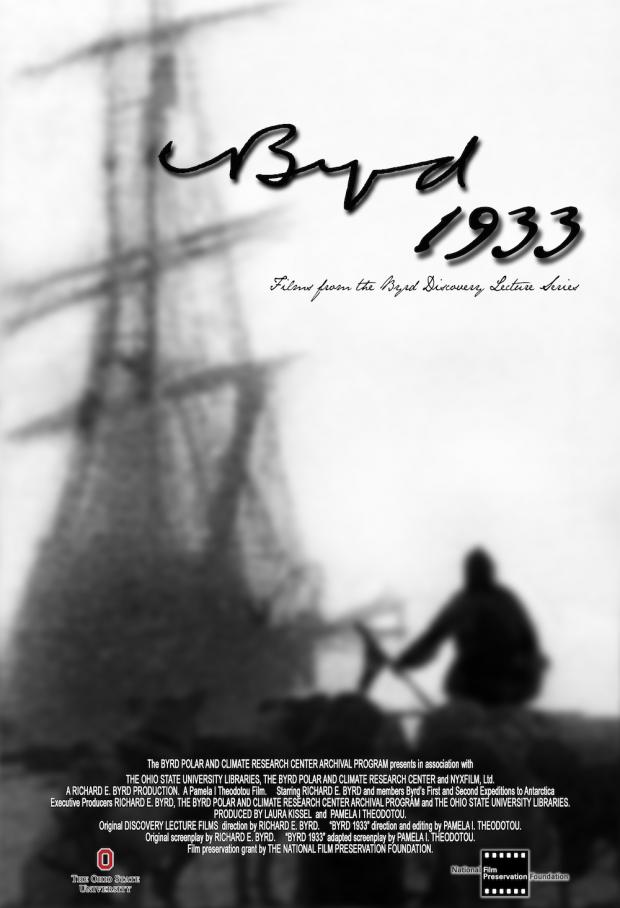
byrd-1933-poster-short-v3

‘Byrd 1933’ was produced using
moving image film found in the Richard E. Byrd Papers.

Byrd 1933 is a documentary by filmmaker Pamela Theodotou,  created from footage filmed primarily during Byrd’s Second Expedition to Antarctica, 1933-1935. Originally known as the “Discovery Lecture Series,” preservation of the original films was made possible by a generous grant given by the National Film Preservation Foundation to the Byrd Polar and Climate Research Center Archival Program in 2013.

In the twenty-first century, it is easy for us to forget the work that goes into the production of a film. We live in an age where computer generated graphics can create special effects that otherwise would have existed in our imaginations alone. Though there are those filmmakers who go to great lengths to create spectacles by using ‘practical’ effects (which are in no way practical), even they are advantaged by modern technology. Much of the danger associated with traditional film-making is nonexistent in a digital environment, making the very concept of ‘film’ mean something different to us now than it did before. The great ‘exploration’ films and television shows of our time, such as The Revenant or Star Trek, differ in one very significant way when compared to the exploration films of the past: the worlds being ‘explored’ are well known to us or are simple constructions of technology and imagination. The ‘Wild West’ has been tamed for at least a century and man cannot yet travel through space with relative ease, for example. We know that the men and women working on those projects were safe for the entirety of production. The same cannot be said, however, for those cameramen shooting footage during Byrd’s Second Antarctic Expedition in 1933-1935.

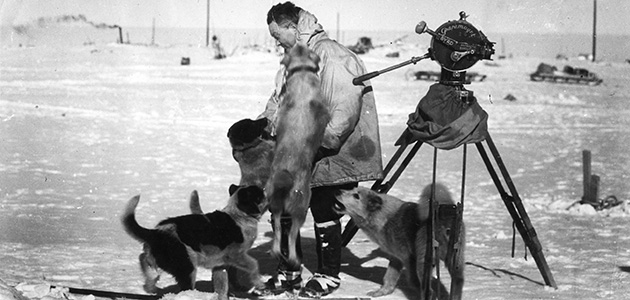
2015-10-19-1445239989-7831860-byrdpolaradmiralbyrdcollectionpups

A still from ‘Byrd 1933’ featuring
Byrd and some dogs.

Several  cinematographers from Paramount Pictures[1] accompanied the famed explorer Richard E. Byrd on the expedition, with the purpose of bringing Antarctica back to the public. The aim was to create a feature film of the expedition, one that would rival that of a film produced in Hollywood. While moving images of Antarctica had been brought back to the United States before, it was not of this caliber[2].  The Antarctic, with its freezing conditions and other environmental hazards, was in many respects the last ‘frontier’ for mankind. Relatively little was known about the continent.

According to Pamela Theodotou, creator of Byrd 1933, the imagery captured by this film crew is best compared to famed photographer Ansel Adams.

image-from-8517

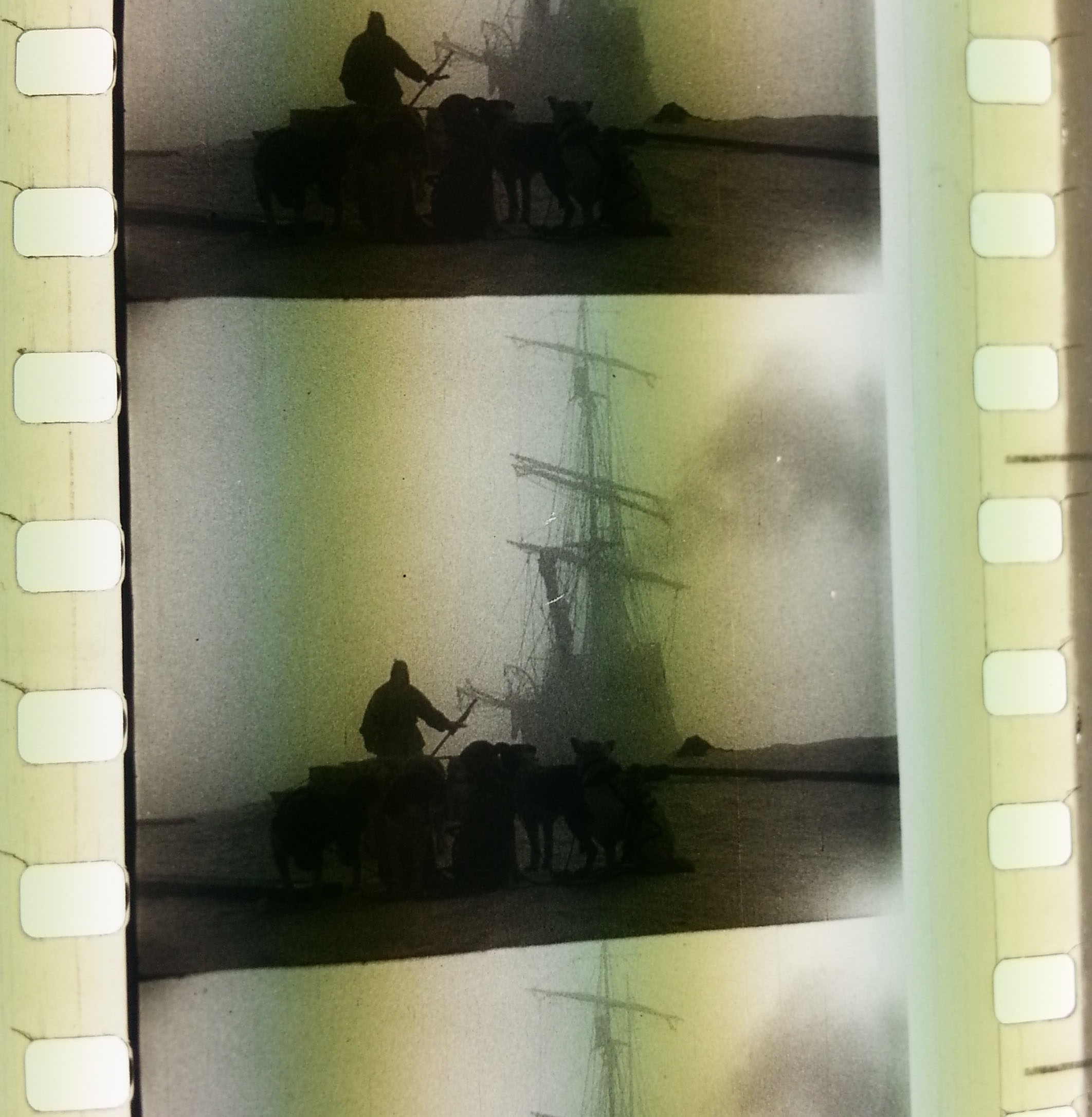
Film used in ‘Byrd 1933’.

But what is truly remarkable is the work and struggle that went into the production of this footage. Filming is difficult under the best of conditions. One must worry about lighting, angles, and exposure times. Film development is a difficult and time consuming task. Now, imagine doing all of this in Antarctica, under freezing and dangerous conditions not only to yourself, but the film that often contains shots that may be irreplaceable. Pamela Theodotou writes on the process:

With temperatures at times 75 below zero, mechanics don’t work well and freeze solid; never mind the danger of film emulsion staying intact as it is wound around a spool inside the camera as it is turned. There were many reports of the camera freezing up, the oil used to lubricate them notwithstanding the cold, and lenses crusting over with ice crystals constantly if you breathed too close to them… The extreme cold complicated everything, equipment froze within minutes, mechanics ceased up, lenses fogged quickly if not handled carefully. And that was just the process of shooting. Complicating matters was the process of developing the film in those conditions… Never mind the developing of motion picture film. In photography you might have a roll of 36 pictures to develop into 36 images. These cinematographers had to develop hundreds of thousands of frames because one second of film is generally 24 frames a second.[3]

dsc_0016

Many reels made on the
Second Byrd Antarctic Expedition
(1933-1935) have become dust.

The actual process of filming and developing that film was a daunting task. Developing meant eighteen hours of work in absolute darkness to preserve the images on the film.[4]

The filmmakers endured the same conditions as the other members of the expedition. They faced the same cold, the same hazardous terrain, the same threats brought by ice. The film crew worked in these conditions with tools and resources that were not meant for the freezing cold.

It can be awe-inspiring when one considers what had to be done in order to shoot this film.  If one is in the local Columbus area, please consider joining us at the Westerville Public Library when Byrd 1933 is screened there on Friday, March 24 by the Westerville Historical Society. One can also view Byrd 1933 this coming April at the Ohio History Connection as part of its “Exploration Weekend.”

For more information on both events and the eventual release of Byrd 1933 to the public, please visit the Polar Archives.

For more information about filmmaker Pamela Theodotou and the process of creating Byrd 1933, please visit the film’s website .  Video content is featured, including the trailer, an introduction to the film given by Pamela Theodotou herself, and several featurettes!


[1] Pamela Theodotou, e-mail message to author, November 03, 2016.

[2] Pamela Theodotou.

[3] Pamela Theodotou.

[4] Wallace West, Paramount Newsreel Men with Admiral Byrd in Little America (Racine: Whitman Publishing Company, 1934), 32


Works Cited

West, Wallace. Paramount Newsreel Men with Admiral Byrd in Little America. Racine: Whitman             Publishing Company, 1934),


Written by John Hooton.

Older posts Newer posts