

This blog post is part of the Frozen Friday Series, an A-Z journey of the Polar Archives. Each week, we will feature some aspect of the history of polar exploration with a blog post written by our student authors.
Over the next few weeks, we will be publishing one of four blogs highlighting portions of our interview with Dr. Lonnie Thompson, a leading glaciologist and outspoken climate scientist at the Byrd Polar and Climate Research Center. Each post will focus on a theme from the interview and feature highlights of that particular section. A full transcript of the interview can be found here.
This week, we are focusing on where Dr. Thompson’s research has taken him and why he does it. The situations Dr. Thompson finds himself in might surprise you. Next week, we will be discussing Climate Change, specifically Dr. Thompson’s response to the lack of action being taken in Washington D.C.
How you ever encountered any trouble with people in other countries, be it a government official that’s being difficult or any less-than-legal groups?
Oh, yes. It comes with the territory. When we were drilling in New Guinea, we had all our official papers from the Indonesian government but the drilling team was attacked by a one hundred and fifty Amungme people. At the base of the mountain, there are four tribes and they’re at war with each other…Fortunately, we were drilling up in the clouds so they couldn’t find us. Then they went to break into the freezer, into Tembagapura, where we were storing the ice cores. The company we were working with got word they were going to break in, so the company took the cores and moved them to another freezer down on the coast. When they broke in there was nothing in there.
Then I get this call from the head of the mining operation and he asks me to come down and talk to these Amungme people. There are one hundred and fifty Amungme in a room and the security guards are around. I start to talk and explain to them who we are and what we’re doing and, when I am about twenty minutes into the lecture, they all stood up and they screamed. I looked at the translator, and the security guards say, “It’s okay, they always do that before they go to war” [laughs].

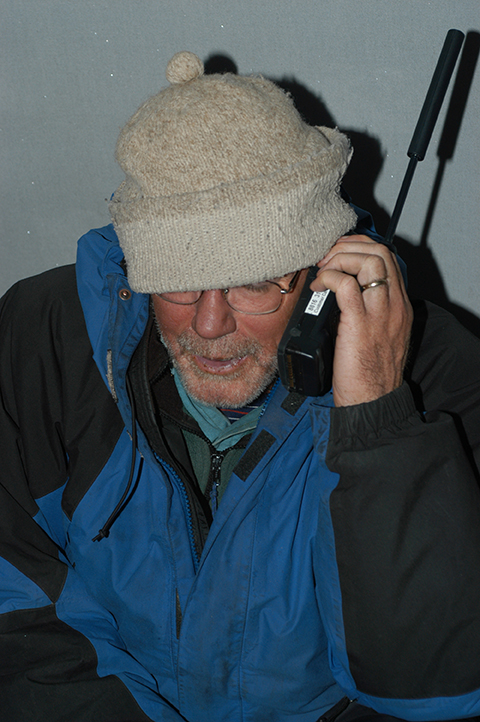
Dr. Thompson cuts an ice core on the Guliya Icecap,
Tibet in October of 2015.
I thought “Oh, okay…” But I come to find out that in their religion, the arms and legs of their god are the mountains and the valleys. The glacier is the head of their god and, in their words, we were drilling into the skull of their god to steal their memories. I told them, “that is exactly what we’re doing.” I also told them that “the day will come very soon, in a matter of years, when the only part of your god’s memories will be in a freezer in Ohio State University.”
There was a big discussion between the elders of the tribe and the younger people. The elders said “No, the glaciers will always be there. They are part of our tradition.” The younger people said, “Have you been to the glaciers recently? Have you seen what’s happening to them? They’re disappearing.” In the end, we were given permission to finish our project, take the ice cores, and go home.
Afterward we had this meeting and I asked the head of the mining company and said, “I came a year early. I always come a year early to give lectures to let people know what we’re doing and ask for their help. Why didn’t we meet with these people?” He said, “Well, it’s simple. There are four tribes and they are at war with each other. You make one friend, you make three enemies. They would not have given you permission, so it was better to do it and ask forgiveness.” [Laughs]
So every project has its own unique story about how you actually get the project done…The local people when we went to drill Sajama, the highest mountain in Bolivia –you have all your official documentation but it’s always a challenge. Bolivia was particularly a challenge. I think they’ve been a nation for forty years, or something like that. They’ve probably had about thirty-five governments. So you get your permits the previous year, as we did, but when we actually arrived, two weeks earlier the government had changed… Dealing with changing landscapes is a real factor in what we do.
Frankly, there are times when windows are open, you get into certain parts of the world and other times you cannot. You have to wait until the window is open so you can get in and do your thing, get the ice, and get out. Every country is different. Even in Bolivia, once we got permission from the government to go out and drill, there is a tribe, the Aymara tribe, that lives in a village at the base of the ice field and when we had to meet with them, the whole community was there and there was a medicine woman who was very deadset against us drilling. She said that we would anger the gods. In their religion the gods live on the mountaintops in the glaciers. And what are we going to do? Drill through it! She said the glacier will split and the climate will change. There’ll be starvation in the village…

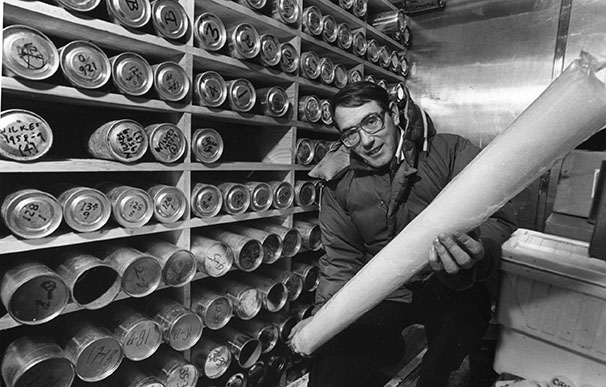
Dr. Thompson inspects the result of his hard work on
the Guliya Icecap in October of 2015.
In the end, they decided to give us permission if we did three things: Donate five hundred dollars to the local library…Hire local village people for the logistics, moving things (we had planned to do that anyway). The third one was that “You will participate in an ancient sacrifice to the gods of Sajama, asking forgiveness for what you are about to do.”
I said, “Okay…what are we sacrificing?” It turned out to be a white alpaca and I said “Okay, that’s what happens to alpaca anyway, so we can do this.” There was a ceremony set up and the whole village came out, all of our drill team. The alpaca is blindfolded and they have two priests that ask forgiveness and they cut the throat of the alpaca, catch it in a cup and sprinkle it in the ground with their prayers. Then the animal is cut in half. The head of the village and the head of expedition (me), the heart is roasted in the fire and we split it. Then the animal is split between the drill team and the village…
So, the fact is, no matter where you get your degree, no one trains you to make this really happen in the real world. I always figure that we are the outsiders, this is their culture. It is not for me or our team to judge, but on the other hand we need their support in order to make the expeditions succeed. After that, we had great support. We could not have done it without the village people.
There is a reoccurring theme: glaciers are holy places. It doesn’t matter if it’s the Himalayas with the Tibetans or in the Andes in South America or over in New Guinea… I feel very fortunate at the time we came along that we are able to get these archives because in all cases now they are disappearing. In some places where we’ve drilled thirteen, fifteen years ago, those places are gone… In many ways, timing is so important…
So, you’ve eaten the heart of an alpaca, you’ve talked down an angry tribe on the brink of war, drilled into the mind of a god, dealt with turbulent revolutionary governments and you’ve endured high altitudes. Why? Aren’t there other, easier ways to study climate? Like, can’t you study clouds?
[Laughs] I think about that sometimes. Every time we write a proposal to do a project, initially you’re worried about “Okay, will it get funded?” Then it gets funded and you’re excited for about an hour. Then you realize… “Oh, I’ve got to do this. Oh my god” [laughs] …

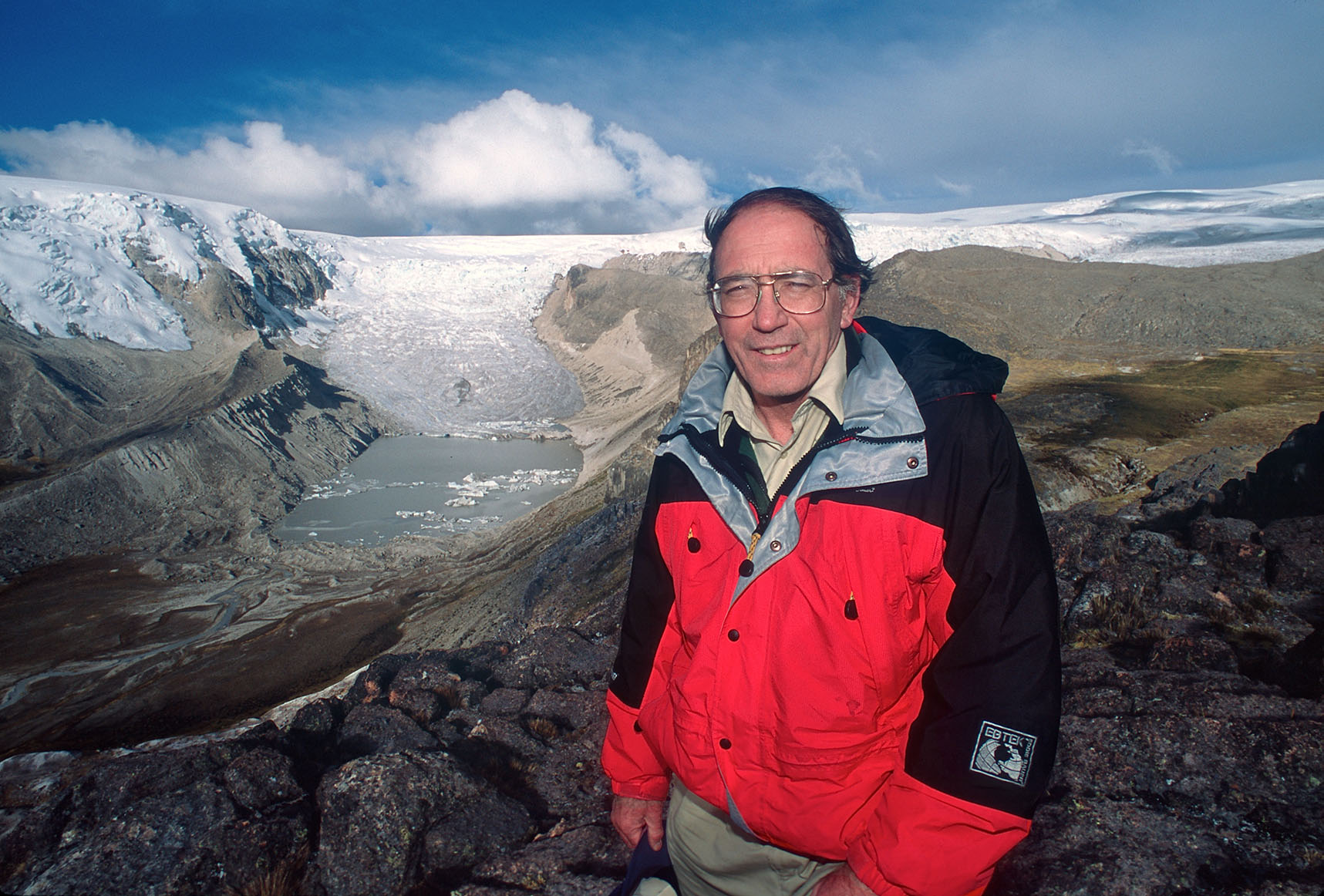
Dr. Thompson holds a specimen on the Quelccaya
Ice Cap in June of 2016.
I would say that the human race, not just me, but the human race has a mad gene. [Laughs] You think about it, all the Polynesians that settled the islands of the Pacific, how many of them went out and never came back? Yet they still went out. Now we’re developing our space program and going out to Mars. Well, chances are, there are going to be problems. People aren’t going to make it.
But yet, that will not stop the human race from proceeding. Life and advancement has always been a function of risk and reward. I think that we forget that about human nature…It’s always been that you’ve got to have people that want to push the envelope. If you push the envelope, there will be risk associated with that fact. If you don’t take the risk, you don’t make the breakthroughs. It’s always a matter of balancing these two things. I think that probably at the end of the day, it’s probably a defective gene. [Laughs]
So that’s why you do it? You have a defective gene that makes you want to push the envelope?
I think it’s a characteristic in human beings that has been with us for a very long time. It has served us well in the big scheme of things…To me, this is one thing that gives me hope for the future is that as a race we are very innovative. We can find solutions to problems once we realize they are true problems. I would say that this is where we are with climate change. This is a large number of people, not the majority, but a large number of people who are currently in control will argue that this is not a problem. But this is a problem. This is physics and chemistry. Human beings are such that if there is any hope that if you do not have to deal with a problem, you don’t. But when your backs to the wall and you have no other choice, we’re pretty good about coming together and finding a solution. On the issue of Climate Change, the beauty of it is that we caused it. If we caused it, we can fix it. If we weren’t causing it, then we wouldn’t be able to fix it. To me it’s a matter of when we actually decide to do that.
Published by John Hooton.






Recent Comments