From Woody's Couch

Our Playbook on OSU History

Category: Frozen Friday (page 5 of 10)

Frozen Fridays: ‘Q’ is for Questionable Theories!

This blog post is part of the Frozen Friday Series, an A-Z journey of the Polar Archives.  Each week, we will feature some aspect of the history of polar exploration with a blog post written by our student authors

Here at the Polar Archives, our job is to preserve and make available to the public all materials in our collections. Every day we receive reference requests from individuals seeking to study items held in the archives and we gladly help them in any way we can. Sometimes patrons are seeking out information regarding a relative, hoping to prove that a family legend was true. Alternatively, maybe a patron is doing research on one of Admiral Byrd’s expeditions for a class assignment and needs to read one of his journals.  Or perhaps a documentary producer or author visits to conduct research on a film or book project.

Hollow Earth believers claim that at
either pole is a massive hole that
leads to the Hollow Earth. Many
claim that explorers such as Admiral
Richard E. Byrd have flown into one of
these holes, though the Papers of
Admiral Byrd hold no evidence
supporting that claim.

We are also happy to answer questions that might not require any in-depth research,  or any questions about the general content of the Byrd Polar and Climate Research Center Archival Program. “Where should I look to find any information on my great-grandfather’s role in a Cook expedition” is a question we might get.  These are just a few of the possible scenarios.

However, sometimes we get requests that are a little more unorthodox. While we of course treat every request with the respect and service owed, some requests are objectively unusual. Although no items in our collections are classified, we have had the Freedom of Information Act unnecessarily referenced several times.  Though some items within our collections were at some point classified, all have since been declassified for some time. Some requests specifically mention subjects that are not a part of mainstream dialogue, such as alien life or underground civilizations. These kinds of subjects usually are tied to one of two questionable theories that commonly come up at the Polar Archives: The Hollow Earth theory and the Flat Earth theory.  I have endeavored to learn what I can about these alternative theories and give a basic rundown of their essential tenets.

One brand of Hollow Earth theory believes that at
the center of the Earth is an inner sun that provides
heat and light for the world inside the Earth.

Many cultures have had a Hollow Earth-like globe featured in their mythology, but modern Hollow Earth beliefs seem to date back to John Cleves Symmes, Jr. in the early nineteenth century. The Hollow Earth theory has evolved over time and is now as varied as its devotees, but the universal, core belief of Hollow Earth theorists is that the Earth is hollow. The crust of the Earth is the outer shell and embedded in this crust some miles below us is the ‘center of gravity’, where gravity is reversed. Above that line, objects are pulled towards the center of the planet. Below that line, objects are pulled away from the center. Below the planetary wall exists a completely new world complete with its own continents and central sun. Inhabiting this allegedly lush and warm world is anything from large, thin Grey Aliens, ancient cultures such as the Vikings of Greenland, to Nazis fleeing Allied forces after the Second World War. Some theorists tie this theory to religion, claiming that the mythical Garden of Eden lies beneath us and Adam and Eve were banished from below to the surface. The Lost Tribe of Israel is claimed to have migrated into the subterranean Earth. Hollow Earth theorists believe that the Polar Regions can provide the proof that will convince the rest of the world of their theory. At each of the poles lies entrances into the hollow Earth. Some claim that these entrances are gaping holes that extend miles while others believe that caverns exist that lead to the underworld.

Some Hollow Earth theorists maintain that
advanced cultures live in the Hollow Earth, such as
the notorious Greys, an alien species that is claimed
to frequent the Earth.

Hollow Earth theorists claim that proof exists in numerous fantastical ‘accounts’ of surface dwellers reaching the inside. A common claim is that our own Admiral Richard E. Byrd flew into the Hollow Earth on his famous (or infamous) flight to the North Pole. Another claim, which I came upon while researching for the earlier Operation Highjump Frozen Fridays post, portrays the expedition as an American invasion of Antarctica which failed after encountering heavy resistance from flying saucers.

Some believe that our own Admiral Richard E. Byrd
was forced to retreat from Antarctica by saucers
coming from the Hollow Earth during Operation
Highjump (1946-47).

The other common theory, the Flat Earth, has a bit more uniformity to it. The Flat Earth Society, along with other similar societies, works toward the goal of ‘enlightening’ humanity away from the “Round Earth Conspiracy”. This “Planar Conspiracy” appears to be motivated by the desire to gain power and wealth by siphoning money from space budgets. Flat Earth theorists maintain that the world is flat. The North Pole sits at the center of the map, with the continents and oceans surrounding it. Circumnavigation is thus possible by simply sailing in a circle around the pole. While the North Pole sits at the center, the Antarctic encircles the world, creating a massive ice wall that extends for hundreds of miles beyond the ocean. Believing that the moon landing and photographs are fake, Flat Earth theorists claim that astronauts simply lie about their experiences. Gravity is declared to be false and the claim put forth that objects simply fall. What scientists refer to as the atmosphere is believed to be a dome of air that separates us from the outside. This ‘Dome’, ‘Firmament’, or ‘Vault of Heaven’ is filled with holes that appear to us as stars.

In Flat Earth theory, the Earth has the North Pole at
its center with the rest of the map radiating from it.
The Antarctic lines the world with what is known as
the ‘Ice Wall’ that is very large and extends for
hundreds of miles beyond the points at which it
meets the world’s oceans.

I reached out to the Byrd Polar and Climate Research Center for a response from individuals who have devoted their careers to the study of science. I received the following response from Jason Cervenec, Education and Outreach Director at the B.P.C.R.C., edited for the sake of brevity:

While “questionable theories” have been proposed in the past and will continue to be suggested in the future, science by its very nature has a way of eventually discarding or refining these theories. Some questionable theories first seem quite plausible, such as the Earth being flat …until overwhelming evidence… is discovered… In science, claims must be refutable and based on observations in the natural world. These two underlying components have been around since at least the time of Sir Francis Bacon in the 1500s and 1600s. Likewise, accepted claims in science are ultimately determined by consensus of peers, in other words, the experts who work in a particular scientific discipline. This process plays out today when scientists create posters and talks for conferences that ultimately result in conversations, with manuscripts eventually getting submitted to peer-reviewed journals. Publication is part of the process of acceptance of a claim in the scientific community… This reaching of consensus by experts is very different than our egalitarian views in the United States where everyone’s ideas receive equal treatment and validity. In science, experts determine the accepted claims, often referred to as facts outside of the scientific community, in the discipline where they work.

Questionable theories, such as the Earth being hollow, have been around for a few centuries but have no basis in evidence. In fact, they are easily refuted by satellite data in addition to accounts of the many people, including many researchers from Ohio State, who have travelled to both the Arctic and Antarctic. Nonetheless, these theories persist, often with associated conspiracy theories that the photographic evidence is fraudulent and the military will not allow individuals to visit Antarctica. Similar to witch hunts in Salem, these claims are not based in evidence and often promulgated by individuals who openly state that they are irrefutable. Therefore, these claims are inherently unscientific. While this does not appeal to our sense of egalitarianism of ideas in everyday life, science relies on evidence, prior research, and the wisdom of experts.

Science as a process strives to rigorously weed out ill-formed theories, such as the Flat Earth and Hollow Earth theories. In addition to the centuries of evidence mounted against these questionable theories, no supporting evidence has yet been found in the collections of the Polar Archives.  But you don’t have to take our word for it; our collections are open to public research and study, and we encourage researchers to come to their own conclusions! If you’d like to make an appointment to use the collections of the polar archives contact us!

Written by John Hooton.

Frozen Fridays: ‘P’ is for Penguin!

This blog post is part of the Frozen Friday Series, an A-Z journey of the Polar Archives.  Each week, we will feature some aspect of the history of polar exploration with a blog post written by our student authors.

‘Little Mo’ sits atop his post in the
University Archives.

‘P’ is for penguin. One penguin in particular. ‘Little Mo’, as we call him, was probably born somewhere in the Antarctic some eight or nine decades ago. He enjoys chilling at the Ohio State University Archives when he is stuffed. You see, that was a joke. ‘Little Mo’ is a stuffed (as in taxidermy) chinstrap penguin. ‘Mo’ was brought back to the United States from Antarctica at the end of the United States Antarctic Service Expedition (1939-41), but passed away in transit. Expedition member Anthony Morency then had the poor little penguin preserved and kept him as a family heirloom. ‘Little Mo’ found his way to the Polar Archives by way of Virginia Rich, daughter of Anthony Morency. Morency, who served under Admiral Richard E. Byrd on the United States Antarctic Service Expedition (1939-41), Operation Highjump (1946-47), and Operation Deep Freeze (1955-56), has a fascinating collection of artifacts housed at the Byrd Polar and Climate Research Center Archival Program. ‘Mo’ is but one example of the unique artifacts held within the archives. This blog post will highlight some of Morency’s most unusual artifacts.

The members of the East Base of the United States
Antarctic Service. Anthony Morency (second from
left, top row) and possibly ‘Little Mo’ (front row).

First, a cartoon. This cartoon (below) representing a portion of Task Force 68 of Operation Highjump (1946-47). The scene, playfully drawn in the fashion of a Disneyesque cartoon, depicts the supply ship Yancey of the Central Group (Task Force 68.1) of the Highjump fleet. Possibly meant to represent the mooring of the Yancey in the Bay of Whales and the unloading of supplies for the construction of Little America IV, the artist has drawn several concerned penguins and a scurrying crew of men dressed in Antarctic coats.  A scroll of text sits at the bottom of the cartoon. The text written on this scroll is a familiar sight in the Morency Collection: a tongue-in-cheek declaration commemorating the achievements of the relevant expedition (in this case Operation Highjump).

The public is encouraged to come to the archives and check out cool artifacts like this one!

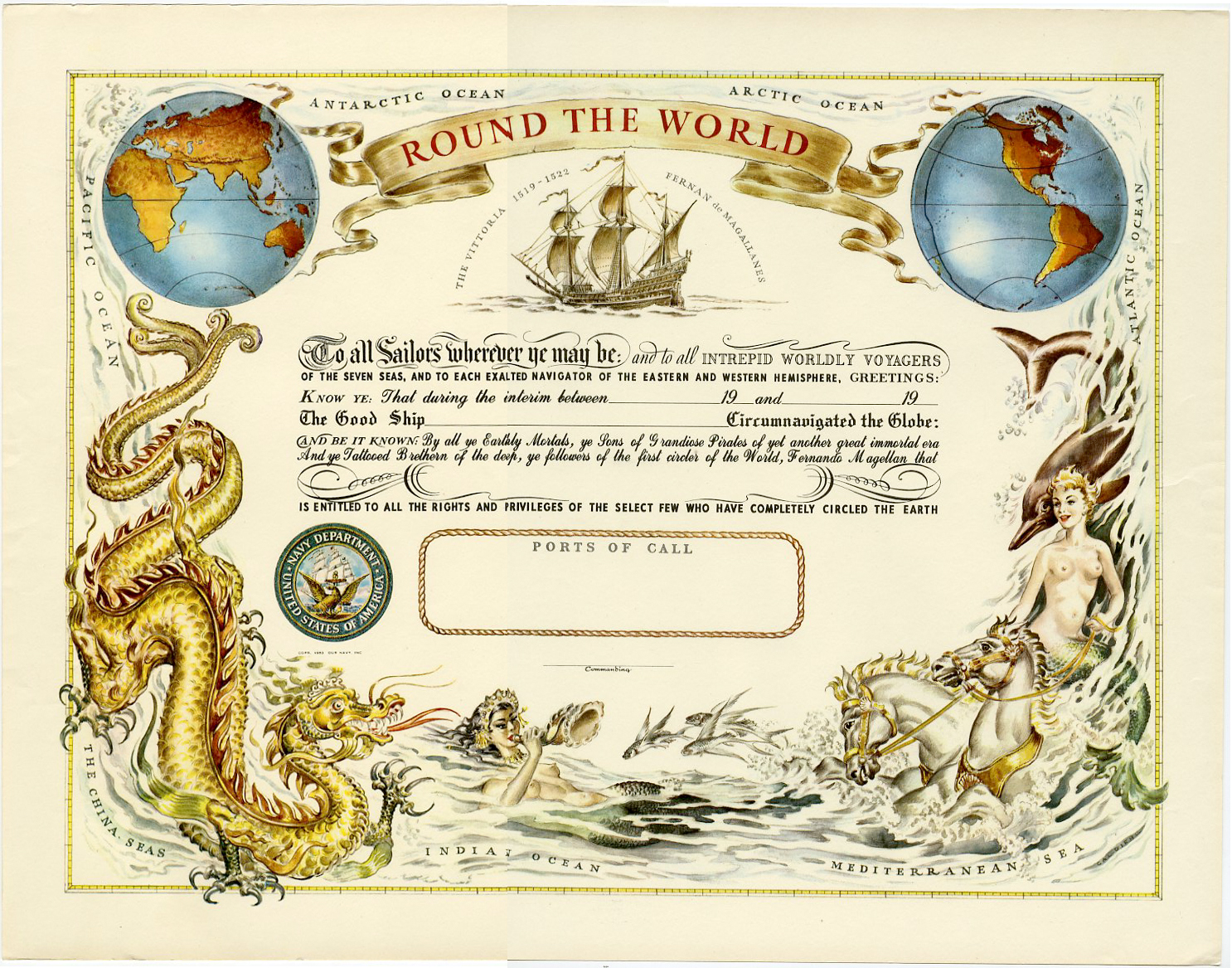
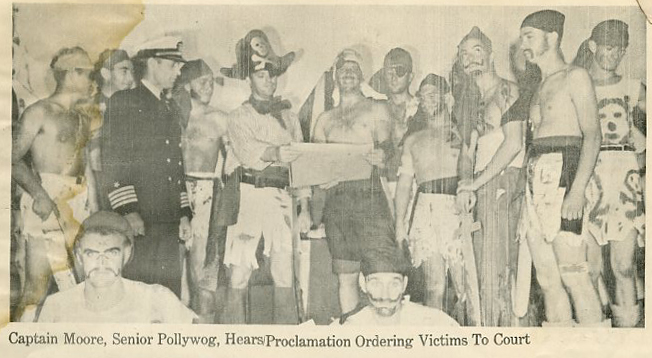
“To all ye farers of the deep” (as on the cartoon) or some variant thereof marks the beginning of several certificates found in the Morency Collection. These declarations come from fictitious governments or organizations, such as the Imperium Neptuni Regis and the Silent Occult Mysteries of the Far East. The artwork on the “documents” is not uniform. Some depict Western legends such as mermaids and King Neptune, whereas others feature Eastern-style dragons and sea serpents. Others depict contemporary images of steel ships and expedition related images, like penguins. All of these certificates (below), presumably acquired by Morency on his many voyages, feature a common theme of nautical imagery and language.

Several of these certificates exist and can be found in the Morency collection.

These certificates often commemorated traversing a geographical feature, in this case the 180th meridian latitude.

This certificate utilizes Western nautical imagery that is common in the Morency certificates…

…whereas this one utilizes both Eastern and Western imagery to commemorate the circumnavigation of the globe.

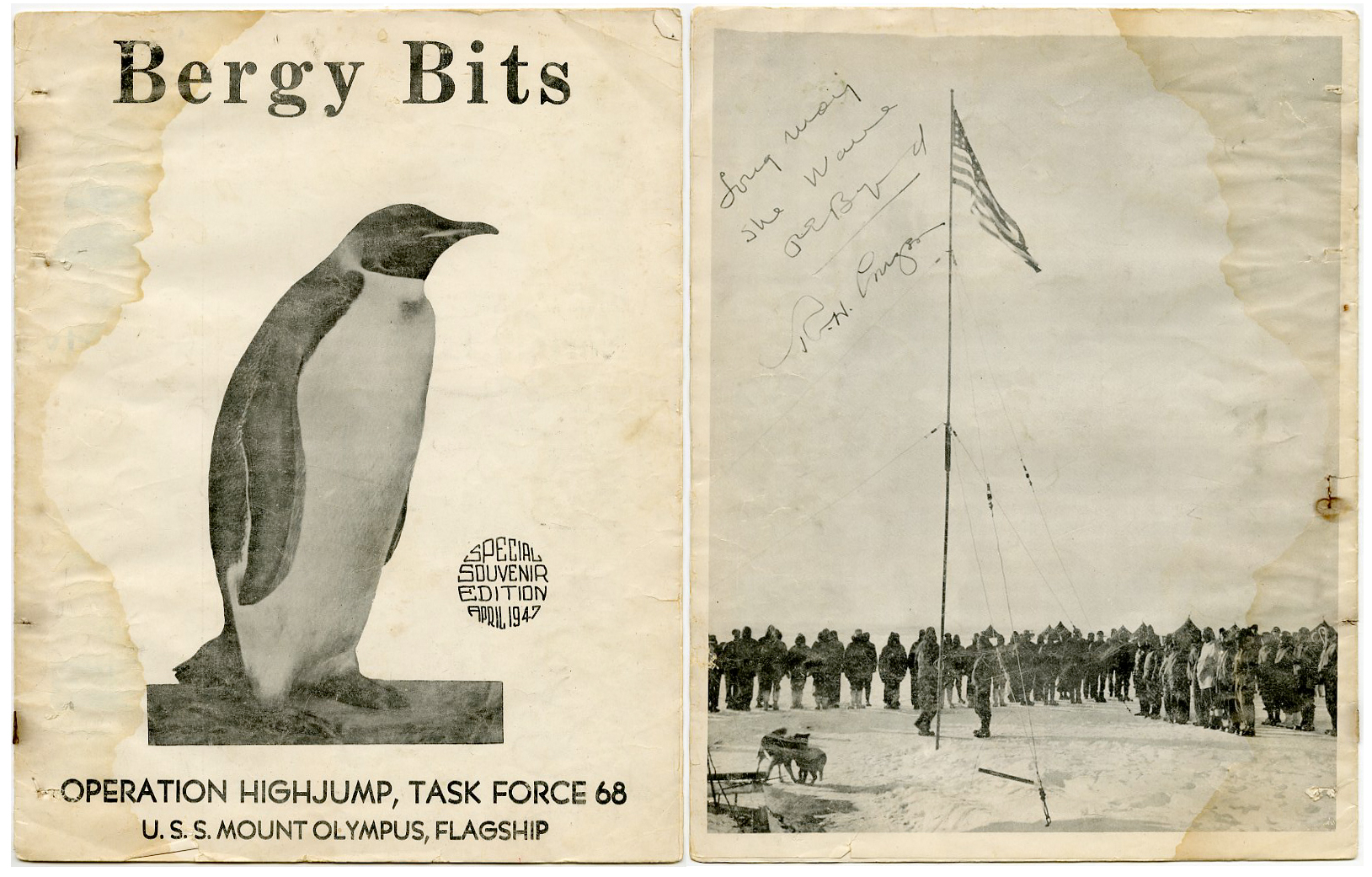
The aforementioned cartoon rests in a large, thin booklet, humorously titled Bergy Bits after the chunks of ice not quite large enough to be icebergs. Published in April of 1947, Bergy Bits contains from cover to cover photographs taken during Operation Highjump. Bergy Bits tells the story of Task Force 68 through these photographs, from photographs of the force traveling to, working in, and traveling from Antarctica. The booklet itself is lighthearted and nostalgic, often making jokes relating to the photographs it holds. Bergy Bits contains images of majestic Antarctic landscapes, fun crew antics, curious wildlife, playful sled dogs, and even a Maori Poi dance party.

The front and back covers of ‘Bergy Bits’. The back cover (right) features the signature of Operation Highjump
leader Admiral Richard E. Byrd.

An example of humor in ‘Bergy Bits’. To err is human, to arr is pirate.

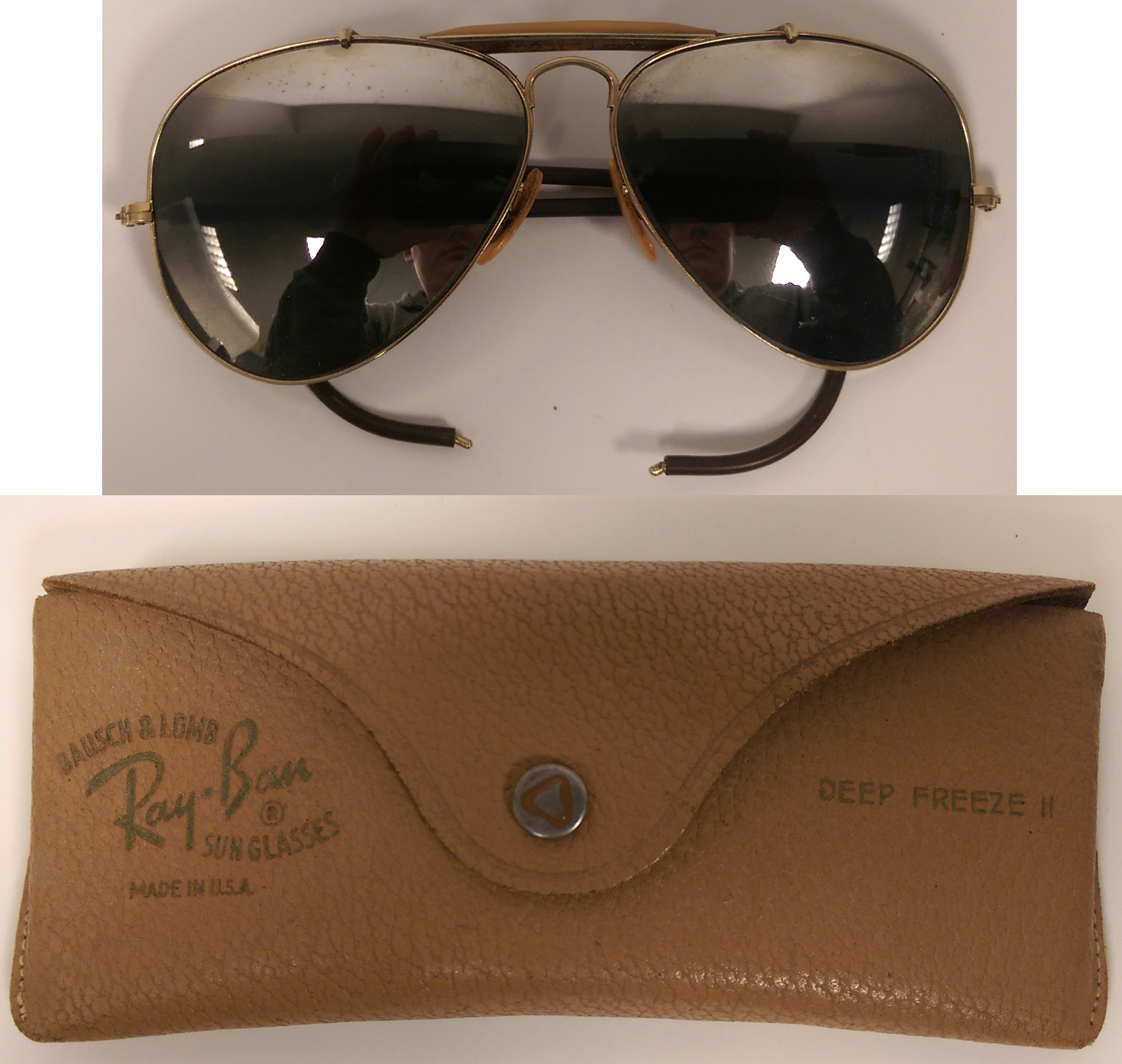
The Anthony Morency Papers, despite the name, do not just hold papers. Obviously, ‘Little Mo’, is not a three dimensional model constructed of paper. The Morency collection has, for example, a stunning pair of Operation Deep Freeze sunglasses (with case), a Deep Freeze engraved lighter, a United States Antarctic Program/National Science Foundation clothing patch, and even a placemat from Covey’s Little America, a travel center named for Admiral Byrd’s bases in Antarctica.

The sunglasses and their case that were used by
Anthony Morency during Operation Deep Freeze.

This lighter is engraved to
commemorate Operation Deep Freeze
II (1957-58), part of the continuing
missions to Antarctica by the United States
Military for the purpose of
maintaining an American presence on
the continent.

The Anthony Morency Papers is an eclectic collection of materials that, like many other collections in the Polar Archives, contain a great number of amazing artifacts. It is well worth a trip to the Byrd Polar and Climate Research Center Archival Program to check out our amazing materials!

Written by John Hooton.

Frozen Fridays: ‘O’ is for Outreach!

This blog post is part of the Frozen Friday Series, an A-Z journey of the Polar Archives.  Each week, we will feature some aspect of the history of polar exploration with a blog post written by our student authors.

‘Mysteries in Ice’ celebrated the 25th anniversary of the Byrd Polar and Climate Research
Center Archival Program.

Outreach has always been an important part of the efforts of polar explorers. For those individuals that would brave the frozen conditions of the most northern and southern regions of the world, there were two seasons: exploration season and funding season. In the words of famed explorer Admiral Richard E. Byrd, campaigning “follows a certain remorseless pattern- an exhausting period of preparation and begging, a heavy field campaign, and on top of that a dreary struggle to pay off accumulated debts, piling up like the layers of a cake.”[1] To Byrd, the effort was  worth it, as it was “a thousand times better…to face ruin in New York than accept the dreadful responsibility of starting south lacking a single bit of equipment… necessary for the safety of the men.”[2] This campaign often took the form of lecture tours, designed to present the scientific findings and experiences of Byrd’s exploits. Byrd would ‘vanish’ for months, going on lecture tours around the nation. He would spend half of his nights on a train and the rest of his time attempting to catch-up on correspondence he had received while away. Many of the letters came from children asking questions about the Poles. Byrd devoted much time to responding to these letters.[3]

Lynn Lay of the Goldthwait Polar Library engages
with young people at the ‘Mysteries in Ice’ exhibit.


The Byrd Polar and Climate Research Center (B.P.C.R.C.) and its Archival Program has continued this tradition of educational outreach.  Outreach takes a variety of forms, and includes exhibitions, tours, lectures, presentations of film and other media, classroom visits, and even lesson plans.  Of course, this blog is part of this outreach! In 2008, the B.P.C.R.C. Archival Program worked with teachers to create lesson plans for middle school and high school teachers. Cold Cases intends to teach students how to think historically in regards to sources and research methods. Cold Cases utilizes a wide range of sources, including diary entries, letters, photographs, reports, and memoirs, to accomplish this goal. Cold Cases can be found here!

Eileen McSaveney and Terry Tickhill take a breather
in Antarctica in early 1970.


For the twenty-fifth anniversary of the Byrd Polar and Climate Research Center Archival Program, the Thompson Library Gallery hosted a large exhibit of materials featuring historical archival materials as well as items that document current and past polar science. Running from October 5, 2015 through January 3, 2016,  Mysteries in Ice displayed clothing worn in Antarctica, an ice core from China, rock samples from remote regions, and more. The wider anniversary celebration featured footage from Admiral Byrd’s previously mentioned lecture tours, a panel of experts discussing the 2015 Paris Climate Negotiations, and even a talk given by Terry Tickhill Terrell, a member of the first all-women expedition to Antarctica.

This image of the ‘Byrd 1933’ poster
has been posted to this blog before,
but it is no less cool to look at!

Of course, the Byrd Polar and Climate Research Center and its Archival Program has more events coming up in the near future:

Check out one or more of these events and like our Facebook page!

Written by John Hooton.

[1] Richard E. Byrd, Discovery (New York: G.P. Putnam’s Sons, 1935), 9.

[2] Richard E. Byrd, Little America ((New York: G.P. Putnam’s Sons, 1930), 9.

[3] Sheldon Bart, Race to the Top of the World: Richard Byrd and the First Flight to the North Pole (Washington, D.C.: Regnery History, 2013), 419.

Older posts Newer posts