From Woody's Couch

Our Playbook on OSU History

Category: Students (page 3 of 32)

Varsity ‘O’ member had more to brag about than athletic ability

Editor’s Note: Recently, Peggy Knight graciously donated the Varsity “O” sweater her father, Arthur Gordon Knight, earned as a member of the OSU Track and Field Team in 1938. It turns out that while Knight had the legs of a racehorse, as it were, he also had the heart of a poet: In 1949 the then-married student, who had interrupted his studies to serve in World War II, won a short-story contest for “The Shovel.” His own story seemed intriguing, so we asked Peggy to tell us more about her father. Below is his story, which we have edited for length.

1938 men's track team. Knight is in the second row, fourth from the right

1938 men’s track team. Knight is in the second row, fourth from the right

The son of immigrants, Knight was born in 1917 and grew up in Lakewood, Ohio. One of Peggy’s first stories about her father was when he was about eight years old. His older sister had diabetes, and there were no insulin shots at the time to help regulate her blood sugar. He kept an eye on her, though, so he could prevent an “episode.” As Peggy says, “One time… as they walked together he saw she was shaking and sweating profusely. Knowing she had little time before collapsing, he reached in his pockets hoping to find a bit of candy that he normally carried for her. He did not have any but he also knew the best thing for her was a glass of orange juice.  He had no money and there were no stores about, so he ducked into a neighborhood bar. The bartender tried to run him out thinking he was a mischievous neighborhood scamp, but he quickly explained the situation and the bartender was happy to provide the juice. Even then, my dad showed great compassion and sense of responsibility.”

Knight was extremely curious about the world, so he decided after he graduated from high school to do some exploring. He spent six months traveling around Mexico, including doing some digging in the ruins of Oaxaca. When he returned home, he decided to attend OSU, thinking at the time he would become a Geology major. After arriving on campus in the fall of 1936, however, he switched majors to English Literature, in the hopes it would better prepare him for a career that would allow him to explore and write about the world.

Knight was also interested in sports, and he decided to participate in either OSU’s football or track program. After spending time in a few football practices, he realized he was not going to excel and would probably spend most of his later life nursing old injuries from the game. He focused then on track and field, helping the OSU team establish new team records in the mile-relay event in 1938. He was good enough to earn a Varsity “O” sweater that year, and he started dreaming of going to the 1940 Olympics.

Knight's Varsity "O" sweater and a photo of the 1938 team

Knight’s Varsity “O” sweater and a photo of the 1938 team

However, his dream was never fulfilled because of World War II, which also interrupted his studies. Early in 1941, he and Peggy’s mother, Betty, eloped, and in June, he enlisted in the Army. According to Peggy, her father did not talk much about the war, but he did share several anecdotes with her, one of which was about being an ordinance officer with “a knack for bombs. He became the local go-to-guy for bombs that fell but did not go off.  He was called out to defuse bombs as needed and, as a child, I saw many gold-toned flaming bomb pins in his dresser drawer that he was given after each bomb was unarmed.  He told me he was very happy he was a smoker because his matchbook was his biggest weapon against difficult bombs.  He used the flap to prevent contact between the pin and the explosives.”

When his four years of service were up, the war wasn’t over yet, so he decided to re-enlist, this time in the Air Force. It was during these three years of service – he reached the rank of Second Lieutenant – that he hatched the idea for his future award-winning short story.

A year after returning home and to Ohio State in 1948, Knight enrolled in a short story class, English 507, where he wrote “The Shovel.” It was submitted to the Columbus Chapter of the National Society of Arts and Letters, and won first prize. The story, about a British woman in the days just before D-Day, was described by one judge as “a very profound story,” according to a Lantern article. In the article, Knight said he planned to be a creative writer after he graduated that June.
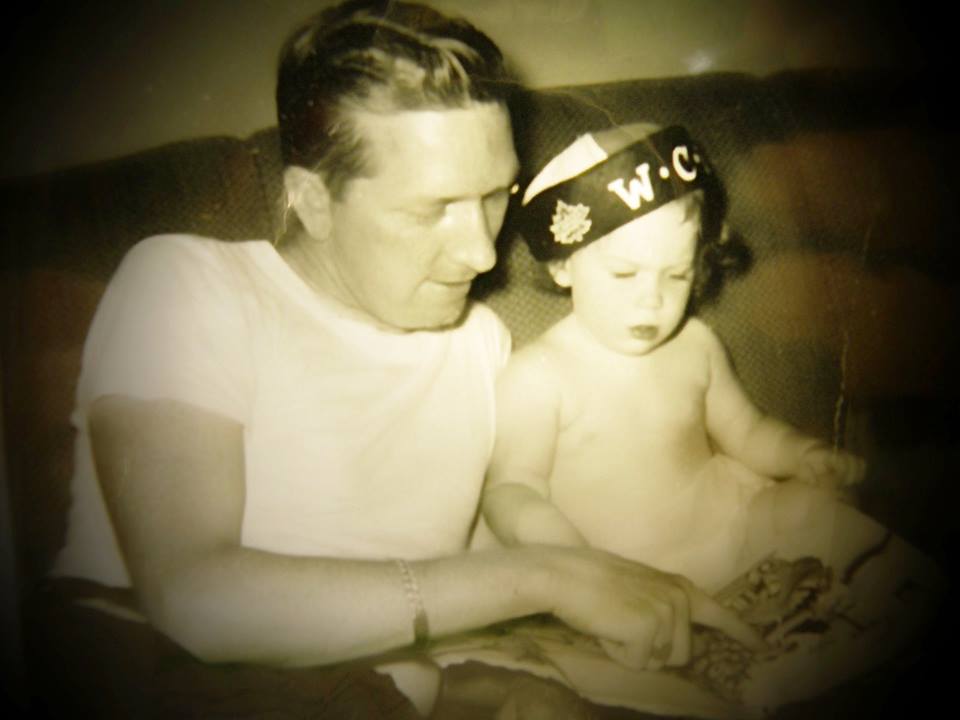
Knight, sharing a book with his daughter, Peggy

Knight, sharing a book with his daughter, Peggy

But Knight had a family to support (Peggy was adopted in 1953) and he began working in his father’s insurance agency. He and his family eventually moved to Galveston, Texas, though, where he became vice president of the American National Insurance Company. Because of a heart condition, Knight decided to retire early, and that’s when he was really able to satisfy his curiosity about the world and his passion for writing.

In 1970, he opened a rare and antique book dealership, and at about the same time, he became a columnist for the Galveston Daily News. “Now, his life was everything he hoped for in a career,” Peggy says, “he bought and sold rare books, 13th-century manuscripts and other types of writing, and spent hours reading them before selling them.  He was filling additional hours with writing his editorial columns.  And on occasion, he locked himself in his home office where I could hear his ‘new and modern’ electric typewriter clacking away with determination.”

His career as a Galveston columnist came to an abrupt end when he submitted a column about the “Johnson Memorial.” It was about a pull-chain toilet affectionately known by that name at the Rowfant Club in Cleveland (a literary society of which Knight was a long-standing member). According to Peggy, “no matter how good the article was or what the history of the water closet was, the publishers of the paper felt that the cultured ladies of Galveston society would not be pleased with talk of toilets, even in the modern age of the ’70s.  My father refused to be censored and pulled out of the ‘editorial comment’ business.”

After a flood destroyed much of their home – including many of Knight’s books and other life treasures – he and Betty moved to Ocala, Florida, where he died in 1987 at the age of 70 from melanoma. Peggy concludes:

“In his effects, I found nine unpublished and unfinished novels on which he’d been working.

He was a great man to many, an enemy to none.  He was a hero to me.”

We would like to thank Peggy for her wonderful donations, and we say donations because she not only provided us with a beautiful Varsity “O” sweater, but also a wonderful recounting of her father’s life. Our records focus mostly on him being an OSU athlete, so we appreciate her taking the time to show that his own story was much more than that.

Persistence pays off! OSU Mystery Man’s identity revealed

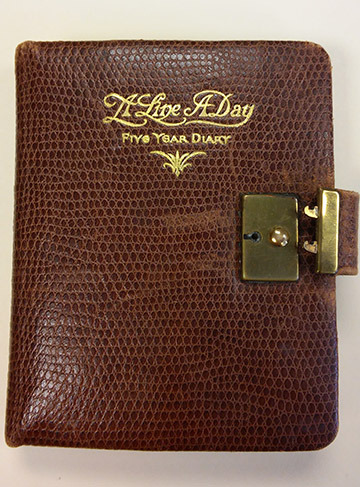
Editor’s note: Last fall, the University Archives received a diary that clearly had been written by a former OSU student but had no identification of who he was. So, we set to work trying to determine the diary writer’s actual identity. And by “we,” we mean our student assistant, Belle Teesdale, who went above and beyond to piece together the diary’s many clues to determine who the original owner was. Belle didn’t stop there, though. She found out quite a lot about OSU Mystery Man, actually. But we’ll let her tell you herself:

Belle Teesdale with the student diary

Belle Teesdale with the student diary

The task of discovering the identity of someone’s diary is not an easy one—especially when it’s from the 1930s and the handwriting is in messy cursive. I began reading the diary on the very first page, from top to bottom like a book and continued doing so for the next few pages. However, something seemed off. The handwriting and pen ink changed every few sentences. I soon realized that this was a 5-year diary—meaning that every page focused on one specific day, but it was divided into 5 sections for each year. This diary began in 1931 and ended in 1935. Instead of reading each page in its entirety, I had to read only a section to figure out the chronological order.

One of the first things I noticed was that whoever this man was, he was not excelling academically. He would continually jot down how he was getting C’s and D’s in his courses. I also realized that this man started attending OSU only in the fall of 1932, even though the diary started in 1931. Continuing to investigate, I learned that the Mystery Man had gone to Dartmouth College for his freshman year. This made sense since he noted in his diary how strange it was to see women on campus and in classes at OSU, considering Dartmouth was an all-male college at this time.

Diary_insideI began jotting down anything that could help me find out who this diary belonged to. I knew (or thought) he was a member of the Phi Kappa Psi fraternity, since he had been a Phi Psi at Dartmouth and continued to attend their events and dances at OSU. I knew he was taking business-related classes—Economics, Finance, Salesmanship, Money and Banking. I knew his birthday was February 22. I knew he dated a lot of girls (Peggy, Jean, and Flora, to name a few). I knew he liked playing tennis and swimming during the summer. I knew he had the funds to travel often (Chicago, Canada, New York City) and eventually buy a car. I knew he moved to Dunedin Road in Clintonville. And I knew that by 1935, he was in graduate school here.

However, not knowing exactly what Class he was a member of or when he graduated kept the mystery going. I repeatedly tried looking through the Makio yearbooks at the Phi Psi group photos and looking through the names of the members each year. I crossed these names with their addresses in the student directories from 1932-35. No luck. I was beginning to think I’d never find out who this guy was.

It was one specific clue that lead to the identity of the OSU Mystery Man. On June 10th 1935, OSU Mystery Man wrote in his diary, “Commencement started before six. Only one to get Bus. Admin. Names mixed up, so provided only good laugh of the evening.”

Since the University Archives has copies of all the Commencement programs, I went to the June 1935 edition, turned to the page listing master’s degree recipients in Business Administration, and there he was—one name, only one in his category, just like he said. William Chenoweth Brown. The commencement program said that he had graduated from Dartmouth with a degree in Economics in 1933. He had mentioned in his diary a few times that he had contacted Dartmouth and was (somehow) able to transfer his credits and still graduate from there.

William Brown's senior portrait from the Dartmouth College yearbook, the Aegis.

William Brown’s senior portrait from the Dartmouth College yearbook, the Aegis, 1933

I immediately looked him up in the Makios to see what my mystery man looked like, but I was unable to find him there, which is not unusual for a graduate student.

After the Makios, I went to The Lantern online digital archives and searched his name. One article about him said that while he was in San Francisco for a summer job in 1934, he and another Phi Psi members witnessed a strike by dock workers that included huge mobs, and lots of fighting.

After contacting the Dartmouth Archives, more information poured in about what happened to the mystery man after his diary ended on December 31, 1935.

The next few years of his life after graduating from OSU are unclear, but Brown, who had been born in 1912, went to some kind of finance school and enlisted in the U.S. Army on July 10, 1942. Brown was stationed in Africa briefly, but most of his service was spent in Italy where he rose to be a Captain. He was also awarded with a Bronze Star in May 1945 for his meritorious service in combat.

By 1946, he was married to Edna Ruth Randall (who went by Pat). By 1950, Pat and William had a son, Randall. The family stayed in the Columbus area throughout their lives, and Randall graduated from Upper Arlington High School, going on to receive a bachelor’s degree from Ohio Wesleyan (his mother’s alma mater) and a Master’s in Education from Ohio State. William passed away at the early age of 66 in 1978.Unfortunately, Pat passed away in 1992, and Randall passed away in 2011.

Who is this OSU Mystery Man? A diary reveals his identity

profile2What if you diligently kept a diary during your college days, noting all of the social and intellectual ups and downs of life as a student? The people you dated, the classes you took, the places where you had fun on and off-campus, and more. That’s the kind of thing you would want to hold onto, either for future family members or just to remind you of times past.

But what if you either forgot or intentionally left your name off of the diary? Maybe you figured you would always keep it close, so why bother? Maybe you didn’t want outsiders knowing it was you who wrote it.

Then something happens or maybe a series of things, and you and the diary are separated somehow. Consequently, no one will ever know that it was your life depicted on its pages.

Or will they? Last fall, a woman called the Archives to say she had attended an auction and had bought a box of random discards from people’s lives for a few bucks. Inside was a diary, and its original keeper appeared to be associated with OSU. She wanted to donate it.

Once the Archives received the diary, we put our tenacious student assistant, Belle Teesdale, on the trail of determining who the writer was. She found out all kinds of things:

1. It was a young man who had some extended family in Harrisburg

2. He was a member of Phi Kappa Psi and somehow related to the Triangle fraternity

3. He took classes at OSU but also attended Dartmouth University

4. He had a very active social life, attending plays and movies, going out to dinner at the Neil House and other Columbus landmarks

Diary_inside5. He was a bit of a “player,” in the modern vernacular: He seemed to go out with a lot of women during the diary’s five-year span. Even so, he was sometimes on the losing end of break-ups.

6. He traveled quite a bit, going west to California and across the ocean to Europe at different points.

Eventually, Belle figured out who it was, and so will you, after a series of tweets and Facebook posts over the next few weeks giving diary entries as clues. We start with this blog because it turns out the OSU Mystery Man was born on February 22, 1912 – 103 years ago, as of yesterday. We’ll end the series next month on March 20, revealing his identity and the larger picture of his life as an OSU student and beyond.

Older posts Newer posts