From Woody's Couch

Our Playbook on OSU History

Category: Students (page 4 of 32)

Orton Hall Chimes have struck the right chord with Buckeyes for 100 years

Orton Hall Bell Tower, 1995For 100 years, students making their way across the Oval have been serenaded by the Orton Hall Chimes – 12 bells that have become an integral part of the OSU experience for many in the University community. They were delivered to OSU on Feb. 11, 1915, after the classes of 1906, ’07, ’08, ’09, ’10, ’11, ’13, and ’14 banded together to purchase the bells for roughly $8,000. (The class of 1912, apparently a group of nonconformists, decided to donate a mantel piece to the Main Library).

The dozen bells, together weighing roughly 7 ½ tons and all tuned in D flat, were installed over the following weeks. According to a “Contract for Chimes” signed by the Board of Trustees with the manufacturer, the McShane Co., the bells were to be made out of Lake Superior copper (about three-quarters) and imported East India block tin, and they were guaranteed not to crack. At Commencement that year, the Chimes were officially dedicated, and also that year, a new organization called “The Chimes Club” formed to take charge of playing melodies at 11:50 a.m. and 4:50 p.m. daily. Chemistry Professor W.L. Evans noted at the time that it was “expected that the advent of the chimes will create a new interest in college music at OSU.”

Orton Chimes before installation, 1915

Orton Chimes before installation, 1915

A few years later, the classes of 1919 and 1920 purchased an automatic striker for the bells to mark the time of day, and by 1949, the bells were renovated and an electric clock device was installed so the Chimes would ring on the quarter hour and the full Westminster Quarters melody would play at the full hour.
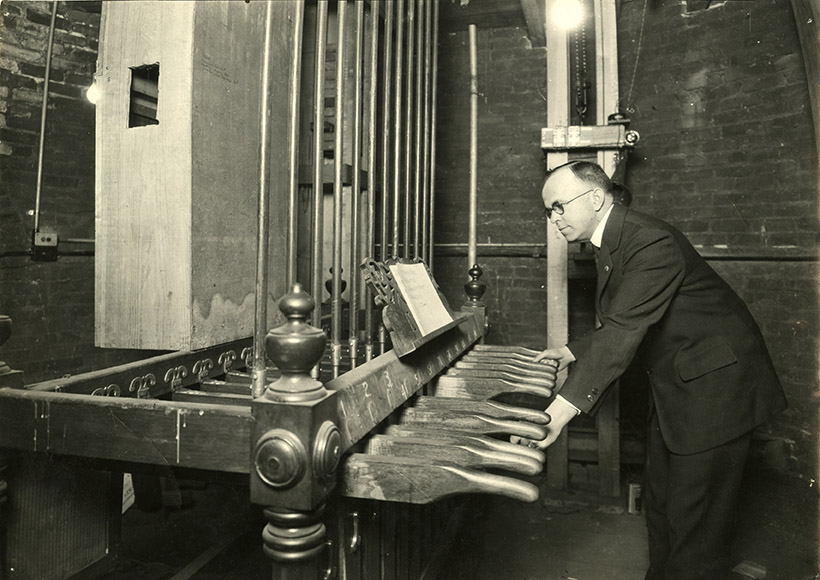
Allen McManigal, 1920s

Allen McManigal, 1920s

Meanwhile, the twice-daily serenades were still done by hand. Four faculty members – including Evans – traded the duty of climbing the 80-some steps twice a day to play the serenades in the Chimes’ early history. Later, an engineering drawing professor, Allen McManigal, took charge of the Chimes, playing them himself or supervising music students to do so. His direction continued for more than 25 years until his death in 1950; later, Music Professor Wilbur Held, an organ music specialist, supervised students. In the 1960s, these students, called Chimes Masters, were paid $25 a week for the responsibility of making it to the top of the tower in time to play such songs as “June is Busting Out All Over” on especially dreary or snowy days. In addition, “Carmen Ohio” was played during the football season, as well as carols during the holidays.

After roughly 60 years of ringing, the chimes needed a little tune-up, so the Class of 1978, in conjunction with OSU, made a $28,000 repair to the bells in 1985. A year later, a more modern electrical system was installed to automate the serenades as well, although an electric keyboard also was installed, making it much easier and less laborious to play by hand.
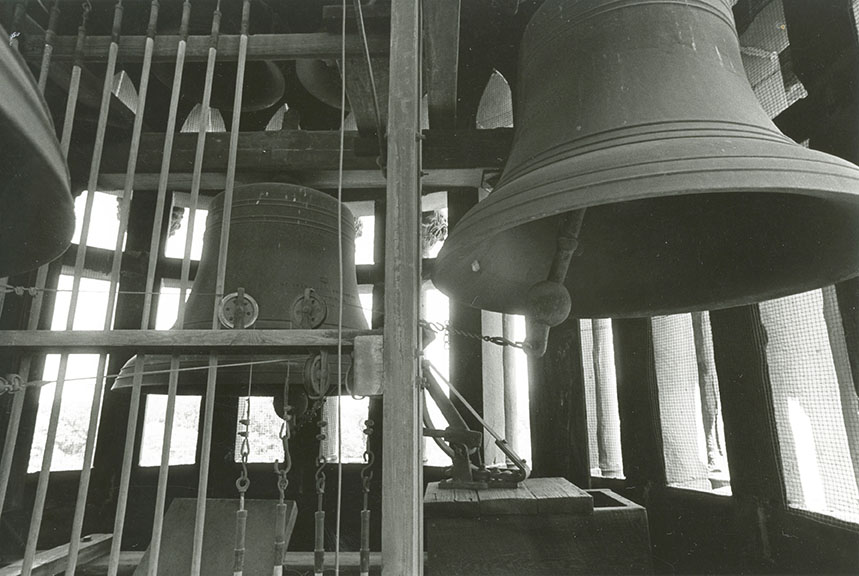
Orton Hall bells, 1985By 2003, two new bells were installed, this time chiming at G sharp and A sharp. This $12,000 addition enabled the Chimes Masters to have much more a variety in songs to play, which was often a complaint made by students over the years. These new notes could now play songs like “America the Beautiful” and “The Buckeye Battle Cry.”

On Wednesday, Feb. 11, 2015, the Ohio Staters, Inc., will host a 100th-anniversary celebration event at Orton Hall from 5:30 p.m. to 8 p.m. The event will feature remarks by President Drake, refreshments, a display of related artifacts and tours of the tower. For more information go to the Staters’ Facebook page.
Twelve Days: Archives donors deliver the goods – in so many ways

(In celebration of the University Archives’ upcoming 50th Anniversary in 2015, we bring you “The Twelve Days of Buckeyes.” This is day 9 in a series of 12 blog posts highlighting the people who were instrumental in the creation and growth of the Archives.)

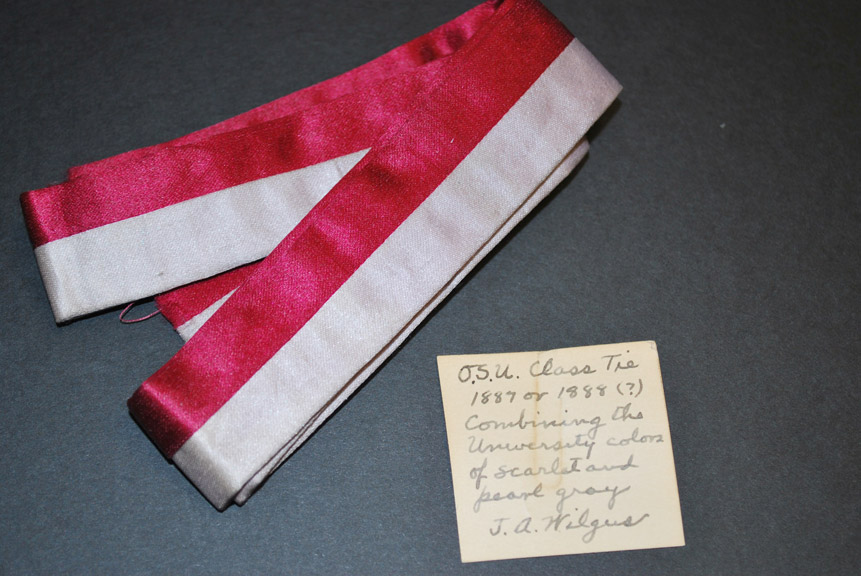
Wilgus' tie, c1887-1888

Wilgus’ tie, c1887-1888

We’d like to focus today on the unsung heroes of Archives everywhere: those individuals who decide the “old stuff” in their lives needs a more permanent home. So they take on the sometimes herculean task of finding just the right place and sending the materials there.

Take, for instance, Peggy Wymore. She has absolutely nothing to do with OSU, except for the important fact that her grandfather, James Alva Wilgus, earned his bachelor’s and master’s degree from OSU (1888 and 1889, respectively). He then spent many years in education, retiring from the State Teachers’ College in Wisconsin in June 1939 as a professor of History and Social Sciences. He died two months later.

Peggy Wymore, donor of Wilgus material

Peggy Wymore

So his OSU materials – the coolest thing is his scarlet-and-gray class tie –survived nearly 75 years, thanks to the Wilgus family, including Peggy, who was the last one to have these items in her possession and who contacted the Archives to see if we would want his things. We sure did. And, in fact, we were so thrilled, we wrote a blog about him.

Luckily for the Archives, there are many people like Ms. Wymore who can’t bear to discard such items as the class tie – an item we had never seen before – and they do the legwork to track down the Archives to ask if we want the materials. They carefully pack these items, often providing much-appreciated detailed explanations, then ship them to the Archives, often at their own expense, from all over the country.

Naddy's ROTC uniform

Naddy’s ROTC uniform

It is the explanation of an ROTC unifom that makes this particular donation stand out. In 2006, John Naddy donated the jacket, pants and hat he wore while he was in ROTC at OSU in the early 1940s. Back then, all male students had to take military science classes; however, at this particular time their training took on extra meaning since war was imminent. For Naddy, as with many young men of his generation, he recounted his story very matter-of-factly in a letter that is so priceless in its charm, and what it divulges about that time period, that we urge you to read it for yourself.

Then, there are the donors for whom it’s a no-brainer on where their precious keepsakes should end up permanently. Arthur “Jerry” Grundies was one such donor. Grundies was a varsity tackle who played OSU football under Coach Francis Schmidt from 1938 to 1940.

Grundie's football uniform

Grundies’ football uniform

Grundies at a 2008 football game

Grundies at a 2008 football game

Grundies didn’t play professionally after college; he went to war instead, serving in the U.S. Army in Italy and North Africa, and earning a Purple Heart and Bronze Star along the way. After the war, he became a sales representative for various oil companies in the region until his retirement. In 2002, Grundies donated his football uniform to the Archives – it’s the earliest version we have and one of the most often displayed items in our collection. He had a strong connection to OSU, so strong that the Archives received holiday cards from him until his death in 2010.

No matter why people donate materials to the Archives, we are extremely grateful that they do. Such artifacts are so helpful in helping us demonstrate through exhibits and tours the history of Ohio State, and we look forward to sharing them with our patrons and visitors for many years to come.

Twelve Days: Jesse Owens’ legacy lives on at the Archives

(In celebration of the University Archives’ upcoming 50th Anniversary in 2015, we bring you “The Twelve Days of Buckeyes”. This is day seven in a series of 12 blog posts highlighting the people who were instrumental in the creation and growth of the Archives.)

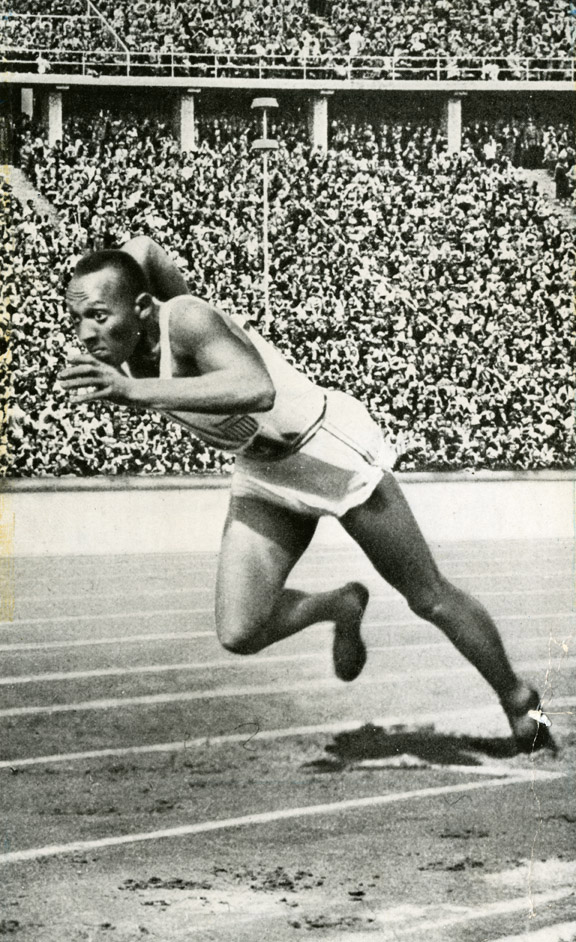
Owens competing in the 200 meter dash at the Berlin Olympics, 1936

Owens competes at the 1936 Olympics

Though Jesse Owens’ most famous accomplishment happened more than 75 years ago, many people today still remember what it was – winning four gold medals in track at the 1936 Berlin Olympics – and what it meant – an African-American man showing the Adolph Hitler that his propaganda about the superiority of the Aryan race was bunk.

Fewer people may remember, however, that Owens attended OSU before going on to make history at the Olympics. That doesn’t mean, though, that his collection of papers, photos and artifacts housed here at the University Archives is ignored. Far from it.

The Archives acquired the bulk of collection from Owens’ widow, Ruth, from 1987 to 1990. Additions were subsequently made by the Owens family, particularly Marlene Owens Rankin, one of Owens’ daughters. Most of the collection is composed of materials from when he started attending OSU in 1933 to his death in 1980. The roughly 100 cubic feet of materials include many artifacts such as his Olympic gold medals. But there are also other items that signify his later roles in life, such as a tankard given to him in 1955 for his role as sports ambassador to India, an appointment made by then-Pres. Dwight D. Eisenhower.

Former University Archivist Rai Goerler looks through collection material with Ruth Owens, 1987

Former University Archivist Rai Goerler looks through collection material with Ruth Owens, 1987

Owens' Olympic gold medals

Owens’ Olympic gold medals

Since acquiring the collection and to this day, the Archives has helped many people from all walks of life learn more about Owens. The staff regularly receives requests from filmmakers, documentary makers and book writers for help on their projects to tell Owens’ story. Classes here at OSU will often visit the Archives to look through his materials as part of their research on all kinds of topics, from sports history to English rhetoric.

And the staff always knows when National History Day comes around because every year, without fail, we receive requests from elementary school students from around the country who want to know more about Owens for their projects. Their enthusiasm and curiosity about Owens are an annual delight. In fact, it is always our pleasure and honor to help patrons connect with Owens who, 35 years after his death, can still inspire people from around the world to learn about his life and his legacy.

To learn more about Jesse Owens, see the Archives’ online exhibit about him.  And, check out the Owens’ photographic collection on the Libraries Knowledge Bank.

Older posts Newer posts