From Woody's Couch

Our Playbook on OSU History

Category: Football (page 4 of 9)

Black History Month: Football player had higher calling than just ‘phys ed’

William Bell

William Bell

William “Big Bill” Bell was a standout tackle for the OSU football team, but his academic career off the field far outshone his performance on it.

Bell played for the Buckeyes from 1929 through 1931, and earned All Big Ten and Honorable Mention All-American honors his final season. But football wasn’t his only activity: He was a member, and Sergeant of Arms, for the African-American social fraternity, Alpha Phi Alpha, and he was a member of Varsity “O,” the Collegiate Council, and the Interracial Council.

His senior year, the Upper Class Cabinet of the OSU chapter of the YMCA tapped Bell to lead a new committee on interracial relations. In doing so, the Cabinet’s president, Wallace Hall, revived a then-dormant policy of allowing African-American members to become a member. In a Lantern article about Bell’s appointment, Hall said “Bell is a good worker, and I see no reason he should not be a member of the cabinet.”

Bell was named Interracial Chairman of the Upper Class Cabinet, 1931 Makio

Bell was named Interracial Chairman of the Upper Class Cabinet, 1931 Makio

After graduating in June 1932, Bell began a long career coaching football at historically African-American colleges, including Claflin College in South Carolina, Florida A&M University, Howard University and finally North Carolina A&T State University. Bell worked more than 20 years at North Carolina A&T in a number of capacities, including athletic director and professor of physical education. (Along the way, Bell received his master’s degree in physical education and his PhD in physical education from Ohio State, in 1937 and 1960, respectively.)

After organizing physical education departments at several universities, Bell ended his career as athletic director of Fayetteville (Alabama) State University where he assisted in the development of Fayetteville’s National Youth Sports Program, a summer organization for disadvantaged youths.

He died at the age of 81 in 1981 in Fayetteville. In Bell’s obituary, a former student of Bell’s at North Carolina said Bell “never said ’phys. ed.’ He always said ‘health and physical education.’ He wanted it to be a profession.”

Woody Hayes: five fun facts far from the football field

1951_Woody_posed_001

Woody Hayes, 1951


Everyone knows about Woody Hayes’ career as the head coach of the Buckeyes: his 205-61-10 record (the most wins ever by an OSU coach), the 13 Big Ten championships, eight Rose Bowl visits, five national championships, and three Heisman trophies his players won, not to mention the two times he was selected National Coach of the Year.

But Woody had a very diverse and different life off the field.  The following list of five fun facts about Coach Hayes will highlight some of the more interesting aspects of his life you probably don’t know about!


Hayes with President Richard Nixon, n.d.

Hayes with President Richard Nixon, n.d.

  • Hayes graduated from Denison University in 1935 as a double major in history and English and a minor in physical education. He graduated from OSU in 1948 with a master’s degree in educational administration. This was three years before he would be hired as football coach.
  • Hayes was good friends with Presidents Nixon and Ford and also knew Presidents Reagan and Bush. He was very involved in the Ohio Republican party and supported current governor John Kasich early in his political career.
  • Hayes had a wide variety of other notable friends, including Jack Nicklaus, Bob Evans, Milton Caniff, Dave Thomas, Bob Hope, and George Steinbrenner.
  • Hayes was a great admirer of Ralph Waldo Emerson and was invited to give a lecture at Harvard in 1982 on the occasion of the 200th anniversary of Emerson’s death. His signature “Pay Forward” motto was inspired by Emerson’s essay on Compensation.

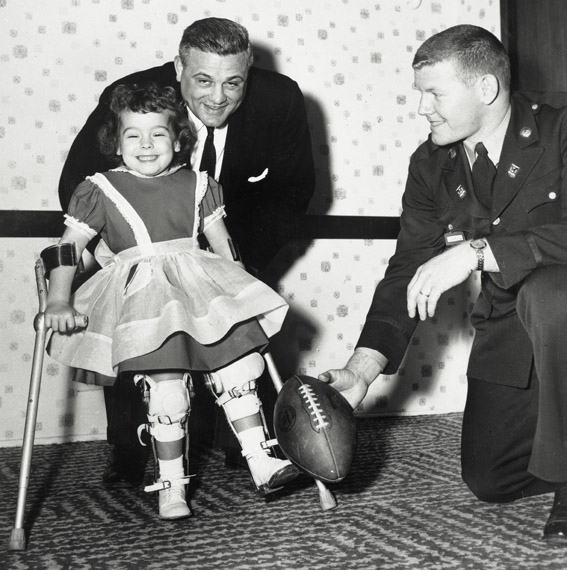
    Hayes with Easter Seal child, 1958

    Hayes with Easter Seal child, 1958

  • Hayes was a dedicated supporter of many charitable organizations, particularly those, like the Easter Seals, that benefitted children. He spent quite a bit of time visiting hospital patients, answering phones at telethons, and speaking at events to raise funds for various causes.


For more information about these and other surprising facts about Coach Hayes, click through to our web exhibit about Hayes or visit our exhibit in Thompson Library between Jan. 7 and Feb. 28.

Trimmings from the delicious OSU-Michigan rivalry

Michigan game action (from left to right), 1928, 1932, 1952

For more than 100 years OSU has been playing the University of Michigan in football, and from that long rivalry, the Archives has accumulated a lot of stories, from the mundane to the unexpected to the downright dangerous.

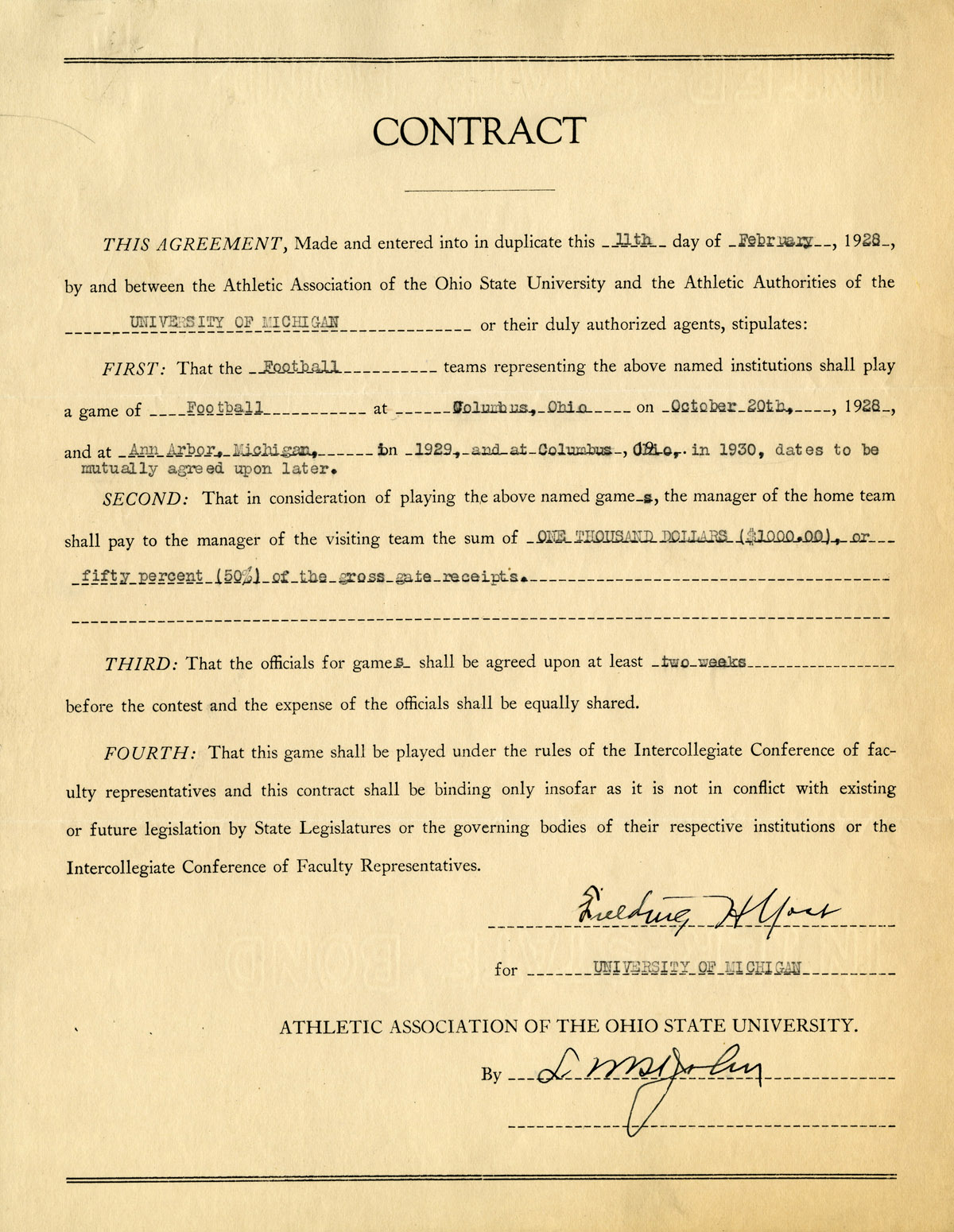
#1 – Contract, 1928

First the mundane: Click on the first image and you’ll see how the contracts outlining how gate receipts would be distributed looked in the old days. We particularly love the clause that starts: “THAT the Football teams representing the above named institutions shall play a game of football…” Well, what else were they going to play – water polo? But these things must be specific in order to be legally enforceable, we suppose. Can you imagine how such a contract might read today?

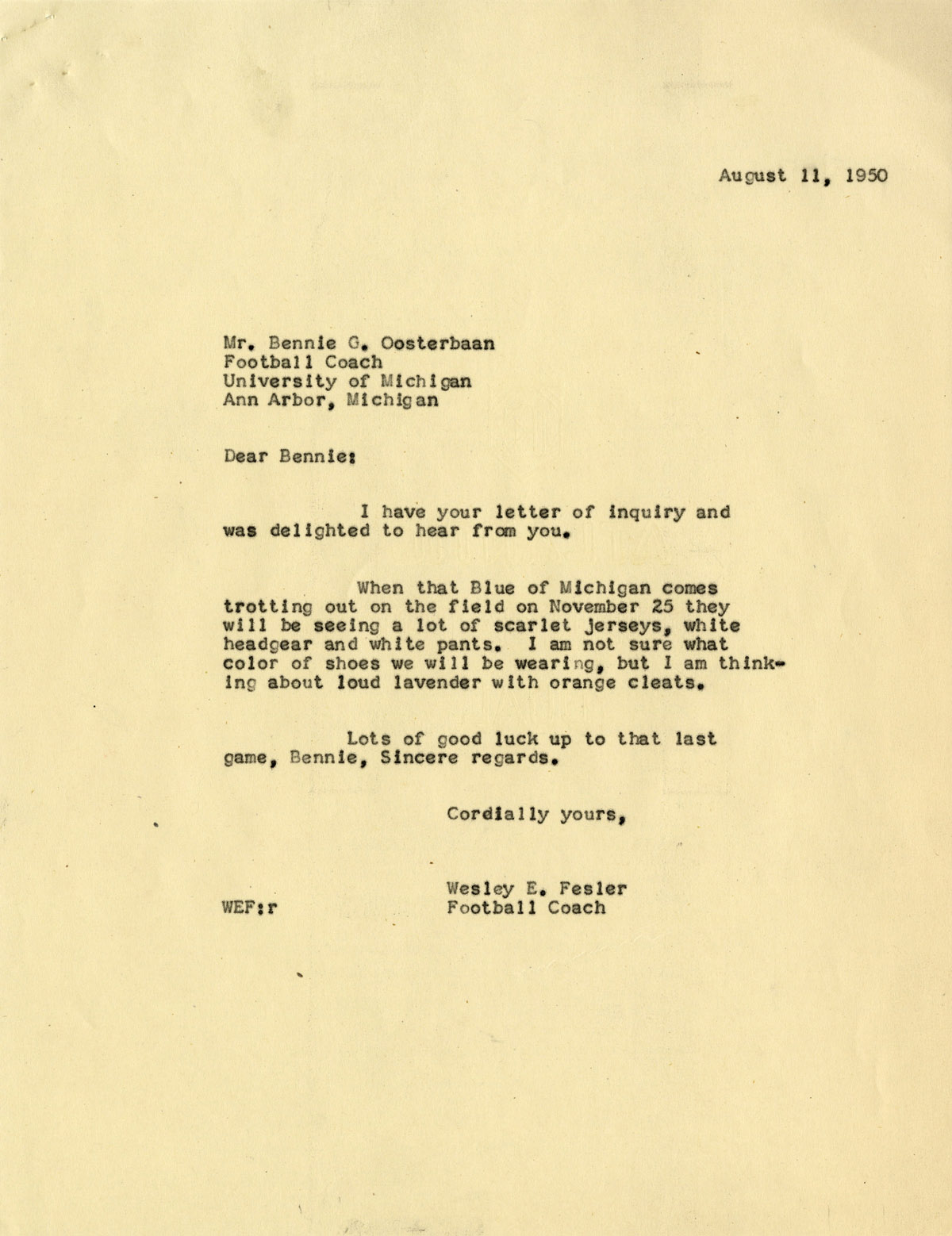
Now for the unexpected: Some of the game preparations by the coaches that were very ordinary for the time, would seem downright bizarre now. Today’s example is in a 1950 letter, (#2 on right), from then-OSU Coach Wes Fesler to then-University of Michigan Coach Bennie Oosterbaan, a letter that seemed quite lighthearted, considering it concerned the biggest game of what would be Fesler’s last season with the Buckeyes.

#2 – Letter, 1950

In any case, in the letter, Fesler describes the color of each article of clothing the OSU players will be wearing at the game. You might ask, why in the world would he do that? Remember that in 1950, television was relatively new, and programs were still broadcast exclusively in black and white. So each team’s uniform combinations had to contrast sufficiently enough with the other team’s for the home audience to be able to tell which team was doing what on the field.

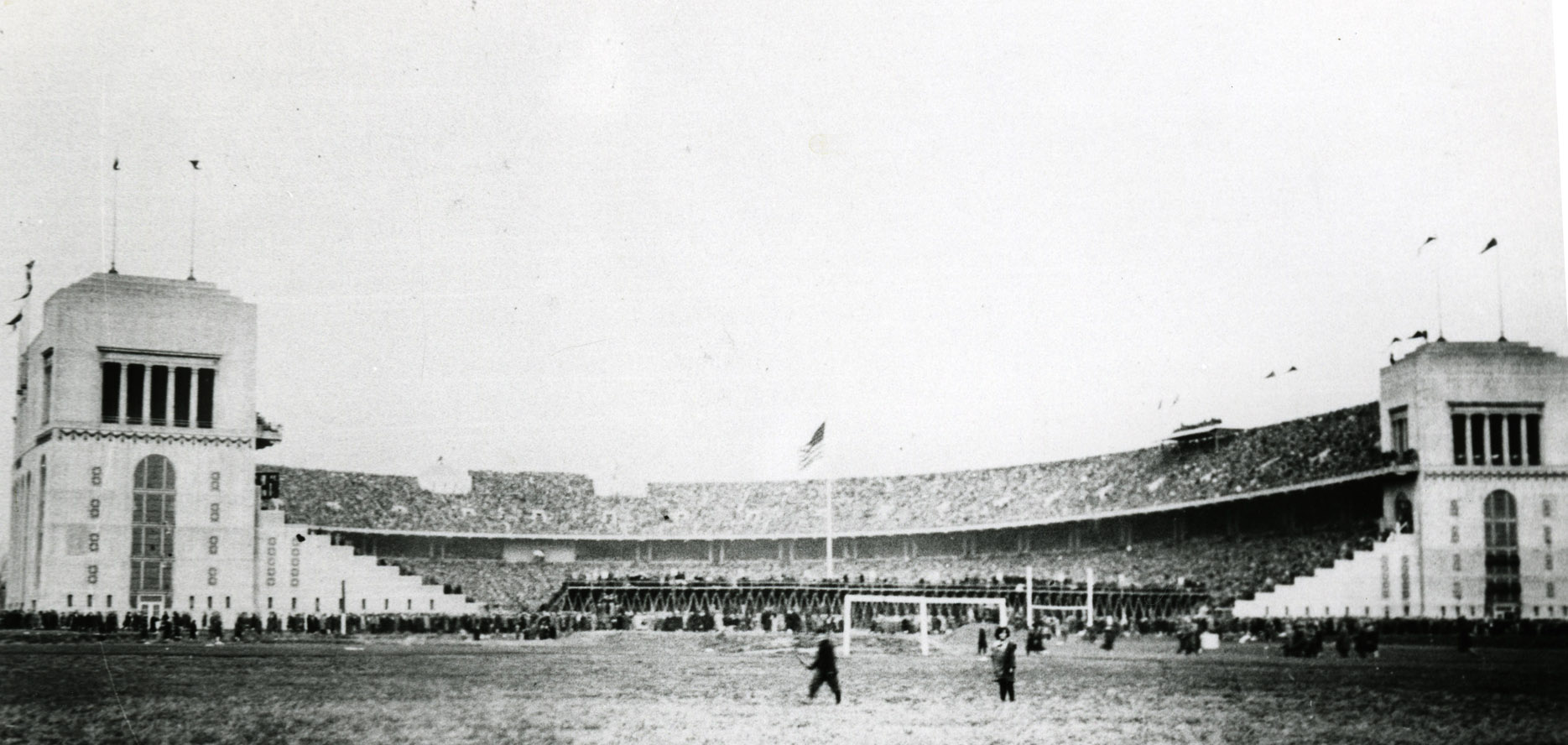
And now, for the dangerous: We all know the rivalry between The Ohio State University and “That State Up North” can become heated, but in 1926 the rivalry took a backseat to a dangerous incident in the stands. During the November 13 game, a defective pyrotechnic bomb was shot off by the military department. The shot was supposed to explode in the air and reveal a flag with Ohio State’s emblem; instead, it fell into temporary bleachers. Three people were seriously injured and remained in the hospital for an extended period of time, while several others experienced minor burns to their skin and clothing. The University reimbursed each spectator for his or her clothing and medical expenses, totaling more than $12,000.

The Stadium is shown here during the 1926 Michigan game. The temporary bleachers are in the foreground of the photo.

And the last item really has nothing to do with the OSU-Michigan game, but it does have to do with Thanksgiving weekend, and both teams were involved:

In 1931 President Hoover thought he would help tackle the unemployment issues of the day by asking colleges and universities to donate their profits to local charities from a football game played on Thanksgiving. According to athletic director Lynn St. John’s papers, the Western Conference schools were not in favor of scheduling charity games. Pressure was placed on the schools, however, and the decision was made to add extra games at the end of the 1931 season. A round-robin game between Chicago, Iowa, Indiana, and Illinois was scheduled for Thanksgiving Day at Staff Field in Chicago. The remaining teams played head-to-head on the Saturday after Thanksgiving: Northwestern versus Purdue, Wisconsin versus Michigan, and Ohio State versus Minnesota.

The Buckeyes, unfortunately, lost the game to the Golden Gophers and in doing so, lost a chance at a piece of the Western Conference title. The games did raise more than $137,000 for the unemployed, though, with more than $30,000 donated to the Ohio State Relief Commission.

Read more about the OSU-Michigan rivalry in our web exhibit:

http://library.osu.edu/projects/OSUvsMichigan/index.htm

Older posts Newer posts