From Woody's Couch

Our Playbook on OSU History

Category: Football (page 5 of 9)

The Illibuck Stops Here

Bucket and Dipper members pose with the Illibuck, 1955

Long before the OSU-Michigan game ended play for the regular season, it was a tradition for the Illini-Buckeye rivalry to bring things to a close. From 1921-1933, Ohio State and Illinois met to play their final games.

In 1925, OSU’s junior honorary, Bucket and Dipper, decided to spice up the series with the introduction of Illibuck, a turtle who was awarded to the winner of the past year’s meeting between the two teams. Illinois’ junior honorary, Sachem, got in on the fun, and the Illibuck is passed back and forth between the teams to this day. Bucket and Dipper and Sachem regularly travel back and forth to games to meet with their corresponding organization and escort Illibuck. The name was chosen because it combines parts of both schools’ nicknames.

In addition to the Illibuck, the rivalry’s traditions include a ceremonial peace pipe, which is shared by the two honoraries at halftime. According to a 1966 article in The Daily Illini, the ceremony occurred as follows: “Two groups of students one from each school, will meet in the center of the gridiron, shake hands, smoke a peace pipe and drink from a wooden bucket. Then the Illini will give the OSU group a turtle named ‘Illibuck.’”

Illibucks, 1988
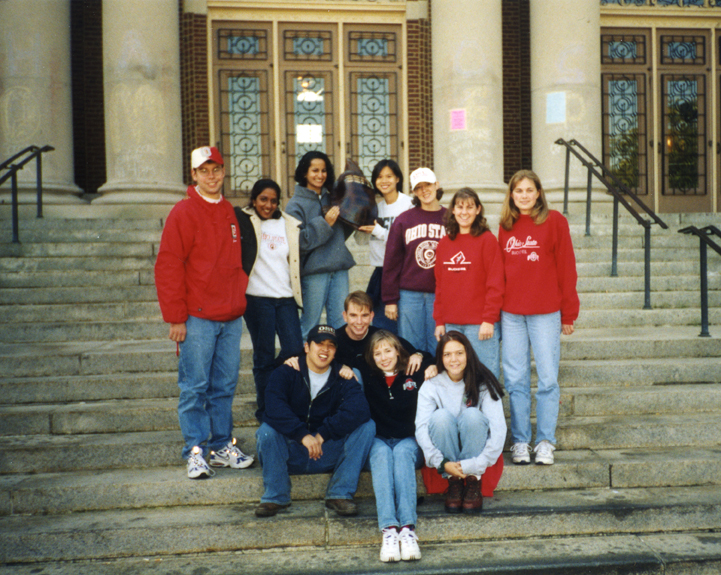
Bucket and Dipper members pose on the steps of Foellinger Auditorium, University of Illinois, 1998

The turtle was chosen because of its longevity but, in an ironic twist, the first Illibuck, a snapping turtle purchased in a Columbus pet store, suffered from the stress of being passed back and forth between Columbus and Champaign and passed away after only two years. Before his death, he spent his two years living in various fraternity houses and campus buildings at the University of Illinois, even briefly sharing space with an alligator in the Natural History building. He was much celebrated and beloved around campus.

The modern Illibuck is made of wood and is replaced as his shell fills up with scores from games featuring the two teams. This year’s game will be the 99th time the two have played since they first met on the field in 1902. Ohio State currently leads the series, 63-30-4, but Illinois has been known to pull off surprising upsets against the Buckeyes, and the Illini have won 7 of the past 11 games held at the Shoe.

If you happen to be on OSU’s campus, you can stop by the University Museum on the first floor of University Hall to see an Illibuck on display.

To read more about the history and adventures of Illibuck, look in the digital archives of The Daily Illini (UIUC’s campus paper) and The Lantern (OSU’s campus paper).
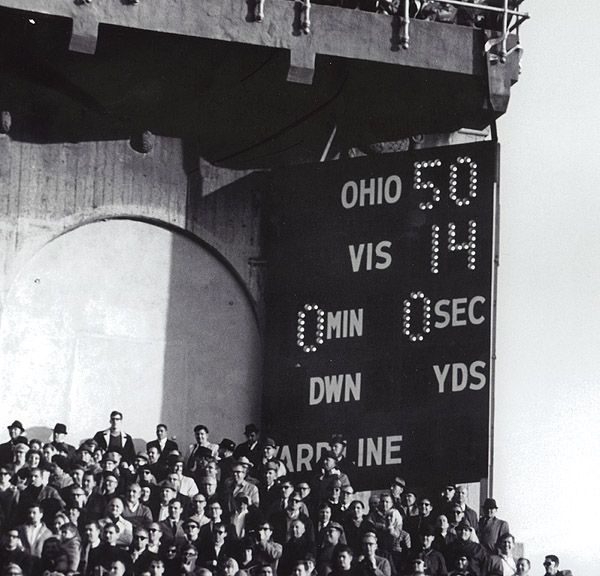
Early OSU Football: ringers, riots, red ink and … recitations?

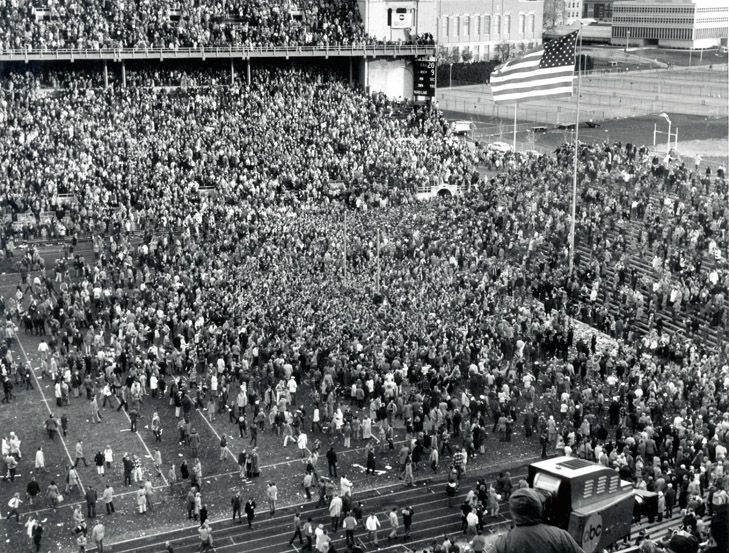
1968

This week, a patron asked if we could find out when the OSU Marching Band first played at a football game. We tracked down a likely answer in James Pollard’s “Ohio State Athletics: 1879-1959,” which also offered a wealth of hard-to-imagine tidbits about the early football program at OSU. (Because we don’t have many photos from the early days, we’ve decided to post a few images that help illustrate how far the program has progressed over the years.)

For instance, soon after intercollegiate competition started 1891, there were charges of brutality, the use of “ringers” (non-students) and – hard to imagine today – coaches playing on their own teams. It led to various college faculties to call for the abolishment of football. Luckily, nothing ever came of their appeals.

Training was also much different from the current regimen. Pollard quotes the Columbus Dispatch in describing a typical day of football training in the 1890s:

Every fellow rises at 7 o’clock and breakfasts at training table…on rare beefsteak, poached eggs, fried potatoes and dry bread. The forenoon hours are devoted to study and recitation and at noon an hour is spent rehearsing signals and individual practice… At 4 o’clock the men practice team work with the second University eleven until dark, when they take a run of several miles and then rub down, eat supper and go to bed.

Football practice, 1916

Also unheard of for today’s football program was the gloomy financial picture The Wahoo reported for the 1892 season. (The Wahoo was the name of the student newspaper during a brief period of the early 1890s.) The newspaper gave figures showing estimated costs of $550 – more than double the estimated receipts of $250.

Football ticket line, 1949

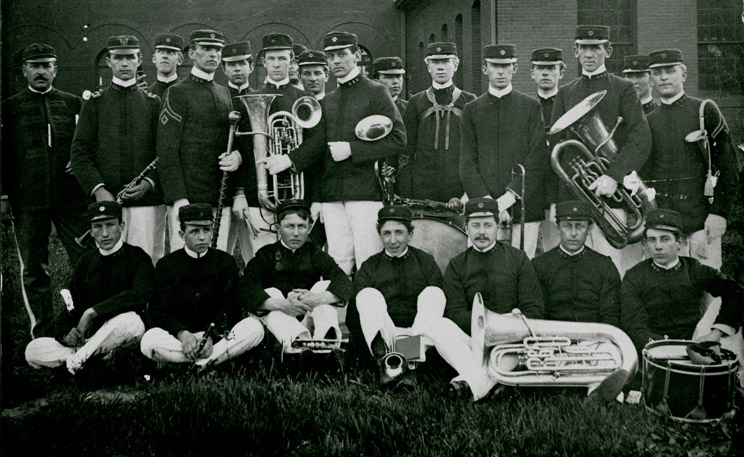
In 1893, three years after the football team was founded, the OSU Marching Band made its first appearance at the Oct. 21 game between OSU and Oberlin. According to Pollard, who was quoting The Columbus Dispatch, “the newly organized O.S.U. band” led a “parade of the city” on the morning of the game and gave a concert just before play started.  Clearly the band was not nearly as effective as it is now; the football team suffered a 38-10 loss that day. Back then, of course,  the band consisted of roughly a dozen musicians; today, membership tops 210 members.

Band, 1900

Meanwhile, fans became so incensed at an early score by the Kenyon College team in the second half of a Nov. 30, 1892, game, that the crowd poured onto the field and tore down a portion of the fence. Pollard, quoting the Dispatch again, said “The game had to be stopped until the police cleared the grounds.” The crowd’s passion did not always lead to destruction: Two years later, after OSU won the Thanksgiving game against Kenyon, the Dispatch reported that “the crowd went crazy and carried the winners off the field.”

1970

Former Buckeyes have been pros at NFL coaching

This Sunday, you can watch a number of former OSU players or assistant coaches pacing the sidelines as head coaches, leading their teams to either victory or defeat in an NFL game: Pete Carroll (Seattle Seahawks), Dick Lebeau (Pittsburgh Steelers), and Lovie Smith (Chicago Bears) all did stints at OSU. But OSU coaches have been making the transition to the NFL as far back as the 1950s:

Legendary coach Sid Gillman played for and was an assistant coach at OSU in the 1930s. Gillman went on to become head coach at Miami University, then the University of Cincinnati. In 1955 he made the transition to the NFL and became head coach of the Los Angeles Rams. In 1960, Gillman became the first coach of the AFL Los Angeles Chargers, remaining in that position through the team’s move to San Diego and the merger of the NFL. His career continued as head coach of the Houston Oilers. Gillman’s love of the game can be traced to his influence on modern football. He was one of the first coaches, if not the first coach, to study game footage to prepare for games; he insisted on using the deep downfield pass during games; and he pushed for a championship game between the AFL and NFL teams in the early 1960s. Gillman is the only person to be inducted into the Pro Football Hall of Fame and College Football Hall of Fame as a coach.

Sid Gillman, 1933

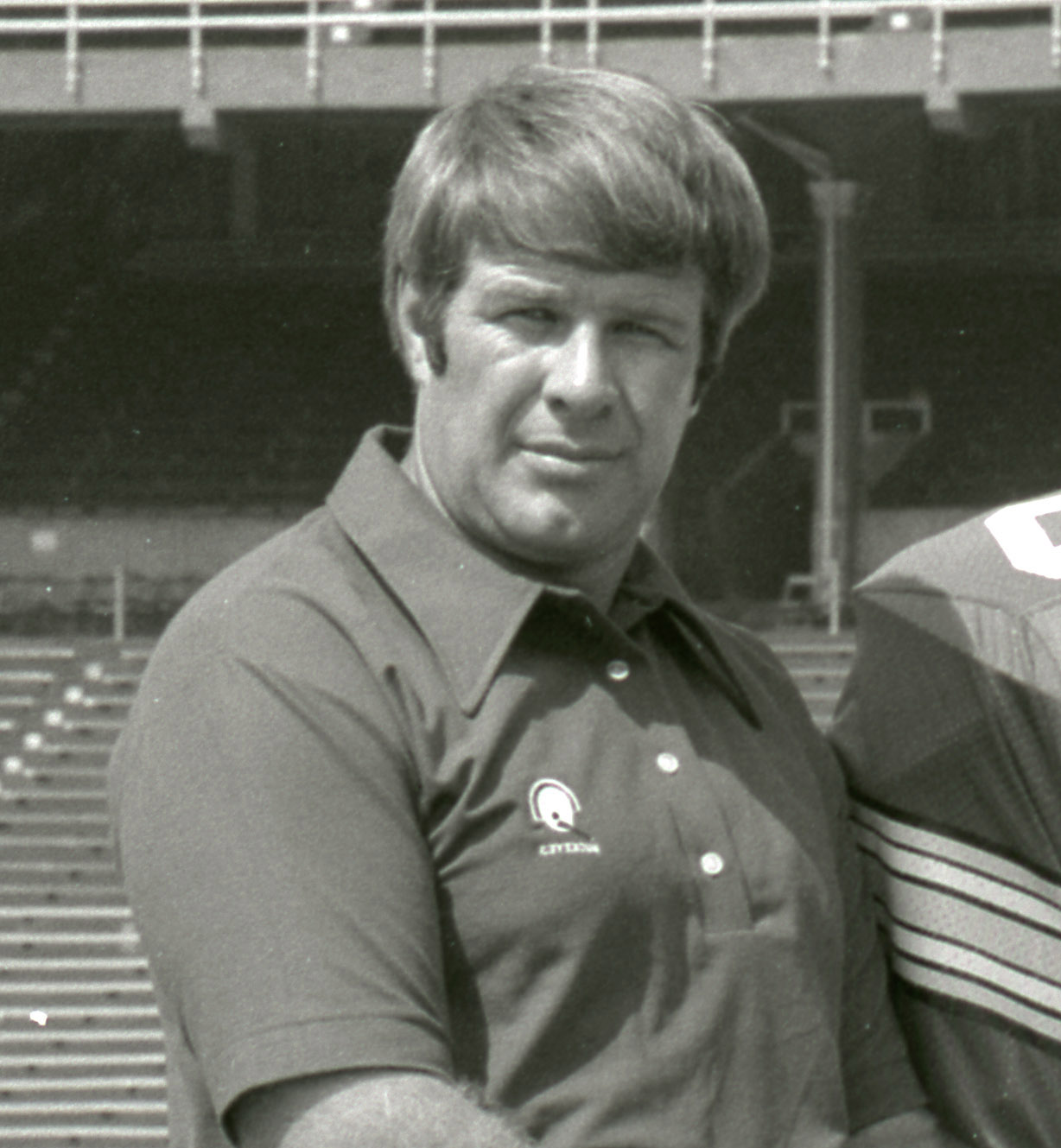
Joe Bugel was an assistant coach at Ohio State in 1974 before his career in the NFL began. During most of his career Bugel was an assistant coach, helping many teams reach the playoffs and the Super Bowl. In 1982 he began calling his Washington Redskins offensive line the “Hogs,” a nickname that has carried on as a Redskins tradition. Bugel continued coaching in the NFL as head coach of the Phoenix Cardinals, and as an assistant at the Oakland Raiders, San Diego Chargers. He then returned to the Redskins as offensive line coach until his retirement in 2010.

Joe Bugel, 1974

Gary Moeller also has had a long coaching career in college and pro football. Moeller played for the Buckeyes as a linebacker and center from 1961 to 1963. He began his coaching career in 1967 as an assistant at Miami University and continued on to the University of Michigan. Moeller was head coach of the University of Illinois and the University of Michigan before switching to the NFL. In the NFL, Moeller served as an assistant coach for Cincinnati, Detroit, Jacksonville and Chicago. In 2000, he became interim head coach of the Lions for a year, and later served as linebackers coach for the Chicago Bears.

Gary Moeller, 1960


Older posts Newer posts