From Woody's Couch

Our Playbook on OSU History

Category: Events (page 6 of 13)

WWII hero Don Scott ‘brought great credit to his alma mater’

Don Scott, 1939

Don Scott, 1939

When World War II broke out, many OSU students immediately signed up to join in the fight, suspending their studies for a much greater cause. Probably none of them was more well-known than Don Scott, the archetypical Big Man on Campus.

And here’s why: After entering Ohio State in 1938, Scott participated in baseball, track, basketball, and most notably football. In addition to being on the Players’ All American team for football and the first Big 10 Championship for basketball, Scott was also elected to sophomore, junior and senior Honor Societies as well as being a member of the Phi Delta Theta fraternity.

Don Scott, 1941

Don Scott, 1941

After enlisting, by May 1941, Scott, along with other OSU athletes were stationed in Tulsa, Oklahoma, for Air Corps Training Detachment. By October, Scott had completed training and had advanced to get his wings and commission in the Army Air Corps. He was eventually promoted to a Captain.

Unfortunately, on October 1, 1943, at the age of 23, Scott was killed in a bomber crash over England. This marked the 100th alumnus or former student to give his life in World War II. One week after his death, on October 8, his wife gave birth to their child, Don Sands Scott.

Meanwhile, in the spring of 1942, the U.S. Navy leased Port Columbus to train its pilots. At the time, OSU was using Port Columbus for its own civilian pilot training program, and the Navy’s lease would pretty much have doomed OSU’s program to failure. However, OSU Prof. Karl W. Stinson, a lieutenant in the Air Corps of World War I and a professor in the Department of Mechanical Engineering went to then-OSU Pres. Howard Bevis with an idea: Build an OSU airport.

President Bevis and Carl Steeb, then-University Business Manager, considered the idea, liked it, and found $100,000 for the project. Stinson himself scouted the nearby then-countryside, and found a flat portion of land near what is now Sawmill Road. Ohio State purchased 385 acres (larger than Port Columbus), and set about building a hangar, runways and fences.

Don Scott Field, 1949

Don Scott Field, 1949

Soon after Scott’s death, President Bevis presented a resolution to the Board of Trustees that read, in part:

[Scott] was one of the nation’s great athletes; he was a sportsman in the finest sense of that term; he was a thorough gentleman, beloved by all who knew him; his life brought great credit to his alma mater. … As a fitting commemoration … I desire to propose to this Board that the airfield now owned and operated by the University be designated ‘Don Scott Field.’

The board approved the resolution and the newly named Don Scott Field was used by the Navy until the end of the war, when OSU transferred its focus to a civilian aviation curriculum.

– Filed by B.T.
School’s Out

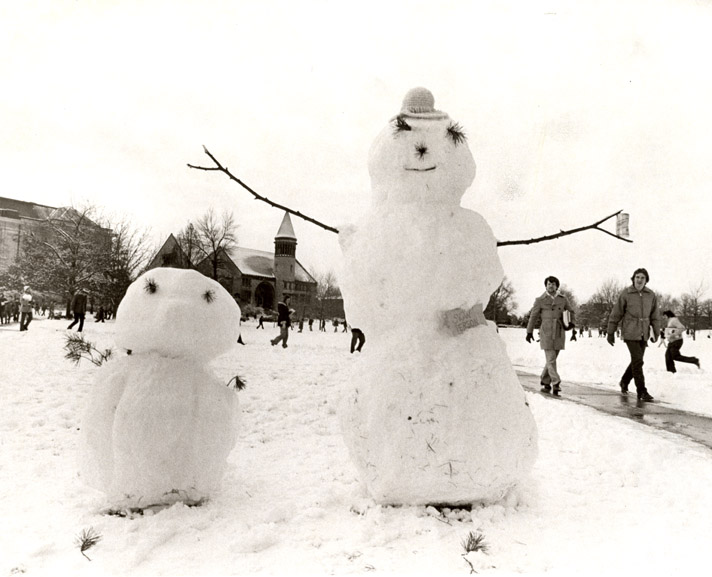
Oval, 1976

Oval, 1976

The recent polar vortex that shut the campus for two days serves as a reminder that even the Ohio State University isn’t impervious to the forces of nature. The campus has been closed a number of times for weather-related hazards, but classes also have been cancelled for a variety of other reasons over the years.

1918: October 11-November 12. Were you to travel through time to November 11, 1918, on the OSU campus, you might think classes were cancelled in celebration of the signing of the armistice between the Allied Forces and Germany that marked the end of World War I, but that wasn’t the case. The campus was instead shut down in an attempt to stop the spread of the influenza epidemic.

1968: April 9. Classes scheduled to be held between 8am and 4pm were cancelled out of respect for the funeral of Rev. Dr. Martin Luther King Jr., who was assassinated on April 4 in Memphis, TN.

Students hold a memorial for Martin Luther King, 1968

Students hold a memorial for Martin Luther King, 1968

1970: May 7-19. The University closed for nearly two weeks after four students were killed by the National Guard on May 4 at nearby Kent State University. The closure was an attempt to calm protestors on OSU’s campus and was largely successful. Learn more at our web exhibit on the 1970 Student Demonstrations.

1971: February 8. President Fawcett cancelled classes at 3 p.m. due to the 10 inches of snow that had fallen by then. He was quoted in The Lantern as doing so to “allow streets and sidewalks to be cleared so classes and offices can operate normally Tuesday.”

1977: January 18. Classes were cancelled due to cold weather in an attempt to conserve gas and electric resources at the request of Columbia Gas and Southern Ohio Electric. But students didn’t get too much of a break: Cancelled classes were rescheduled for President’s Day.

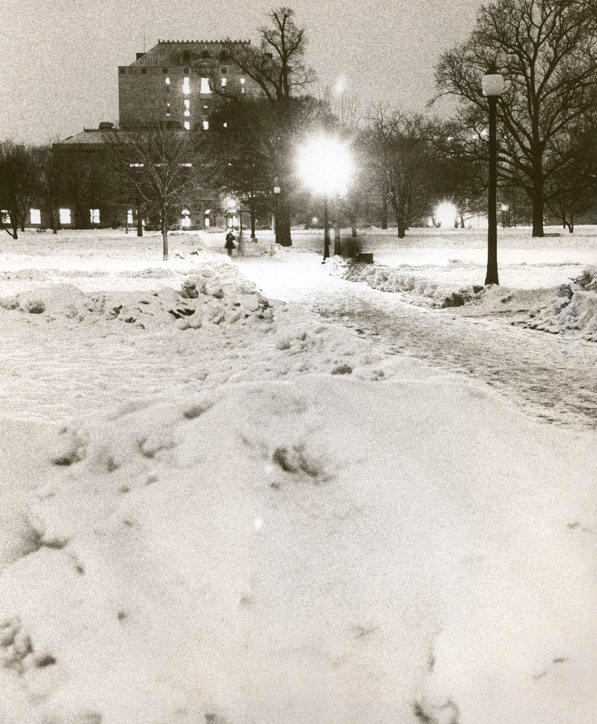
Photo of the Oval, 1978

The Oval after the Blizzard of ’78

1977: April 8. All classes scheduled on West Campus were cancelled after an explosion in Scott Hall. The blast was caused by an electrical malfunction and injured a graduate student and a firefighter.

1978: January 26-27. The famed Blizzard of ’78 stopped all but essential services on campus with 65 mph wind gusts and almost five inches of snow. Payroll operations, Medical Center personnel, telephone center operators, physical facilities workers, and student-life employees all braved the elements to keep necessary functions going.

1984: February 28. It wasn’t quite the Blizzard of ’78, but the snowstorm that hit town in late February of ’84 did manage to bring most of Columbus screeching to a halt. In addition to the county offices, courts, highways, and garbage pickups that were shut down for the day, some campus parking garages were closed and classes were cancelled starting at 4 p.m.

From founding, OSU community celebrated Thanksgiving with a day’s respite

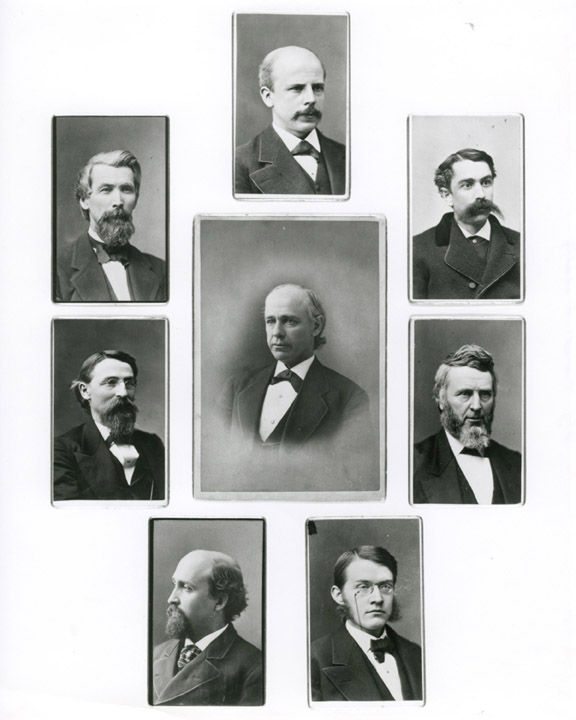
The first faculty of the University, 1873

The first faculty of the University, 1873

On Friday, November 21, 1873, just over two months after the University first opened its doors, the faculty were talking about taking a vacation.

In this particular case, it made sense: Not even a week later, Thanksgiving would be celebrated, so they needed to decide whether classes would be held that Friday. The faculty minutes for that date – the group’s 10th meeting ever – say “that Thursday Nov. 29 (Thanksgiving day) and the Friday following be allowed as holiday by the college, and that all college exercises be disbanded.” It was the only item of business for that meeting.

During World War II, Thanksgiving Day was a holiday for only civilians on campus. All Army and Navy-related classes were still in session on Thanksgiving. At that time, the Commencement ceremony for Autumn Quarter fell in early December, so classes on the Friday after Thanksgiving were considered a must.

In 1945, after the war was over, it was decided that no classes would be held from the Wednesday night before Thanksgiving until the following Monday – a first since before the war – to allow students to travel home for the holiday. In 1946 University faculty and staff were given both Thanksgiving Day and the following Friday off again in recognition for all of the overtime hours they had put in throughout the quarter with the record number of students enrolled that year.

President Bevis, 1948

President Bevis, 1948

In 1947 President Bevis ordered classes to be held the Friday after Thanksgiving, with the tradeoff that employees would get Christmas Eve, Christmas Day and Boxing Day, as well as the following weekend off. He stated that the University’s payroll deadlines, as well as orientation and fee payment deadlines necessitated the working Friday.

Classes were again eliminated for the Friday off as early as 1957, according to the Lantern, although OSU employees still had to show up to work. In the mid-1970s, during the nationwide energy crisis, the academic calendar was changed so that finals were completed by Thanksgiving. University employees still had to work the day after the holiday. By the mid-1980s, however, University classes were cancelled and University offices were closed both days.

–Filed by C.N.

Older posts Newer posts