
1940
Perhaps one of the few Ohio State traditions new students may wish to stay buried is the class cap, otherwise known as the ‘beanie.’ Freshmen (men only) used to be strong-armed into wearing caps in the name of creating school spirit and class unity. If by unity the administration meant commiseration, well then they got what they set out to achieve.
The caps and rules were in use from 1912 until the mid-century. Wearing the caps was just one of the rules enforced by “all men of the upper classes;” however, the junior men’s honorary Bucket and Dipper and its members were the only people ever authorized, by the Student Senate and the President of the University, to carry out the traditional punishment: namely, throwing offenders into Mirror Lake. Ironically, if some unauthorized person attempted to chuck a freshman in the lake, Bucket and Dipper members were honor-bound to protect the freshman.
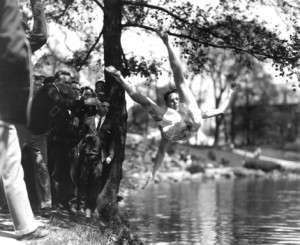
A freshman is tossed into Mirror Lake, 1926
Freshmen men were thus required to wear the caps from Freshman Week at the beginning of the term, until Cap Bonfire on Tradition Day, in June. Students caught without their beanies, or violating one of the freshmen rules, were punished. As one Alumni Monthly article put it, “Irregular meetings of Bucket and Dipper are held when freshmen are chased from the Long Walk and from the steps of University or Derby Hall.” These meetings convened on the edge of Mirror Lake and ended with the offending freshmen taking a swim. Other rules that could earn a dunking: skipping Chapel (which was mandatory until 1926), doing something to offend an upper classman (such as the freshman who posted signs saying “Bucket and Dipper go to Hell” near the Long Walk), or setting foot on the Long Walk.
As for Bucket and Dipper, the 14 members at that time were all junior men and had been chosen for their leadership, scholarship and service. Such greats as Chic Harley and Milt Caniff were members. During their initiation, members were thrown in Mirror Lake, so perhaps they had the prerequisite experience needed.
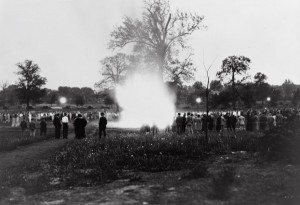
Freshman week cap burning, 1926
Thus, in June the freshman waged a two-day war on Bucket and Dipper. The “war” usually consisted on a tug-of-war across Mirror Lake—where the freshman consistently ended up in the lake. That night, students would gather for the Cap Bonfire, when some freshman opted to burn their beanies. (Many freshman did keep their beanies as a memento of their servitude.) Following the bonfire, many freshmen (again, ladies were excluded) went for a walk in their shirttails to cause a ruckus outside the home of then-OSU President William Oxley Thompson.
In 1926 Bucket and Dipper attempted to delay the burning; in the melee that followed, 103 freshman were thrown in the lake and the police were called. Ironically, it was a policeman that gave a freshman a concussion, not a trip into the lake. The following year, then-OSU President George Rightmire forbade Bucket and Dipper from dunking anyone, deserved or not. From then on, it seems the Bucket and Dipper initiates were the only ones to go swimming.
As for the caps themselves, fashion in hats changed rather rapidly. Some prime examples from Ohio State include the “peanut-shaped skull cap,” “knitted toboggan” cap or “jockey-style” cap, or one with a “rolled brim topped with a scarlet button.”
Filed by C.N.
To learn more about the tradition of freshmen beanies at OSU and other Big Ten universities, visit our web exhibit, “Beanies of the Big 10” at http://library.osu.edu/projects/beanies/.










Recent Comments