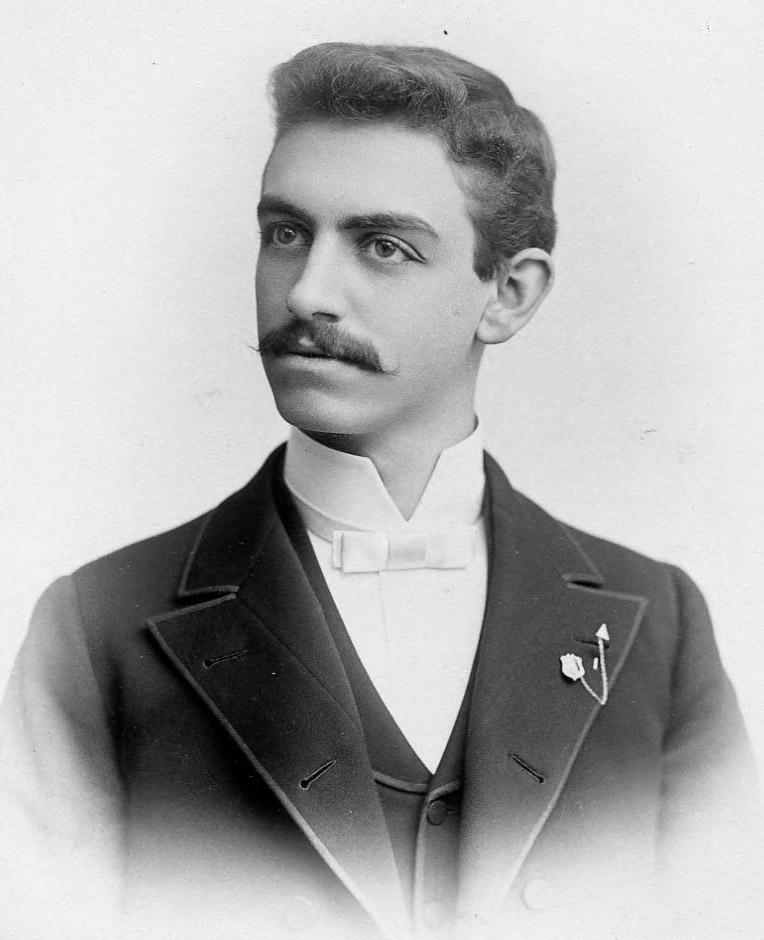
James Wilgus, 1888
We recently had the chance to peek at the University’s early student life, thanks to Peggy Wymore, granddaughter of James Alva Wilgus, an early OSU graduate who also taught here briefly before leaving to study at Harvard. Wymore graciously donated a number of items from Wilgus’ time here as a student, including a class tie, some of his class essays, some memorabilia from student groups to which he belonged, and some of the exams he gave undergrads when he was teaching history here.
Our resources on individuals who attended OSU before 1900 are unfortunately slim – student directories, early Makios (which were more like literary magazines back then), and if the person became very famous or successful in his or her field, an obituary. So we never really know what happened to students from this era – what did they do after graduating? Where did they go? What were their lives like?

Wilgus’ tie, c1887-1888
Thanks to Peggy Wymore, we not only have mementoes of Wilgus’ time here, but she also was kind enough to fill in a lot of the details of his life after OSU – and that of his wife, Flavia, also an alum.
Wilgus was born on a farm near Conover, Ohio, in 1866. He attended a rural school and worked on his father’s farm until age 16 when he entered Ohio State in 1882 as a preparatory student, which meant, like many students coming to OSU at the time, he had to complete a number of prerequisites before becoming an official freshman. Such prerequisites included Latin, Algebra and Physics. He entered as a freshman in 1884, taking a wide range of classes like Latin, Botany, History and Physical Labor.

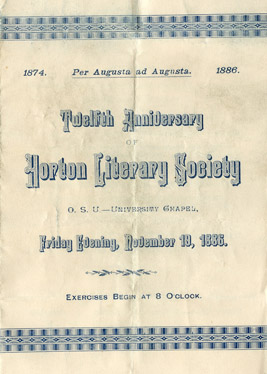
Brochure for Horton Literary Society event, 1886
Meanwhile, Flavia McGurer – the future Mrs. Wilgus – entered Ohio State as a Preparatory student in 1887. Her courseload included German, Trigonometry and Physical Geography. According to the 1889 Makio, the Columbus resident had entered OSU as a freshman and was listed as class historian of the Class of ’92. But she never graduated. That’s because she married Wilgus on Christmas Day in 1889, then traveled with him after he earned his master’s degree, to Harvard University where he was a Thayer Scholar from 1891-1892. He was reappointed at Harvard for a second year, but his failing health prevented him from taking the appointment.
The traveling continued, however: The couple moved to Minnesota in 1894 where Wilgus was hired at the State Normal School in St. Cloud to finish out the term starting in January of that year. In September, OSU President William H. Scott asked Wilgus to do a small amount of teaching in history, and Wilgus returned to Columbus to serve as assistant of History from 1894-95. On January 3, 1895, Wilgus received a telegram from James Chalmers, professor of the Platteville (Wisconsin) Normal School, asking him to “accept the history professorship” there. (The name later changed to the Wisconsin State Teachers’ College – Platteville.)
Wilgus accepted, and the couple moved to Wisconsin, where he spent the rest of his career at the State Teachers’ College as a professor of History and Social Sciences. He taught there until his retirement June 6, 1939. He died in Platteville shortly after that – July 24, 1939.

Flavia McGurer Wilgus, 1888
Upon moving to Platteville in 1895, “Mrs. Wilgus at once identified herself with the Platteville Normal. The Wilgus home became a place where students as well as faculty members spent many happy hours. As the years passed, the family circle became larger. Curtis came, then Dorothea, and finally Wallace . . . Mrs. Wilgus continued to live in her beautiful, helpful way.” (from the June 23, 1926, issue of “The Exponent,” the Platteville State Teachers’ College newspaper).
Flavia also was involved in many activities and societies at her church; she was a member of the Eastern Star as well as other women’s clubs and civic societies. In 1903 she even had a small mail-order business. During World War I she contributed monthly to “The Fatherless Children of France.”
According to Wymore, Flavia was a loving mother, devoted to her children and active in their lives – their studies, play, training, and even in making many of their clothes: In Dorothea’s letters to home from the University of Wisconsin, she would draw a picture of what she wanted in an outfit, and Flavia would sew it up for her.
On June 21, 1926, 31 years after she and her husband moved to Platteville, Flavia died suddenly and unexpectedly after complications set in from an emergency operation. In her obituary it stated, “Mrs. Wilgus was a beautiful life. Forgetful of self, . . . writing upon every page of the book of her life . . . All who approached her were received with that simple grace that bespoke the true woman. . .”
We’d like to thank Peggy Wymore most sincerely for not only preserving such important tokens of her grandparents’ lives, but for sharing some of them with us, as well as her grandparents’ stories. Thank you, Peggy!

Horton Literary Society, back of brochure, 1886
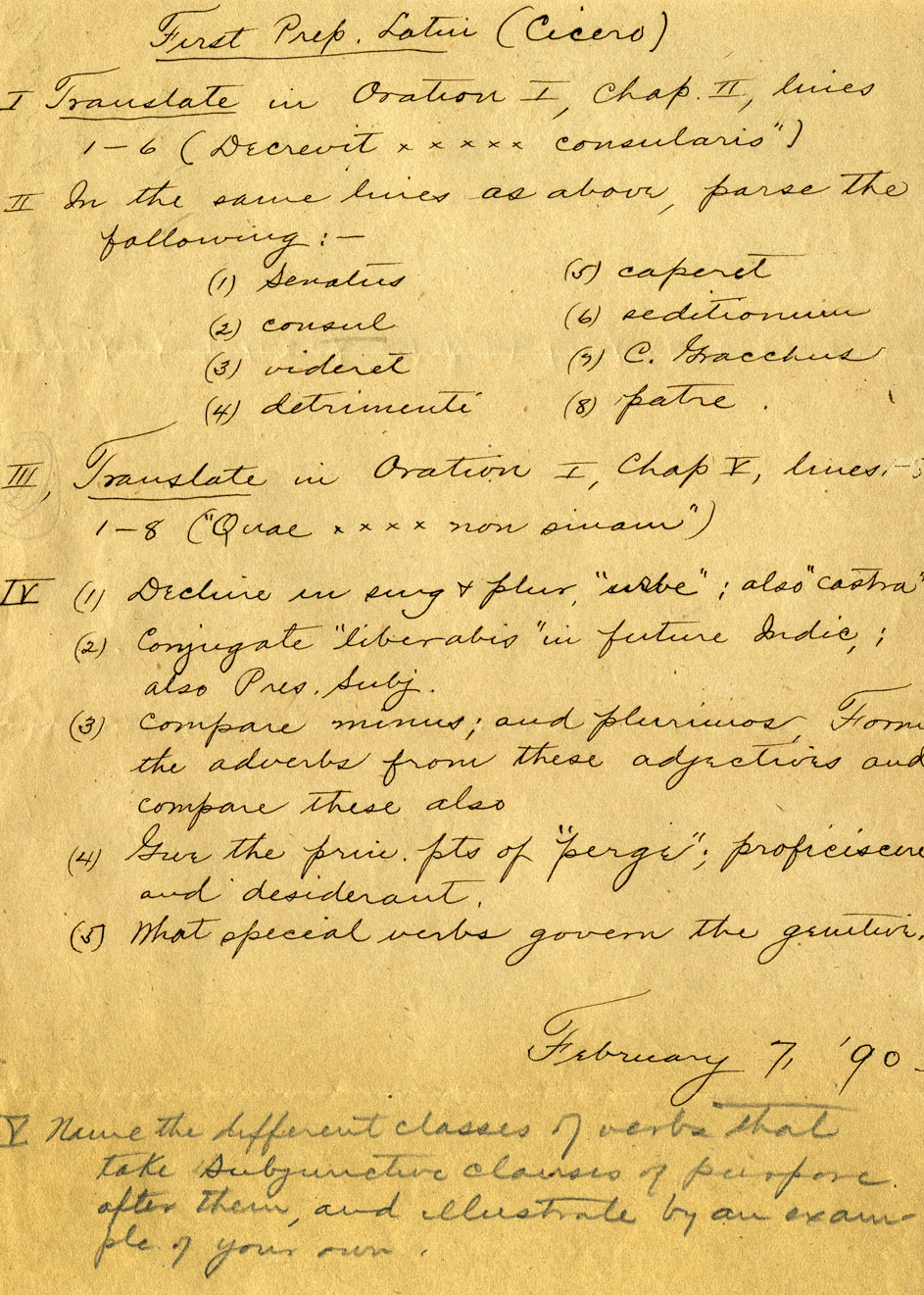
Exam questions from Wilgus’ Roman History Class at OSU, 1888











Recent Comments